

stock market

Wall Street
Market News

Market Recovery or Bear Trap? Insights from a Wall Street Expert

U.S. stocks rebounded on Tuesday after fears of a weakening economy triggered a global selloff, leading to Wall Street’s worst day since 2022. Despite the rebound, Barry Bannister, chief equity strategist at Stifel, warns it is too early to jump back into the U.S. stock market. He maintains his prediction that the S&P 500 (SPX) will drop to 5,000 by October, a 12% decline from its July peak, due to a significantly slowing economy and persistent inflation. “Our view remains a correction to 5,000 on the S&P 500 by October,” Bannister and his team wrote in a Monday note. “While we foresee a low-double-digit correction, there is also a risk of a bear market if the slowdown turns into a recession, which would be a surprise to investors and the Federal Reserve.” A market correction typically occurs when a stock index falls at least 10% from a recent high. This can worsen into a bear market, marked by a drop of 20% or more. The S&P 500 last entered correction territory on October 27, 2023, and the recent selloff has brought it close to another correction. It is currently down 7.5% from its high of 5,667 set on July 16, according to Dow Jones Market Data. Earlier this year, Bannister predicted a summer selloff and has repeatedly forecasted a market correction by October. His stance makes him one of Wall Street’s few remaining bears, as many other strategists have raised their year-end targets for the S&P 500, expecting multiple interest-rate cuts by the Fed. Bannister and his team advise investors to remain defensive, favoring “defensive-value” sectors such as healthcare, consumer staples, and utilities. These sectors typically perform well if inflation remains high and GDP growth slows sharply, offering a hedge against a potential recession. On Tuesday, the S&P 500 and Nasdaq Composite (COMP) each rebounded over 1%, while the Dow Jones Industrial Average (DJIA) advanced 0.8%, according to FactSet data. John PaulJohn Paul is the founder of DayTradeToWin, a trading education and software company established in 2008, supporting traders worldwide. His expertise focuses on price action-based futures trading strategies and structured market analysis. DayTradeToWin delivers trading education, indicators, and software tools designed to help traders apply disciplined, rule-based decision-making across global futures markets. He is the creator of multiple trading methodologies, including the Sonic System, Atlas Line, and Trade Scalper, which help traders identify structured opportunities in markets such as the E-mini S&P 500 (ES), Nasdaq (NQ), crude oil (CL), and gold (GC). Official website: https://daytradetowin.com daytradetowin.com

JPMorgan
Market News

Unveiling the Classic Signs of a Stock-Market Bottom: JPMorgan’s Expert Tips

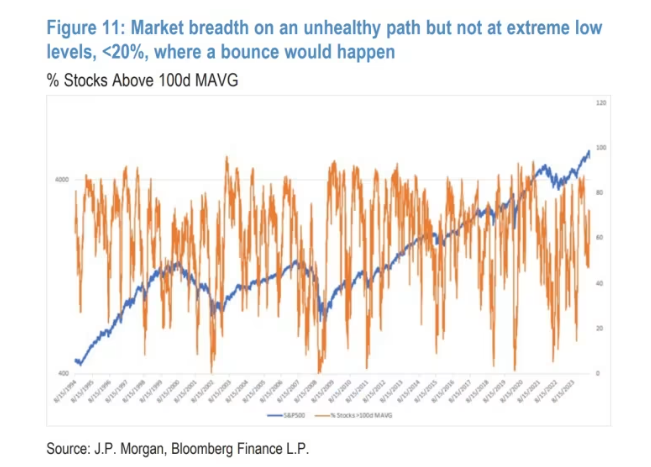
U.S. stock index futures are up early Tuesday following a significant decline on Monday that caused the S&P 500 to drop by 3%, marking its worst single-day performance in nearly two years. Over the past three sessions, the S&P 500 lost 6%, the Nasdaq Composite fell 8%, and the Russell 2000 plummeted 10%. These declines are driven by fears of a U.S. recession and the Bank of Japan’s interest rate hike, which impacted the yen carry trade. The pressing question now is whether the worst is over for the market. Thomas Salopek, head of cross-asset strategy at JPMorgan, believes the answer is no. He explains that the necessary conditions for a market bottom are not yet present. Salopek identifies the pullback as “legitimate,” supported by widening credit spreads, a steepening Treasury yield curve, and the outperformance of utilities over the broader market. Factors like economic slowdowns or disinflation, which negatively affect other sectors, benefit utilities and defensive sectors that thrive on lower interest rates. “The growth outperformance of the second quarter suggested an economic slowdown while the third-quarter defensive leadership suggests growth risk,” says Salopek. Salopek also questions the optimistic view of labor market data, which suggests that the rise in the unemployment rate is due to increased labor supply. “If that were the case, we would expect unemployment to stabilize, not continue to rise as it has,” he notes, adding that Hurricane Beryl affected the latest figures. With the next jobs report a month away, investors need to focus on technical and risk-based signals, which are not indicating a market bottom, according to Salopek. For instance, stocks rarely bottom when the VIX (the market’s fear gauge) is at its highs, although the VIX has dropped sharply in early Tuesday trading. Additionally, the 20-day moving average’s slope does not provide reassurance, and crossing above it is “a minimum starting point.” He also notes that the put/call ratio typically peaks at market lows. The percentage of Nasdaq stocks above their 100-day moving average is 34%, but Salopek would prefer this to drop to 20% before considering it closely. Similarly, the percentage of stocks at four-week lows is far from the 60% seen in previous corrections. He also monitors the American Association of Individual Investors sentiment survey, which sent a strong signal in fall 2022 when sentiment was worse than during the COVID crisis. “Historically, a confluence of these bottoming signals during market corrections helps pinpoint the best time to re-enter,” Salopek says. For now, he recommends staying underweight in stocks and waiting for conditions to worsen enough to signal capitulation. John PaulJohn Paul is the founder of DayTradeToWin, a trading education and software company established in 2008, supporting traders worldwide. His expertise focuses on price action-based futures trading strategies and structured market analysis. DayTradeToWin delivers trading education, indicators, and software tools designed to help traders apply disciplined, rule-based decision-making across global futures markets. He is the creator of multiple trading methodologies, including the Sonic System, Atlas Line, and Trade Scalper, which help traders identify structured opportunities in markets such as the E-mini S&P 500 (ES), Nasdaq (NQ), crude oil (CL), and gold (GC). Official website: https://daytradetowin.com daytradetowin.com

stocks
Market News

Wall Street Woes: Stocks and Crypto Fall Sharply

Dow, S&P 500, and Nasdaq-100 Futures Plunge Sunday Night U.S. stock-market futures fell late Sunday following a turbulent week on Wall Street, during which the Nasdaq entered correction territory. As of 11 p.m. Eastern, Dow Jones Industrial Average futures dropped over 250 points, or 0.7%. S&P 500 futures decreased by 1.4%, and Nasdaq-100 futures fell 2.4%. All showed slight improvements from their session lows late Sunday. Crude oil futures rose slightly amid concerns over escalating hostilities in the Middle East. Cryptocurrencies also fell, with Bitcoin dropping 8% to below $55,000 after reaching over $65,000 on Friday. Ether dropped more than 15%. Japan’s Nikkei 225 plunged 5%, continuing the previous week’s trend, as global markets reacted to recent U.S. economic data and Wall Street’s losses. U.S. stocks fell on Friday after a weaker-than-expected jobs report raised concerns about economic growth. This followed Fed signals on Wednesday indicating potential interest rate cuts in September. However, investors worry these cuts might come too late to prevent a recession. Last week, all three major indexes experienced significant losses. The S&P 500 had its worst week since April, falling 2.1%. The Dow also dropped 2.1%, and the Nasdaq saw a 3.4% decline, ending 10% below its July 10 record close, placing it in correction territory. Stephen Innes, managing partner at SPI Asset Management, noted, “Market participants scrambled for hedges amidst growing panic over interest rates and a looming recession. The spike in volatility underscores how jittery markets have become.” He added, “The real question is whether the typical market reflex to sell volatility or buy the dip can overcome the anxiety from this sudden recession scare.” Investors might brace for further declines in tech stocks on Monday after Warren Buffett’s Berkshire Hathaway revealed it reduced its Apple stake by nearly 50% last quarter. Tech stocks have struggled recently, highlighted by Intel, whose stock plunged 26% on Friday following disappointing earnings. John PaulJohn Paul is the founder of DayTradeToWin, a trading education and software company established in 2008, supporting traders worldwide. His expertise focuses on price action-based futures trading strategies and structured market analysis. DayTradeToWin delivers trading education, indicators, and software tools designed to help traders apply disciplined, rule-based decision-making across global futures markets. He is the creator of multiple trading methodologies, including the Sonic System, Atlas Line, and Trade Scalper, which help traders identify structured opportunities in markets such as the E-mini S&P 500 (ES), Nasdaq (NQ), crude oil (CL), and gold (GC). Official website: https://daytradetowin.com daytradetowin.com
dow
Market News

500-Point Dow Decline: Rethinking Economic News and Stocks

Strategist: Dow Selloff Reflects ‘Buy the Rumor, Sell the Fact’ on Fed Rate-Cut Signal Thursday’s selloff, which saw the Dow Jones Industrial Average on track for its largest one-day drop since May, was partly attributed to a series of weaker-than-expected economic data. The relationship between economic news and the stock market seems to be shifting. Traditionally, bad economic news was seen as good for stocks because it reinforced the case for Federal Reserve interest rate cuts. However, Thursday’s reaction indicates a change, with disappointing data now negatively impacting stocks. What’s behind this shift? Despite a generally strong labor market, signs of weakness are emerging. Several consumer-focused companies report increasing stress among lower-income consumers. Federal Reserve Chair Jerome Powell hinted on Wednesday that a rate cut might come in September if economic data supports it. However, some analysts believe the Fed has waited too long to ease. Neil Dutta, head of economics at Renaissance Macro Research, commented, “The Fed’s delay, combined with today’s rising jobless claims, low unit labor costs, and slowing global manufacturing, suggests we are at a point where bad economic news is bad for markets.” Thursday’s economic data painted a gloomy picture. First-time jobless claims reached their highest level in nearly a year, possibly due to seasonal auto-plant closures. The stock selloff intensified after the Institute for Supply Management’s July manufacturing index fell for the fourth consecutive month to 46.8%, signaling a contracting manufacturing sector. Ian Lyngen, rates strategist at BMO Capital Markets, remarked, “Bad news is bad again. Claims increased, ISM disappointed, unit labor costs underperformed, and stocks sold off. The macro narrative is shifting, and the data hasn’t reached a deeply worrying point yet.” Treasury yields fell in response, with the 10-year note dropping below 4% for the first time since February. Yields move inversely to price. The Dow ended the day with a loss of around 495 points, or 1.2%, after dropping as much as 744 points. Initially, cyclical stocks led the decline, followed by tech stocks. The tech-heavy Nasdaq Composite slumped 2.3%, the S&P 500 fell 1.4%, and the small-cap Russell 2000 dropped 2.3%. Not everyone sees this as a growth scare. Kent Engelke, chief economic strategist at Capitol Securities Management, noted that the market’s downturn appeared to be a “buy on the rumor, sell on the fact” response to Powell’s hint at a future rate cut. Additionally, tech stocks remain highly priced, and disappointing results from companies like Amazon and Apple could lead to further declines. John PaulJohn Paul is the founder of DayTradeToWin, a trading education and software company established in 2008, supporting traders worldwide. His expertise focuses on price action-based futures trading strategies and structured market analysis. DayTradeToWin delivers trading education, indicators, and software tools designed to help traders apply disciplined, rule-based decision-making across global futures markets. He is the creator of multiple trading methodologies, including the Sonic System, Atlas Line, and Trade Scalper, which help traders identify structured opportunities in markets such as the E-mini S&P 500 (ES), Nasdaq (NQ), crude oil (CL), and gold (GC). Official website: https://daytradetowin.com daytradetowin.com

S&P 500
Market News

Unpacking July’s S&P 500 Drops Amid the Great Rotation

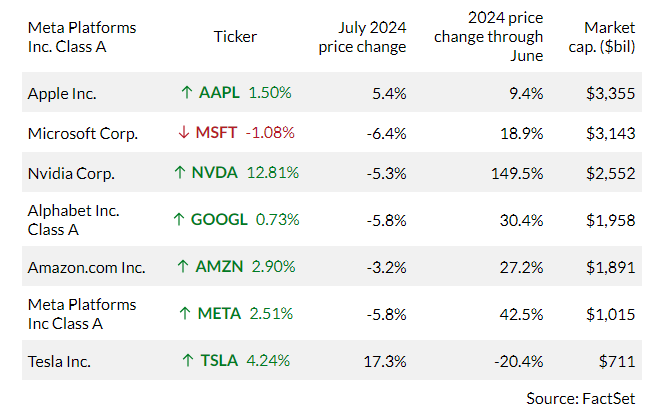
Seven months into 2024, the stock market has shown robust performance, but July marked a significant shift. A “Great Rotation” began, moving investor funds away from Big Tech and toward value stocks and small-caps. On Wednesday, MarketWatch’s Joseph Adinolfi summarized July’s stock-market dynamics, highlighting how expectations of a change in Federal Reserve policy prompted investors to shift away from the largest technology stocks. He also explored the potential for continued rallies in value stocks and small-caps. A look at the performance of broad stock indexes underscores investors’ renewed interest in market segments that had underperformed for several years through the first half of 2024, while Big Tech names had soared. Index Performance in July Here’s a summary of how several indexes performed during July, alongside their price changes for the first half of the year to illustrate the rotation. All price changes exclude dividends. Sector Performance in July Here’s how the 11 sectors of the S&P 500 performed during July, sorted by their performance: Worst Performers in July Here are the 10 S&P 500 stocks that fell the most in July: These tech stocks soared in the first half of the year but pulled back in July. CrowdStrike (CRWD -0.72%) faced a unique challenge with a worldwide computer outage caused by a software update on July 19, which weighed heavily on its share price. The Magnificent Seven’s Performance These seven companies constitute 30.6% of the SPY portfolio and dominated technology stock action, especially last year. Here’s their performance in July and during the first half of 2024, sorted by market capitalization as calculated by FactSet: This shift in investor behavior indicates a potential long-term trend as the market adjusts to new economic conditions and expectations. John PaulJohn Paul is the founder of DayTradeToWin, a trading education and software company established in 2008, supporting traders worldwide. His expertise focuses on price action-based futures trading strategies and structured market analysis. DayTradeToWin delivers trading education, indicators, and software tools designed to help traders apply disciplined, rule-based decision-making across global futures markets. He is the creator of multiple trading methodologies, including the Sonic System, Atlas Line, and Trade Scalper, which help traders identify structured opportunities in markets such as the E-mini S&P 500 (ES), Nasdaq (NQ), crude oil (CL), and gold (GC). Official website: https://daytradetowin.com daytradetowin.com

wall street
Market News

Treasury’s Market Role: New Research Ignites Discussion

A newly published white paper has ignited controversy on Wall Street and in Washington by accusing the Treasury Department of using short-term Treasury bills to manipulate the economy for political gain, potentially reigniting inflation. The paper, released last week, contends that the Treasury’s strategy of financing a substantial portion of the U.S. debt with short-term Treasury bills is a deliberate attempt to influence the economy. Authors Stephen Miran and Nouriel Roubini have termed this approach “activist Treasury issuance.” “By adjusting the maturity profile of its debt issuance, Treasury is dynamically managing financial conditions and, through them, the economy, usurping core functions of the Federal Reserve,” wrote Miran and Roubini. The Treasury Department has robustly denied these allegations, and numerous bond-market experts have also questioned the paper’s conclusions. Lou Crandall, chief economist at Wrightson ICAP, stated in a report to MarketWatch, “Treasury issuance over the past year has evolved in ways consistent both with its historical behavior and recent Treasury guidance. The Treasury is simply following its stated plans.” Treasury Secretary Janet Yellen also refuted the claims, telling MarketWatch, “There is absolutely no such strategy. We have never discussed anything of the sort.” Her statement first appeared in a Bloomberg News report. Miran and Roubini argue that the Treasury’s excess issuance of bills over the past nine months has had an impact equivalent to roughly $800 billion in quantitative easing, akin to reducing the 10-year yield by 25 basis points or the federal-funds rate by a full percentage point. They assert this has countered the Federal Reserve’s efforts to tighten monetary policy and cool the economy. Senator Bill Hagerty, a Tennessee Republican, echoed these concerns, suggesting that the Treasury’s reliance on bills is politically motivated. In a statement to MarketWatch, he said, “Politics has no place in Treasury debt issuance. Secretary [Janet] Yellen’s Treasury has manipulated long-term interest rates by dramatically shifting the maturities of U.S. debt to boost the economy before November. This back-door quantitative easing undermines public trust in our nation’s debt and risks our government’s ability to respond to future crises.” A Treasury official, speaking anonymously, criticized the paper for misrepresenting the guidance issued by the Treasury Borrowing Advisory Committee (TBAC). The official emphasized that the 15% to 20% range recommended by TBAC is a guideline, not a rule, allowing for flexibility. They noted that the shift toward more bill issuance was more modest than the paper suggests and that the Treasury has been gradually reducing its issuance of bills as a share of net new debt issued. Despite these denials, some experts see merit in the paper’s arguments. Bob Elliott, CEO of Unlimited and former chief of foreign-exchange policy at Bridgewater Associates, questioned why the Treasury hasn’t reduced the share of bills more quickly, noting that current economic conditions do not require significant easing. The idea that the Treasury might be working against the Fed’s efforts first gained traction after the department’s quarterly refunding announcement for the fourth quarter on November 1. The bond market was experiencing turmoil, with the yield on the 10-year Treasury note hitting its highest level in over 15 years. Guy LeBas, chief fixed-income strategist at Janney Montgomery Scott, pointed out that while the Treasury’s actions might influence financial conditions, other factors, such as the Federal Reserve’s stance on interest rates, also play a significant role. Miran defended the use of TBAC guidance as a benchmark, stating it was the only suitable reference provided by the Treasury. He argued that the Treasury has not provided a convincing reason for its continued reliance on bills. Details from the next quarterly Treasury refunding announcement are expected on Wednesday, while the Federal Reserve will announce its latest decision on interest rates later in the day. John PaulJohn Paul is the founder of DayTradeToWin, a trading education and software company established in 2008, supporting traders worldwide. His expertise focuses on price action-based futures trading strategies and structured market analysis. DayTradeToWin delivers trading education, indicators, and software tools designed to help traders apply disciplined, rule-based decision-making across global futures markets. He is the creator of multiple trading methodologies, including the Sonic System, Atlas Line, and Trade Scalper, which help traders identify structured opportunities in markets such as the E-mini S&P 500 (ES), Nasdaq (NQ), crude oil (CL), and gold (GC). Official website: https://daytradetowin.com daytradetowin.com

Scroll to Top