stock news

tariff
Market News

Tariff Shock Hits Stocks as Trump Targets Europe

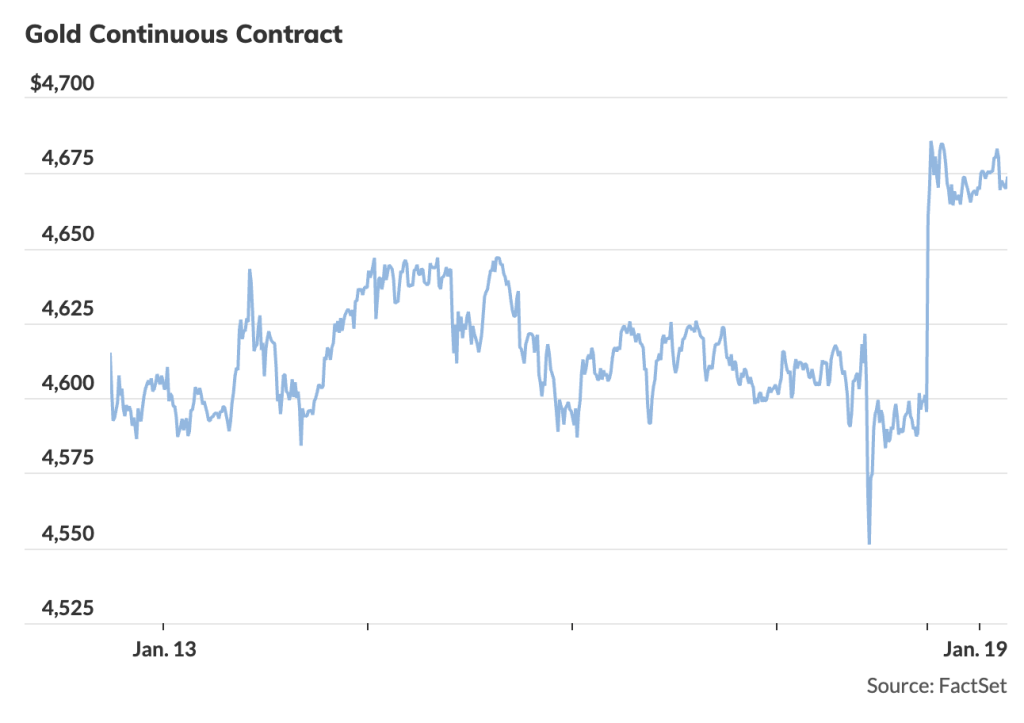
Global Markets Slide as Trump’s Europe Tariff Threats Ignite Trade War Fears, Gold Hits Record Global financial markets came under heavy selling pressure on Monday after U.S.President Donald Trump threatened new tariffs on several European countries, reigniting fears of a widening trade conflict and sending investors rushing into safe-haven assets. U.S. stock futures led global equities lower, while gold and silver surged to record highs as traders reduced risk exposure following Trump’s weekend announcement linking tariffs to negotiations over Greenland. “President Trump’s actions have reignited geopolitical risks and brought trade uncertainty back to the forefront,” said Kyle Rodda, senior financial market analyst at Capital.com. E-mini S&P 500 futures fell around 1%, Hong Kong’s Hang Seng Index dropped about 1%, and Europe’s STOXX 600 slid more than 1% in early trading. U.S. cash markets were closed for the Martin Luther King Jr. holiday. Safe Havens Rally as Risk Assets Sell Off Gold futures climbed above $4,670 an ounce for the first time on record, while silver surged past $94 an ounce to a new all-time high. Germany’s 10-year government bond yield, the euro zone benchmark, fell about two basis points as investors piled into sovereign debt. Trump Targets Eight European Countries On Saturday, Trump said the United States would impose 10% tariffs on imports from Denmark, Norway, Sweden, France, Germany, the United Kingdom, the Netherlands, and Finland starting February 1. He added that the tariff rate would rise to 25% on June 1 unless a deal is reached for the “complete and total purchase of Greenland,” according to a post on Truth Social. European officials are reportedly preparing countermeasures that could include up to €93 billion in tariffs on U.S. goods or restrictions on American companies’ access to European markets. Escalation Risks Cloud Global Outlook The eight countries targeted by Trump accounted for about $350 billion in U.S. imports in 2024. Holger Schmieding, chief economist at Berenberg, said a 10% tariff could lift U.S. consumer prices by as much as 0.15%. “Trump’s threat puts the entire U.S.-EU trade framework at risk,” Schmieding said. “If this escalates further, the damage to U.S. consumers could be nearly three times as severe.” Europe May Deploy Anti-Coercion Measures Analysts say the European Union could respond by activating its Anti-Coercion Instrument, a legal framework designed to counter economic pressure from foreign governments. “That could mean retaliatory tariffs — potentially against U.S. Big Tech — as well as investment restrictions,” said Ipek Ozkardeskaya, senior analyst at Swissquote. “That helps explain why Nasdaq futures are under heavier pressure than the broader market.” Precious Metals Remain in a Strong Bull Trend Strategists said the renewed trade tensions strengthen the bullish case for gold and silver. “With geopolitical and trade uncertainty rising again, investors are naturally moving to hedge risk, which further supports precious metals,” said Michael Brown, senior research strategist at Pepperstone. Markets Expect Familiar Negotiation Tactics Some analysts cautioned that markets may be seeing a familiar pattern. “This looks like another ‘escalate to de-escalate’ strategy that ultimately ends in a deal, though not without significant volatility along the way,” said strategists at Evercore ISI. Trump is expected to meet European leaders at the World Economic Forum in Davos this week, while markets also await a U.S. Supreme Court ruling on the legality of his use of emergency powers to impose tariffs. Defense Stocks Outperform European defense stocks bucked the broader market decline, with shares of Rheinmetall, BAE Systems, and Thales all trading higher on expectations of higher regional defense spending.

blackrock
Market News

BlackRock AUM Jumps to New All-Time High

BlackRock’s Assets Hit $14 Trillion as Market Rally Fuels Record Inflows BlackRock’s assets under management (AUM) surged to a record $14 trillion at the end of last year, lifted by strong global stock markets and a wave of investor money flowing into the company’s exchange-traded funds. The world’s largest asset manager said it attracted $698 billion in net inflows for the full year, including $342 billion in the fourth quarter, marking one of the strongest growth periods in the firm’s history. Chairman and CEO Larry Fink said BlackRock is heading into 2026 with “accelerating momentum across our entire platform,” following the integration of newly acquired businesses Global Infrastructure Partners, HPS Investment Partners, and Preqin, which significantly expand its presence in private markets and alternative assets. “Our business pipeline continues to broaden across products, regions, public and private markets, as well as technology and data,” Fink said. “We’re seeing strong fundraising activity as we move toward our goal of $400 billion in private markets fundraising by 2030.” BlackRock also delivered better-than-expected financial results. Fourth-quarter revenue climbed 23% to $7 billion, pushing full-year revenue to $24.2 billion, up 19% from the previous year. Adjusted earnings per share reached $13.16, beating analysts’ expectations of $12.19, according to FactSet. Markets reacted positively to the earnings report. BlackRock shares rose more than 2% in premarket trading and are now up roughly 10% over the past year, reflecting growing investor confidence in the company’s long-term strategy.

credit card
Market News

Why Trump’s Credit Card Plan Is Unlikely to Pass

A proposed 10% cap on credit card interest rates from President Donald Trump could deal a significant blow to U.S. card issuers’ profits and business models — but Wall Street analysts say the odds of it becoming law remain slim. Trump said in a social-media post Friday that he plans to move forward with a campaign pledge to impose a one-year cap on credit-card APRs, starting January 20. The surprise announcement immediately rattled financial markets and sent shares of major consumer lenders sharply lower. However, Jefferies analyst John Hecht said in a Saturday note that Trump lacks the executive authority to impose such a cap on his own. Any attempt to push the proposal through Congress would likely be “dead on arrival,” he wrote, citing the wide-ranging economic impact and the lack of support for similar measures in the past. Raymond James policy analyst Ed Mills added in a Sunday note that interest-rate caps are typically governed by state law, not federal mandates. While the political risk has increased now that the president has publicly raised the issue, Mills said the overall legislative risk remains relatively low. Why a 10% Cap Would Change the Credit Market Analysts and banking-industry groups warn that a 10% cap would not simply mean cheaper credit. Instead, card issuers would likely tighten lending standards, limiting access to credit for borrowers with lower credit scores. That could lead to slower consumer spending, weaker retail sales, and a drag on overall economic growth, according to Hecht. Which Companies Are Most Exposed Hecht evaluated the potential impact on several major card lenders, including: Visa and Mastercard would be largely unaffected since they do not lend directly to consumers. Following the announcement, Synchrony and Capital One shares each fell about 9% in premarket trading. American Express Would Still Take a Hit While American Express serves a more premium customer base, Hecht estimates that a 10% cap would still cut its net interest margin to about 5.7% from 9.2%. The impact would be far more severe for lenders with greater exposure to subprime borrowers. Bottom Line Despite the market’s sharp reaction, analysts believe the proposal faces major legal and political hurdles. For now, the idea is more of a headline risk than a base-case scenario — but it underscores growing political scrutiny of the consumer credit industry.

markets
Market News

Friday Could Shock Markets

U.S. stocks have started 2026 on solid footing, but investors could be facing their first major volatility event of the year as two powerful catalysts approach: the December U.S. jobs report and a potential Supreme Court ruling on President Trump’s tariffs. So far, markets have remained calm despite rising geopolitical tensions and continued sector rotation within equities. But beneath the surface, traders are positioning for a possible surge in volatility. “Things feel a little too quiet, a little too calm,” said Michael Arone, chief investment strategist at State Street Investment Management. Volatility Signals Are Rising Options markets suggest traders are bracing for a sharp move. According to Interactive Brokers, the S&P 500 is expected to swing nearly 1% in either direction based on Friday’s options pricing—potentially the most volatile trading day of 2026 so far. At the same time, the VIX volatility index has been creeping higher even as stocks rise, signaling growing demand for downside protection. “A relatively calm options market suggests there’s room for surprises,” said Steve Sosnick of Interactive Brokers. Jobs Report: A High-Stakes Moment for Overvalued Markets Friday’s employment report will be the first U.S. labor market snapshot of 2026, and it arrives at a sensitive moment. The S&P 500 is trading above 22 times forward earnings, a level close to the early 2022 peak that preceded a prolonged bear market. According to Sevens Report Research, this leaves little room for disappointment. Economists expect: Why It’s Tricky: “The ideal outcome is a ‘Goldilocks’ report—steady growth without overheating,” said Tom Essaye of Sevens Report Research. Labor Data Offers Some Reassurance Recent data shows the labor market may be cooling in a healthy way. December job cuts fell to their lowest level in 17 months, while hiring plans hit their strongest December in three years, according to Challenger, Gray & Christmas. Tariff Ruling Could Add Another Shock The Supreme Court may also rule Friday on the legality of Trump’s tariffs. Most traders expect at least some of the tariffs to be struck down, though markets appear partially prepared for that outcome. If the tariffs are overturned: Retailers like Walmart, Costco, and Dollar General could see the biggest immediate reaction, as more than 1,000 companies have filed lawsuits to recover tariff payments. What If Tariffs Stay? If the court upholds the tariffs, some strategists believe stocks could rally, since the policy has not derailed economic growth and has generated significant government revenue. Bottom Line With valuations stretched and confidence high, markets are extremely sensitive to surprises. Friday may become the first real stress test for markets in 2026.

market
Market News

Big Market Shift: What’s Rising Now

The U.S. stock market is undergoing one of the most important changes in years — and many investors haven’t noticed it yet. While the S&P 500 index has barely moved since late October, a powerful rotation trade has been unfolding beneath the surface. For the first time in years, technology stocks are no longer the only engine driving market gains. Instead, leadership is shifting toward value stocks, energy, financials, materials, and small-cap stocks. This change could define market performance in 2026 and beyond. After more than two years of AI-fueled dominance by mega-cap tech stocks, investors are now looking for better valuations, broader earnings growth, and new opportunities outside Big Tech. What Is a Stock Market Rotation? A stock market rotation happens when investors move money from one group of stocks or sectors into others. Since the bull market began in late 2022, market returns have been heavily concentrated in a handful of mega-cap technology stocks tied to artificial intelligence. But that narrow leadership is now starting to fade. According to UBS, market participation is finally broadening. “We’ve already been seeing a little bit of broadening out,” said David Lefkowitz, Head of U.S. Equities at UBS Global Wealth Management. “We think it could broaden further.” This is exactly what a healthy bull market looks like: more stocks, more sectors, and more styles participating in the rally. The Data Confirms It: The Average Stock Is Beating Big Tech For years, the traditional S&P 500 (which is weighted toward the biggest companies) easily outperformed the equal-weight version of the index. That meant a few giant tech stocks were doing most of the work. Now that trend has flipped. Since late October: This tells us something crucial:👉 The average stock is now outperforming the mega-cap giants. The Dow Jones Industrial Average — which is more value-oriented — is also off to its best start to a year in more than two decades. Value Stocks Are Beating Growth Stocks Again Another major shift is happening in investment style leadership. Since October: Value stocks typically: Growth stocks, especially in tech, dominate when money is cheap and hype is high. That environment is now changing. Sector Rotation: Energy, Financials, and Materials Take the Lead The clearest evidence of rotation is in sector performance: Since late October: This shows investors are repositioning for economic growth, falling interest rates, and improving global demand. Rising commodity prices have also boosted materials and mining stocks, while financials benefit from a stronger economy and healthier lending conditions. Why This Is Happening: The 2026 “Goldilocks” Economy Markets are starting to price in a Goldilocks scenario for 2026: “2026 could mark the return of a Goldilocks economy — and a reset for both equity and fixed-income markets,” said Jack Janasiewicz of Natixis. This environment is perfect for value stocks, cyclical sectors, and small-cap stocks. Small-Cap Stocks Could Be the Biggest Winners After years of underperformance, small-cap stocks are finally showing signs of life. Even more important: 📊 Analysts now expect small-cap earnings to grow faster than large-cap earnings in 2026 — the first time this has happened since the bull market began in 2022. According to Yardeni Research, small and mid-cap stocks could outperform large caps this year, especially in: Small caps also benefit the most from: The AI Trade Isn’t Dead — But Leadership Is Changing Artificial intelligence is still a massive long-term trend. But investors are no longer buying every stock with “AI” in the story. Instead, markets are becoming more selective, separating real winners from overpriced hype. The bigger change is this: 👉 The market no longer depends on just 7 stocks to go up. That’s a healthy and sustainable shift. The S&P 500 Still Has a Dangerous Concentration Problem Even after the recent rotation: This extreme concentration is another reason why broader market participation matters so much going forward. Valuations: The Biggest Reason the Rotation Has More Room to Run The valuation gap in the U.S. stock market is enormous: That means: 💡 There is massive upside potential in value stocks and small caps if this rotation continues. “If this trend holds, there is a vast valuation gap to close,” said Michael O’Rourke of Jones Trading. What This Means for Investors This is what a healthier bull market looks like: For diversified investors, 2026 could be one of the best years in a long time to look beyond mega-cap tech. Final Thoughts: The Market Is Entering a New Phase After years of narrow leadership dominated by AI and mega-cap tech, the U.S. stock market is finally broadening out. If economic growth holds, inflation stays controlled, and the Fed cuts rates, value stocks, cyclical sectors, and small caps could lead the next phase of the bull market. The rotation trade is no longer a theory. It’s already happening. 🚀

stocks
Market News

Wall Street Is Quietly Loading These Automation Stocks

Goldman Sachs is keeping its 7,600 target for the S&P 500, suggesting the market still has about 9% upside this year. But beneath that optimistic headline, the investment bank is warning investors that U.S. stocks are entering a far more fragile and volatile phase. In a new strategy note led by Ben Snider, Goldman says today’s market is showing a dangerous combination of rich valuations, heavy concentration in mega-cap stocks, and strong recent gains — a pattern that has historically appeared near major market tops. The firm points to similarities with the 1920s boom, the Nifty Fifty era of the 1970s, the 1987 rally, the dot-com bubble, and the 2021 surge — all periods that ended with painful market corrections. Is the Stock Market Overheated? Goldman is careful not to call this a full-blown bubble yet. Some classic signs of excessive speculation are missing. IPO activity remains muted, fund flows are relatively weak, and corporate leverage is still low by historical standards, even though it is rising. Speculative trading, as defined by Goldman, includes heavy activity in unprofitable companies, penny stocks, and stocks trading at more than 10 times enterprise value to sales — and those areas have not reached previous extremes. On the economic side, the bank says the main risks would be either a sharp slowdown in growth or a sudden shift toward tighter monetary policy. For now, neither seems likely. Still, Goldman warns that the supportive macro environment could fade later in the year as fiscal and monetary stimulus weakens and AI-driven disruption accelerates. Earnings Growth May Slow, Volatility May Rise Looking further ahead, Goldman expects S&P 500 earnings growth to decelerate in 2027 compared to 2026. At the same time, the upcoming midterm election cycle could increase policy uncertainty and market volatility, as has often happened in the past. While new policy tailwinds are possible, the firm says investors should prepare for a noisier and more unpredictable market environment. AI Spending Is Exploding — and So Is the Use of Debt One of the biggest structural shifts in the market is the massive surge in AI investment. Goldman notes that capital spending has risen to roughly 75% of corporate cash flow, meaning future growth in AI investment will increasingly rely on borrowing. “As spending and debt grow, the level of profits needed to justify these investments also rises,” the strategists caution. So far, mega-cap tech leaders such as Amazon, Alphabet, Meta, and Microsoft have mostly seen their stock prices move in line with earnings expectations — a big difference from the valuation excesses of the late 1990s tech bubble. “Phase 3-D”: Where AI Moves Into the Real World While much of the AI boom has focused on chips, cloud computing, and data centers, Goldman believes the next major opportunity lies in AI-powered robotics and automation. The firm calls this shift “Phase 3-D” — the stage where artificial intelligence starts interacting directly with the physical world. A basket of 26 stocks commonly held in U.S. robotics and automation ETFs — including Kratos Defense, Joby Aviation, AeroVironment, and Teradyne — delivered strong gains in early 2023 and again in 2025. Despite that, these stocks still trade at a reasonable 26 times forward earnings. Even more telling, investor exposure remains low. The largest robotics ETFs attracted only $750 million in inflows in the second half of last year, suggesting the theme is still under-owned. The Next Phase of the AI Stock Market Trade Goldman expects the AI investment story to broaden beyond infrastructure spending. As corporate adoption increases and spending growth slows, attention should shift toward: Bottom Line: Robotics and Automation Could Be the Next AI Mega-Trend While Goldman Sachs is warning that the overall stock market is becoming more vulnerable to pullbacks and volatility, it also sees a powerful opportunity taking shape. As artificial intelligence moves from software into the real economy, robotics and automation stocks could become the next big winners of the AI revolution — and one of the most compelling investment themes for traders and long-term investors alike.

Scroll to Top