
stock news

Market News

A Look Back: The Growth of a $10,000 S&P 500 Investment Over Two Decades

Outperforming the market is a difficult endeavor only a few people can accomplish. It is important to mention that it is easier to do better than the stock market when it goes down. In the year 2021, the stock market grew by 29%, but only 15% of money managers did better than the standard. In contrast, the S&P 500 dropped 18% in 2022, and only 51% of money managers did worse than the benchmark. Nevertheless, this achievement rate is not encouraging because more than half of the managers still did worse than the market. Consider this fact, even if you’re still amazed, that the market is expected to have more gains every year than losses. This means that overall, the market is expected to perform better than any funds that are actively managed. If you can’t beat them, join them Warren Buffett, a prosperous investor, advises that most individuals invest in an S&P 500 index fund. This investment method is reliable in generating money over a long period and is easier than finding profitable investments. Even when he is no longer here, Buffett suggests his wife invest only in index funds. It is easy to determine the value of your current money if you had put $10,000 into an investment twenty years ago. The sum of the dividends amounts to more than $65,000, leading to a gain of 555%. This computation remains unchanged despite the variations in the stock market and the necessity of moving money between various stocks. It is possible to choose to invest in this manner while also including various individual stocks in your portfolio, similar to how Berkshire Hathaway is handled by Buffett. Creating a group of approximately 25 thoughtfully selected stocks that are suitably diversified and optionally incorporating an index fund investment offers favorable possibilities for constructing a strong stock portfolio that surpasses the market. Even if you only invested your money in an index fund, you would still be in a favorable position. Don’t discount monthly contributions The benefits are even greater at present. If you had made a monthly deposit over the same time frame, your profits would have been significantly greater. Over the past 20 years, the index has typically yielded an annual return of about 10%. If you initially invested $10,000 and added $100 to your account monthly, you would presently have $136,000 in your portfolio. If you did the math, you would find that $24,000 was contributed over a 20-year span. However, since the funds were not invested for the entire period, the advantages of compound interest have not yet been fully enjoyed. Investing in the stock market presents several advantages. It allows higher returns than other investment choices, such as bonds or savings accounts. Opting for stocks can also broaden your portfolio and reduce your exposure to risk. Furthermore, by investing in the stock market, you can own a portion of renowned corporations that exhibit growth potential and appreciate value in the long run. In conclusion, if you aim to accumulate wealth and safeguard your financial prospects, investing in the stock market may prove to be a wise decision. Warren Buffett often communicates his trust in the United States to his investors. Choosing to invest in the stock market is a means of demonstrating confidence in the capabilities of American enterprises. There are times when the market is affected by unexpected events, which can have either positive or negative outcomes in the short term. These events can be difficult to predict, such as the COVID-19 outbreak, which is considered a prime example of an unforeseeable event. Nevertheless, investing in the stock market can provide access to the long-term growth potential of the United States, which can eventually improve your financial circumstances. Going through a significant period of inflation at present could strengthen this notion. While there have been instances of extreme inflation in the past, they are rare, and it is plausible that you may not witness one in your lifetime. Nonetheless, putting your money in an S&P 500 index fund can provide security despite any financial challenges and can still result in substantial profits in the long run. John PaulJohn Paul is the founder of DayTradeToWin, a trading education and software company established in 2008, supporting traders worldwide. His expertise focuses on price action-based futures trading strategies and structured market analysis. DayTradeToWin delivers trading education, indicators, and software tools designed to help traders apply disciplined, rule-based decision-making across global futures markets. He is the creator of multiple trading methodologies, including the Sonic System, Atlas Line, and Trade Scalper, which help traders identify structured opportunities in markets such as the E-mini S&P 500 (ES), Nasdaq (NQ), crude oil (CL), and gold (GC). Official website: https://daytradetowin.com daytradetowin.com

federal
Market News

Investors Brace for Impact: Fed Hints at Further Interest Rate Increases

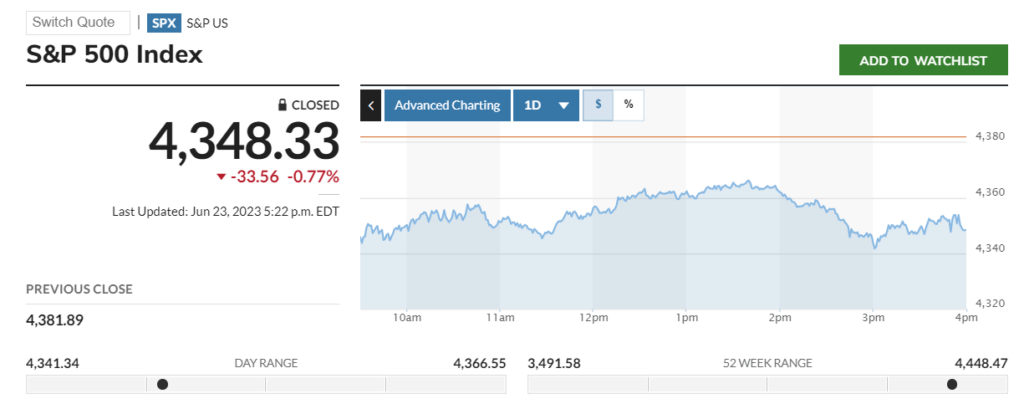
The S&P 500 fell in value over the course of the week following Jerome Powell’s testimony to Congress in which he revealed that all members of the Federal Open Market Committee had reached a consensus regarding the intention to increase interest rates before the year’s end. In the general market gauge, June saw a significant decrease, which brought an end to several weeks of strong performance. Other indexes, such as the Dow Jones and Nasdaq Composite, also struggled during the week, with the former dropping by 2% and the latter experiencing a drop of over 2.6% by the end of the week. During the past five days of trading until June 21st, the technology sector encountered a loss of 2 billion dollars, marking the largest reduction within the last 10 weeks. After the Federal Open Market Committee’s decision to stop increasing interest rates in March 2022, investors from various fields felt positive. Although Powell’s remarks were met with disappointment, the optimism continued among investors. It is expected that central banks all over the world will raise interest rates once more due to the continuation of inflation in various economies. Narendra Modi, the leader of India, being in Washington, D.C., was a noteworthy occurrence as the Biden administration gave him tremendous attention. President Biden highlighted the importance of the relationship between the United States and India, which is expected to be essential for this century, as India aims to establish its position as one of the world’s most influential financial and military powers. During the earnings call of FedEx Corp., there were mixed reactions regarding the news that the company’s revenue for the fourth quarter decreased by 10.2% or $21.9 billion, falling short of the analysts’ predicted revenue of $22.7 billion. Nevertheless, the company surpassed the estimated earnings per share of $4.89 by achieving $4.94 per share. Remember Bitcoin? The digital currency grew substantially, with a weekly increment of around 20% until Friday. It went beyond the $30,000 mark, reaching $31,200 after various financial organizations revealed new cryptocurrency initiatives. What’s next The forthcoming report on New Home Sales will give an understanding of the state of the housing market in May, whereas the Personal Consumption Expenditures index, due on Thursday, will provide a view of the inflation measure that the Federal Reserve is inclined towards. Walgreens, a company specializing in pharmaceuticals, is scheduled to disclose its profits on Tuesday. The following day, Micron Technologies, a manufacturer of semiconductor chips, and General Mills, a dominant player in the food sector, will also divulge their financial outcomes. On Thursday, Nike, an industry leader in sportswear, will reveal their earnings. Lastly, on Friday, Constellation Brands, a major producer of beverages, will report its financial standing. John PaulJohn Paul is the founder of DayTradeToWin, a trading education and software company established in 2008, supporting traders worldwide. His expertise focuses on price action-based futures trading strategies and structured market analysis. DayTradeToWin delivers trading education, indicators, and software tools designed to help traders apply disciplined, rule-based decision-making across global futures markets. He is the creator of multiple trading methodologies, including the Sonic System, Atlas Line, and Trade Scalper, which help traders identify structured opportunities in markets such as the E-mini S&P 500 (ES), Nasdaq (NQ), crude oil (CL), and gold (GC). Official website: https://daytradetowin.com daytradetowin.com
wall climbing
Market News

Stock Investors’ Wall of Worry: A Surprising Catalyst for the Emergence of a New Bull Market

The most recent data regarding money movement within mutual funds indicates a positive stock trend. However, it harms bonds. By only considering the information provided, your resulting conclusion would differ. According to EPFR-TrimTabs, American equity funds (both open-end and exchange-traded) have experienced a total net outflow of $86.5 billion in the current year. Conversely, U.S. bond funds have gained a total of $169.9 billion in investments. When analyzing fund flows, it is essential to take a contrarian approach. This idea is demonstrated in the provided chart, which shows that despite the stock market‘s positive performance from 2016 to 2020, U.S. equity funds had net outflows every year during this period. Nonetheless, things changed in 2021 when there was a switch to inflows, which came just in time for the 2022 bear market. Bond funds showed some behavior that went against the norm. They experienced significant amounts of money coming in during 2021, which was the highest in quite some time. Nonetheless, during 2022, they faced a significant decrease in the market, which was one of the worst in a long time or even ever before. The relationship between the performance of a fund and the movement of money in or out of it is not always clear-cut. Sometimes the connection is immediate, while other times it takes longer to become apparent. Thus, using monetary data to predict market timing over a long period may not be straightforward. However, as a general rule, when a large amount of money flows into a fund, the returns are usually average or even negative, while significant outflows often lead to decent returns, if not better than expected. Scholars have analyzed the relationship between exchange-traded funds (ETFs) and fund flow. In a study published in the Review of Finance two years ago, it was found that ETFs that experience substantial outflows usually perform better than ETFs with large inflows for up to a year after these notable fund movements. In an interview, Matthew Ringgenberg, a finance professor at the University of Utah and co-author of the research, explained the likely sequence of events that led to inadequate performance. He suggested that when ETFs become saturated with investors, particularly those in retail, the price exceeds the net asset value of its underlying stocks. To rectify this, certain market facilitators called authorized participants to create new ETF shares and eliminate the excess value. During the previous summer, a report was published in the Review of Financial Studies that found an explanation for poor performance; it could be due to investors being too excited about the most popular funds and ETFs. The report showed that ETFs that are created to cater to specific investor trends often receive a substantial amount of investment shortly after their launch but underperform compared to the market’s risk-adjusted returns by 5% yearly over five years after launch. In recent times, investors have shown a keen interest in artificial intelligence, which is evident from a recent trend. A study published in Finance Research Letters indicates that there was better stock performance when the ETF featured the acronym “AI.” This trend is similar to the internet bubble in the late 1990s, where adding “dot com” to a company’s name improved its stock performance. This research reveals a crucial concept that contradicts common perceptions, which Warren Buffett expressed as “being careful when others are being reckless, and being reckless when others are being careful.” Recent information on investment funds suggests that most people investing in the stock market are currently being more careful than adventurous. This is evident because, even though the S&P 500 has grown by an impressive 15% in 2023, investors have generally taken their money from U.S. equity funds. Taking a broad perspective, this is particularly good news. If regular investors had eagerly participated in the positive trend, those who are opposed to it would have more reason to worry about the sustainability of this new upward trend in the stock market. Nonetheless, the fact that they haven’t done so implies that there is a substantial amount of prudent hopefulness supporting this optimistic market. John PaulJohn Paul is the founder of DayTradeToWin, a trading education and software company established in 2008, supporting traders worldwide. His expertise focuses on price action-based futures trading strategies and structured market analysis. DayTradeToWin delivers trading education, indicators, and software tools designed to help traders apply disciplined, rule-based decision-making across global futures markets. He is the creator of multiple trading methodologies, including the Sonic System, Atlas Line, and Trade Scalper, which help traders identify structured opportunities in markets such as the E-mini S&P 500 (ES), Nasdaq (NQ), crude oil (CL), and gold (GC). Official website: https://daytradetowin.com daytradetowin.com
Stock today
Market News

Navigating the Summer Stock Rally: Expert Market Technicians Share Their Worries

The stock market tends to rise with the increase in temperatures during summer. After 164 days, the S&P 500 index has entered a bull market due to a 23% increase from its lowest point in October 2020. The recovery period from a bear market to a bull market was only longer in 1947, which took 281 days. According to recent reports, the Bureau of Labor Statistics has announced the lowest inflation rate in two years at 4%, and on June 14th, the Chairman of the Federal Reserve, Jerome Powell, announced that there would be no further increase in interest rates, ending a 15-month aggressive increase trend. A number of experienced individuals in the market are warning that while there are potential indicators suggesting that the markets may have a favorable outcome during the summer, the continual rise in the stock market may not be accurate and could just be a short-lived trend. Jim Stack, a seasoned market professional and the author of the InvesTech Research newsletter, believes that the ongoing bull market, if confirmed as genuine, would be regarded as an extraordinary event in the history of Wall Street. According to Stack’s analysis, the Russell 2000, which includes stocks with the lowest market value, typically shows the greatest gains at the beginning of a period of rising stock prices. Over the last four decades, the index has achieved an average increase of 30% eight months after the start of a bullish period. Nevertheless, at present, the index has only risen around 13% from its lowest point in October. Moreover, InvesTech uncovered that the primary reason for the S&P 500’s 81% increase this year can be traced back to the top 10 stocks including Apple, Tesla, and Amazon. This demonstrates a significant preference for big-name stocks and an undesirable trend of excessive optimism in the market, according to CEO Jim Stack. As a result, smaller stocks are being disregarded. Stack claims that we are currently in a situation that we have not encountered before and therefore it is unfamiliar to us. Stack is not predicting a recurrence of the financial crisis. However, he is pointing out that this year’s macroeconomic and technical indicators are signaling a riskier situation for investors. This situation bears similarity to the circumstances preceding the 2007 crisis. InvesTech is concerned despite the Federal Reserve’s more careful approach to interest rates. Even though inflation is going down, the Fed is still relying on the Core Personal Consumption Expenditure Price Index, which excludes food and energy, to measure inflation. With this index showing more than double the desired inflation rate of 2%, the Fed will likely keep tinkering with interest rates. For centuries, the Yield Spread Model of the Federal Reserve has proven to be a dependable predictor of economic hardships. This model computes the variance between the rates of short and long-term treasury bonds. InvesTech’s assessment reveals that at present, the model signals a 71% possibility of an economic slump. The Conference Board’s Leading Economic Index (LEI), which is an indicator of an imminent or current economic decline, has decreased for 13 consecutive months. This offers further proof that a recession is likely. Stack stated that the decrease of the LEI has exclusively taken place when the US economy was experiencing a downturn. In longer bear markets, the subsequent bull markets are typically shorter, according to Stack. He gave the examples of the Great Depression between 1929 and 1932, where there were five bull markets, and the tech bubble in 2000, where Wall Street standards only saw two bull markets. Jeff Hirsh, who is the editor-in-chief of the well-known Stock Trader’s Almanac that has been around for over half a century and is also a market technician, has shared his opinion that the current bull market does not follow the typical seasonal trend that is usually observed during summer, known as the “summer rally”. He explains that this “summer rally” is when the Dow Jones Industrials reaches its lowest point in May or June, and then its highest point within 60 to 90 days of that low. However, he argues that this trend is baseless and not applicable in reality. Based on the data provided by InvesTech Research, the Dow Jones Industrial Average generally sees minor growth between the months of May and June, followed by a rebound in September. Furthermore, their research demonstrates that investing $10,000 from November to April may result in considerably higher profits compared to investing that same amount from May to October. This variance in returns could potentially yield an additional $970,000 or more to an individual’s profits. David Keller, the Chief Market Strategist at StockCharts.com, stated that the positive start to June is unexpected as historically, June has not been a profitable month. However, Keller observed that the S&P 500 has become overbought due to this positive news, indicating the possibility of the end of the bull market, as this is a traditional sign. In an interview with Forbes, Keller mentioned that certain prominent industry leaders like AAPL and MSFT are currently achieving their best performance rates up till now. As a result, it is probable that they will undergo a notable drop in performance. Hirsh predicts that there will be a similar increase in the market to what was seen in mid-July 2022 in the coming year. However, it is expected that the market will decline in August and September as the Federal Reserve reevaluates interest rates. Hirsh states that it is common for the market to decrease in activity during the summer due to people taking time off from work and investing. However, as autumn comes around, investors tend to revisit and reassess their investment plans while companies prepare to publish their results for the third quarter. InvesTech recommends that investors exercise prudence and remember that it’s better to be defensive than offensive during the summer season. Hirsh suggests that it is advantageous to enjoy the summer and put money into profitable sectors like healthcare and biotechnology. Furthermore, if

S&P 500
Market News

S&P 500 Soars: Stock-Market Rally Pushes Index Toward 7 Consecutive Wins

U.S. stocks showed a small uptick on Friday and continued a noteworthy upward trend, which was attributed to signs of a potential decrease in inflation and improved job prospects. What’s happening What’s driving the market The S&P 500 saw its sixth consecutive increase on Thursday, marking the longest period of consecutive gains since November 2021. At the same time, the Nasdaq attained its peak level since March 2022, and the Dow ended the day with its highest closing price since December 2nd. The rise in stock prices occurred after a second rise in the number of people losing employment. Stephen Innes, who works at SPI Asset Management, said that although the latest economic data was varied, the increase in people losing their jobs indicated a weaker job market and a less assertive Federal Reserve. Investors are now more focused on economic data relating to job figures and inflation, rather than solely relying on the advice of the Fed for the July FOMC meeting. Two Federal Reserve officials also discussed how failures in the banking sector could affect the decision to increase interest rates. Christopher Waller suggested that this issue could still influence the central bank’s decisions. Tom Barkin, the President of the Richmond Federal Reserve, has stated that he refuses to back the proposal of putting an end to interest rate hikes unless he is fully persuaded that inflation is decreasing at a substantially more rapid pace, as he believes that it remains at an unsatisfactory level. During a speech in Maryland on Friday, Barkin restated that the goal for inflation is 2%. He expressed skepticism about the potential situation where a decrease in demand causes inflation to quickly return to that goal. If upcoming data does not support that narrative, Barkin is willing to take further measures, but he does not have a vote in the Fed’s interest rate-setting committee this year. As per Citi’s international experts, the significant increase of 15% in the S&P 500 index, due to the performance of leading tech firms, should not discourage investors. They argue that a limited control by certain companies in the market does not warrant selling, and throughout history, the stock exchange has usually shown greater results after such instances. The value of the US dollar in relation to the Japanese yen (USDJPY, 0.72%) reached its highest point in seven months due to the Bank of Japan’s decision to not make any changes to its interest rate policies. Following the rate cuts made by China on Thursday, the Hang Seng (HK:HSI) continued to increase and has now fully recovered from the losses it suffered in May. BlackRock has filed for a bitcoin investment fund to be available to the public, while the worth of Bitcoin (BTCUSD) has exceeded $25,000. Companies in focus John PaulJohn Paul is the founder of DayTradeToWin, a trading education and software company established in 2008, supporting traders worldwide. His expertise focuses on price action-based futures trading strategies and structured market analysis. DayTradeToWin delivers trading education, indicators, and software tools designed to help traders apply disciplined, rule-based decision-making across global futures markets. He is the creator of multiple trading methodologies, including the Sonic System, Atlas Line, and Trade Scalper, which help traders identify structured opportunities in markets such as the E-mini S&P 500 (ES), Nasdaq (NQ), crude oil (CL), and gold (GC). Official website: https://daytradetowin.com daytradetowin.com

Stop sign
Market News

Stock Market Rally Persists: What Role Could the Fed Play in Its Eventual Slowdown?

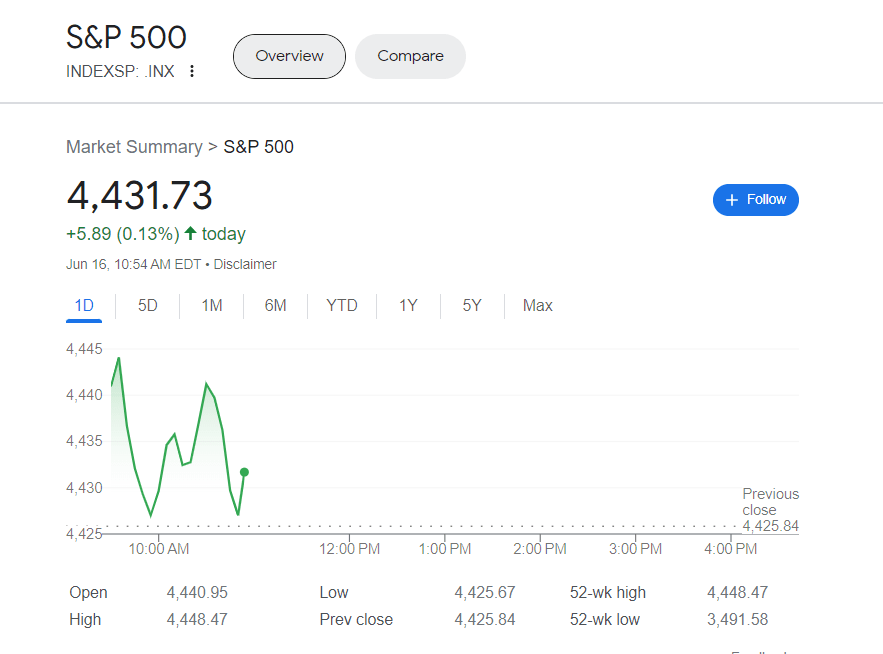
After the recent meeting of the Federal Reserve, there are individuals who remain uncertain and worried about the market on Thursday, especially regarding the instability of technology stocks. The Federal Reserve has chosen not to raise interest rates for the time being, but they plan to do so two times later on. Still, Chairman Jerome Powell tried to downplay the significance of this announcement. Even though the projection has been made, the market has yet to acknowledge the recommended two rate increases. Some say don’t overthink this: According to Tim Duy, the main economist at SGH Macro Advisors, it is not wise to assume that Powell’s statement suggests a willingness to be less rigid. He thinks that the choice to raise interest rates was already made in May and that misconceptions about the Fed’s plans have caused uncertainty. As a result, Duy suggests anticipating an increase in interest rates in July as well as either October or November. Julian Emanuel, who led a research firm called Evercore ISI, has stated in a report that the Federal Reserve’s impact on the stock market may not be as significant as widely believed. The report suggests that Powell and the Fed lack the power to make any drastic decisions that could negatively affect the growth of the stock market. Emanuel and his team have informed their clients that it is doubtful that the “momentum market” has come to a halt as stated by the Federal Reserve. They have cited the summer of 1999 as an example of a similar and unstable market. Their definition of a “momentum market” is one that is not easily swayed by outside influences like the decisions of the Federal Reserve. Which elements will be responsible for the cessation of the robust and invincible bull market? The following is the inventory they have assembled: Emanuel and his team are closely monitoring specific signs that may indicate the market is approaching its highest point, particularly as the S&P 500 approaches the 4,450 level. Evercore published a note on June 4 suggesting that if the market maintains its current pace, their estimated price target for the S&P 500 by the end of the year could be achieved as early as July 4.Evercore recommends that investors maintain a positive outlook on particular stocks referred to as “momentum masters,” which comprise Alphabet (GOOGL), Zscaler (ZS), and Copa Holdings (CPA). These stocks are part of the Russell 1000 index and have displayed impressive results in terms of performance, both in the current year and from March 30 onwards, positioning them among the top 20 companies within the index. Analysts have assigned all of these stocks an outperform rating. John PaulJohn Paul is the founder of DayTradeToWin, a trading education and software company established in 2008, supporting traders worldwide. His expertise focuses on price action-based futures trading strategies and structured market analysis. DayTradeToWin delivers trading education, indicators, and software tools designed to help traders apply disciplined, rule-based decision-making across global futures markets. He is the creator of multiple trading methodologies, including the Sonic System, Atlas Line, and Trade Scalper, which help traders identify structured opportunities in markets such as the E-mini S&P 500 (ES), Nasdaq (NQ), crude oil (CL), and gold (GC). Official website: https://daytradetowin.com daytradetowin.com

Scroll to Top