
stock news

Market News

Deciphering the Puzzle: Shedding Light on the Curiously Low Fear Gauge of Wall Street

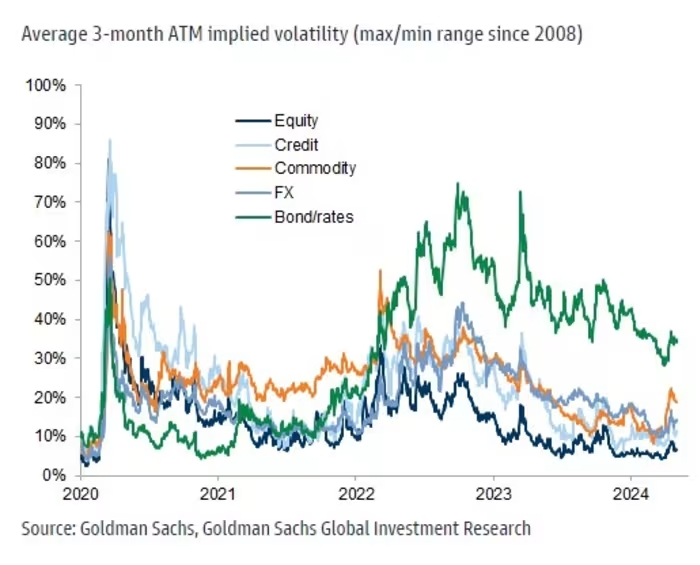
Challenging Misconceptions: Unraveling the Truth Behind the VIX’s Low Levels After a recent bout of stock-market turbulence, the subsequent dip in the Wall Street’s “fear gauge,” the Cboe Volatility Index (VIX), has prompted debates about its validity. Some attribute its decline to factors such as the rise of zero-days-to-expiry (ODTE) options or the increasing prevalence of ETFs. However, Nicholas Colas from DataTrek offers a simpler explanation: the VIX is merely reflecting the current tranquility in the stock market. Colas emphasizes that the VIX is aligning with the subdued volatility observed over the past 100 trading sessions. Given the lower-than-average daily returns of the S&P 500, it’s no surprise that the VIX is on the decline. Contrary to popular belief, the VIX doesn’t predict future market risks but rather mirrors recent market behavior. It primarily considers trading activity in one-month S&P 500 index options. Despite concerns about various potential risks looming over stocks, the VIX’s level remains grounded in recent market trends. Despite hitting its lowest level since late March, another key indicator, the Cboe VVIX, reflecting demand for options tied to the VIX, has also experienced a significant drop. This suggests a broader market sentiment of diminished fear and reduced risk aversion. While U.S. stocks displayed mixed performance on Wednesday, with the S&P 500 and Nasdaq slightly down while the Dow Jones slightly up, the underlying message remains clear: the VIX reflects the recent calmness in the market, despite lingering uncertainties. John PaulJohn Paul is the founder of DayTradeToWin, a trading education and software company established in 2008, supporting traders worldwide. His expertise focuses on price action-based futures trading strategies and structured market analysis. DayTradeToWin delivers trading education, indicators, and software tools designed to help traders apply disciplined, rule-based decision-making across global futures markets. He is the creator of multiple trading methodologies, including the Sonic System, Atlas Line, and Trade Scalper, which help traders identify structured opportunities in markets such as the E-mini S&P 500 (ES), Nasdaq (NQ), crude oil (CL), and gold (GC). Official website: https://daytradetowin.com daytradetowin.com
Goldman Sachs
Market News

Market Alert: Goldman Sachs Highlights Potential Shock Scenarios for Inflation Data

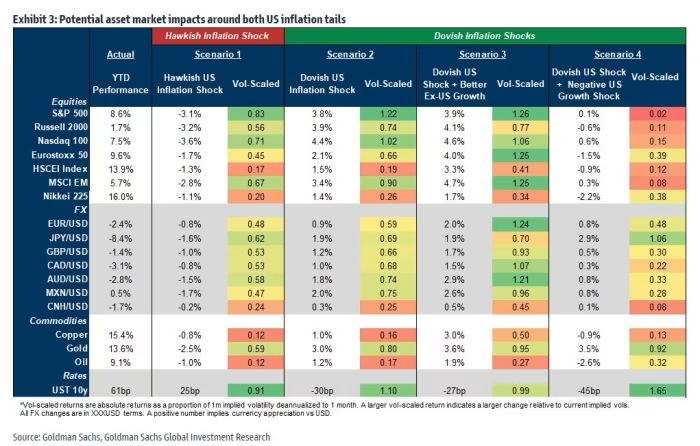
Key Information for Today’s U.S. Trading: Despite April’s 4.1% drop, May has seen a surprising 3% rise in the S&P 500. Investors are now focusing on the upcoming consumer prices data, particularly the CPI, which Goldman Sachs’ Vickie Chang highlights as crucial for market movements. Chang emphasizes the importance of the inflation trajectory for the macro outlook, especially after the recent Fed meeting. Next week’s CPI release will be instrumental in shaping market sentiment. Chang outlines several potential scenarios: The fourth scenario could see upside for bonds, gold, and the yen, although the yen has already experienced a notable uptrend. John PaulJohn Paul is the founder of DayTradeToWin, a trading education and software company established in 2008, supporting traders worldwide. His expertise focuses on price action-based futures trading strategies and structured market analysis. DayTradeToWin delivers trading education, indicators, and software tools designed to help traders apply disciplined, rule-based decision-making across global futures markets. He is the creator of multiple trading methodologies, including the Sonic System, Atlas Line, and Trade Scalper, which help traders identify structured opportunities in markets such as the E-mini S&P 500 (ES), Nasdaq (NQ), crude oil (CL), and gold (GC). Official website: https://daytradetowin.com daytradetowin.com

cash
Market News

The Year of Cash: Outperforming Bonds in 2024 Amid Speculation of a Fed Pivot

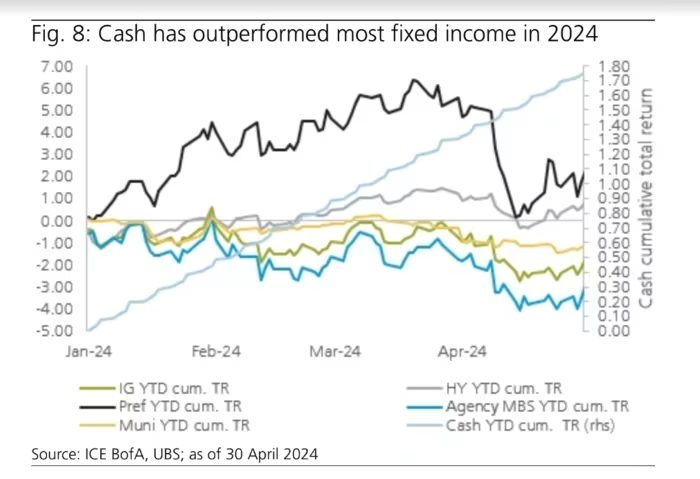
UBS forecasts that securing consistent returns through carry and income compounding will be the primary driver of fixed income performance in the upcoming months. Cash has notably outperformed many segments of the bond market in 2024, a trend celebrated by enthusiasts of a more relaxed investment strategy, colloquially known as “T-bill and chill.” The Federal Reserve’s cautious stance on rate cuts this year, due to persistent inflationary pressures, has contributed to cash’s dominance over bonds. By the end of April, cash had yielded a total return of 1.8%, surpassing the roughly 0.9% return from high-yield bonds. However, municipal bonds, investment-grade bonds, and agency mortgage-backed securities have faced negative returns. Leslie Falconio, leading a team at UBS global wealth management, highlighted the adverse impact of the rapid rise in interest rates on fixed income sectors in April. Notably, preferred securities experienced a significant setback with a -3.85% performance dip during the month. Despite these challenges, Falconio’s team underscores the importance of capitalizing on carry and compounded income to optimize fixed income performance going forward. They note the recent opportunity to secure higher yields, anticipating a potential decline in rates as summer approaches. While bond yields have stabilized in May following remarks from Fed Chair Jerome Powell, uncertainties remain. Powell indicated a reluctance to pursue further rate hikes unless prompted by cooling inflation or unexpected labor market weaknesses. In contrast, the equities market has seen gains year-to-date, with the S&P 500, Dow Jones Industrial Average, and Nasdaq Composite Index all posting positive performances. John PaulJohn Paul is the founder of DayTradeToWin, a trading education and software company established in 2008, supporting traders worldwide. His expertise focuses on price action-based futures trading strategies and structured market analysis. DayTradeToWin delivers trading education, indicators, and software tools designed to help traders apply disciplined, rule-based decision-making across global futures markets. He is the creator of multiple trading methodologies, including the Sonic System, Atlas Line, and Trade Scalper, which help traders identify structured opportunities in markets such as the E-mini S&P 500 (ES), Nasdaq (NQ), crude oil (CL), and gold (GC). Official website: https://daytradetowin.com daytradetowin.com

stock market
Market News

Consumer Stress Ahead: Stock Market Bulls Prepare for the Test

Investors are exercising caution as consumer stocks face a downturn amid uncertainty over potential interest rate adjustments by the Federal Reserve, currently at a 23-year high. Concerns over consumer strain are surfacing, posing risks to the stock market. At the beginning of 2024, investors expected approximately six quarter-point rate cuts starting as early as March. However, persistent high inflation, a tight labor market, and other economic indicators have tempered these expectations. Now, investors anticipate only two to three rate cuts starting in the autumn. Despite a decline in stock prices in April, investors have remained relatively optimistic, relying on the strength of the economy and consumer spending to drive profit growth. Yet, recent reports indicate a shift in consumer behavior towards more cautious spending. Major companies such as McDonald’s, Shake Shack, Wendy’s, Starbucks, and Yum Brands reported lackluster sales growth in the first quarter. While consumer incomes and expenditures are still increasing, spending is surpassing income, signaling heightened financial strain, notes Mace McCain, Chief Investment Officer at Frost Investment Advisors. The potential impact of this strain on consumer spending and the broader economy hinges on future unemployment trends. The latest data, released last Friday, revealed weaker-than-expected U.S. job growth in April, marking a six-month low. Although the unemployment rate slightly rose to 3.9%, remaining below 4% for the 27th consecutive month, this data did not trigger panic among investors. Instead, stocks rallied as investors envisioned an ideal scenario for the economy—neither too hot nor too cold. Gregory Daco, Chief Economist at EY, finds the data encouraging, noting a balanced labor market with moderate demand, historically low employment rates, and cooling wage growth. This combination may pave the way for Federal Reserve rate cuts, according to McCain. Despite the strain on consumers, the broader stock market remains relatively unaffected, suggests Richard Flax, Chief Investment Officer at Moneyfarm. Different income groups are feeling the impact differently, with lower-income individuals facing greater stress, particularly those unable to secure low mortgage rates. Conversely, higher earners continue to spend robustly, buoyed by stock market gains and high housing prices. This divergence underscores a divided economy, with the top income bracket faring better than the lower half, observes McCain. Flax warns of increasing distress among lower-income households, coupled with persistent inflation, potentially exacerbating inequality. Looking ahead, investors await insights from various Federal Reserve officials and anticipate key economic data releases throughout the week, including wholesale inventories, weekly initial jobless claims, and consumer sentiment indicators. John PaulJohn Paul is the founder of DayTradeToWin, a trading education and software company established in 2008, supporting traders worldwide. His expertise focuses on price action-based futures trading strategies and structured market analysis. DayTradeToWin delivers trading education, indicators, and software tools designed to help traders apply disciplined, rule-based decision-making across global futures markets. He is the creator of multiple trading methodologies, including the Sonic System, Atlas Line, and Trade Scalper, which help traders identify structured opportunities in markets such as the E-mini S&P 500 (ES), Nasdaq (NQ), crude oil (CL), and gold (GC). Official website: https://daytradetowin.com daytradetowin.com
Apple
Market News

Quantifying Berkshire’s Apple Advantage: Dividend Hike Breakdown

Apple’s announcement of a 4% increase in its cash dividend brings positive implications for Warren Buffett’s Berkshire Hathaway Inc. Buffett, famously drawn to dividend-yielding stocks, is likely pleased with Apple’s decision to up its cash dividend to 25 cents per share. Berkshire Hathaway holds over 905 million shares of Apple, accounting for around 6% of the tech giant’s total outstanding shares. As a significant shareholder, Berkshire stands to gain substantially from Apple’s augmented dividend payout. Assuming Berkshire maintains its current shareholding, its quarterly dividend from Apple would rise to $226.4 million, compared to the previous $217.3 million. Over the next year, Berkshire could anticipate receiving $905.6 million in Apple dividends, up from $869.4 million prior to the dividend hike, marking a notable increase of over $36 million for the year. The stability of Berkshire’s Apple position sparks speculation on Wall Street, particularly amidst Apple’s recent stock underperformance, with a 5% decline compared to the S&P 500’s 8% rise this year. Buffett’s investment portfolio includes other dividend-paying companies such as Coca-Cola Co., Kraft Heinz Co., and Chevron Corp. In addition to the dividend increase, Apple reported a 10% year-over-year decline in iPhone sales, expanded its stock-buyback program by $110 billion, and addressed some investor concerns regarding its business in China. John PaulJohn Paul is the founder of DayTradeToWin, a trading education and software company established in 2008, supporting traders worldwide. His expertise focuses on price action-based futures trading strategies and structured market analysis. DayTradeToWin delivers trading education, indicators, and software tools designed to help traders apply disciplined, rule-based decision-making across global futures markets. He is the creator of multiple trading methodologies, including the Sonic System, Atlas Line, and Trade Scalper, which help traders identify structured opportunities in markets such as the E-mini S&P 500 (ES), Nasdaq (NQ), crude oil (CL), and gold (GC). Official website: https://daytradetowin.com daytradetowin.com

Goldman Sachs
Market News

Goldman Sachs’ Playbook for Range-Bound Markets: Key Strategies Revealed

Early on Friday, futures for stock indices show optimism, although this could change if the nonfarm payrolls report signals strong wage inflation. The source of this optimism is a 6% rise in Apple shares after the company reported better-than-expected earnings, provided a positive outlook, and proposed additional share buybacks. Although Apple’s influence on the broader market has diminished somewhat, its significant weighting in the S&P 500 remains positive for overall market sentiment. Goldman Sachs’ Global Opportunity Asset Locator team, led by Christian Mueller-Glissmann, remains generally positive about equities. They acknowledge challenges such as persistent inflation in the U.S. and consequent pressure on bond yields but maintain a positive outlook for the year. They believe that equities can still perform well in the late cycle without a recession. As a result, Goldman Sachs retains an overweight position on stocks for both short- and long-term horizons, while being underweight on credit. They point to factors like strong profit margins, robust balance sheets, and increased shareholder returns as reasons for the attractiveness of stocks. However, they caution that equity volatility may persist until inflation decreases and bond market fluctuations stabilize. With monetary policy support waning, they stress the importance of growth to support risk appetite but note that rising bond yields raise the bar for such growth. To navigate these challenges, Goldman recommends overweighting cash in the short term to reduce portfolio risk amid tighter equity/bond correlations. They anticipate that in the event of a significant stock market correction, assets from money market funds could flow into equities. Additionally, Goldman suggests overweighting commodities to diversify against geopolitical risks and potential overheating in late-cycle environments. They see opportunities in oil futures due to recent price declines and anticipate higher gold prices driven by central bank purchases and Chinese demand. Goldman expresses particular confidence in copper and aluminum, citing factors such as a global manufacturing uptick, green transition initiatives, structural supply deficits, and low inventory levels as supportive of their positive outlook on these commodities. John PaulJohn Paul is the founder of DayTradeToWin, a trading education and software company established in 2008, supporting traders worldwide. His expertise focuses on price action-based futures trading strategies and structured market analysis. DayTradeToWin delivers trading education, indicators, and software tools designed to help traders apply disciplined, rule-based decision-making across global futures markets. He is the creator of multiple trading methodologies, including the Sonic System, Atlas Line, and Trade Scalper, which help traders identify structured opportunities in markets such as the E-mini S&P 500 (ES), Nasdaq (NQ), crude oil (CL), and gold (GC). Official website: https://daytradetowin.com daytradetowin.com

Scroll to Top