

stock news

Market News

The Fed’s Tightrope: BlackRock’s Rick Rieder Shares Observations

Wednesday marks the Federal Reserve’s announcement of its policy decision and interest rate forecasts. Rick Rieder of BlackRock notes a shift in investor sentiment regarding potential interest rate cuts, as addressing the last hurdles of inflation proves challenging. During the ongoing two-day policy meeting, Rieder, BlackRock’s Chief Investment Officer of Global Fixed Income, highlights Fed officials’ caution towards rate adjustments due to persistent inflationary pressures, especially in the services sector. He suggests Chairman Powell might hint at a June timeline for rate reductions, emphasizing Powell’s inclination towards easing monetary policy. While expectations lean towards the Fed maintaining its benchmark rate, futures markets indicate a 56% probability of rate cuts starting in June. Rieder anticipates three quarter-point cuts in 2024, though deviations from this forecast could disappoint markets. Rieder also underscores the significance of the Fed’s economic projections release, particularly regarding longer-term interest rate estimates. He suggests potential upward revisions, signaling prolonged higher interest rates. The Fed’s current policy rate aims to curb inflation towards a 2% target, despite recent CPI data showing inflation above this target. Rieder highlights the impact of higher rates on lower-income borrowers, local banks, and commercial real estate, emphasizing strains on consumer spending and financial institutions. Market responses to Fed rate hikes have evolved, reflecting changes in the economy and reduced sensitivity in equities, particularly Big Tech stocks, to interest rate changes. Despite rising Treasury yields, the S&P 500 remains robust, fueled by gains from tech giants. Rieder advocates seeking yield in high-yield corporate credit and securitized debt globally, citing the BlackRock Flexible Income ETF’s attractive annual yield of 6.6%. With a focus on credit quality and attractive returns, Rieder sees ongoing opportunities in fixed income markets, despite tightening credit spreads. John PaulJohn Paul is the founder of DayTradeToWin, a trading education and software company established in 2008, supporting traders worldwide. His expertise focuses on price action-based futures trading strategies and structured market analysis. DayTradeToWin delivers trading education, indicators, and software tools designed to help traders apply disciplined, rule-based decision-making across global futures markets. He is the creator of multiple trading methodologies, including the Sonic System, Atlas Line, and Trade Scalper, which help traders identify structured opportunities in markets such as the E-mini S&P 500 (ES), Nasdaq (NQ), crude oil (CL), and gold (GC). Official website: https://daytradetowin.com daytradetowin.com


Market News

Charting a Regulatory Course: The Prospects of an Apple-Google AI Collaboration

The prior collaboration between tech titans Apple Inc. and Alphabet Inc.’s Google has already drawn federal regulatory attention, triggered by a multi-billion dollar search agreement that led to an antitrust lawsuit from the Justice Department. Now, with talks of another alliance, this time concerning Google’s Gemini artificial intelligence engine, concerns arise about a potential repetition of investigations and accusations of monopolistic practices. Opinions vary, given the ongoing discussions and the specifics of any agreement. However, any pact, especially one involving AI, will attract the scrutiny of federal and state legislators, the Biden administration, consumer privacy advocates, and regulatory bodies. If Apple and Google team up on Gemini AI, it would essentially extend their previous online search partnership, which came under regulatory review. Reports suggest Google paid Apple roughly $18 billion in 2021 to maintain its search engine as the default on iPhones. Outgoing Representative Ken Buck, a Republican from Colorado, cautioned against Google leveraging its AI capabilities to further solidify its dominance in online search unless regulators intervene. Google argues that its collaboration with Apple benefits consumers, who prefer its search engine as the best available product. A judge is expected to make a ruling on the case later this year. For Apple, this potential partnership would provide the groundwork and technological framework to enhance AI features currently in development, potentially making future iPhone releases, such as the iPhone 16, revolutionary in terms of AI functionality, according to Wedbush analyst Daniel Ives. Both Apple and Google were not immediately available for comment following the Bloomberg report breaking the news. At the very least, Justice Department officials are likely to scrutinize the deal once announced, and Apple is anticipated to discuss its AI plans during its Worldwide Developers Conference in June. Antitrust experts suggest that while regulatory scrutiny is possible, it may not necessarily require approval unless contested. The deal’s exclusivity could raise regulatory concerns. Should Apple and Google collaborate on Gemini AI, the tools could enhance iOS capabilities, such as image creation and responding to user prompts. However, recent controversies, such as Google disabling Gemini’s image-generation tool due to biased results, raise concerns about the potential impact of AI on a large scale. This potential AI deal coincides with a sensitive time for Apple, facing regulatory challenges both domestically and internationally. The Department of Justice is reportedly preparing to sue Apple over its tightly integrated ecosystem, while the European Union has already fined Apple for anticompetitive behavior in the music-streaming app market. Furthermore, with the EU’s Digital Markets Act in effect, tech companies must now adhere to stricter regulations regarding user data, adding another layer of complexity to Apple’s regulatory landscape. In the midst of this, the potential partnership between Apple and Google represents a strategic move in the evolving landscape of technology. However, its implications, particularly regarding competition and regulatory compliance, remain to be seen. John PaulJohn Paul is the founder of DayTradeToWin, a trading education and software company established in 2008, supporting traders worldwide. His expertise focuses on price action-based futures trading strategies and structured market analysis. DayTradeToWin delivers trading education, indicators, and software tools designed to help traders apply disciplined, rule-based decision-making across global futures markets. He is the creator of multiple trading methodologies, including the Sonic System, Atlas Line, and Trade Scalper, which help traders identify structured opportunities in markets such as the E-mini S&P 500 (ES), Nasdaq (NQ), crude oil (CL), and gold (GC). Official website: https://daytradetowin.com daytradetowin.com
Market News

Anticipating the Fallout: Stock Market Gears Up for Fed’s Interest-Rate Update

This week, American investors are gearing up for a pivotal moment as the Federal Reserve reveals its latest interest rate projections. The burning questions revolve around changes in the ‘dot plot’ and how Fed Chair Jerome Powell will address them. With inflation persistently above the 2% target, investors are eager to know if policymakers still anticipate three rate cuts in 2024. Recent data indicating ongoing inflationary pressures has raised concerns among investors, who previously expected a rate cut by June. Now, there’s worry that the Fed might delay such moves. The Fed’s policy rate is expected to remain unchanged within a range of 5.25% to 5.5% following the two-day meeting concluding on Wednesday. Consequently, all eyes will turn to the release of the Fed’s latest Summary of Economic Projections, particularly the “dot-plot” revealing individual policymakers’ forecasts for the future fed-funds rate. Thierry Wizman, global FX and rates strategist at Macquarie, suggests the possibility of the Fed postponing rate cuts until midyear, emphasizing the need for additional evidence of sustainable disinflation before any adjustments. Recent trends indicate a slowdown in disinflation, potentially prompting Fed officials to revise upward their projections for 2024 and 2025. Initially, the Fed had anticipated a total of 75 basis points of cuts in 2024 and 100 basis points in 2025, but market sentiment has shifted with expectations now aligned with three quarter-point cuts in 2024. Interestingly, despite concerns over inflation, the stock market has remained buoyant. However, the government-debt market has shown signs of anxiety, particularly following notable increases in Treasury yields. Looking ahead, the potential adjustment of the neutral rate by the Fed could have significant implications for both bond and stock markets. A higher neutral rate could translate to fewer interest-rate cuts in the future, affecting market dynamics. As investors brace for the Fed meeting, caution is advised, particularly regarding bond investments. Increased apprehension among traders might trigger a selloff in the government-debt market. Furthermore, any indications of a higher long-term neutral rate could exert downward pressure on stocks, impacting their recent upward trajectory. John PaulJohn Paul is the founder of DayTradeToWin, a trading education and software company established in 2008, supporting traders worldwide. His expertise focuses on price action-based futures trading strategies and structured market analysis. DayTradeToWin delivers trading education, indicators, and software tools designed to help traders apply disciplined, rule-based decision-making across global futures markets. He is the creator of multiple trading methodologies, including the Sonic System, Atlas Line, and Trade Scalper, which help traders identify structured opportunities in markets such as the E-mini S&P 500 (ES), Nasdaq (NQ), crude oil (CL), and gold (GC). Official website: https://daytradetowin.com daytradetowin.com

Market News

U.S. Economy Enters Stagflation Era: What Lies Ahead?

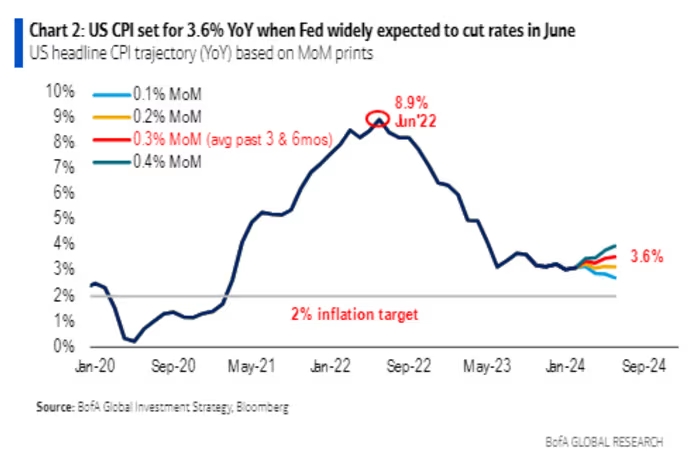
A Bank of America strategist is sounding the alarm that the U.S. economy is moving away from a ‘Goldilocks’ scenario to one resembling the stagflation of the 1970s, where inflation persists alongside slowing economic growth. Michael Hartnett emphasizes the importance for investors to take this shift seriously to avoid potential risks. Stagflation, marked by high inflation alongside stagnant economic growth, plagued the U.S. economy in the 1970s and early 1980s. Recent indicators suggest a similar pattern emerging, with inflationary pressures mounting while economic momentum slows. Recent data reveals concerning trends: inflation rates surpassing expectations, with consumer prices rising by 3.2% over the past year and projected to hit 3.6% by June. This has led traders to anticipate the possibility of the Federal Reserve cutting interest rates for the first time since 2022. The inflationary trend extends globally, prompting some emerging-market central banks to halt interest rate cuts. Meanwhile, signs of weakness in the labor market are emerging, threatening the previously strong economic growth in the U.S. Despite government data showing strong job creation, there has been a decline in full-time employment over the past three months. Additionally, fewer workers are quitting their jobs, and small businesses are scaling back hiring plans, indicating labor market challenges. Compounding these issues, rising government spending has led to increased budget deficits, potentially pushing Treasury yields above 4.5% for the first time since late last year. This could exacerbate pressure on U.S. stocks, which have been faltering in recent weeks. In such an environment, commodities, gold, cryptocurrencies, and cash are likely to become more attractive investments, while the equity market landscape may undergo significant changes. Hartnett suggests that a portfolio emphasizing resources and defensive assets could outperform traditional stock investments. Indeed, there are early signs of this shift, with crude oil prices outpacing tech-heavy indices like the Nasdaq-100 since the beginning of 2024. However, despite these warnings, investors continue to pour funds into U.S. equity markets, indicating a reluctance to abandon stocks entirely. Hartnett’s concerns echo those of other Wall Street analysts, including Marko Kolanovic of JPMorgan Chase, who recently highlighted the potential transition from a ‘Goldilocks’ economy to stagflation reminiscent of the 1970s. John PaulJohn Paul is the founder of DayTradeToWin, a trading education and software company established in 2008, supporting traders worldwide. His expertise focuses on price action-based futures trading strategies and structured market analysis. DayTradeToWin delivers trading education, indicators, and software tools designed to help traders apply disciplined, rule-based decision-making across global futures markets. He is the creator of multiple trading methodologies, including the Sonic System, Atlas Line, and Trade Scalper, which help traders identify structured opportunities in markets such as the E-mini S&P 500 (ES), Nasdaq (NQ), crude oil (CL), and gold (GC). Official website: https://daytradetowin.com daytradetowin.com

Market News

Dow Futures Show Modest Gain Amid Inflation Uncertainty

Stock futures in the United States were suggesting a steady start on Friday, but worries about lasting inflation were putting a damper on the momentum that had been building since the beginning of the year. What’s happening On Thursday, the Dow Jones Industrial Average, S&P 500, and Nasdaq Composite all saw decreases. The DJIA decreased by 138 points to 38,906, the SPX fell by 0.3% or 15 points to 5,150, and the COMP dropped 49 points to 16,128. The S&P 500 has gained 8% this year. What’s happening On Thursday, traders were presented with a recent report showing that inflation was declining at a slower pace than previously believed. This was due to producer prices rising more quickly than anticipated. Benjamin Melman, the global chief investment officer of asset management at Edmond de Rothschild, a private banking firm, has reduced investments in U.S. Treasurys due to a perception of higher inflation risks in the U.S. compared to Europe. Melman claimed that there is no bubble in U.S. stocks at the moment. He explained that unlike previous instances like the AI and internet bubbles, there is some actual earnings momentum backing up the current optimism. Melman highlighted that Nvidia’s PE ratio for 2024 is 36, which is considered high but reasonable for a stock with strong growth potential. The company has a neutral stance on stocks in general, as well as in the United States specifically, because they expect a decrease in funds. Melman was primarily focused on the declining reserve balances at the Federal Reserve, however, Japan is also being closely monitored by analysts. The country’s major union has declared a substantial 5.3% salary hike for its biggest corporations, the highest in more than thirty years. This could potentially lead the Bank of Japan to discontinue its negative interest-rate policy soon, possibly as early as next week or within the next month. This Friday, the Empire State manufacturing survey will be published, along with reports on import prices, industrial production, and University of Michigan consumer sentiment. On Friday, there are options tied to more than $5 trillion in stocks, exchange-traded funds, and equity indexes set to expire as part of the quarterly triple witching. Adobe is being closely examined because its sales forecast for the current quarter did not meet the expectations of analysts on Wall Street. John PaulJohn Paul is the founder of DayTradeToWin, a trading education and software company established in 2008, supporting traders worldwide. His expertise focuses on price action-based futures trading strategies and structured market analysis. DayTradeToWin delivers trading education, indicators, and software tools designed to help traders apply disciplined, rule-based decision-making across global futures markets. He is the creator of multiple trading methodologies, including the Sonic System, Atlas Line, and Trade Scalper, which help traders identify structured opportunities in markets such as the E-mini S&P 500 (ES), Nasdaq (NQ), crude oil (CL), and gold (GC). Official website: https://daytradetowin.com daytradetowin.com

Market News

Robinhood’s Stock Climbs as Retail Trading Storms Back

In February, Robinhood Markets Inc. witnessed a substantial 36% surge in equity trading volumes compared to the previous month. This surge fueled a remarkable rise in the company’s stock during Wednesday’s after-hours trading session. Throughout February, the online trading platform experienced an impressive $80.9 billion in trading volumes, marking a significant increase from January’s figures. Notably, trading volumes for options contracts rose by 12% to $119.1 million, while cryptocurrency trading volumes grew by 10% to $6.5 billion. The total assets under custody for the month reached $118.7 billion, demonstrating a robust 16% increase from Robinhood’s January levels. Additionally, the company recorded net deposits of $3.6 billion. Following this strong performance, Robinhood’s shares surged by 10% in after-hours trading on Wednesday, contributing to a notable 91% increase over the past 12 months. Robinhood has been capitalizing on the resurgence of interest in retail trading, as evidenced by its recent quarterly earnings report, which highlighted an increase in monthly active users and transaction-based revenue. During a JMP Securities conference earlier this month, Chief Financial Officer Jason Warnick expressed optimism about Robinhood’s market potential. He emphasized the significant opportunities presented by the growing strength of retail traders, increased earnings power, and wealth transfer over the next decade, affirming Robinhood’s strong positioning to cater to this evolving customer base. John PaulJohn Paul is the founder of DayTradeToWin, a trading education and software company established in 2008, supporting traders worldwide. His expertise focuses on price action-based futures trading strategies and structured market analysis. DayTradeToWin delivers trading education, indicators, and software tools designed to help traders apply disciplined, rule-based decision-making across global futures markets. He is the creator of multiple trading methodologies, including the Sonic System, Atlas Line, and Trade Scalper, which help traders identify structured opportunities in markets such as the E-mini S&P 500 (ES), Nasdaq (NQ), crude oil (CL), and gold (GC). Official website: https://daytradetowin.com daytradetowin.com

Scroll to Top