
stock news

healthcare
Market News

Healthcare Steps Up: The Dark Horse of 2025

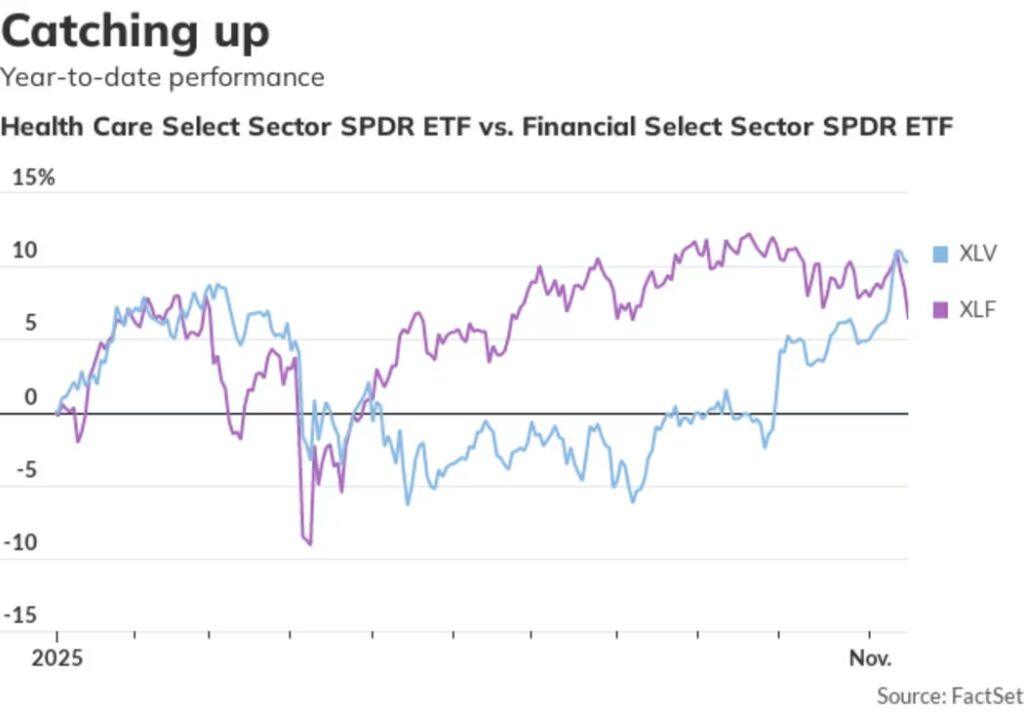
SoFi’s Liz Thomas Says a Surprise Sector Could Shine in 2025 Investor anxiety keeps building as the year winds down, with Monday’s selloff showing no appetite for dip-buying. Concerns over AI and fading hopes for more Fed rate cuts continue to shake the market. AI has been the go-to trade for 2025, but SoFi’s head of investment strategy Liz Thomas argues it may be time to look beyond tech. Her contrarian pick? Healthcare — a sector she believes could turn into a standout performer through 2025 and even into 2026. Thomas admits the call looked risky at first. With HHS Secretary Robert F. Kennedy Jr. taking office and pushing early policy changes, the sector was bracing for impact and had a tough year. “It was definitely a contrarian choice going into 2025,” she told MarketWatch. “The sector was pricing in a lot of fear.” But she still expects a strong catch-up trade, pointing out that healthcare could quickly close the gap with — or even overtake — industrials. Recent performance supports her case: healthcare has jumped from being one of the year’s laggards to outperforming financials. The XLV ETF is now up around 10% in 2024, compared with a little over 6% for XLF. Thomas says investors rotating out of pricey tech names are hunting for growth that doesn’t come with stretched valuations. “Earlier this year, healthcare was in the bottom percentile of valuations versus the S&P 500. It doesn’t get much cheaper than that,” she said. Pharma and biotech, in particular, are showing a promising mix of value and growth — something Thomas says could make healthcare a repeat pick for 2026 as SoFi finalizes its outlook. She also notes the sector tends to perform well in midterm election years, adding to its defensive appeal for 2026. Heading into 2025, SoFi was broadly optimistic but cautious about two risks: inflation heating back up and AI falling short on monetization. Neither issue has surfaced yet, though Thomas still sees potential cracks in the AI trade. One prediction that hasn’t hit: software beating semiconductors. Even so, she believes a rotation could still happen. “As tech investors become more valuation-conscious, software could be the next gateway that brings AI into real-world use,” she said. After Monday’s nearly 800-point drop in the Dow, Thomas thinks excess speculation is finally being flushed out — especially in momentum pockets. Still, she expects a late-year chase as fund managers try to catch up. Her warning: “Everyone thinks they’ll exit before a crash. You never know when it comes, but when stocks get this stretched, a reality check usually follows.” John PaulJohn Paul is the founder of DayTradeToWin, a trading education and software company established in 2008, supporting traders worldwide. His expertise focuses on price action-based futures trading strategies and structured market analysis. DayTradeToWin delivers trading education, indicators, and software tools designed to help traders apply disciplined, rule-based decision-making across global futures markets. He is the creator of multiple trading methodologies, including the Sonic System, Atlas Line, and Trade Scalper, which help traders identify structured opportunities in markets such as the E-mini S&P 500 (ES), Nasdaq (NQ), crude oil (CL), and gold (GC). Official website: https://daytradetowin.com daytradetowin.com
market
Market News

Market Rally: Can Earnings Keep It Going?

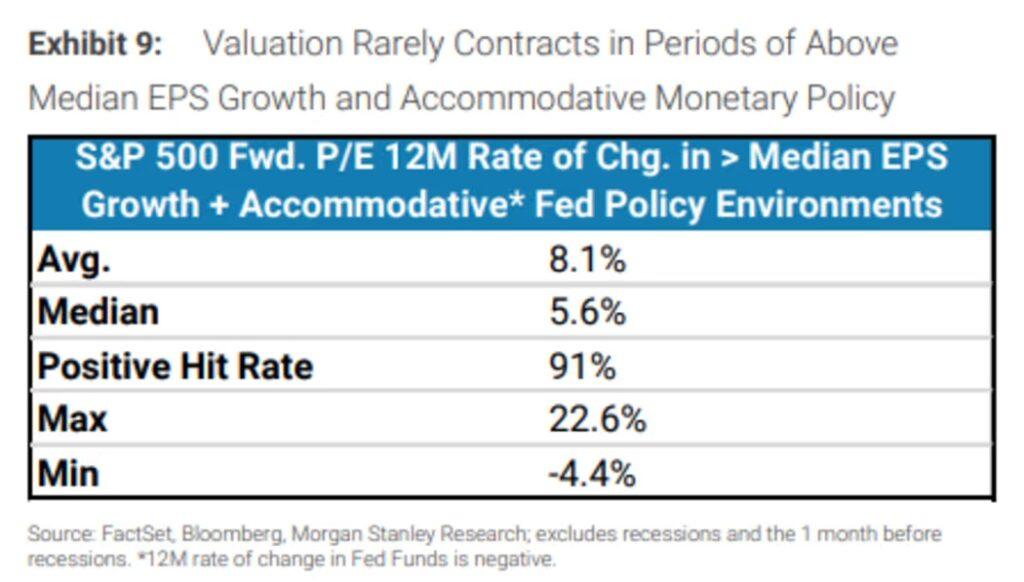
Earnings strength and a more supportive Federal Reserve should help sustain market valuations, says Morgan Stanley strategist Mike Wilson. Investors continue to buy the dips. S&P 500 futures opened the week 1.5% above Friday’s intraday low, reflecting a still-bullish tone. In a Monday note, Wilson and his team raised their 12-month S&P 500 target to 7,800, up from a prior 7,200 forecast for mid-2025. From current levels, that implies roughly 16% upside. Even if the index tops 7,000 this year, Morgan Stanley still expects double-digit gains through 2026. Wilson sees next year’s economy benefiting from growth-positive catalysts such as tax cuts and deregulation, reversing the drag from tariffs and government job reductions. “A new bull market and rolling recovery began in April, which means it’s still early days,” Wilson writes. “It may not look obvious yet, especially in lagging areas of the economy and market.” This backdrop supports a healthier earnings outlook. Morgan Stanley expects companies to gain from positive operating leverage, stronger pricing power, and AI-driven efficiency improvements. Recent data backs that up: third-quarter results showed a 2.2% revenue beat rate for the S&P 500 — double the average — and 8% median EPS growth for Russell 3000 stocks, the fastest in four years. The bank now forecasts S&P 500 EPS of $272 in 2025 (12% growth), $317 in 2026 (17% growth), and $356 in 2027 (12% growth). Monetary policy is another tailwind. Wilson believes markets are underestimating how accommodative the Fed will be over the next 6–12 months. He expects softer labor data and a willingness from policymakers to “run it hot” to result in a looser stance on both rates and the balance sheet. While Wilson anticipates a slight contraction in the market’s P/E multiple — from about 22.3 to 22 — he notes that strong earnings growth and easy monetary policy rarely trigger meaningful valuation compression. Despite underperformance this year — the Russell 2000 ETF has lagged the S&P 500 by roughly 7 percentage points — Wilson expects leadership to broaden. He is upgrading small caps to overweight, citing improving earnings revisions relative to large caps. Wilson is also shifting sector preferences. Morgan Stanley now favors consumer discretionary goods stocks — including Amazon, Dick’s Sporting Goods, AutoNation, and Wayfair — over services. He notes that earnings revisions in goods are improving, and the long-term performance ratio between goods and services is near historic lows and starting to turn higher. The firm also reiterates its overweight view on financials, and upgrades healthcare to overweight as its preferred “quality growth” sector. John PaulJohn Paul is the founder of DayTradeToWin, a trading education and software company established in 2008, supporting traders worldwide. His expertise focuses on price action-based futures trading strategies and structured market analysis. DayTradeToWin delivers trading education, indicators, and software tools designed to help traders apply disciplined, rule-based decision-making across global futures markets. He is the creator of multiple trading methodologies, including the Sonic System, Atlas Line, and Trade Scalper, which help traders identify structured opportunities in markets such as the E-mini S&P 500 (ES), Nasdaq (NQ), crude oil (CL), and gold (GC). Official website: https://daytradetowin.com daytradetowin.com

stocks
Market News

Stocks at Risk if Key Levels Break

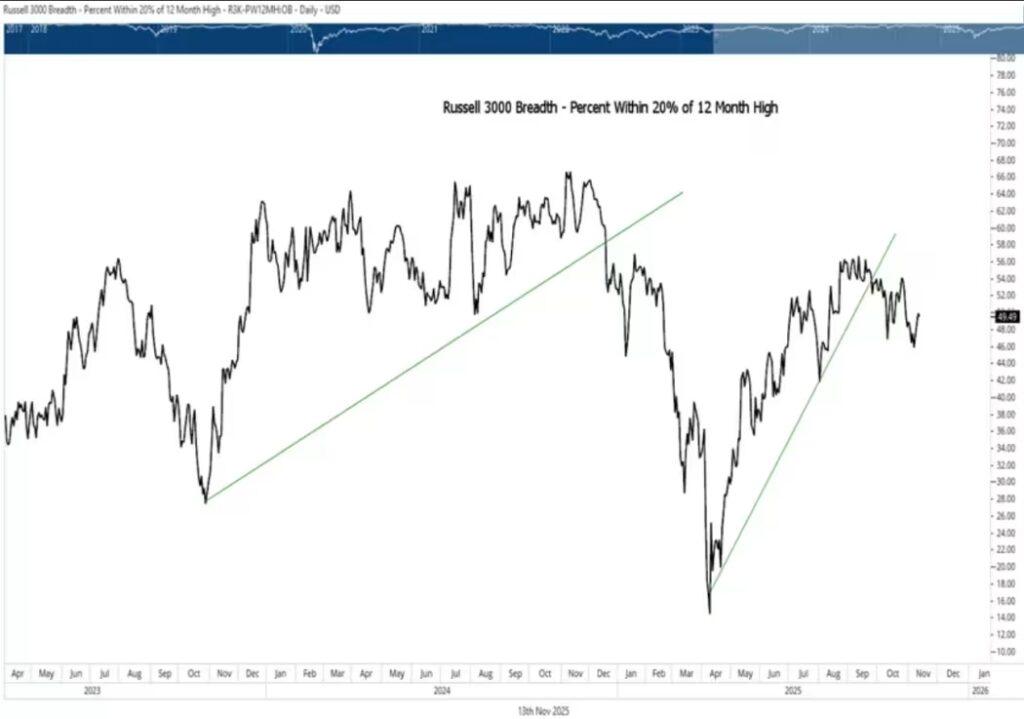
Mark Newton Flags Weak Market Breadth as Stocks Stay Under Pressure U.S. equities remained on the defensive early Friday after Thursday delivered the market’s worst drop in more than a month. The Nasdaq Composite slid 2.3%, and tech stocks look poised to drag the market lower again as concerns over stretched valuations and a slower-than-hoped pace of Fed rate cuts unsettle investors. When fundamentals lose traction, technical signals tend to matter more. Citi strategists note that their “When Generals Fail” indicator still points to a constructive long-term trend for mega-cap tech. Among the so-called Mag 7, only Meta is currently below its 200-day moving average — a sign the broader outlook remains intact. But Mark Newton, Fundstrat’s head of technical strategy, is not as relaxed. He’s focused on market breadth — the share of stocks rising along with the indexes — which has started to weaken. Newton points out that the percentage of Russell 3000 stocks sitting within 20% of their 12-month highs has begun to roll over, much as it did late last year and ahead of the 2022 market peak. At around 50%, he says this measure needs to firm up and hold through year-end. Continued deterioration would be “problematic for equities.” “Markets usually show internal weakness before corrective periods,” Newton cautions. “This time looks no different.” A potential catalyst that could reverse the tide: Nvidia. The AI bellwether, which closed Thursday at $186.86, reports earnings on Nov. 19. Strong numbers and upbeat guidance could provide a broader boost. Newton adds that he wouldn’t turn bearish on the stock unless it breaks below $178.91, last Friday’s low. He also highlights key levels that must hold: A break below these early-November lows would open the door to increased volatility before markets stabilize. Newton still expects a December bounce, though he’s less convinced that new highs will come immediately. Still, his broader tone remains constructive: while market breadth is a current challenge, subdued sentiment makes a compelling case for buying dips during a seasonally strong period. John PaulJohn Paul is the founder of DayTradeToWin, a trading education and software company established in 2008, supporting traders worldwide. His expertise focuses on price action-based futures trading strategies and structured market analysis. DayTradeToWin delivers trading education, indicators, and software tools designed to help traders apply disciplined, rule-based decision-making across global futures markets. He is the creator of multiple trading methodologies, including the Sonic System, Atlas Line, and Trade Scalper, which help traders identify structured opportunities in markets such as the E-mini S&P 500 (ES), Nasdaq (NQ), crude oil (CL), and gold (GC). Official website: https://daytradetowin.com daytradetowin.com
investors
Market News

Investors Pivot: From Tech Titans to Value Winners

Investors Shift Gears: From Tech Titans to Value Plays After years of chasing high-flying tech stocks, investors are now turning to the market’s long-overlooked “old economy” names. Sectors like healthcare and industrials — once laggards — are suddenly back in the spotlight. On Wednesday, the Dow Jones Industrial Average surged past 48,000 for the first time in history, logging a second straight record close. Optimism over a potential end to the longest U.S. government shutdown helped lift the blue-chip index, said Sam Klar, portfolio manager at GMO Domestic Resilience ETF. “The main theme is: Value is back,” said Jamie Cox, managing partner at Harris Financial Group, noting strong performances from healthcare and industrial stocks. While the Dow soared, the Nasdaq Composite slipped 0.26%, extending its recent underperformance. The Dow has now outpaced the Nasdaq by 2.38 percentage points over the past two sessions — its strongest two-day lead since February. The AI Trade Loses Steam After dominating markets for much of the past year, AI-driven tech stocks are showing cracks. Momentum names like Oklo Inc. (OKLO) and Palantir Technologies (PLTR) have stumbled, while value sectors have gained traction. “Earlier this year, it felt like AI stocks could do no wrong,” said Klar. “Now the market’s asking, ‘How good is good enough?’ That uncertainty is healthy — and overdue.” Some of the shift may simply reflect profit-taking, said Cox. “It’s a responsible reallocation of capital,” he added. Shutdown Hopes Buoy Sentiment Markets were also encouraged as Congress neared a deal to reopen the federal government. Historically, shutdowns have had little lasting effect on equities, and stocks often rally once the standoff ends, noted Adam Turnquist, chief technical strategist at LPL Financial. Still, the S&P 500 is off to one of its weakest Novembers in years, raising doubts about whether the usual year-end rally can gain traction. Rotation or Reset Ahead? Some analysts caution against calling this a full-blown trend. Bob Savage, head of markets macro strategy at BNY, said the move looks more like profit-taking than a permanent shift out of tech. Large investors — including pension and foreign funds — haven’t yet changed their allocations in a meaningful way. “This rotation is about surviving year-end without getting hit on valuations,” Savage said. Much depends on the Federal Reserve’s December meeting and whether another rate cut is on the table. “Show me a Fed cut and stronger growth,” Savage added, “and I’ll tell you how 2026 looks.” For now, it’s less of a market correction and more of a rebalancing act — a reminder that even in an AI-driven era, value still has a place at the table. John PaulJohn Paul is the founder of DayTradeToWin, a trading education and software company established in 2008, supporting traders worldwide. His expertise focuses on price action-based futures trading strategies and structured market analysis. DayTradeToWin delivers trading education, indicators, and software tools designed to help traders apply disciplined, rule-based decision-making across global futures markets. He is the creator of multiple trading methodologies, including the Sonic System, Atlas Line, and Trade Scalper, which help traders identify structured opportunities in markets such as the E-mini S&P 500 (ES), Nasdaq (NQ), crude oil (CL), and gold (GC). Official website: https://daytradetowin.com daytradetowin.com
Goldman Sachs
Market News

Goldman Sachs Cautions on Market Concentration Risks

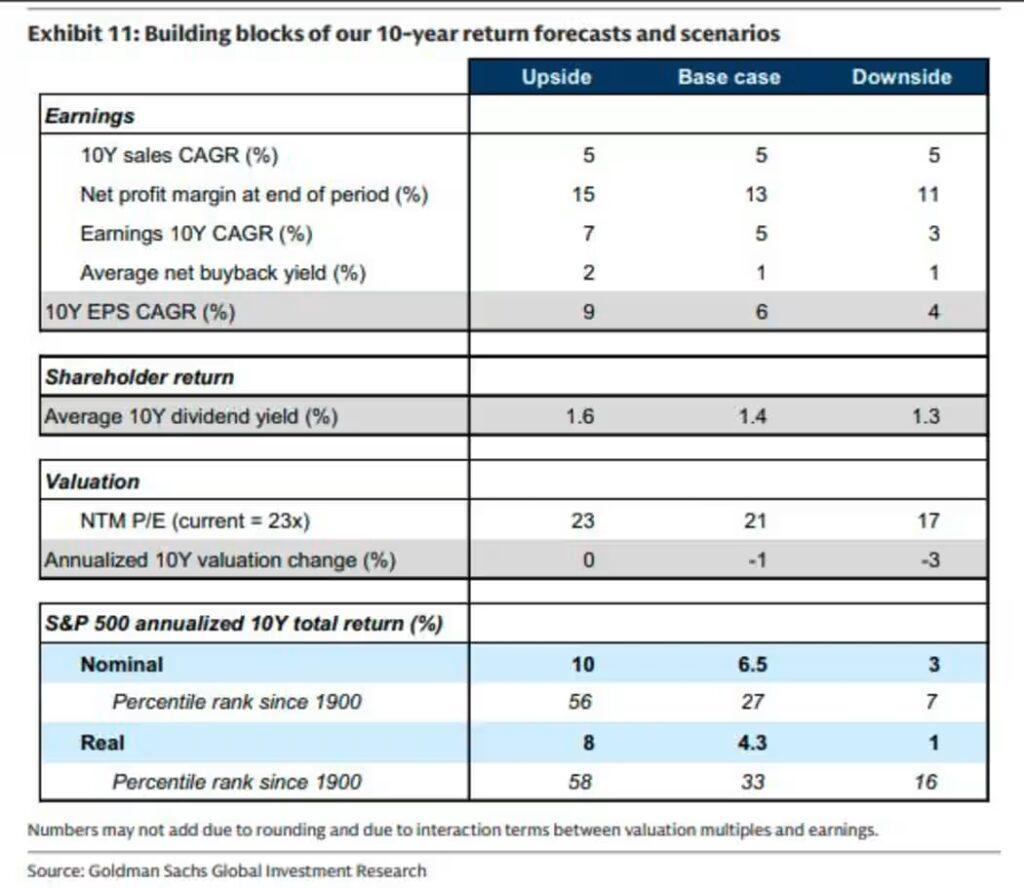
Goldman Sachs Sees S&P 500 at 7,600 by 2026, But Warns of Tech Fatigue Goldman Sachs strategists are sounding a cautious note on Wall Street’s biggest winners, warning that the “superstar” tech stocks driving recent gains may eventually lose momentum. In one of the first forecasts for next year, Goldman projects the S&P 500 to reach 7,600 by the end of 2026, an 11% rise from current levels. Looking further out, the bank expects the index to deliver a 6.5% annualized return over the next decade — slightly below its 7.7% forecast for global equities and near the 27th percentile of historical returns since 1990. Their 10-year outlook includes a range of 3% to 10% annualized returns. The base case reflects 6% earnings-per-share growth, offset by a 1% drop in valuations and a 1.4% dividend yield, with revenue growth expected to track nominal GDP. A softer U.S. dollar could also provide a modest lift. Goldman notes that corporate profit margins remain near record highs at 13%, up from 5% in 1990, thanks to globalization, lower interest rates, and reduced corporate taxes — tailwinds that may not repeat in the next decade. The bank’s valuation forecast assumes a 4.5% nominal Treasury yield by 2035 and a forward P/E of 21, down roughly 10% from current levels. Still, the strategists see a major wild card in market concentration. The dominance of a few mega-cap tech firms has powered the market higher, but if their profitability or valuations falter — and no new leaders emerge — broader returns could suffer. On the upside, AI could prove to be a powerful growth engine, potentially lifting earnings-per-share growth to 9%, well above Goldman’s base forecast. John PaulJohn Paul is the founder of DayTradeToWin, a trading education and software company established in 2008, supporting traders worldwide. His expertise focuses on price action-based futures trading strategies and structured market analysis. DayTradeToWin delivers trading education, indicators, and software tools designed to help traders apply disciplined, rule-based decision-making across global futures markets. He is the creator of multiple trading methodologies, including the Sonic System, Atlas Line, and Trade Scalper, which help traders identify structured opportunities in markets such as the E-mini S&P 500 (ES), Nasdaq (NQ), crude oil (CL), and gold (GC). Official website: https://daytradetowin.com daytradetowin.com

wells fargo
Market News

Wells Fargo Says Tech Rally Looks Too Hot to Handle

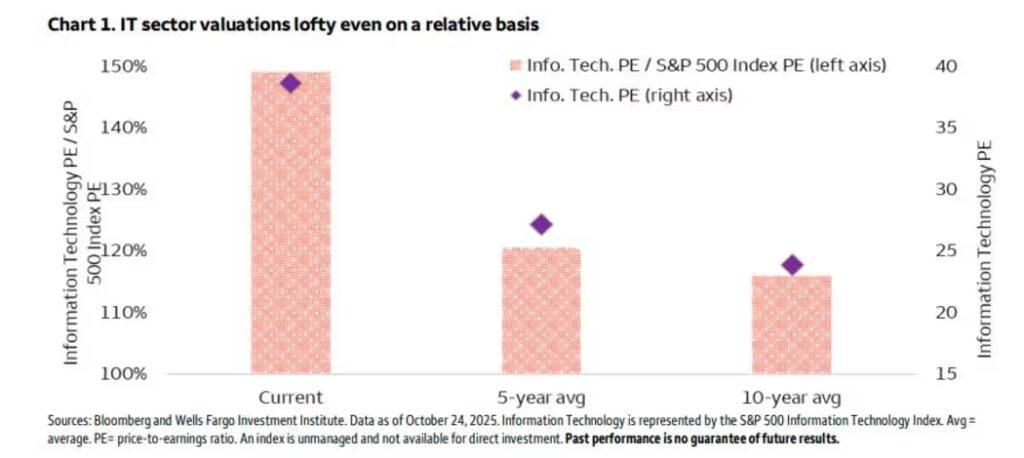
Wells Fargo Warns: Tech Sector’s Sky-High Expectations Could Lead to Trouble The AI trade — powered by heavyweights like Nvidia — bounced back to start the week, but renewed concerns over CoreWeave are cooling the excitement. Investors now find themselves torn between chasing the AI boom and fearing another bubble, reminiscent of the dot-com era. That uneasy balance prompted the Wells Fargo Investment Institute (WFII) to downgrade the S&P 500 Information Technology sector — home to Nvidia, Microsoft, Broadcom, and other AI leaders — from favorable to neutral. The main reason: valuations have gotten too rich. According to Douglas Beath, WFII’s global investment strategist, the sector surged nearly 60% since April, outperforming the broader S&P 500 by over 25%. While AI momentum continues to drive sales, profits, and cash flow, Beath warns that overly optimistic sentiment makes the sector susceptible to disappointment if earnings results fall even slightly short of expectations. Beath also points to lingering U.S.–China trade tensions and growing concerns over the payoff from massive AI capital spending. Investors are becoming uneasy about whether these record-level investments will deliver the returns needed to justify lofty stock prices. Although a correction may be temporary, WFII advises taking some profits and trimming tech exposure back to market weight. Instead, the firm recommends rotating into industrials, utilities, and financials — three sectors that can still benefit from the AI infrastructure boom but come with more reasonable valuations. In Beath’s view, the message is clear: AI’s growth story remains intact — but investors may want to cool their enthusiasm for tech stocks. John PaulJohn Paul is the founder of DayTradeToWin, a trading education and software company established in 2008, supporting traders worldwide. His expertise focuses on price action-based futures trading strategies and structured market analysis. DayTradeToWin delivers trading education, indicators, and software tools designed to help traders apply disciplined, rule-based decision-making across global futures markets. He is the creator of multiple trading methodologies, including the Sonic System, Atlas Line, and Trade Scalper, which help traders identify structured opportunities in markets such as the E-mini S&P 500 (ES), Nasdaq (NQ), crude oil (CL), and gold (GC). Official website: https://daytradetowin.com daytradetowin.com

Scroll to Top