
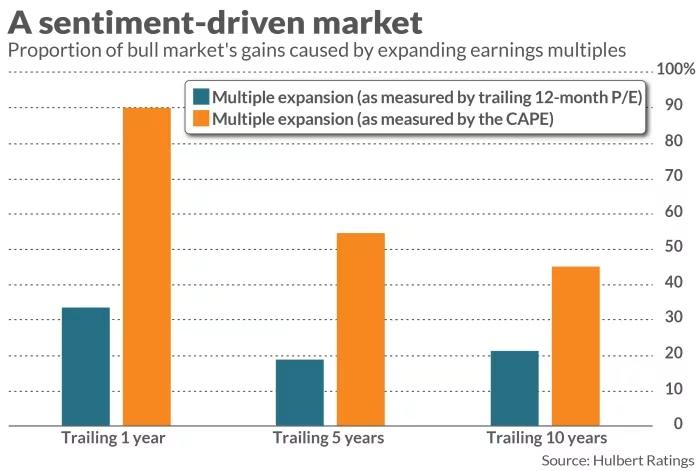
Currently, the market appears to be sentiment-driven, leaving the bulls on shaky ground. The S&P 500 performance over the past five years provides a telling example.
A Bull Market Backed by Earnings is Stronger Than One Fueled by Emotion
A bull market rooted in earnings growth offers a far sturdier foundation than one driven by investor sentiment. Recent market volatility underscores this point. For instance, on Nov. 19, the Dow Jones Industrial Average (DJIA) plunged over 400 points shortly after the opening bell, only to recover and end the day nearly unchanged. Such erratic swings defy fundamental analysis and instead highlight the unpredictable nature of investor emotions.
If the index had risen in line with earnings per share, it would be below 4,500—around 25% lower than its current level. Instead, the S&P 500 sits above 5,900, a climb largely attributable to a significant expansion in price-to-earnings (P/E) ratios rather than proportional earnings growth.
Earnings Growth vs. Sentiment
The driving force behind market gains—earnings or sentiment—often depends on the time frame of analysis. David Rosenberg, founder of Rosenberg Research, highlights this dynamic, noting that U.S. stocks have climbed 41% over the past year despite earnings growing by just 4%. Without the expansion of P/E multiples during this period, Rosenberg estimates the S&P 500 would be closer to 4,600.
Different methods of calculating earnings can yield slightly varied perspectives, whether focusing on trailing 12 months, forward 12 months, or the inflation-adjusted 10-year averages used in Robert Shiller’s Cyclically Adjusted Price/Earnings (CAPE) ratio. However, the conclusion remains consistent: the recent bull market has leaned heavily on expanding P/E multiples.
The Interest Rate Factor
This reliance on inflated P/E ratios is even riskier in today’s rising interest rate environment. Historically, P/E multiples tend to shrink when interest rates rise due to discounted cash flow models, which lower the present value of future earnings. Yet, despite the 10-year U.S. Treasury yield more than doubling over the past five years, P/E ratios have expanded significantly.
If interest rates had steadily declined over this period, the increase in P/E multiples might seem more sustainable. Instead, the current market dynamic heightens vulnerability, as higher interest rates and an over-reliance on sentiment create a precarious situation.
The Takeaway
Investor sentiment is inherently volatile, leaving the stock market prone to sharp fluctuations like those seen earlier this week—or worse. A bull market grounded in robust earnings growth would offer far greater stability than one propped up by the unpredictable whims of investor emotions.

John Paul is the founder of DayTradeToWin, a trading education and software company established in 2008, supporting traders worldwide. His expertise focuses on price action-based futures trading strategies and structured market analysis.
DayTradeToWin delivers trading education, indicators, and software tools designed to help traders apply disciplined, rule-based decision-making across global futures markets.
He is the creator of multiple trading methodologies, including the Sonic System, Atlas Line, and Trade Scalper, which help traders identify structured opportunities in markets such as the E-mini S&P 500 (ES), Nasdaq (NQ), crude oil (CL), and gold (GC).
Official website: https://daytradetowin.com