
Concerns that central banks will eventually print money to erode the real value of government debt remain the primary force behind gold surge, while geopolitical tensions are reinforcing its safe-haven appeal.
Gold’s move to a new record high signals the return of the so-called “great debasement trade,” according to Robin Brooks, senior economist at the Brookings Institution and former chief currency strategist at Goldman Sachs. His remarks came as bullion climbed above $4,400 an ounce.
In a Substack post, Brooks said the rally reflects the Federal Reserve’s recent rate cut and growing fears of debt monetization — the risk that central banks will absorb government bond issuance.
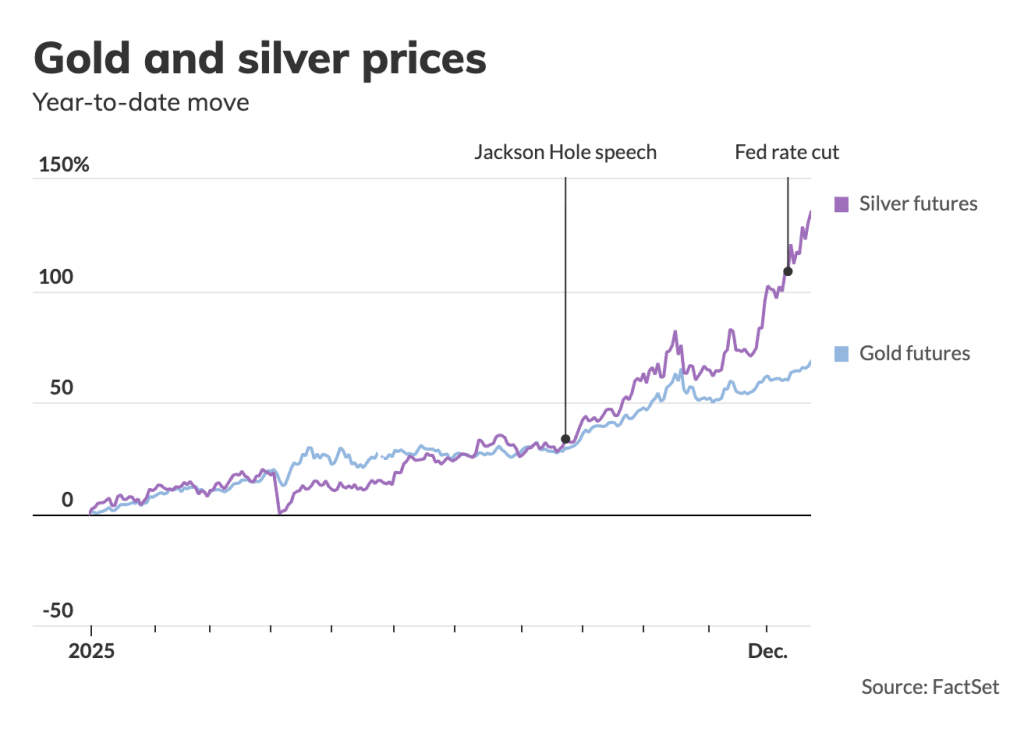
Gold is now up 68% in 2025, while silver, driven by many of the same dynamics, has surged 140% after also setting a fresh high this week.
Geopolitical risks have added further momentum. Escalating tensions in Venezuela and Ukrainian attacks on Russian ports and shipping have heightened gold’s appeal as a store of value.
Brooks traces the breakout in precious metals to Chair Jerome Powell’s dovish Jackson Hole speech on Aug. 22 and the Fed’s 25-basis-point rate cut on Dec. 10. Markets are now pricing in further easing by the central bank.
He argues that the debasement trade is spreading beyond precious metals. Currencies with relatively low debt burdens, including the Swedish krona and the Swiss franc, are increasingly moving in line with gold and silver. A comparison of G10 currencies against the dollar shows rising correlations with precious metals.
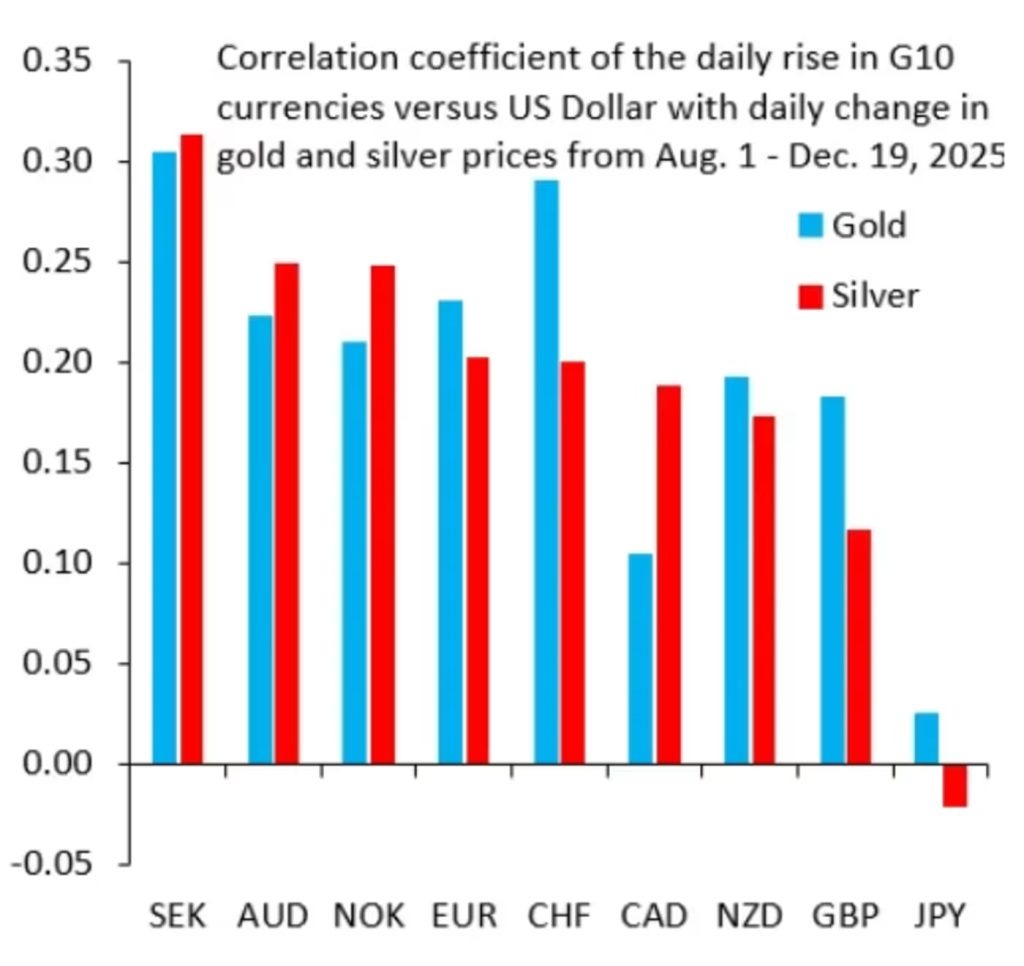
The krona’s strength, Brooks notes, is particularly striking given its history as a volatile currency rather than a traditional safe haven. He also cautions that the dollar’s apparent stability is misleading, as its strength against the weak Japanese yen masks broader softness against a wider basket of currencies.
Jeroen Blokland, economist and manager of the Blokland Smart Multi-Asset Fund, highlights the ongoing Japanese yen carry trade as another pillar supporting gold. Investors continue to fund positions in higher-risk assets by borrowing yen, with precious metals among the favored destinations.
Blokland wrote on X that last week’s Bank of Japan rate hike — taking policy rates to 0.75%, the highest since 1995 — has failed to unwind the carry trade. Inflation is likely to remain structurally elevated, while the interest-rate gap between Japan and the U.S. remains wide enough to sustain yen-funded trades.
Japanese 10-year government bond yields have continued to climb and have nearly doubled this year, reaching around 2.08%.

John Paul is the founder of DayTradeToWin, a trading education and software company established in 2008, supporting traders worldwide. His expertise focuses on price action-based futures trading strategies and structured market analysis.
DayTradeToWin delivers trading education, indicators, and software tools designed to help traders apply disciplined, rule-based decision-making across global futures markets.
He is the creator of multiple trading methodologies, including the Sonic System, Atlas Line, and Trade Scalper, which help traders identify structured opportunities in markets such as the E-mini S&P 500 (ES), Nasdaq (NQ), crude oil (CL), and gold (GC).
Official website: https://daytradetowin.com