
Market News

markets
Market News

Why Are Markets Rising Amid Recession Fears?

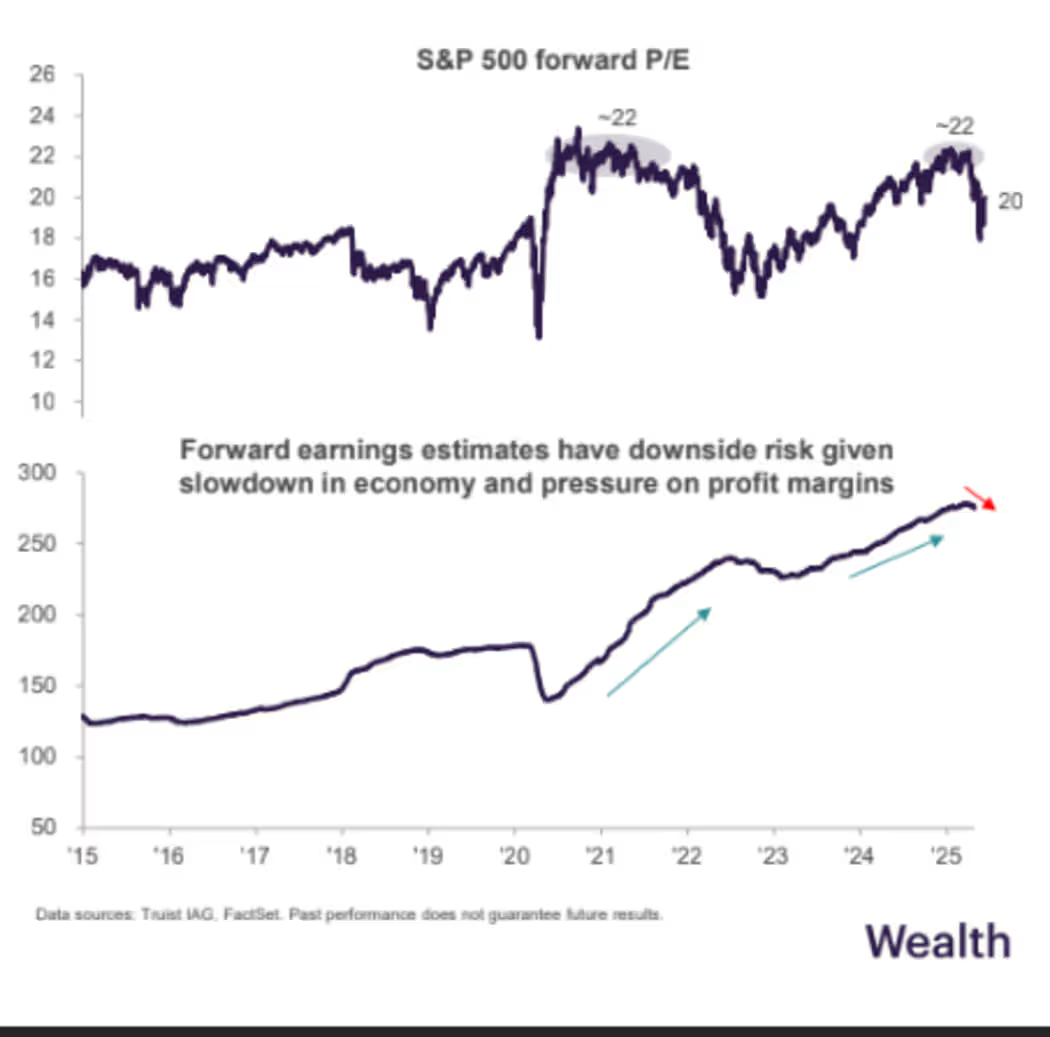
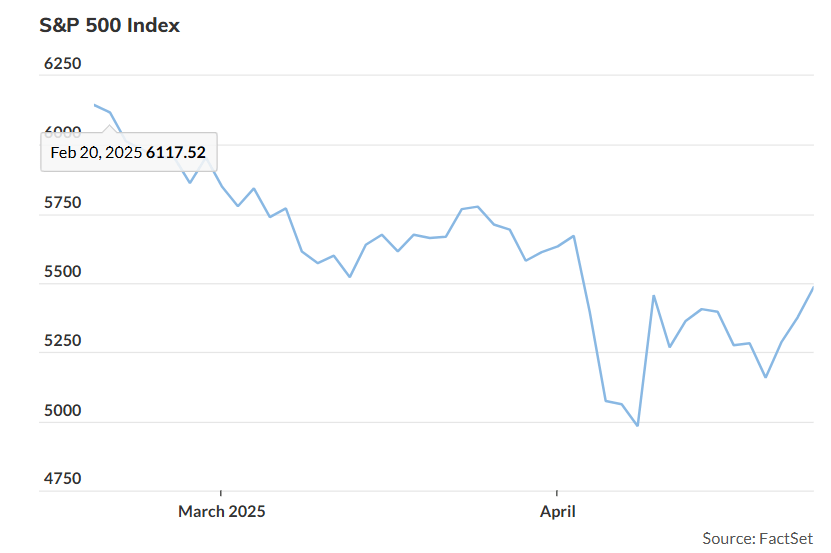
Markets Rebound Despite Recession Fears as Trump Pushes Trade and Tax Reforms Treasury Secretary Scott Bessent said Tuesday that President Donald Trump is making meaningful progress on trade deals and a new tax bill — developments that have offered some relief to investors as April’s volatility winds down. Optimism around potential pro-growth policies has helped the S&P 500 log its longest streak of gains since November, despite lingering concerns. However, Trump’s tariffs announced on April 2, and partially paused on April 8, rattled global markets and deepened anxiety among U.S. businesses and households. The moves triggered stock market turbulence and raised fears of a potential recession. Luke Tilley, chief economist at Wilmington Trust, said his team shifted to a “recession as baseline” outlook on April 9. He noted that even if the new tariffs are rolled back, overall import duties remain elevated compared to historical norms. Wilmington now puts the odds of a recession at 60% within the next year, expecting it to be short and shallow. So why the rally in stocks? Investors appear to be looking past short-term volatility, betting that the worst may already be priced in. Tilley pointed out that in past recessions, the S&P 500 has fallen around 20% on average — roughly in line with recent losses — and typically recovers within 11 months. As of April 8, the index was down 18.9% from its February 19 high, and 21.3% on an intraday basis when including April 7. Still, the market’s ability to bounce back quickly has given some investors confidence. Yet challenges remain. The S&P 500 is down 7.3% over Trump’s first 100 days in office — the worst showing since Nixon’s second term. Meanwhile, Bessent has warned that markets need to “detox” from pandemic-era stimulus after years of outsized gains. Adding to the uncertainty is the drop in the S&P 500’s price-to-earnings ratio — from 22x at the end of last year to below 20x — driven by doubts over Trump’s policies and competition from China’s AI advancements. “It’s hard to justify a return to 22x valuations amid slowing earnings, weaker economic data, and rising uncertainty,” said Keith Lerner of Truist Advisory Services. Still, markets found footing Tuesday. The Dow rose 300 points (0.8%), while the S&P 500 and Nasdaq both gained 0.6%, according to FactSet. John PaulJohn Paul is the founder of DayTradeToWin, a trading education and software company established in 2008, supporting traders worldwide. His expertise focuses on price action-based futures trading strategies and structured market analysis. DayTradeToWin delivers trading education, indicators, and software tools designed to help traders apply disciplined, rule-based decision-making across global futures markets. He is the creator of multiple trading methodologies, including the Sonic System, Atlas Line, and Trade Scalper, which help traders identify structured opportunities in markets such as the E-mini S&P 500 (ES), Nasdaq (NQ), crude oil (CL), and gold (GC). Official website: https://daytradetowin.com daytradetowin.com
consumer
Market News

Is Consumer Fear Trump’s Economic Weak Link?

Consumer Confidence Takes Historic Nosedive in Trump’s Early Months Amid Tariff Fears President Donald Trump’s return to the White House has been marked by a steep and sudden decline in consumer confidence—falling faster than at any time since the 1990 recession. Daniella Knight, a mother of three from Annapolis, Maryland, says she’s already feeling the pressure. “I’m terrified,” she said, worried that Trump’s tariffs will drive up everyday prices. “Politicians won’t feel it if the price of milk or electronics goes up—but families like mine will.” Despite campaigning on promises to revive the economy and ease financial stress, Trump’s early economic moves—especially sweeping tariffs—have rattled markets and fueled anxiety. Polls show that many Americans feel worse off than they did when Trump took office just months ago. Consumer sentiment has dropped sharply, with Americans increasingly pessimistic about their finances, job prospects, and the broader economy. Many are cutting back on spending, skipping large purchases, and tightening household budgets—moves that are already being felt by businesses. “Sentiment across consumers, investors, and businesses is down, and that matters,” said Mark Zandi, chief economist at Moody’s Analytics. “That kind of uncertainty will weaken the economy.” According to University of Michigan’s long-running consumer sentiment survey, expectations have dropped around 30 points since January—the steepest early-term drop for a president in more than three decades. “This isn’t a normal post-election fluctuation,” said Joanne Hsu, the survey’s director. “It’s a major decline.” Tariffs are a recurring concern among respondents, even though they aren’t directly mentioned in survey questions. While some tariffs have been paused, others—such as a 10% baseline tariff on many imports—remain in place, adding to consumer uncertainty. Gallup recently found a record 53% of Americans say their financial situation is worsening—surpassing the peak pessimism of the early pandemic. And Fed data shows fewer people expect financial improvement, with more anticipating decline. The political divide is stark: Republicans, buoyed by Trump’s return, now report far more confidence than during the Biden years. But even among Trump voters, worry is growing. Support for tariffs among Republicans has dipped slightly, while opposition has risen. Still, the White House remains optimistic. “President Trump’s policies created historic economic growth during his first term, and we’re doing it again,” said spokesman Kush Desai. But signs of strain are mounting. Retailers and homebuyers are pulling back. Redfin reports one in four Americans are canceling major purchases due to tariff-related uncertainty. Airlines and major brands like Chipotle and Procter & Gamble are lowering expectations as consumer spending slows. Mortgage delinquencies are on the rise, especially among first-time and lower-income buyers. Job security fears are also increasing: nearly a third of workers say they’re worried about layoffs, according to recent surveys. “People make decisions based on what they think is coming,” said Hsu. “If they don’t feel confident, they stop spending—and that drives the economy.” For Knight, the outlook is clear: “I’m already trying to find ways to cut back, but with kids, that’s not easy. Prices are rising, and it feels like there’s no safety net.” John PaulJohn Paul is the founder of DayTradeToWin, a trading education and software company established in 2008, supporting traders worldwide. His expertise focuses on price action-based futures trading strategies and structured market analysis. DayTradeToWin delivers trading education, indicators, and software tools designed to help traders apply disciplined, rule-based decision-making across global futures markets. He is the creator of multiple trading methodologies, including the Sonic System, Atlas Line, and Trade Scalper, which help traders identify structured opportunities in markets such as the E-mini S&P 500 (ES), Nasdaq (NQ), crude oil (CL), and gold (GC). Official website: https://daytradetowin.com daytradetowin.com
S&P 500
Market News

S&P 500 Stalling? Turn to Oversold Stocks Instead

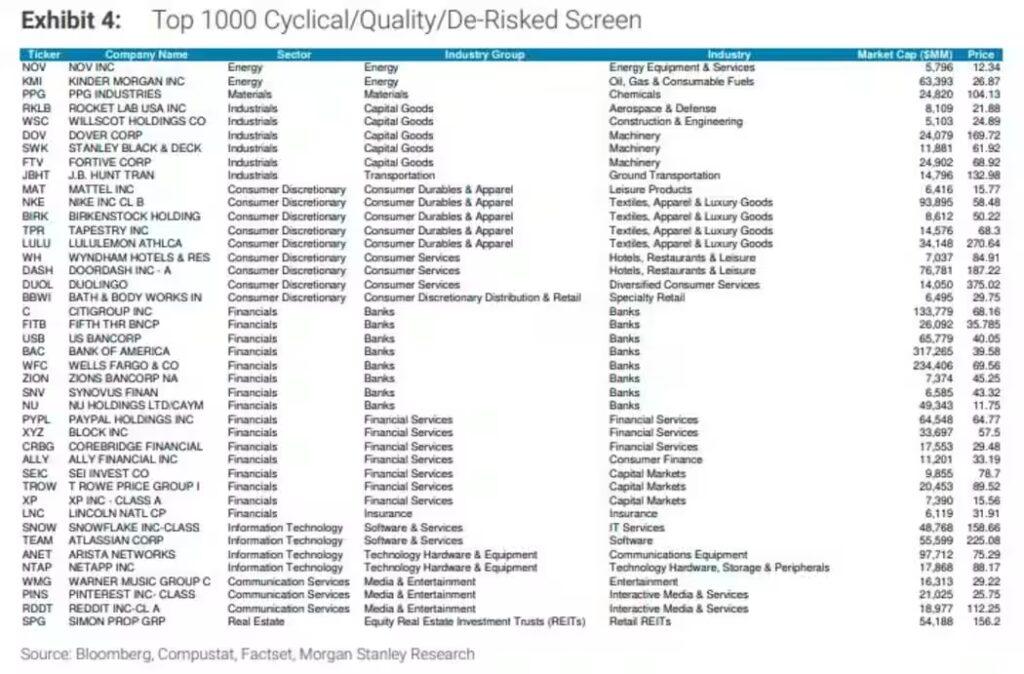
Morgan Stanley: Stick with High-Quality Cyclical Stocks as Market Remains Rangebound As the S&P 500 continues to trade sideways, Morgan Stanley strategists are advising investors to focus on high-quality cyclical stocks that have already priced in a potential slowdown in both earnings and economic growth. Led by Mike Wilson, the team at Morgan Stanley notes that the S&P 500 remains trapped between 5,000 and 5,500. While they see the next resistance between 5,600 and 5,650, they don’t expect a meaningful breakout until several catalysts materialize: a significant U.S.-China tariff reduction (currently at 145%), clear signs of Fed interest-rate cuts, a drop in the 10-year Treasury yield below 4.0%, and a strong rebound in corporate earnings revisions. Markets are facing a critical week of data releases. Wilson and his team point to Friday’s nonfarm payrolls report and Thursday’s ISM manufacturing survey as key events. A swing in ISM data — expected between 46 and 48 — could significantly move stocks. While some slowdown has been priced into equities, the risk of a broader labor market downturn or mild recession has not, they warned. Sustained stability in labor data over several months would be needed to ease those concerns. In the meantime, Morgan Stanley recommends a balanced approach: maintaining defensive exposure while selectively adding to high-quality cyclical stocks that have already adjusted to weaker conditions. Their definition of “quality” includes companies with strong management teams, consistently high returns, and healthy balance sheets. “Cyclicals” are companies whose earnings closely track economic growth. To help guide investors, the strategists screened the top 1000 U.S. stocks by market capitalization, focusing on those rated overweight or equal weight by Morgan Stanley, considered cyclical, and deemed less risky based on several valuation and performance metrics. The top five stocks from their screen are: Other notable mentions include Mattel, Nike, and several bank stocks. Overall, Wilson and his team prefer U.S. equities to international ones, citing a weaker dollar that should support U.S. earnings more than those in Europe or Japan. With earnings less volatile and a bias toward higher quality, they see the U.S. market as better positioned in today’s late-cycle environment. John PaulJohn Paul is the founder of DayTradeToWin, a trading education and software company established in 2008, supporting traders worldwide. His expertise focuses on price action-based futures trading strategies and structured market analysis. DayTradeToWin delivers trading education, indicators, and software tools designed to help traders apply disciplined, rule-based decision-making across global futures markets. He is the creator of multiple trading methodologies, including the Sonic System, Atlas Line, and Trade Scalper, which help traders identify structured opportunities in markets such as the E-mini S&P 500 (ES), Nasdaq (NQ), crude oil (CL), and gold (GC). Official website: https://daytradetowin.com daytradetowin.com
sonic
Market News

Today’s Winning Trade Recap: Sonic System

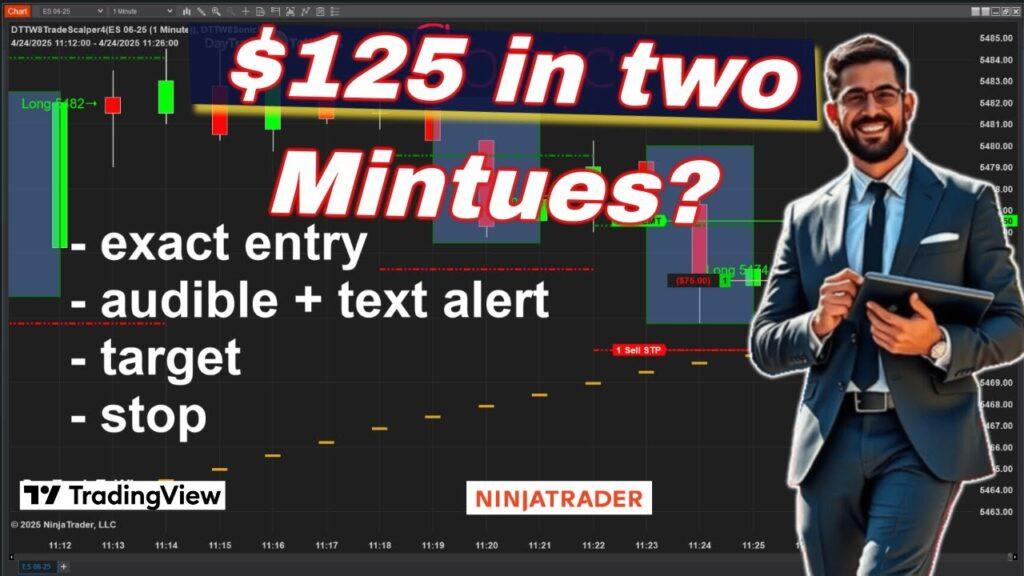
Today we’re continuing our journey with the powerful Sonic Trading System. As always, a quick reminder: trading involves risk. Only trade with money you can afford to lose. If you’re a member of Day Trade to Win, make sure to join our live trading room where we showcase real-time signals and much more! 📈 Live Signal: Long Opportunity Today, we received a live long signal at 5474.25. Here’s the setup: The Sonic system does the heavy lifting by automatically placing stops and targets. All you need to do is follow the signals.We recommend using a limit order to avoid slippage, but market-if-touched or even market entries can also work depending on your style. A little patience today could have even snagged a better price! 📊 Trading Approach: Keep It Simple For today’s trades, I’m using a 1-minute E-mini S&P chart.The Sonic system also performs great on: Pro Tip:If you’re just starting, trade the Micro E-mini first. It’s a smart way to get comfortable before moving into bigger markets. The Sonic system is available on both NinjaTrader and TradingView platforms. Plus, every user gets access to live training sessions, where we dive deep into settings, entry techniques, and strategies for best results. 📈 How Many Trades Should You Take? Success isn’t just about spotting signals — it’s about knowing when to stop. ✅ We typically aim for 5–6 trades per day.✅ Today, we’ve already seen five or six consecutive winners! Quick Tip:If you spot one or two winning trades in a row, it often signals strong momentum. That’s your green light to enter smartly. I also prefer to keep trades quick—about 10 to 15 minutes—depending on the market conditions. 🚀 Take Your Trading to the Next Level Not a member yet? Now’s the perfect time!Create your free account at DayTradeToWin.com and unlock: Skip the outdated indicators. Learn to trade the right way—with pure price action.Let’s get you ready for success in our next training session! Until then, Good Trading! John PaulJohn Paul is the founder of DayTradeToWin, a trading education and software company established in 2008, supporting traders worldwide. His expertise focuses on price action-based futures trading strategies and structured market analysis. DayTradeToWin delivers trading education, indicators, and software tools designed to help traders apply disciplined, rule-based decision-making across global futures markets. He is the creator of multiple trading methodologies, including the Sonic System, Atlas Line, and Trade Scalper, which help traders identify structured opportunities in markets such as the E-mini S&P 500 (ES), Nasdaq (NQ), crude oil (CL), and gold (GC). Official website: https://daytradetowin.com daytradetowin.com

S&P 500
Market News

Trump Reversals Spark S&P 500 Rebound

What It Will Take for the S&P 500 to Reclaim Record Highs—and for Other Indexes to Recover Wall Street isn’t known for subtle reactions, and the recent market swings are a case in point. The S&P 500 rallied sharply on Thursday, officially climbing out of correction territory by closing more than 10% above its April 8 low—reached shortly after President Trump’s April 2 tariff announcement, which rattled global markets. That low marked the bottom of a sharp selloff driven by renewed trade tensions and fears of economic fallout. A key turning point came when the Trump administration paused new tariffs for most countries (excluding China), calming market nerves. From that April low to Thursday’s close, the S&P 500 recovered an eye-popping $4.253 trillion in market value, according to Dow Jones Market Data. Still, the index remains 10.7% below its February record high, and broader uncertainty continues to hang over the markets. Jamie Cox, managing partner at Harris Financial Group, attributed much of the volatility to the surge and subsequent decline in the Cboe Volatility Index (VIX)—Wall Street’s “fear gauge”—which soared above 50 during the worst of the selloff but has since retreated to around 20. “When volatility unwinds, stocks tend to rebound just as dramatically,” he noted. Adding to the bullish momentum was Trump’s recent softening tone toward Federal Reserve Chair Jerome Powell, saying he doesn’t plan to remove him before his term ends in 2026. That reassurance helped settle investor jitters about central bank independence. Pimco’s Libby Cantrill and Tiffany Wilding cautioned in a client note that firing Powell could actually hinder Trump’s goal of lower interest rates. Markets seemed to agree, as the 10-year Treasury yield fell six basis points Thursday to 4.32%, following its largest weekly move since 1987 just two weeks ago. “The Fed’s direction weighs heavily on markets,” said Cox. “Removing uncertainty around Powell is a big stabilizing factor.” Looking ahead, Cox said that progress on trade deals and a cooling of Fed tensions could help push stocks back toward record highs. With Congress returning next week, a breakthrough on budget negotiations and the debt ceiling could further lift investor confidence. Still, much hinges on how the global trade landscape evolves. Cox expects negotiations with China to drag on, while deals with Europe and others may come together more quickly. Where the major indexes stand now: John PaulJohn Paul is the founder of DayTradeToWin, a trading education and software company established in 2008, supporting traders worldwide. His expertise focuses on price action-based futures trading strategies and structured market analysis. DayTradeToWin delivers trading education, indicators, and software tools designed to help traders apply disciplined, rule-based decision-making across global futures markets. He is the creator of multiple trading methodologies, including the Sonic System, Atlas Line, and Trade Scalper, which help traders identify structured opportunities in markets such as the E-mini S&P 500 (ES), Nasdaq (NQ), crude oil (CL), and gold (GC). Official website: https://daytradetowin.com daytradetowin.com

gold
Market News

Gold Hit Hard: Bull Run Ending?

Gold Suffers Sharpest Drop Since 2021 as Trade Tensions Ease and Fed Uncertainty Fades Gold prices saw their steepest single-day drop in nearly four years on Wednesday, as a shift in U.S. trade policy rhetoric and reduced fears over the Federal Reserve’s leadership deflated the metal’s momentum. After a blistering rally that saw gold top $3,500 an ounce earlier this week, prices tumbled $125.30, or 3.7%, to close at $3,294.10 — the biggest one-day percentage drop since June 2021, according to Dow Jones Market Data. Tuesday’s session had already hinted at weakness, with gold futures pulling back from a record intraday high of $3,509.90 to settle at $3,419.40. The decline followed signs that the White House may ease tariffs on Chinese imports, according to reports, and a softening stance from former President Trump toward Fed Chair Jerome Powell. That double shift eased fears that had fueled gold’s rally and reduced demand for the metal as a safe-haven asset. “Gold’s been riding the trade-war narrative, and that leg just got wobbly,” said Stephen Innes, managing partner at SPI Asset Management. He added that the rally had been driven more by headlines and speculation than fundamentals, and with those headlines cooling, the rally is deflating fast. Jonathan Krinsky of BTIG noted that gold had climbed to more than 27% above its 200-day moving average — a historically extreme level that often signals overbought conditions and a potential “blow-off” top. When that threshold has been reached in the past, gold has typically pulled back toward its average in the following months. Despite the sharp correction, many analysts see this as a healthy pause rather than a definitive peak. “There’s nothing indicating that $3,500 is a hard top,” said Michael Armbruster of Altavest. “We’re still in an uptrend — this looks like a standard correction within a bull market.” Jim Wyckoff of Kitco.com agreed, suggesting the rally may be near the end of its cycle in terms of timing, but not necessarily in price. “Markets often experience larger swings near the end of a bull phase, but gold could still surprise to the upside before it’s over.” Gold had been on a tear since 2022, rising from around $1,600 an ounce on the back of geopolitical turmoil, high inflation, and fears over global economic stability. Even after this week’s drop, the metal remains up significantly, with gains of over 25% year to date. “This correction doesn’t change the underlying bullish thesis,” said Trevor Yates, senior investment analyst at Global X ETFs. “It’s more about investor positioning than any shift in fundamentals.” He noted continued demand from central banks and ongoing economic uncertainty as key supports for gold. With the metal still outperforming equities in 2025 and broader market volatility persisting, analysts suggest the recent dip may offer a strategic entry point for long-term investors John PaulJohn Paul is the founder of DayTradeToWin, a trading education and software company established in 2008, supporting traders worldwide. His expertise focuses on price action-based futures trading strategies and structured market analysis. DayTradeToWin delivers trading education, indicators, and software tools designed to help traders apply disciplined, rule-based decision-making across global futures markets. He is the creator of multiple trading methodologies, including the Sonic System, Atlas Line, and Trade Scalper, which help traders identify structured opportunities in markets such as the E-mini S&P 500 (ES), Nasdaq (NQ), crude oil (CL), and gold (GC). Official website: https://daytradetowin.com daytradetowin.com

Scroll to Top