
Market News

dollar
Market News

U.S. Dollar on Thin Ice

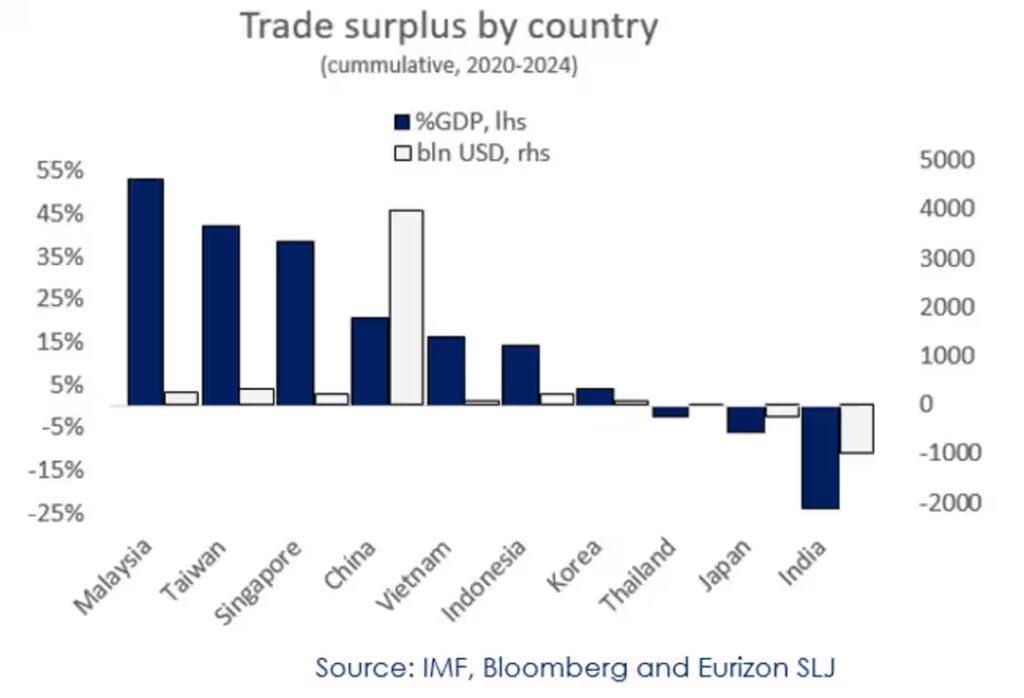
Taiwan Dollar’s Surge May Foreshadow a Sharp Decline in the U.S. Dollar, Analyst Warns A sudden spike in the Taiwan dollar could be an early sign of a much larger, disorderly drop in the U.S. dollar, according to Stephen Jen, CEO and co-CIO of Eurizon SLJ Capital. Jen, a veteran currency strategist, has warned since 2022 of a potential “avalanche”-like selloff in the greenback. In a new report with co-author Joana Freire, he suggests that recent currency movements in Asia — particularly the Taiwan dollar’s surge — may signal that such a scenario is unfolding. “We believe the risk of investors being blindsided by a sudden, non-linear selloff in the dollar is rising,” Jen and Freire wrote. “The Taiwan dollar’s sharp move is one example. We expect others to follow.” Their concern stems from a buildup of over $2.5 trillion in U.S. dollar reserves across key Asian exporters including China, Taiwan, Malaysia, and Vietnam. Much of this capital is held in liquid instruments not reflected in standard investment flow data. If even a portion of these holdings is sold, it could trigger a sharp drop in the dollar’s value. Jen notes that these countries are well aware the dollar is overvalued — a view that could accelerate selling if confidence erodes. Additional risks include a potential rebound in China’s economy and anticipated interest-rate cuts by the Federal Reserve in 2025, which could further weaken the dollar. While the Fed is not expected to cut rates immediately, markets are pricing in 75 basis points of easing next year. At the same time, U.S. dollar reserves held by foreign central banks have been declining for years. A second Trump presidency, with its focus on tariffs and currency policy, could add more pressure on foreign holders to reduce exposure. Jen sees China as the most immediate threat. The People’s Bank of China has so far kept the yuan stable against the dollar, even as the greenback has fallen over 8% this year, according to the ICE U.S. Dollar Index (DXY). But if Beijing allows the yuan to appreciate — possibly in response to U.S. accusations of currency manipulation — it could trigger broader dollar weakness. “The dollar overhang is just too large,” Jen and Freire warned. “If the Fed cuts, the dollar weakens, and China rebounds, the stage is set for an avalanche.” The dollar’s recent 9% drop against the Taiwan dollar — the largest move in that currency pair since at least 2007 — has revived speculation that foreign investors may be reducing their U.S. asset exposure. Other Asian currencies, like the South Korean won, also saw gains. Still, some remain skeptical. Analysts at Barclays argue the Taiwan dollar’s rally is overdone and say large Taiwanese insurers are unlikely to sell dollar assets at a loss, just as they avoided doing so in 2022. Though Treasury yields spiked last week, some economists attribute that to a strong April jobs report rather than foreign selling. However, Deutsche Bank data shows Taiwan-based ETFs recently offloaded U.S. fixed-income assets, hinting that the shift may already be underway. For now, Jen and his team are watching closely — waiting to see whether the dollar’s long-feared avalanche has indeed begun. John PaulJohn Paul is the founder of DayTradeToWin, a trading education and software company established in 2008, supporting traders worldwide. His expertise focuses on price action-based futures trading strategies and structured market analysis. DayTradeToWin delivers trading education, indicators, and software tools designed to help traders apply disciplined, rule-based decision-making across global futures markets. He is the creator of multiple trading methodologies, including the Sonic System, Atlas Line, and Trade Scalper, which help traders identify structured opportunities in markets such as the E-mini S&P 500 (ES), Nasdaq (NQ), crude oil (CL), and gold (GC). Official website: https://daytradetowin.com daytradetowin.com

amd
Market News

AMD’s Move Amid Rising Trade Tensions

AMD Projects Strong Growth in 2025 Despite Economic and Regulatory Pressures Advanced Micro Devices Inc. (AMD) expects strong growth this year, bolstered by its expanding product lineup, even as it navigates a challenging macroeconomic climate and new U.S. export restrictions targeting sales to China. During AMD’s fiscal first-quarter earnings call, CEO Lisa Su said that while the global environment remains “dynamic,” the company is well-positioned to outperform due to the strength of its product portfolio. Su noted that restrictions on the export of its Instinct MI308X accelerators to China are expected to be offset by momentum in its core computing and AI businesses. The company anticipates double-digit revenue growth in 2025, driven by increased market share for its new “Zen 5” Epyc and Ryzen CPUs, as well as its Radeon GPUs. Su also confirmed AMD plans to scale up production of its next-gen Instinct MI350 AI accelerators in the second half of the year. “We see the current environment as a strategic opportunity to further differentiate AMD,” Su said. “Our growing portfolio combines leadership in compute and AI across data centers, PCs, edge, and embedded applications.” AMD reported first-quarter revenue of $7.4 billion—up 36% year-over-year and above the $7.1 billion expected by analysts. Adjusted earnings per share came in at 96 cents, topping Wall Street’s estimate of 94 cents. The company’s stock rose 1.8% in after-hours trading, though it remains down roughly 18% year to date. Data center revenue reached $3.7 billion, a 57% year-over-year increase, driven by strong sales of Epyc CPUs and Instinct GPUs. Su said the company delivered a strong start to 2025, marking the fourth straight quarter of accelerating annual growth. For the current quarter, AMD expects revenue of approximately $7.4 billion, plus or minus $300 million—above the $7.2 billion projected by analysts. However, it anticipates adjusted gross margins of around 43%, factoring in $800 million in charges related to compliance with the new export control rules. Elsewhere, AMD’s client segment posted a 68% jump in revenue to $2.3 billion on strong Ryzen demand, while gaming revenue declined 30% to $647 million due to lower semicustom product sales. John PaulJohn Paul is the founder of DayTradeToWin, a trading education and software company established in 2008, supporting traders worldwide. His expertise focuses on price action-based futures trading strategies and structured market analysis. DayTradeToWin delivers trading education, indicators, and software tools designed to help traders apply disciplined, rule-based decision-making across global futures markets. He is the creator of multiple trading methodologies, including the Sonic System, Atlas Line, and Trade Scalper, which help traders identify structured opportunities in markets such as the E-mini S&P 500 (ES), Nasdaq (NQ), crude oil (CL), and gold (GC). Official website: https://daytradetowin.com daytradetowin.com
market
Market News

Stock Market Rally at Risk After Tariff Reversal

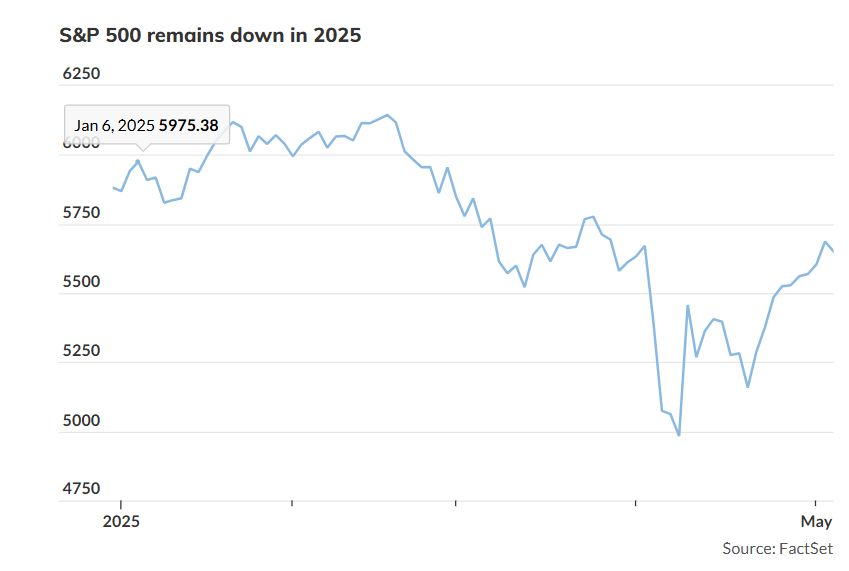
Sevens Report Warns of Potential ‘Sell-the-News’ Market Reaction Amid Trade Optimism The U.S. stock market may struggle to extend recent gains—even if new trade deals are announced—because much of the tariff relief has already been priced in, according to Sevens Report Research. “We could even see a ‘sell-the-news’ move once some trade deals are announced,” warned Tom Essaye, founder of Sevens Report Research, in a note Monday. He noted that the Trump administration has significantly scaled back its sweeping April 2 “liberation day” tariff plan, delaying implementation and exempting key sectors like semiconductors, electronics, pharmaceuticals, and autos. The S&P 500 fell 0.6% on Monday to 5,650.38 after logging a nine-day winning streak, the longest since 2004. But despite the recovery from early April losses, Essaye remains skeptical that current momentum can continue. “The recent developments aren’t enough to push the S&P 500 sustainably higher,” he said, maintaining a target range of 5,100 to 5,500. Investors have closely tracked trade negotiations, concerned that higher tariffs will weigh on growth and raise consumer costs. While easing tensions with China have buoyed sentiment, Essaye cautioned that risks remain. “Tariffs will still be significantly higher than they were at the start of the year, and that’s a headwind,” he said. The S&P 500 has trimmed earlier losses but remains down 3.9% year-to-date after April marked its third straight monthly decline. Broader indexes, including the Nasdaq and Dow, also ended lower on Monday. “Economic data has been solid, but we haven’t felt the real impact of tariffs yet,” Essaye said. “The risk to growth is clearly to the downside.” In this environment, he favors defensive market sectors such as utilities, consumer staples, and healthcare. He also recommends diversification through equal-weighted and low-volatility ETFs, such as the Invesco S&P 500 Equal Weight ETF (RSP), the iShares MSCI USA Min Vol Factor ETF (USMV), and the iShares MSCI USA Quality Factor ETF (QUAL). “While the past month hasn’t been as bad as feared, ‘not as bad’ isn’t the same as good,” Essaye concluded. “Markets may be pricing in more strength than the fundamentals currently support.” John PaulJohn Paul is the founder of DayTradeToWin, a trading education and software company established in 2008, supporting traders worldwide. His expertise focuses on price action-based futures trading strategies and structured market analysis. DayTradeToWin delivers trading education, indicators, and software tools designed to help traders apply disciplined, rule-based decision-making across global futures markets. He is the creator of multiple trading methodologies, including the Sonic System, Atlas Line, and Trade Scalper, which help traders identify structured opportunities in markets such as the E-mini S&P 500 (ES), Nasdaq (NQ), crude oil (CL), and gold (GC). Official website: https://daytradetowin.com daytradetowin.com

fed
Market News

Lower Your Fed Hopes, Trump and Investors

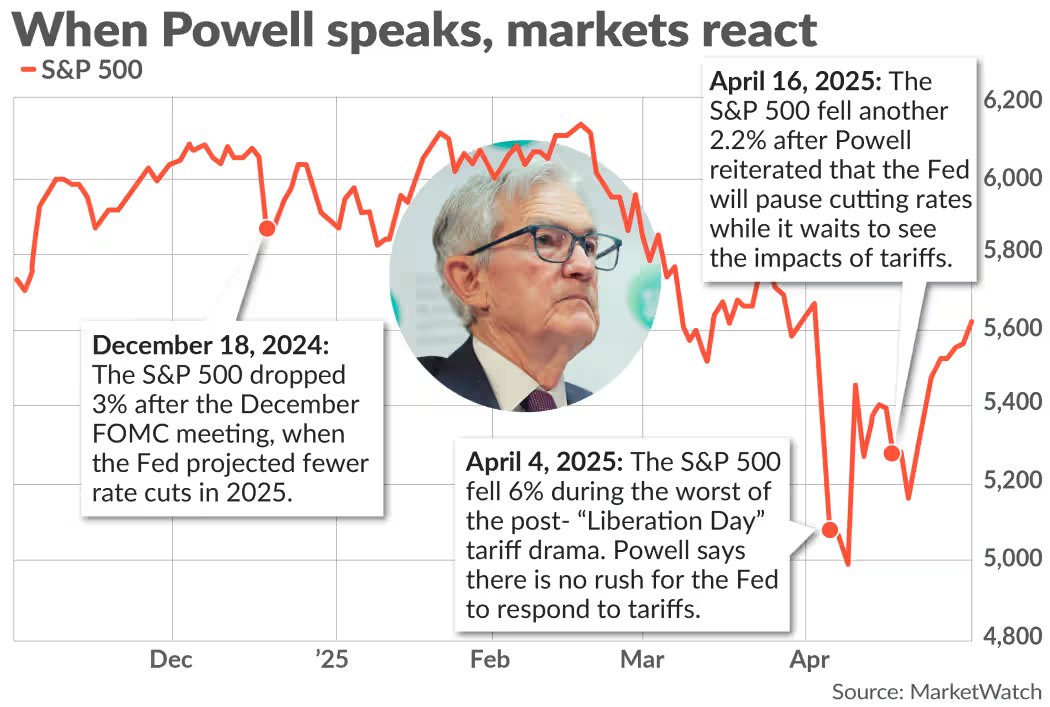
All Eyes on the Fed This Week — Even Without a Rate Cut The Federal Reserve is set to hold its policy meeting on May 6–7, and while no interest rate cut is expected, markets and political leaders—including former President Donald Trump—will be watching closely. Trump has repeatedly called for lower rates, arguing that inflation is under control and that cheaper borrowing costs would boost the economy and markets. On Friday, he took to Truth Social with an all-caps post: “NO INFLATION, THE FED SHOULD LOWER ITS RATE!!!” Lower rates could support economic growth and strengthen Trump’s economic platform, but the Fed has shown no urgency to move. Chair Jerome Powell and the central bank remain cautious, pointing to inflation risks tied to Trump’s own policies, including tariffs and immigration restrictions. After three rate cuts in late 2024, Powell signaled in December that further reductions would be limited. The Fed’s projections, or “dot plot,” now show just 50 basis points of cuts in 2025—half the amount anticipated earlier. That shift triggered a nearly 3% drop in the S&P 500. Part of the Fed’s hesitation stems from the uncertainty surrounding Trump’s economic agenda. New tariffs, tightened immigration enforcement, and shifting trade policies haven’t fully worked their way through the economy. Many of the announced measures have been delayed or revised, complicating the Fed’s decision-making process. “There’s a real divide between hard economic data and softer indicators like sentiment surveys,” said Allen Bond, portfolio manager at Jensen Investment Management. “We’re starting to see weakness in the soft data, but not yet in the hard numbers.” Trump’s Attacks on Powell Rattle Markets Tensions between Trump and Powell flared in April, after Powell warned that tariffs could drive inflation higher and emphasized a wait-and-see approach. Markets fell sharply—6% on April 4 and another 2.2% on April 16—on concerns that the Fed wouldn’t act swiftly enough to counter economic disruptions. Trump lashed out at Powell, calling him “Too Late Jerome” and suggesting he could fire him—comments that alarmed investors and raised concerns about the Fed’s independence. The S&P 500 dropped another 2.4% the day Trump made those remarks. According to Steve Sosnick, chief strategist at Interactive Brokers, Fed independence is one of the reasons global investors trust U.S. markets. Undermining that trust can have serious consequences. “Casting doubt on the Fed’s autonomy shakes investor confidence,” Sosnick said. Trump later walked back his threat to fire Powell, and markets quickly recovered. The S&P 500 launched into a nine-day winning streak—the longest in more than 20 years—fueled partly by optimism over trade talks and relief that the Fed’s independence was intact. What Comes Next As this week’s Fed meeting approaches, markets are riding high. But investors know the rally may be vulnerable if Powell doesn’t deliver the dovish tone they’re hoping for. According to the CME FedWatch Tool, there’s a 99.5% chance the Fed will hold rates steady in May, with markets still pricing in three cuts by year-end. Still, Powell has made it clear that the Fed wants more clarity—particularly on the inflationary effects of tariffs—before making any policy moves. With the current 90-day pause on new tariffs ending in July, June could also be too soon for a rate cut. Sosnick sees only two scenarios where rate cuts are likely: either inflation slows significantly, or the economy deteriorates enough to force the Fed’s hand. “The second scenario is one where you have to be careful what you wish for,” he warned. Markets ended last week on a strong note. The S&P 500 rose 2.9%, the Dow gained 3%, and the Nasdaq climbed 3.4%. Both the Dow and S&P 500 logged nine-day win streaks—something not seen since 1992. The question now: Will Powell’s remarks keep the rally alive, or reset expectations? John PaulJohn Paul is the founder of DayTradeToWin, a trading education and software company established in 2008, supporting traders worldwide. His expertise focuses on price action-based futures trading strategies and structured market analysis. DayTradeToWin delivers trading education, indicators, and software tools designed to help traders apply disciplined, rule-based decision-making across global futures markets. He is the creator of multiple trading methodologies, including the Sonic System, Atlas Line, and Trade Scalper, which help traders identify structured opportunities in markets such as the E-mini S&P 500 (ES), Nasdaq (NQ), crude oil (CL), and gold (GC). Official website: https://daytradetowin.com daytradetowin.com

apple
Market News

The Apple Selloff Paradox

Apple Beats iPhone Sales Expectations, but Tariff Uncertainty Weighs on Investors Apple Inc. exceeded Wall Street expectations with its latest earnings report, driven by stronger-than-expected iPhone sales. However, a lack of clarity from executives on how the company will handle potential tariff impacts left investors uneasy, sending the stock down nearly 4% in after-hours trading on Thursday. While CEO Tim Cook provided some commentary on rising trade costs, the company’s guidance did little to reassure markets. Apple projected an additional $900 million in costs for the June quarter if current tariffs remain unchanged — a figure that doesn’t account for a possible economic slowdown. Still, Apple’s financial results for the quarter were solid: However, not all metrics were positive. The narrow margin of Apple’s outperformance, combined with weakness in some areas, didn’t ease investor concerns about future performance. There’s also skepticism over whether the strong iPhone results were boosted by a rush to purchase ahead of expected tariff hikes. Cook dismissed this theory, noting that iPhone inventory levels remained consistent throughout the quarter, suggesting stable demand rather than a pre-tariff buying spike. When it came to forward-looking guidance, Apple offered limited insight beyond the current quarter. However, Cook did outline changes in Apple’s supply chain aimed at mitigating trade risks. He said 50% of iPhones shipped to the U.S. are now made in India — a share expected to rise and become the majority in the June quarter. Most iPads, Macs, Apple Watches, and AirPods will now come from Vietnam. These shifts suggest Apple is anticipating higher U.S. tariffs on Chinese-made products and is working to reduce its exposure accordingly. Cook confirmed that products sold outside the U.S. will continue to be manufactured primarily in China. Despite investor concerns, some analysts remain optimistic. Kevin Cook, a strategist at Zacks, called the $900 million tariff cost relatively modest, noting the company’s agility in restructuring its operations. “If any global tech company can adapt quickly and effectively, it’s Apple,” he said. John PaulJohn Paul is the founder of DayTradeToWin, a trading education and software company established in 2008, supporting traders worldwide. His expertise focuses on price action-based futures trading strategies and structured market analysis. DayTradeToWin delivers trading education, indicators, and software tools designed to help traders apply disciplined, rule-based decision-making across global futures markets. He is the creator of multiple trading methodologies, including the Sonic System, Atlas Line, and Trade Scalper, which help traders identify structured opportunities in markets such as the E-mini S&P 500 (ES), Nasdaq (NQ), crude oil (CL), and gold (GC). Official website: https://daytradetowin.com daytradetowin.com

meta
Market News

Meta Shows AI Bets Are Paying Off

Meta Hikes AI Spending—but Strong Ad Growth Keeps Investors Onboard Meta Platforms Inc., the parent of Facebook, raised its capital expenditure forecast for the year, signaling an aggressive push into artificial intelligence. But thanks to strong quarterly results, investors appear unfazed. The company now expects to spend $64 billion to $72 billion on capex in 2024, up from its prior range of $60 billion to $65 billion. That’s a sharp increase from the $39 billion it spent last year. The spending surge reflects Meta’s efforts to ramp up AI infrastructure and stay competitive in a crowded tech landscape. Investor concerns about runaway AI spending were top of mind heading into earnings season—especially amid fears of slower ad growth due to economic pressures and tariffs. But Meta’s solid performance helped offset those worries. The stock climbed 5.4% in after-hours trading Wednesday. Meta reported first-quarter earnings per share of $6.43, beating Wall Street’s estimate of $5.23 and rising from $4.71 a year earlier. Advertising revenue hit $41.39 billion, ahead of expectations and reflecting stronger-than-anticipated growth. “Ad growth in the quarter was much better than anticipated, especially on a constant-currency basis,” said Gil Luria, head of technology research at D.A. Davidson. He noted that the stronger revenue gives Meta more flexibility to raise its investment levels. By contrast, Alphabet Inc. kept its capex guidance flat at $75 billion last week, highlighting a more cautious approach. Meta defended its ramped-up spending, saying it’s necessary to meet internal demand for compute power and build out advanced AI systems. Management believes these tools will directly improve its advertising business by enhancing targeting and boosting conversion rates. Although the company flagged some softness in Asia-based ad spending tied to tariff concerns, it said overall trends for Q2 are healthy. Meta guided for revenue of $42.5 billion to $45.5 billion, with the midpoint above analyst estimates. To further bolster ad revenue, Meta is expanding placements into new products like Threads and WhatsApp, while continuing to use AI to help advertisers improve performance. John PaulJohn Paul is the founder of DayTradeToWin, a trading education and software company established in 2008, supporting traders worldwide. His expertise focuses on price action-based futures trading strategies and structured market analysis. DayTradeToWin delivers trading education, indicators, and software tools designed to help traders apply disciplined, rule-based decision-making across global futures markets. He is the creator of multiple trading methodologies, including the Sonic System, Atlas Line, and Trade Scalper, which help traders identify structured opportunities in markets such as the E-mini S&P 500 (ES), Nasdaq (NQ), crude oil (CL), and gold (GC). Official website: https://daytradetowin.com daytradetowin.com

Scroll to Top