

Market News

market
Market News

When This Is Over,’ Market Falls 80%

Spitznagel: This Market Drop Is Just a ‘Trap’ — The Real Crash Is Still Ahead Mark Spitznagel, one of Wall Street’s most bearish and accurate investors, says the recent stock market drop isn’t the big crash he’s been warning about — it’s just a setup. “I’m expecting an 80% crash eventually. But this isn’t it. This is a trap,” Spitznagel told MarketWatch. “When the real thing hits, you’ll know.” Spitznagel is the founder and CIO of Universa Investments, a hedge fund built to thrive during extreme market shocks. Universa follows a “Black Swan” strategy, inspired by Nassim Taleb, focusing on rare, devastating events — and profiting from them. The fund made headlines in early 2020, returning over 4,100% as COVID fears tanked the market. Today, Spitznagel says Universa is still positioned as if a crash is coming — even though he doesn’t think it’s here yet. “This is another shakeout. Not the end. The real reckoning will come when this bubble truly bursts,” he said. “It’s a deeply contrarian view, but I stand by it.” Markets were volatile Monday. The Dow dropped more than 200 points (down 0.57%), the S&P 500 gained 0.35%, and the Nasdaq slipped 0.84%. Last week’s steep losses, sparked by new tariffs from President Trump, marked the S&P’s worst two-day slide since March 2020. Spitznagel has long predicted a massive downturn, one potentially worse than 1929. He’s not trying to time it exactly but warns the U.S.’s mounting debt poses serious risk. Earlier this year, he urged investors not to get caught off guard: “Don’t be the sucker who sells low and buys high.” His advice? Be positioned to weather chaos — easier said than done for most. “Our clients have stayed long through this bull market,” he said. “The doomsayers think they’ve nailed it. Take it from an actual doomer — they haven’t. And they’re not ready for what’s coming.” Still, Spitznagel believes retail investors can keep it simple. In a 2023 Fortune interview, he recommended low-cost index funds and disciplined investing — especially during downturns. His key point: stay invested, don’t overextend, and avoid panic selling. John PaulJohn Paul is the founder of DayTradeToWin, a trading education and software company established in 2008, supporting traders worldwide. His expertise focuses on price action-based futures trading strategies and structured market analysis. DayTradeToWin delivers trading education, indicators, and software tools designed to help traders apply disciplined, rule-based decision-making across global futures markets. He is the creator of multiple trading methodologies, including the Sonic System, Atlas Line, and Trade Scalper, which help traders identify structured opportunities in markets such as the E-mini S&P 500 (ES), Nasdaq (NQ), crude oil (CL), and gold (GC). Official website: https://daytradetowin.com daytradetowin.com
S&P 500
Market News

Morgan Stanley Predicts Further S&P 500 Losses

Mike Wilson, the lead strategist at Morgan Stanley, is warning investors to prepare for a potential 7% to 8% further drop in the S&P 500 unless there’s a reversal in the White House’s tariff plans or a change in the Federal Reserve’s stance. Wilson’s team, in a note sent to clients on Monday, stated that the next major support level for the S&P 500 — where buyers may step in — is at 4,700. This level aligns with the 200-week moving average, a key long-term technical indicator, which they believe offers strong support. The S&P 500 closed last week at 5,074.08, experiencing a 9% decline, its steepest weekly drop since March 2020. This was sparked by a sharp two-day selloff after President Trump announced global reciprocal tariffs. While Morgan Stanley had previously set 5,100 as a critical support level, they adjusted it to 4,700 given the continued downward pressure on the market, with S&P 500 futures showing a potential 3% loss and Dow futures dropping over 1,200 points. Trump’s administration has not shown any signs of backing down on the tariffs, and Federal Reserve Chairman Jerome Powell suggested the central bank would adopt a “wait and see” approach, assessing the economic impact of the tariffs. Wilson’s team pointed out that many stocks have struggled throughout the year, despite the broader indexes holding up until mid-February. This underperformance has been primarily driven by the broad trend of negative earnings revisions, with more companies lowering earnings expectations than those raising them. As the tariffs weigh on market sentiment, further negative earnings revisions are expected. “The question now is how much of this has been priced in, and which sectors and stocks are either attractive or at risk,” said Wilson. Cyclical stocks, which are closely tied to the economy, have underperformed defensive stocks by over 40% in the past year, particularly from April to September last year. For Morgan Stanley, this suggests that concerns over economic growth have persisted for some time, reinforcing their view that the economy has been in a prolonged struggle. The strong performance of defensive stocks has highlighted their dominance, and Wilson’s team believes the recent selloff in these stocks signals forced liquidation and signs of exhaustion in the correction. The strategists are sticking with their preference for high-quality, large-cap, and defensive stocks, emphasizing that these are the types of investments that are likely to weather the current environment best. One such stock is American Tower REIT, which has been upgraded to overweight and added to their Fresh Money Buy list, replacing Eaton Corp. Wilson’s team sees American Tower as a defensive stock with growth potential, particularly as interest rates are expected to decrease, in line with their forecast. Also on the list are CenterPoint Energy, Coca-Cola, Colgate-Palmolive, McDonald’s, Northrop Grumman, Progressive Corp., Public Service Enterprise, and Walmart. Wilson’s team also expects small-cap stocks to continue underperforming due to their greater exposure to economic uncertainty, weakening earnings projections, and historical trends of underperformance in later market cycles. While there are opportunities beneath the surface in the small-cap sector, they believe it’s too early to start picking bottoms. Among small-caps, they favor high-quality stocks in financial services, software, telecom services, biotech, and household products. John PaulJohn Paul is the founder of DayTradeToWin, a trading education and software company established in 2008, supporting traders worldwide. His expertise focuses on price action-based futures trading strategies and structured market analysis. DayTradeToWin delivers trading education, indicators, and software tools designed to help traders apply disciplined, rule-based decision-making across global futures markets. He is the creator of multiple trading methodologies, including the Sonic System, Atlas Line, and Trade Scalper, which help traders identify structured opportunities in markets such as the E-mini S&P 500 (ES), Nasdaq (NQ), crude oil (CL), and gold (GC). Official website: https://daytradetowin.com daytradetowin.com

S&P 500
Market News

S&P 500 Forecasts Fall—It’s Not Just Tariffs

Capital Economics Slashes S&P 500 Forecast as AI Hype Fizzles The stock market is in free fall, and forecasts are following suit. After the S&P 500 plunged 4.8%—its worst day since the COVID crash—analysts are rapidly revising their expectations. The latest cut comes from Capital Economics, where chief market economist John Higgins has slashed his bullish 2025 target from 7,000 to 5,500. What changed? A toxic combo: rising recession risks from Trump’s new tariffs and a cooling AI trade. Higgins had been banking on two key drivers for his previous call—moderate economic growth and relentless investor appetite for AI-powered gains, especially in big tech and chip stocks. But now, both pillars are wobbling. “Even before the tariff news, we expected a slowdown,” Higgins said. “Post-announcement, we still don’t forecast a recession—but the risk is clearly higher.” He also points to potential drags from stalled tax policy, persistent inflation, and fewer Fed rate cuts than previously hoped. But the real surprise? His growing concern about China’s emerging challenge to U.S. dominance in AI. Higgins notes that Chinese players like DeepSeek could disrupt the market by monetizing AI with cheaper, older tech—putting U.S. big tech earnings in jeopardy. If there’s an AI bubble, he suggests, it might be in the earnings projections, not just the lofty valuations. “Analysts haven’t moved to cut EPS forecasts for U.S. tech—but that could be coming,” he warned. Nvidia, the AI poster child, is already down nearly 33% from its highs. Higgins isn’t ruling out a rebound but says it likely won’t come until macro conditions improve and U.S. firms prove resilient against global threats. With his new 5,500 target for 2025, Higgins is pricing in a forward P/E of around 18 based on current EPS estimates of $305—though that too may shift. He now sees a slower recovery ahead: 6,000 in 2026, and 6,500 in 2027. John PaulJohn Paul is the founder of DayTradeToWin, a trading education and software company established in 2008, supporting traders worldwide. His expertise focuses on price action-based futures trading strategies and structured market analysis. DayTradeToWin delivers trading education, indicators, and software tools designed to help traders apply disciplined, rule-based decision-making across global futures markets. He is the creator of multiple trading methodologies, including the Sonic System, Atlas Line, and Trade Scalper, which help traders identify structured opportunities in markets such as the E-mini S&P 500 (ES), Nasdaq (NQ), crude oil (CL), and gold (GC). Official website: https://daytradetowin.com daytradetowin.com

apple
Market News

Apple Shares Slide—What Investors Should Know

Apple Faces Tariff Uncertainty but Has a History of Exemptions Apple’s strong brand loyalty, high profit margins, and past success in securing tariff exemptions may help it weather the latest trade challenges. On Wednesday, President Donald Trump announced a new 34% tariff on Chinese goods—on top of an existing 20% tariff—sending shockwaves through the tech sector. Wedbush analyst Daniel Ives called the move “worse than the worst-case scenario” and described the tariff hike as “a jaw dropper.” Apple Inc. (AAPL) was among the hardest-hit stocks, falling 7.1% in after-hours trading. If those losses extend into Thursday’s session, it would mark Apple’s steepest single-day drop since September 3, 2020, when shares fell 8.0%. Despite investor concerns, Apple was granted tariff exemptions during Trump’s first term, raising speculation about whether the company can secure similar relief this time. Ives remains optimistic. “It’s a very nervous announcement for Apple given its China exposure,” he told MarketWatch. However, he believes iPhones and other Apple products will likely be exempt again. “Investors will sell first and ask questions later, but we saw this play out in Trump 1.0,” he added. Apple’s sharp stock decline underscores two key challenges. First, while the company has diversified its supply chain—expanding production to Vietnam—Trump also announced a 46% tariff on Vietnamese goods, limiting Apple’s ability to sidestep the impact. Second, in today’s economic climate, raising prices to offset tariffs could hurt demand and squeeze profitability. Still, some analysts believe the selloff is overdone. “Even without an exemption, Apple may not be as affected as people fear,” said Angelo Zino, a technology analyst at CFRA, who maintains a buy rating on the stock. “Over the last six years, Apple’s gross margins have grown from about 38% to 47%, giving them room to absorb some of the costs.” Apple could also distribute the burden across its supply chain. And if prices rise, the company is betting that its strong customer retention and ecosystem of services—accounting for 21% of total revenue—will help mitigate the impact. “For now, the White House says it isn’t making deals,” Ives wrote. “But we believe negotiations and workarounds will emerge in the coming months as companies and countries adjust to this new tariff environment.” Apple did not immediately respond to MarketWatch’s request for comment. When asked about tariffs during its January earnings call, CEO Tim Cook said the company was “monitoring the situation” but had no further comment. Zino remains confident in Apple’s ability to navigate the uncertainty. “We trust Apple’s leadership more than most in the tech industry.” John PaulJohn Paul is the founder of DayTradeToWin, a trading education and software company established in 2008, supporting traders worldwide. His expertise focuses on price action-based futures trading strategies and structured market analysis. DayTradeToWin delivers trading education, indicators, and software tools designed to help traders apply disciplined, rule-based decision-making across global futures markets. He is the creator of multiple trading methodologies, including the Sonic System, Atlas Line, and Trade Scalper, which help traders identify structured opportunities in markets such as the E-mini S&P 500 (ES), Nasdaq (NQ), crude oil (CL), and gold (GC). Official website: https://daytradetowin.com daytradetowin.com
tariffs
Market News

Beyond Tariffs: More Uncertainty for Investors

Investors anticipating market stability after President Trump’s April 2 tariff deadline may need to prepare for ongoing turbulence instead. While further details on Trump’s “reciprocal” tariffs are expected by Wednesday’s close, it may take several days for major U.S. trade partners to assess the situation and formulate a response. Jason Draho, head of asset allocation for the Americas at UBS Global Wealth Management, noted that investors will be focused on understanding the long-term implications of these tariffs and the timeline for resolution. Market pressures have already driven stocks into correction territory, with the S&P 500 recording its steepest quarterly decline since Q3 2022, according to Dow Jones Market Data. The downturn suggests investors have adopted a more cautious outlook on corporate earnings, though Draho believes peak tariffs are unlikely to remain in place permanently. For stocks to regain momentum, upcoming economic data must alleviate recession fears. Alternatively, if economic conditions worsen, a shift in trade policy from the Trump administration or a monetary policy adjustment by the Federal Reserve might be necessary to restore confidence. A Narrow Window for Policy Implementation President Trump has vowed to bring about a “golden age” for America in his second term. So far, only gold prices have mirrored that aspiration, repeatedly reaching record highs. Instead, Trump’s focus on tariffs, immigration, and government reduction has weighed on consumer sentiment, stoked inflation concerns, and heightened fears of recession—allowing European stocks to outperform their U.S. counterparts. While the administration describes this as a necessary “detox” for the U.S. economy, it may have only a short window to implement its broader policy agenda, which includes tax cuts, deregulation, and a smaller federal government. With the 2026 midterm elections approaching, economic stability will be crucial in sustaining policy momentum. After weeks of uncertainty, April 2 is expected to provide some clarity—perhaps a framework for businesses and trade partners to understand how tariffs will be applied, suggested Bill Campbell, global bond portfolio manager at DoubleLine. While global corporations seem willing to adjust to Trump’s tariffs, they require a clear mechanism for compliance costs, potential rebates, and infrastructure planning timelines. “The administration must tread carefully,” Campbell warned, citing the administration’s “razor-thin majority in Congress” and the interconnected nature of its policy initiatives. “What they can’t afford is a sharp economic downturn and a surge in unemployment.” Trump has framed the Republican victory in November’s election as a mandate for swift action. Following April 2, his administration is expected to pivot toward other priorities within the first 100 days, particularly fiscal policy. “Fiscal policy will take center stage in April,” said John Velis, Americas macroeconomic strategist at BNY. “There’s a massive shift in policies underway, and everyone recognizes that.” However, further economic slowdown could weaken stocks, particularly if the Federal Reserve is compelled to cut interest rates. Lower rates would enhance the appeal of bonds, which still offer some of the highest yields seen in the past decade, noted Robert Tipp, chief investment strategist at PGIM Fixed Income. “In that case, the downside risks would be concentrated in cash and equities,” Tipp warned. On Monday, the Dow Jones Industrial Average recorded its worst quarter since Q2 2024, while the Nasdaq Composite saw its largest quarterly decline since Q2 2022, according to Dow Jones Market Data. John PaulJohn Paul is the founder of DayTradeToWin, a trading education and software company established in 2008, supporting traders worldwide. His expertise focuses on price action-based futures trading strategies and structured market analysis. DayTradeToWin delivers trading education, indicators, and software tools designed to help traders apply disciplined, rule-based decision-making across global futures markets. He is the creator of multiple trading methodologies, including the Sonic System, Atlas Line, and Trade Scalper, which help traders identify structured opportunities in markets such as the E-mini S&P 500 (ES), Nasdaq (NQ), crude oil (CL), and gold (GC). Official website: https://daytradetowin.com daytradetowin.com

stocks
Market News

Global Stocks Outshine U.S. – Exceptionalism Fading?

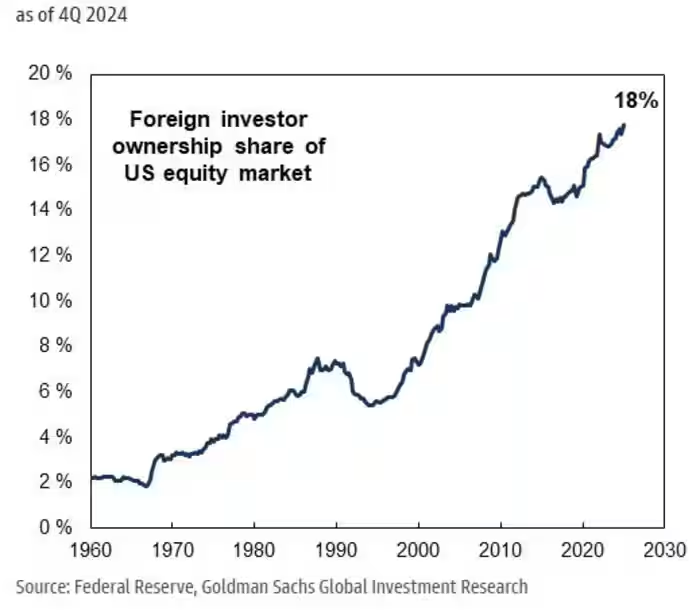
International stocks posted their strongest first-quarter outperformance against U.S. stocks on record, according to Dow Jones data. In late 2024, the “American exceptionalism” trade was thriving, with investors pouring money into U.S. stocks following Donald Trump’s election victory in November. However, the first quarter of 2025 has painted a different picture. U.S. stocks have struggled due to the unwinding of artificial intelligence-driven trades and uncertainty surrounding tariffs, while international markets have surged ahead. As of Monday, the S&P 500 (SPX) was on track to trail global stocks—measured by the MSCI All Country World Index ex-U.S. ETF (ACWX)—by nearly 11 percentage points in the first quarter. This would mark the largest first-quarter outperformance by international stocks on record, based on Dow Jones Market Data dating back to 1987. Despite this shift, U.S. stocks have significantly outperformed their international counterparts over the past two decades. Since March 2005, the S&P 500 has risen 370%, compared to less than 65% for the MSCI All Country World Index ex-U.S. ETF, excluding dividends. This suggests that a “catch-up” trade is now underway. “We’re finally seeing some reversion to the mean,” said Ryan Dykmans, chief investment officer at Dunham & Assoc. Investment Counsel, in an interview with MarketWatch. Historical data indicates that when international stocks outperform U.S. equities significantly in the first quarter, they tend to maintain that lead for the rest of the year. Global Market Performance Stock performance has varied globally in the first quarter. The STOXX Europe 600 (SXXP), covering eurozone, U.K., and Swiss stocks, is on track for its best first-quarter outperformance against the U.S. since 2015, according to Dow Jones data. In contrast, Japan’s Nikkei 225 (NIK) has struggled, falling over 10% in local-currency terms, according to FactSet data. Currency Weakness and Foreign Investment Risks For foreign investors in U.S. stocks, 2025 has been particularly challenging. The U.S. dollar has declined alongside equities. As of midday Monday, the ICE U.S. Dollar Index (DXY) had dropped about 4% for the quarter, while the S&P 500 had fallen over 5.5%, per FactSet data. This marks the first time both have fallen simultaneously in a calendar quarter since early 2018. A weaker dollar amplifies losses for foreign investors. Many had avoided hedging their currency exposure due to the dollar’s historical strength. If U.S. stocks continue to lag, international investors may shift funds to Europe or other markets, potentially exacerbating U.S. stock losses in a negative feedback loop. “There was a time when U.S. stocks were primarily owned by domestic investors,” said Hardika Singh, an economic strategist at Fundstrat Global Advisors. However, since the early 2000s, foreign investment in U.S. stocks has grown significantly. According to Federal Reserve data cited by Goldman Sachs, foreign investors held 18% of U.S. equities in late 2024, up from 7% in 2000 and just 2% in 1960. By late 2024, U.S. stocks accounted for 57% of global equity market value, surpassing the peak of the dot-com bubble in 2000. However, their share has since declined to 54%. Singh attributes the recent outperformance of international stocks to a “catch-up” trade rather than a long-term shift. While Trump’s tariff policies introduce uncertainty, their economic impact is expected to be global as trading partners retaliate. Moreover, U.S. companies are still projected to experience stronger earnings growth than their global peers in 2025, reinforcing Fundstrat’s expectation that U.S. stocks will regain leadership before year-end. “It really is to the rest of the world’s advantage that the U.S. continues to do well,” Singh added. On Monday, the S&P 500 rose 0.6%, trimming earlier losses. The Dow Jones Industrial Average (DJIA) gained 417 points, or 1%, reaching 42,001, while the Nasdaq Composite (COMP) fell 0.1% as Big Tech stocks continued to struggle. John PaulJohn Paul is the founder of DayTradeToWin, a trading education and software company established in 2008, supporting traders worldwide. His expertise focuses on price action-based futures trading strategies and structured market analysis. DayTradeToWin delivers trading education, indicators, and software tools designed to help traders apply disciplined, rule-based decision-making across global futures markets. He is the creator of multiple trading methodologies, including the Sonic System, Atlas Line, and Trade Scalper, which help traders identify structured opportunities in markets such as the E-mini S&P 500 (ES), Nasdaq (NQ), crude oil (CL), and gold (GC). Official website: https://daytradetowin.com daytradetowin.com

Scroll to Top