

Market News

stocks
Market News

Market Drop as Trump Dismisses Auto Tariff Impact

Investors Brace for Market Volatility as Trump Plans Sweeping Tariffs U.S. stock futures dipped on Sunday as investors grew anxious over President Donald Trump’s forthcoming reciprocal tariffs, which he signaled would target nearly all countries. The tariffs, aimed at addressing perceived trade imbalances, are expected to be announced this week. “I couldn’t care less if the prices on foreign cars go up; they’re going to buy American cars,” Trump stated in a Saturday interview with NBC News. “We have plenty.” The planned 25% tariffs on foreign-made cars and auto parts are set to take effect on Thursday. Additional tariffs, potentially as high as 20%, could be imposed on a broader range of imports, according to the Wall Street Journal. Market Reactions and Growing Uncertainty At 11 p.m. Eastern on Sunday, Dow Jones Industrial Average futures (YM00) fell around 180 points or 0.4%, while S&P 500 futures (ES00) slipped 0.7% and Nasdaq-100 futures (NQ00) declined 1.2%. Bitcoin (BTCUSD) also lost ground, falling below $82,000. On Friday, the Dow tumbled 1.7%, the S&P 500 dropped 2%, and the Nasdaq Composite sank 2.7%, extending March’s losses. Concerns over tariffs, inflation, and weak economic data have fueled worries of stagflation—a period of low growth and high inflation. Overseas markets mirrored these concerns, with Japan’s Nikkei 225 falling 4%, and stocks in Hong Kong (HSI -1.3%), South Korea (KOSPI -3%), and Australia (ASX 200 -1.74%) also declining. Trump Dismisses Price Hike Concerns Trump denied reports that he advised U.S. automakers against raising prices in response to tariffs. “No, I never said that,” he told NBC News. “I couldn’t care less if they raise prices, because people are going to start buying American-made cars.” A White House aide later clarified that Trump’s comments referred to foreign-made cars. Despite this, economists warn that the tariffs will likely drive up prices, even for domestic vehicles, due to the higher cost of imported parts. Industry Experts Expect Significant Price Increases Morgan Stanley analysts forecast that car prices could rise by 11% to 12% on average as automakers pass on tariff costs to consumers. Bloomberg Intelligence’s Steve Man warned of further strain on already thin profit margins for automakers. “Even if Trump pressures companies to maintain prices, the financial impact will be severe,” Man said. “There’s no avoiding the ripple effects on the industry.” Stephen Innes, managing partner at SPI Asset Management, described the tariffs as a significant threat to global supply chains. “A 25% blanket tariff on imported vehicles isn’t just a trade policy shift; it’s a seismic shock for inflation and supply chains,” he said. A Permanent Trade Policy Shift? Trump suggested that the tariffs will be a long-term measure, unlike previous levies on Mexico and Canada that faced delays. He maintained that the scheduled April 2 deadline is firm unless trading partners offer substantial concessions. “I’m open to negotiations,” Trump said, “but only if they’re willing to give us something of great value.” As investors await further details on the tariffs, market volatility is expected to persist, with implications likely to ripple across industries and global trade. John PaulJohn Paul is the founder of DayTradeToWin, a trading education and software company established in 2008, supporting traders worldwide. His expertise focuses on price action-based futures trading strategies and structured market analysis. DayTradeToWin delivers trading education, indicators, and software tools designed to help traders apply disciplined, rule-based decision-making across global futures markets. He is the creator of multiple trading methodologies, including the Sonic System, Atlas Line, and Trade Scalper, which help traders identify structured opportunities in markets such as the E-mini S&P 500 (ES), Nasdaq (NQ), crude oil (CL), and gold (GC). Official website: https://daytradetowin.com daytradetowin.com

tariff
Market News

Trump’s Tariff Spark Options Frenzy — Stocks to Watch

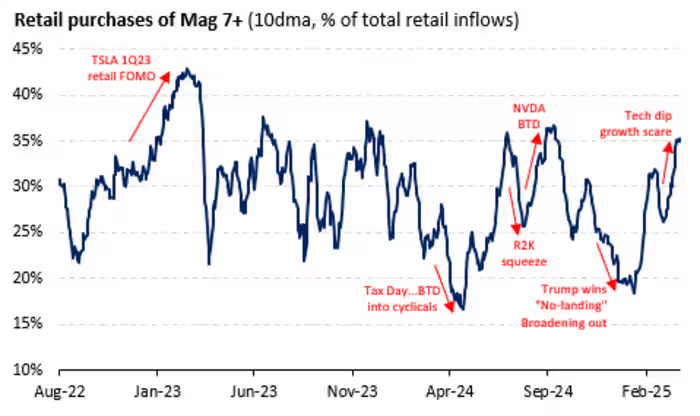
Retail investors are bracing for a decisive moment as President Donald Trump’s April 2 tariff announcement looms. After months of tariff-induced market volatility, many have seized the opportunity to buy the dip. With the announcement now imminent, their strategy is about to face a critical test. “They’re standing on the edge of either a major win or a costly mistake,” investor-research firm Vanda Research noted in a recent report. Vanda Research data shows that despite the S&P 500 pulling back from its February 19 peak, retail investors have poured over $32.9 billion into U.S. stocks. This influx places retail buying activity in the 97th percentile for any 24-trading-day period since 2014. Beyond equities, there has been a notable surge in options trading. Marco Iachini, senior vice president of research at Vanda, highlighted a shift toward bullish call options, signaling that investors may be positioning for a market rebound. “The spike in options activity on Monday prompts a key question: Are investors hedging against uncertainty ahead of April 2, or are they reinforcing their belief in a market recovery?” Vanda’s report stated. While options buying typically aligns with increased equity purchases, the divergence seen this week suggests a more tactical approach. Options contracts require less capital upfront than stock purchases, enabling investors to maintain exposure while managing risk. This strategy mirrors patterns seen in August 2024, when a sharp market selloff led to a similar rise in options activity. Investors may once again be hedging their bets, preparing for both volatility and potential upside in the wake of the tariff decision. John PaulJohn Paul is the founder of DayTradeToWin, a trading education and software company established in 2008, supporting traders worldwide. His expertise focuses on price action-based futures trading strategies and structured market analysis. DayTradeToWin delivers trading education, indicators, and software tools designed to help traders apply disciplined, rule-based decision-making across global futures markets. He is the creator of multiple trading methodologies, including the Sonic System, Atlas Line, and Trade Scalper, which help traders identify structured opportunities in markets such as the E-mini S&P 500 (ES), Nasdaq (NQ), crude oil (CL), and gold (GC). Official website: https://daytradetowin.com daytradetowin.com

auto
Market News

Auto Sector Reels from Trump’s 25% Tariffs

Automakers are facing tough choices in response to new tariffs: absorb the cost of importing auto vehicles, pass the extra expenses onto consumers, or invest in building U.S. factories. On Wednesday evening, the Trump administration announced a 25% tariff on all cars not manufactured in the U.S. and specific automotive parts. Some components were excluded from these levies. The tariffs will take effect on April 3, one day after the administration plans to unveil a broader reciprocal tariff strategy. According to a White House statement, the tariffs will target passenger vehicles and select parts like engines, transmissions, powertrain components, and electrical systems. The administration also indicated the possibility of expanding tariffs to additional parts if necessary. Parts that meet the U.S.-Mexico-Canada trade agreement (USMCA) requirements will remain exempt until further guidelines are established for taxing non-U.S. content. These tariffs pose significant challenges for automakers, who must decide whether to absorb the added costs, increase prices, or shift production to the U.S. Sam Fiorani, vice president of global vehicle forecasting at AutoForecast Solutions, highlighted the difficulty of relocating factories. He noted that most cars imported from Mexico are lower-cost models, while high-margin SUVs and trucks are predominantly produced in the U.S. due to a long-standing 25% tariff on imported SUVs and trucks. “Moving production requires substantial investment and time. It’s not a decision that companies can make quickly,” Fiorani said. Frank DuBois, a professor at American University’s Kogod School of Business, agreed. He emphasized that carmakers cannot swiftly establish new U.S. factories or supply chains, especially with uncertainty surrounding the longevity of the tariffs. Despite these concerns, Trump expressed enthusiasm about the tariffs. “You’re going to see a lot of construction jobs and automobile jobs. It’s exciting,” Trump told reporters. He added that companies with existing U.S. factories would benefit, while those without domestic operations would need to act quickly to avoid the tax. Support for the tariffs emerged from the Alliance for American Manufacturing. The group’s president, Scott Paul, stated that while tariffs aren’t the only method to encourage U.S. auto production, they are necessary. However, stock markets reacted negatively. Shares of major automakers dropped on Wednesday. General Motors Co. (GM) fell 3%, Stellantis (STLA) dropped nearly 4%, and Ford Motor Co. (F) managed a slight 0.1% gain after minimizing losses. European manufacturers such as BMW (BMW), Mercedes-Benz Group (MBG), and Volkswagen (VOW) also experienced losses ranging from 2% to 4%. The broader U.S. stock market followed suit. The S&P 500, Dow Jones Industrial Average, and Nasdaq Composite all declined, breaking a three-day winning streak. Futures for these indices initially fell following the announcement but showed signs of recovery overnight. John PaulJohn Paul is the founder of DayTradeToWin, a trading education and software company established in 2008, supporting traders worldwide. His expertise focuses on price action-based futures trading strategies and structured market analysis. DayTradeToWin delivers trading education, indicators, and software tools designed to help traders apply disciplined, rule-based decision-making across global futures markets. He is the creator of multiple trading methodologies, including the Sonic System, Atlas Line, and Trade Scalper, which help traders identify structured opportunities in markets such as the E-mini S&P 500 (ES), Nasdaq (NQ), crude oil (CL), and gold (GC). Official website: https://daytradetowin.com daytradetowin.com
markets
Market News

Trump’s Treasury Runs Low: Impact on Markets

With cash reserves rapidly depleting, the Treasury Department is expected to exhaust its resources soon, though the exact timing remains uncertain. The so-called “x date” — when the Treasury’s emergency cash management measures will be fully spent — could arrive as early as May. This deadline holds significant implications for President Donald Trump’s tax plans and financial markets. Congressional Republicans Urged to Raise Debt Ceiling The Trump administration has reached its legal limit on issuing additional debt to fulfill the U.S. government’s financial obligations, including Social Security payments and military operations. Tax Plan and Debt Ceiling Interplay If Republicans fail to pass their tax bill before the debt ceiling is raised, they will likely require Democratic support. Brian Gardner, a policy analyst at Stifel, noted that separating the two issues could lead to more complex negotiations. The Trump administration is advocating for an extension of the 2017 individual tax cuts, which analyses suggest have primarily benefited wealthy Americans. Additionally, proposals to eliminate taxes on tips, overtime, and Social Security benefits could increase the overall cost to over $11 trillion over a decade, according to the Committee for a Responsible Federal Budget. Republicans are relying on budget reconciliation, a process that enables a tax bill to pass the Senate with a simple majority. While they could potentially include a debt ceiling increase in the same legislation, some Republicans are reluctant to approve additional debt without bipartisan backing. Deadline Uncertainty and Political Strategy Estimates from the Bipartisan Policy Center suggest the Treasury could default on its obligations between mid-July and early October. However, the exact timing remains unpredictable due to fluctuating tax receipts. House Ways and Means Committee Chair Jason Smith has warned that the deadline could arrive as early as mid-May. Henrietta Treyz, director of economic policy at Veda Partners, suggested that an earlier deadline would benefit House Republicans who want to pass the tax plan swiftly. With a narrow three-seat majority and all House members facing re-election in 2026, Speaker Mike Johnson is under pressure to secure a legislative victory. While House Republicans are pursuing aggressive tax cuts potentially offset by Medicaid reductions, Senate Republicans are showing less urgency. Treyz noted that the Senate GOP is more inclined to adopt a gradual approach to tax reform, avoiding a politically fraught debt ceiling debate. Market Risks and Political Brinkmanship If the debt ceiling increase is not included in the reconciliation process, Republicans will need Democratic votes. Senate Minority Leader Chuck Schumer is expected to face pressure to demand concessions. Gardner warned that such political brinkmanship could elevate market volatility. Previous debt ceiling standoffs have shown that while equity markets often remain stable, bond markets experience disruptions. Investors tend to flock to short-term Treasury bills, and the cost of insuring against U.S. debt typically rises. With both parties entrenched in their positions, the potential for financial uncertainty remains high. House Democratic Caucus Chair Pete Aguilar has already stated that Democrats will not agree to raise the debt ceiling without negotiations, signaling a challenging path ahead. John PaulJohn Paul is the founder of DayTradeToWin, a trading education and software company established in 2008, supporting traders worldwide. His expertise focuses on price action-based futures trading strategies and structured market analysis. DayTradeToWin delivers trading education, indicators, and software tools designed to help traders apply disciplined, rule-based decision-making across global futures markets. He is the creator of multiple trading methodologies, including the Sonic System, Atlas Line, and Trade Scalper, which help traders identify structured opportunities in markets such as the E-mini S&P 500 (ES), Nasdaq (NQ), crude oil (CL), and gold (GC). Official website: https://daytradetowin.com daytradetowin.com

dot-com
Market News

Dot-Com Crash 25 Years Later: Echoes Today?

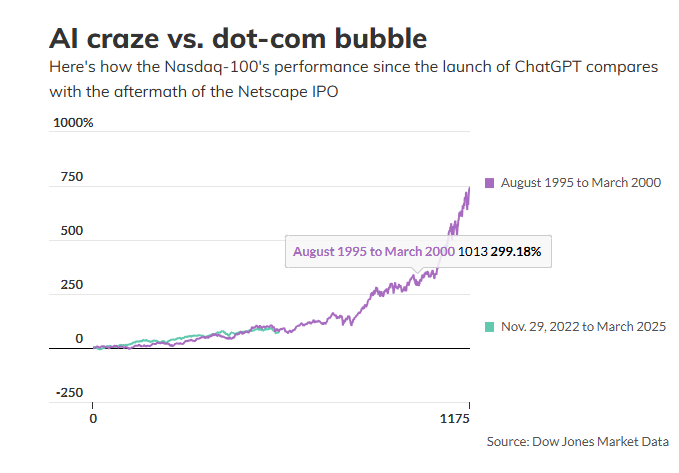
AI Boom Echoes Dot-Com Bubble: Investor Warns of Risks This week marks 25 years since the dot-com bubble peaked, a period of tech-fueled euphoria that ended in a massive market crash. The Nasdaq-100 took over 15 years to recover its dot-com highs. Now, an investor who predicted that crash is raising concerns about today’s AI market. Familiar Warning Signs In hindsight, the signs of the dot-com crash were apparent. Former Federal Reserve Chairman Alan Greenspan’s 1996 warning about “irrational exuberance” went unheeded as investors focused on technological potential over financial fundamentals. The S&P 500 hit its peak on March 24, 2000, at 1,527.46. The Nasdaq-100 followed on March 27 at 4,704.73. The Nasdaq Composite had already reached its high on March 10, while the Dow Jones Industrial Average peaked earlier in January. The Aftermath When the bubble burst, the ensuing bear market wiped out trillions in market value. The Nasdaq-100 plummeted over 80%, while the terrorist attacks of September 11, 2001, and corporate scandals like Enron further eroded confidence. Euphoria and Reckoning During the dot-com era, stock speculation was widespread. Sam Stovall, Chief Investment Strategist at CFRA, recalls the sentiment: “Everyone believed it was a new era where valuations didn’t matter. The only concern was how much money you had in the market.” The Federal Reserve’s interest rate hikes in 1999 and a subsequent mild recession in 2001 exacerbated the downturn. Companies that relied on hype over profitability faced steep losses as revenue projections fell short. A Long Road to Recovery While the S&P 500 regained its highs by May 2007, the Nasdaq-100 and Nasdaq Composite required over 15 years to recover. Startups like Webvan, Pets.com, and Boo.com became infamous for their failures. Even established companies like Cisco Systems, which briefly became the world’s most valuable company, have yet to reach their dot-com-era valuations. Telecom companies like WorldCom collapsed under the weight of fraud and poor business models. Parallels in the AI Craze James Stack, president of InvesTech Research, predicted the dot-com crash. Now, he warns of similarities with the AI market. Since the launch of ChatGPT in 2022, the Nasdaq-100’s gains have mirrored its meteoric rise during the dot-com boom. Despite some moderation in valuations, Stack remains cautious, holding nearly 50% of his clients’ portfolios in cash. “The most concerning similarity is the overconfidence in the market’s resilience. That’s when investors are most vulnerable,” he warned. While AI may deliver long-term value, Stack’s insights serve as a reminder that market bubbles often burst when confidence is at its highest. John PaulJohn Paul is the founder of DayTradeToWin, a trading education and software company established in 2008, supporting traders worldwide. His expertise focuses on price action-based futures trading strategies and structured market analysis. DayTradeToWin delivers trading education, indicators, and software tools designed to help traders apply disciplined, rule-based decision-making across global futures markets. He is the creator of multiple trading methodologies, including the Sonic System, Atlas Line, and Trade Scalper, which help traders identify structured opportunities in markets such as the E-mini S&P 500 (ES), Nasdaq (NQ), crude oil (CL), and gold (GC). Official website: https://daytradetowin.com daytradetowin.com

futures
Market News

Stock Futures Signal Optimism on Wall Street

U.S. stock futures moved higher Sunday night, building on last week’s rebound when the S&P 500 broke a four-week losing streak. As of 11 p.m. Eastern, futures for the Dow Jones Industrial Average (YM00 +0.75%) were up about 220 points, or 0.5%. S&P 500 futures (ES00 +0.97%) gained 0.6%, while Nasdaq-100 futures (NQ00 +1.19%) advanced 0.8%. In commodities, crude oil prices (CL.1 +0.34%) edged down, gold (GC00 +0.22%) remained mostly flat, and bitcoin (BTCUSD +2.54%) briefly surpassed $86,000 for the first time since Thursday. The S&P 500 (SPX +0.08%) rose 0.5% last week, and the Nasdaq Composite (COMP +0.52%) inched up 0.2%, ending their losing streaks. The Dow Jones Industrial Average (DJIA +0.08%) climbed 1.2%, notching its first weekly gain in three weeks. The Federal Reserve kept interest rates steady on Wednesday and reiterated its expectation of two rate cuts later this year. Former President Donald Trump, however, renewed calls for immediate cuts to counteract the impact of his tariffs. Despite the market’s upward momentum, uncertainty remains. Key economic data is expected this week, and Trump’s reciprocal tariffs are set to be announced next week. Investors remain wary of how these tariffs could influence inflation and economic growth. On Sunday, The Wall Street Journal reported that the White House may narrow the tariffs to target specific countries and industries, avoiding broader measures. John PaulJohn Paul is the founder of DayTradeToWin, a trading education and software company established in 2008, supporting traders worldwide. His expertise focuses on price action-based futures trading strategies and structured market analysis. DayTradeToWin delivers trading education, indicators, and software tools designed to help traders apply disciplined, rule-based decision-making across global futures markets. He is the creator of multiple trading methodologies, including the Sonic System, Atlas Line, and Trade Scalper, which help traders identify structured opportunities in markets such as the E-mini S&P 500 (ES), Nasdaq (NQ), crude oil (CL), and gold (GC). Official website: https://daytradetowin.com daytradetowin.com

Scroll to Top