

Market News

nvidia
Market News

After Nvidia, Blogger Sounds Alarm on AI Giant

Jeffrey Emanuel, the former crypto executive and blogger who made waves earlier this year with his warning about Nvidia vulnerability to Chinese AI startup DeepSeek, is now cautioning investors about CoreWeave’s upcoming IPO. Emanuel’s analysis on DeepSeek led to a $600 billion drop in Nvidia market value in a single day, garnering attention from Wall Street to Silicon Valley. Now, he is sounding the alarm on CoreWeave Inc., a New Jersey-based cloud services provider planning to go public. While CoreWeave’s revenue surged 747% in 2024 by running AI data centers, Emanuel warns the company’s business model is fragile. Unlike competitors that own infrastructure, CoreWeave leases its data centers, creating financial risk if AI spending slows. “CoreWeave could face a severe cash crunch if revenue growth stalls and lease obligations remain high,” Emanuel said, comparing it to WeWork’s collapse after unsustainable expansion. CoreWeave plans to offer shares at $47 to $55, seeking to raise $2.5 billion with a market cap of around $25 billion. While lower than previous expectations, Emanuel believes the valuation remains inflated, arguing it should be closer to $3 billion. Not all analysts share his view. Renaissance Capital’s Matthew Kennedy sees CoreWeave’s IPO as a major opportunity for investors wanting exposure to the AI infrastructure boom. However, Emanuel raised concerns over CoreWeave’s dependence on Microsoft, which accounts for 62% of its revenue. Microsoft’s plans to invest $80 billion in its own AI data centers could reduce its reliance on CoreWeave. “CoreWeave’s growth could suffer if Microsoft expands its infrastructure or AI demand falters,” warned D.A. Davidson analyst Alexander Pratt. Additionally, Emanuel questioned CoreWeave’s claims of proprietary AI management software, stating that comparable open-source solutions are available. He also expressed skepticism over CoreWeave’s recent $11.9 billion contract with OpenAI, citing a lack of transparency on financial terms. In 2024, CoreWeave’s revenue reached $1.9 billion, up from $229 million in 2023, but its losses also widened to $863 million. The company’s prospectus outlines significant risks, including its reliance on a few major customers and the need to stay competitive in a rapidly evolving market. While Emanuel holds no financial position in CoreWeave, he hopes his warnings will help retail investors avoid overvalued stocks. “This IPO is a clear attempt to capitalize on AI hype,” he concluded. “Investors should approach with caution.” John PaulJohn Paul is the founder of DayTradeToWin, a trading education and software company established in 2008, supporting traders worldwide. His expertise focuses on price action-based futures trading strategies and structured market analysis. DayTradeToWin delivers trading education, indicators, and software tools designed to help traders apply disciplined, rule-based decision-making across global futures markets. He is the creator of multiple trading methodologies, including the Sonic System, Atlas Line, and Trade Scalper, which help traders identify structured opportunities in markets such as the E-mini S&P 500 (ES), Nasdaq (NQ), crude oil (CL), and gold (GC). Official website: https://daytradetowin.com daytradetowin.com


fed
Market News

Fed Warns: Tariffs Slow U.S. Economy

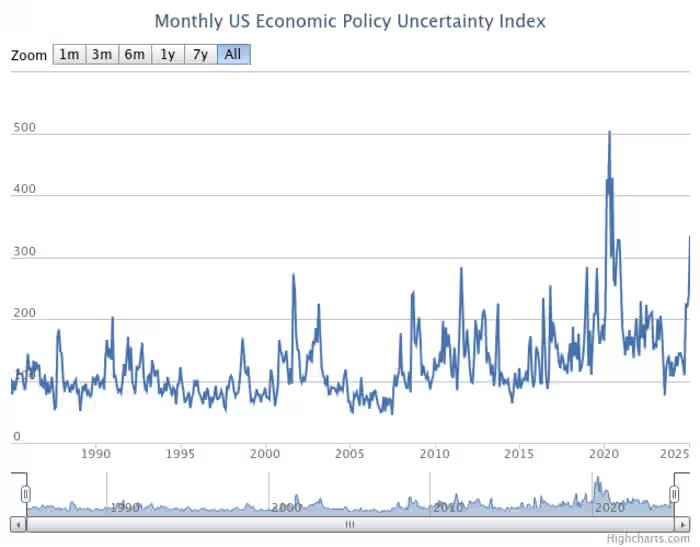
Fed Holds Off on Changes, Maintains Outlook for Two Rate Cuts in 2025 — For Now The Federal Reserve kept interest rates steady on Wednesday and reaffirmed its forecast for two rate cuts in 2025, despite growing economic uncertainty fueled by President Donald Trump’s new tariffs. “Uncertainty today is unusually elevated,” Fed Chair Jerome Powell said at his press conference. “We need to see how things actually play out.” While the Fed’s official projection still shows two cuts next year, Powell emphasized that policymakers are in no rush to move until they have a clearer picture of how the economy responds. He noted the economy remains stable enough to allow for patience. “We are well-positioned to wait for greater clarity,” he said. Markets welcomed the Fed’s cautious approach, with the Dow Jones Industrial Average climbing 0.92% and the S&P 500 up 1.08%. Still, signs of division within the Fed are emerging. Eight officials now expect only one or zero cuts this year — double the number from December — hinting at a more hawkish tone. Matthew Luzzetti, chief U.S. economist at Deutsche Bank, said markets had been bracing for exactly that shift due to persistent inflation concerns. But others pointed out Powell’s calm demeanor. “He seemed very relaxed about inflation,” said Padhraic Garvey, ING’s head of research for the Americas. At the same time, the Fed lowered its 2025 GDP growth forecast from 2.1% to 1.7% and predicted inflation would rise to 2.7% by year-end — well above its 2% target. Powell attributed part of the rise to tariffs but suggested it might be temporary, with inflation expected to ease to 2.2% in 2026. The Fed’s mixed messaging left some economists puzzled. “Uncertainty is high, inflation is climbing, officials are split on rate moves, but they still forecast two cuts. That seems wildly unlikely,” economist Robert Frick commented on social media. Luzzetti noted that any cuts this year would likely be reactionary — what he called “bad-news cuts” — in response to slowing growth. In a separate move, the Fed announced it will slow its balance sheet runoff, allowing just $5 billion in Treasurys to mature without replacement each month, down from $25 billion, while continuing to let $35 billion in mortgage-backed securities roll off. In a rare dissent, Fed Governor Christopher Waller voted against the decision, preferring no change to the runoff pace. The economy has clearly cooled since the start of the year, with uncertainty around trade and immigration policies adding pressure. Meanwhile, inflation remains stubbornly above target, complicating the Fed’s ability to respond proactively. With the White House set to announce new tariffs on April 2, economists warn the Fed could soon face even more challenging conditions. “I think by the time Powell holds his next press conference in May, the data will look quite a bit uglier,” said Scott Anderson, chief U.S. economist at BMO Capital Markets. John PaulJohn Paul is the founder of DayTradeToWin, a trading education and software company established in 2008, supporting traders worldwide. His expertise focuses on price action-based futures trading strategies and structured market analysis. DayTradeToWin delivers trading education, indicators, and software tools designed to help traders apply disciplined, rule-based decision-making across global futures markets. He is the creator of multiple trading methodologies, including the Sonic System, Atlas Line, and Trade Scalper, which help traders identify structured opportunities in markets such as the E-mini S&P 500 (ES), Nasdaq (NQ), crude oil (CL), and gold (GC). Official website: https://daytradetowin.com daytradetowin.com
nvidia
Market News

Nvidia Falls Flat Post-GTC — What Disappointed Investors?

Nvidia’s Keynote Delivered Energy — but Not the Surprise Investors Wanted Jensen Huang took the stage with trademark enthusiasm, speaking for nearly two hours — reportedly without a teleprompter — about Nvidia’s bold future. But for investors hoping for a game-changing announcement, the presentation fell short. Nvidia shares (NVDA) closed down 3.4% on the day, deepening losses that had already begun before Huang’s keynote. While Nvidia’s roadmap is undeniably impressive — highlighting advances in AI, robotics, autonomous driving, and quantum computing — much of what Huang presented felt familiar. “The things Huang said had already been said,” observed Maribel Lopez, founder of Lopez Research. Investors had been hoping for an unexpected catalyst: a surprise revenue stream or a groundbreaking product reveal. Instead, Huang pointed to areas that are still in development and years from delivering meaningful financial returns. Quantum computing remains a long-term prospect, and while robotics is growing, it won’t scale as quickly as Nvidia’s core chip business, according to Lopez. Jefferies analyst Blayne Curtis also expressed mild disappointment, saying he had hoped for “more proof points” demonstrating how Nvidia could expand its total addressable market and drive greater cost advantages. Still, he acknowledged Nvidia’s unmatched strength across hardware, software, and vertical markets. Huang did reveal Nvidia’s product cadence moving forward: a new platform every 12 to 18 months. Next up is Vera Rubin, arriving in late 2026 with 3.3x the performance of today’s Grace Blackwell system and 144 GPUs. Vera Rubin Ultra will follow in late 2027, delivering a massive 14.4x performance increase with 576 GPUs. The company also teased its next-generation platform, “Feynman,” expected in 2028. Curtis noted that Vera Rubin appears to be an incremental upgrade, with Rubin Ultra marking the more significant leap. Even so, Nvidia’s ability to innovate rapidly continues to give it an edge. “Even when they stumble, they recover fast,” Lopez said, pointing to the company’s unwavering ability to stick to its ambitious product cycle. Huang ended by reminding the audience that Nvidia’s technology isn’t an impulse buy. “This isn’t like buying a laptop,” he said. Enterprises need time to plan budgets, infrastructure, and power demands — part of a much larger vision that remains firmly in place, even if short-term surprises are in short supply. John PaulJohn Paul is the founder of DayTradeToWin, a trading education and software company established in 2008, supporting traders worldwide. His expertise focuses on price action-based futures trading strategies and structured market analysis. DayTradeToWin delivers trading education, indicators, and software tools designed to help traders apply disciplined, rule-based decision-making across global futures markets. He is the creator of multiple trading methodologies, including the Sonic System, Atlas Line, and Trade Scalper, which help traders identify structured opportunities in markets such as the E-mini S&P 500 (ES), Nasdaq (NQ), crude oil (CL), and gold (GC). Official website: https://daytradetowin.com daytradetowin.com
vix
Market News

Market Panic Eased — Time to Act?

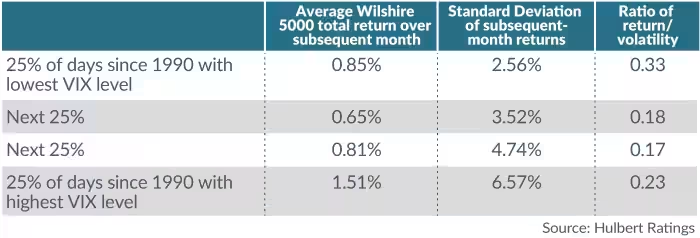
A VIX Spike Can Be Bullish — But Volatility Comes With a Price A surge in the VIX often signals heightened fear — and for contrarians, that can mean opportunity. But while a spiking, it can sometimes precede gains, it also brings sharp market swings that can shake even experienced investors out of their positions. Right now, the VIX is elevated, and if it remains at current levels through the end of March, a cautious portfolio adjustment would suggest reducing equity exposure for April to around 47.6%. The VIX — often called Wall Street’s “fear gauge” — has more than doubled in just 16 trading sessions from mid-February through last week. At current readings, it’s sitting above 92% of all daily levels since 1990. Contrarians see this as a bullish signal, particularly when the spike is sudden and sharp. But here’s the reality: Stocks historically perform better when volatility is low. While high VIX levels may precede market rebounds, those rebounds are often extremely volatile. In contrast, periods of low volatility tend to produce steadier, more reliable returns. A Smarter Way to Manage Risk Research from finance professors Alan Moreira (University of Rochester) and Tyler Muir (UCLA) supports a volatility-based strategy. Their work, “Volatility-Managed Portfolios,” shows that adjusting equity exposure based on volatility levels can improve risk-adjusted returns over time. Their approach is simple: For example, let’s say your target equity exposure is 60%, and you use the VIX’s historical median of 17.61 as your baseline. With a VIX reading of 19.63 at the end of February, you’d scale back equity exposure to 53.8%. If the VIX remains elevated, the model suggests dialing back to 47.6% for April. Since 1990, this strategy has consistently outperformed buy-and-hold on a risk-adjusted basis, with a Sharpe ratio of 0.99 compared to the market’s 0.78 — and it’s continued to outperform in real-time since the study’s publication. The Contrarian Mistake Contrarians aren’t wrong that markets can rise after periods of high volatility. But they often overlook the risk: the return-to-volatility ratio is less favorable when the VIX is high. Historical data shows that although average monthly returns after the highest VIX readings are nearly double those after the lowest VIX readings, the accompanying volatility is nearly three times greater. What This Means Now With the VIX currently in its highest quartile historically, the next market move could very well be upward — but expect a turbulent ride. For most investors, adjusting exposure based on volatility, rather than betting on fear turning into sudden gains, may offer a smoother path to solid returns. John PaulJohn Paul is the founder of DayTradeToWin, a trading education and software company established in 2008, supporting traders worldwide. His expertise focuses on price action-based futures trading strategies and structured market analysis. DayTradeToWin delivers trading education, indicators, and software tools designed to help traders apply disciplined, rule-based decision-making across global futures markets. He is the creator of multiple trading methodologies, including the Sonic System, Atlas Line, and Trade Scalper, which help traders identify structured opportunities in markets such as the E-mini S&P 500 (ES), Nasdaq (NQ), crude oil (CL), and gold (GC). Official website: https://daytradetowin.com daytradetowin.com
market
Market News

No Fed Rescue for Trump’s Market Bulls

Don’t Count on a ‘Powell Put’ This Week, Economist Warns Investors hoping for Federal Reserve intervention amid market volatility may be out of luck. Fed Chair Jerome Powell is unlikely to signal any support measures when policymakers meet this week, despite recent stock market weakness. “The upside risks to inflation suggest that, despite the recent downturn in equities, the chances of a ‘Powell put’ are slim,” said Stephen Brown, deputy chief U.S. economist at Capital Economics. A “Powell put” refers to the expectation that the Fed will step in with rate cuts or other measures if markets decline sharply—a notion dating back to the 1987 stock crash, when then-Fed Chair Alan Greenspan swiftly lowered interest rates. But Powell has consistently signaled a cautious, data-driven approach, making a policy pivot unlikely in the near term. Investors received a similar message last week from former President Donald Trump, who dismissed concerns that his aggressive tariff policies could hurt the economy. In a television interview, he suggested that any short-term pain would be outweighed by long-term trade benefits, effectively ruling out a “Trump put.” That stance forced markets to reassess the likelihood of policy relief from the White House. As a result, stocks have struggled under persistent uncertainty. The S&P 500 posted its fourth consecutive weekly loss, with the Nasdaq Composite slipping into correction territory. The Dow Jones Industrial Average and the small-cap Russell 2000 also approached key technical levels before rebounding on Friday—coincidentally, a day when Trump remained silent on trade matters. More than immediate economic damage, investors fear that prolonged uncertainty around tariffs and policy direction could stifle business investment, hiring, and growth, setting the stage for a slowdown. “The unpredictability of policymaking is more damaging than the tariffs themselves,” said Kevin Gordon, senior investment strategist at Charles Schwab. “Companies can adapt to tariffs if they know what to expect. The real problem is constantly changing policies.” That uncertainty is reflected in consumer sentiment. The University of Michigan’s consumer confidence index fell to a 29-month low in March, highlighting growing economic anxiety. Meanwhile, markets have priced in three potential rate cuts for 2025, anticipating weaker growth ahead. But the Fed faces the same unpredictability as investors. The central bank’s dual mandate—balancing inflation control with full employment—complicates its decision-making. A mix of rising inflation and policy-driven job losses makes it difficult for Powell to justify rate cuts. Given this backdrop, Powell is expected to stick to his patient, wait-and-see approach. Earlier this month, he emphasized that sentiment readings don’t always translate to real economic shifts, reinforcing the Fed’s cautious stance. For investors, that means prioritizing quality. Stocks of companies with strong balance sheets, steady earnings growth, and low volatility have been among the most resilient during recent market turmoil. In uncertain times, financial stability remains key. John PaulJohn Paul is the founder of DayTradeToWin, a trading education and software company established in 2008, supporting traders worldwide. His expertise focuses on price action-based futures trading strategies and structured market analysis. DayTradeToWin delivers trading education, indicators, and software tools designed to help traders apply disciplined, rule-based decision-making across global futures markets. He is the creator of multiple trading methodologies, including the Sonic System, Atlas Line, and Trade Scalper, which help traders identify structured opportunities in markets such as the E-mini S&P 500 (ES), Nasdaq (NQ), crude oil (CL), and gold (GC). Official website: https://daytradetowin.com daytradetowin.com

S&P 500
Market News

S&P 500 Slumps – Here’s What to Expect

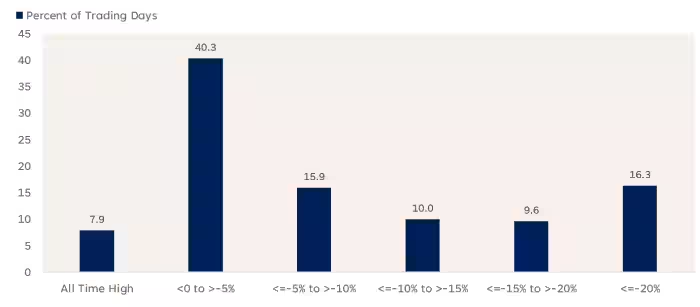
The S&P 500 officially closed in correction territory on Thursday, marking its fastest peak-to-correction decline since March 2020. Another day, another tariff-driven selloff on Wall Street. The U.S. stock market’s sharp decline continued on Thursday, with the S&P 500 dropping 1.4% to close at 5,521.52. The index has now entered correction territory—defined as a 10% drop from its recent high—after falling more than 10% from its February 19 peak of 6,144.15. This correction took just 16 trading days, making it the swiftest such decline since the six-day plunge at the onset of the COVID-19 pandemic in March 2020, according to Dow Jones Market Data. Market Performance After a Correction Historical data suggests that stocks often struggle in the short term after entering correction territory but tend to recover over time. Since 2008, the S&P 500 has averaged a 1.7% decline in the first month following a correction. However, over the next three and six months, the index has historically rebounded by 2.1% and nearly 5%, respectively. One year after a correction, the S&P 500 has posted an average gain of 15.3%, according to Dow Jones Market Data. Tariffs and Market Volatility Thursday’s selloff was exacerbated by escalating trade tensions. President Donald Trump intensified tariff threats against the European Union, calling it a “hostile and abusive taxing and tariffing authority” and warning of a 200% tariff on EU alcohol imports. Meanwhile, Canada is embroiled in a tit-for-tat tariff dispute with the U.S., with Canadian Finance Minister Dominic LeBlanc and Ontario Premier Doug Ford meeting with U.S. Commerce Secretary Howard Lutnick to address trade tensions. The dispute stems from recent U.S. tariffs on steel and aluminum, along with previous threats of a 25% tariff on all Canadian goods. The uncertainty surrounding Trump’s trade policies and retaliatory measures from global partners has fueled risk-off sentiment, increasing volatility and raising concerns about an economic slowdown. Understanding Market Drawdowns Despite the recent downturn, market experts suggest that such pullbacks are not unusual. Adam Turnquist, chief technical strategist at LPL Financial, noted that since 1950, 92% of trading days have experienced some level of drawdown from the S&P 500’s peaks. Declines of less than 5% occur in about 40% of cases, while pullbacks between 5% and 15% have taken place in over a quarter of all trading days. “Although this correction is sharp, it’s not out of the ordinary,” Turnquist explained. He pointed out that rapid selloffs often create oversold conditions, but ongoing market weakness, lack of institutional participation, and defensive sector rotations suggest caution when considering buying the dip. Market Close and Outlook On Thursday, U.S. stocks ended lower, with the Nasdaq Composite falling nearly 2% and the Dow Jones Industrial Average dropping over 530 points, or 1.3%, according to FactSet data. As investors navigate ongoing trade uncertainties, the focus remains on whether the market can stabilize in the coming weeks. John PaulJohn Paul is the founder of DayTradeToWin, a trading education and software company established in 2008, supporting traders worldwide. His expertise focuses on price action-based futures trading strategies and structured market analysis. DayTradeToWin delivers trading education, indicators, and software tools designed to help traders apply disciplined, rule-based decision-making across global futures markets. He is the creator of multiple trading methodologies, including the Sonic System, Atlas Line, and Trade Scalper, which help traders identify structured opportunities in markets such as the E-mini S&P 500 (ES), Nasdaq (NQ), crude oil (CL), and gold (GC). Official website: https://daytradetowin.com daytradetowin.com

Scroll to Top