

Market News

presidents day
Market News

Presidents Day: What’s Open & Closed?

What’s Open and Closed on Presidents Day? Here’s What You Need to Know Presidents Day, observed on the third Monday of February, honors all U.S. presidents but originally celebrated George Washington’s birthday. Officially recognized as Washington’s Birthday on federal and stock market calendars, this year’s holiday falls on February 17. As a federal holiday, many businesses, government offices, and financial markets will be closed. Here’s a breakdown of what’s open and what’s not. Are the Stock and Bond Markets Open? No. The New York Stock Exchange (NYSE), Nasdaq, and bond markets will be closed on Monday. Trading resumes on Tuesday, February 18. Stocks were heading into the holiday weekend with strong momentum. The S&P 500 was just shy of its record close from January 23, while the Dow Jones Industrial Average had gained 5.1% year-to-date, and the Nasdaq Composite was up 3.3% through Thursday’s close. Will There Be Mail Delivery? Are Banks Open? Most banks follow the Federal Reserve’s holiday schedule and will be closed. However, ATMs, mobile banking, and online services will remain available. Check with your local branch for specific hours. Are Government Offices Open? Nonessential federal and state government offices will be closed for the holiday. Are Schools Open? Most schools will be closed, though some districts may use the day as a makeup day for weather-related closures. Check with your local school district for details. Are Stores Open? Yes. Many retailers not only remain open but also offer Presidents Day sales, with discounts on everything from electronics to home goods. Whether you’re planning a shopping trip or just need to know what’s open, now you’re prepared for the holiday schedule. John PaulJohn Paul is the founder of DayTradeToWin, a trading education and software company established in 2008, supporting traders worldwide. His expertise focuses on price action-based futures trading strategies and structured market analysis. DayTradeToWin delivers trading education, indicators, and software tools designed to help traders apply disciplined, rule-based decision-making across global futures markets. He is the creator of multiple trading methodologies, including the Sonic System, Atlas Line, and Trade Scalper, which help traders identify structured opportunities in markets such as the E-mini S&P 500 (ES), Nasdaq (NQ), crude oil (CL), and gold (GC). Official website: https://daytradetowin.com daytradetowin.com


scalping
Market News

Optimize Scalping with ATR Targets

Hello, Traders! Happy Friday! Today, we’re exploring live trades and the importance of dynamically adjusting targets using the Sonic System for scalping. Whether you’re seeking rapid entries and exits or larger profit targets, refining your approach can significantly impact your success. Optimizing Your Scalping Strategy A key takeaway from today’s session is adjusting profit targets based on the ATR (Average True Range). By default, our take-profit target is set at 75% of the ATR, allowing us to capitalize on momentum while managing risk effectively. Live Trade Recap: February 13th We identified multiple long signals throughout the session. Once an audible alert signaled an entry, we followed the system’s guidance on stops and targets: For traders who prefer frequent trades, this method maximizes opportunities while keeping risk under control. However, excessive trading should be avoided—10 quality trades a day are more than sufficient for solid results. Managing Stops & Targets Effectively A balanced 50/50 risk-reward ratio is crucial. We ensure that our target isn’t disproportionately small compared to our stop. If the market moves sideways without hitting either, we exit manually—scalping isn’t about holding on for hours! Live Trade: February 14th – Expanding Targets Today’s market open provided an opportunity to increase profit targets while keeping stops constant. Volatility at market open can be high, so caution is advised. Instead of using a 75% ATR target, we adjusted to 3.5x the ATR for a larger profit window. Trade Breakdown: By securing a better entry price, we reduced risk while maintaining flexibility in managing trades based on live market conditions. Key Takeaways for Scalpers For more trading insights, visit DayTradeToWin.com, get your free member account, and subscribe to the Day Trade To Win YouTube channel for live examples and strategies. See you at the next class! John PaulJohn Paul is the founder of DayTradeToWin, a trading education and software company established in 2008, supporting traders worldwide. His expertise focuses on price action-based futures trading strategies and structured market analysis. DayTradeToWin delivers trading education, indicators, and software tools designed to help traders apply disciplined, rule-based decision-making across global futures markets. He is the creator of multiple trading methodologies, including the Sonic System, Atlas Line, and Trade Scalper, which help traders identify structured opportunities in markets such as the E-mini S&P 500 (ES), Nasdaq (NQ), crude oil (CL), and gold (GC). Official website: https://daytradetowin.com daytradetowin.com

market
Market News

Market Climb, Investors Downplay Trump’s Tariffs

Market Rally Doesn’t Shield Investors from Tariff Risks Wall Street appears unfazed by the looming threat of a global trade war. The S&P 500 closed just shy of a record high on Thursday after President Donald Trump instructed his administration to explore reciprocal tariffs on several U.S. trading partners. Despite concerns about escalating trade tensions, markets surged, reflecting investor sentiment that the economic impact of tariffs may be less severe than initially feared. “The bark is worse than the bite,” said George Young, partner and portfolio manager at Villere & Co., which oversees $1.8 billion in assets. Investors were relieved that Trump’s order didn’t impose immediate tariffs, easing fears of swift economic disruption. Similar tariff-related announcements in the past have also been met with less severe consequences than initially expected. On Wednesday, the S&P 500 climbed 1% to close at 6,115.07, just 0.1% below its record high of 6,118.71 set on Jan. 23. The Dow Jones Industrial Average gained 342.87 points (0.8%), while the Nasdaq Composite surged 1.5%. Earlier this week, Trump imposed a 25% tariff on steel and aluminum imports, following previous levies on goods from Canada, Mexico, and China. However, tariffs on Canada and Mexico were temporarily paused after both countries pledged to tighten border security and combat drug trafficking. Despite the market’s optimism, investors remain cautious. “This is the new normal,” Young told MarketWatch. “The market isn’t ignoring the risks—it’s digesting them one step at a time, waiting to see what actually unfolds.” The tariff debate is far from over. White House officials suggest that reciprocal tariffs could take effect within weeks or months. While the administration has backed away from a universal 10%-20% tariff, a country-by-country approach could result in even higher average tariffs and rising consumer prices, warned Paul Ashworth, chief North America economist at Capital Economics. Tariffs are just one of several economic uncertainties tied to Trump’s policies, noted Matt Eagan, portfolio manager at Loomis, Sayles & Co., which manages $389 billion in assets. “Tax cuts may boost spending but worsen the deficit. Immigration policies could tighten labor markets but drive up wages. Tariffs could slow demand while increasing costs,” Eagan explained. “Investors must look beyond the headlines. Trump’s policies may seem more bark than bite, but complacency is risky.” That complacency could lead to a dangerous cycle, warned Christopher Smart, managing partner at Arbroath Group, a firm specializing in geopolitical risk analysis. “If markets don’t react negatively, Trump may feel encouraged to push even further,” Smart noted. “Tariffs are coming—it’s just a matter of how high they’ll go. Given the market’s calm response so far, the president may be emboldened to test the limits.” John PaulJohn Paul is the founder of DayTradeToWin, a trading education and software company established in 2008, supporting traders worldwide. His expertise focuses on price action-based futures trading strategies and structured market analysis. DayTradeToWin delivers trading education, indicators, and software tools designed to help traders apply disciplined, rule-based decision-making across global futures markets. He is the creator of multiple trading methodologies, including the Sonic System, Atlas Line, and Trade Scalper, which help traders identify structured opportunities in markets such as the E-mini S&P 500 (ES), Nasdaq (NQ), crude oil (CL), and gold (GC). Official website: https://daytradetowin.com daytradetowin.com
Goldman
Market News

Retail Bought the Dip—Goldman Sees Trouble Ahead

Dip Buying Continues, But a Shift May Be Coming Goldman Says The S&P 500 initially fell as much as 1.1% on Wednesday after a hotter-than-expected consumer price index (CPI) report. However, the losses didn’t last, with the index recovering to close down just 0.3%. Scott Rubner, a tactical strategist at Goldman Sachs, attributes the swift rebound to one key factor: retail investors buying the dip. “Retail was buying the early morning dip post-CPI,” Rubner wrote in a client email. “Everyone is in—retail traders, 401(k) inflows, start-of-the-year allocations, and corporate buybacks.” However, Rubner believes this bullish momentum may be nearing its end. “This is the last bullish email I will send for Q1 2025,” he warned, citing shifting market dynamics and the arrival of negative seasonal trends. The E-Mini S&P 500 futures contract is hovering near its 50-day moving average, testing key technical levels. Rubner’s analysis suggests that commodity-trading adviser (CTA) trend followers have more selling pressure ahead if the market declines than buying support if it rises. January and February typically bring strong inflows into 401(k) and 529 plans, but that tailwind is expected to fade soon. Meanwhile, corporate stock buybacks are on pace for a record $1.16 trillion this year, though activity is likely to slow after March 16. Retail investors have been net buyers for 22 consecutive days, including three of the largest buying days on record. But Rubner cautions that this level of demand may not be sustainable for much longer. John PaulJohn Paul is the founder of DayTradeToWin, a trading education and software company established in 2008, supporting traders worldwide. His expertise focuses on price action-based futures trading strategies and structured market analysis. DayTradeToWin delivers trading education, indicators, and software tools designed to help traders apply disciplined, rule-based decision-making across global futures markets. He is the creator of multiple trading methodologies, including the Sonic System, Atlas Line, and Trade Scalper, which help traders identify structured opportunities in markets such as the E-mini S&P 500 (ES), Nasdaq (NQ), crude oil (CL), and gold (GC). Official website: https://daytradetowin.com daytradetowin.com
market
Market News

Forget CPI: This Markets Signal Warns of Prolonged Inflation

Investors Eye CPI Report as Inflation Concerns Linger As investors brace for January’s consumer price index (CPI) report, financial markets remain on edge over persistent inflation concerns. While expectations suggest little change or a slight improvement from December, one key indicator continues to flash warning signs. The five-year breakeven inflation rate—a measure of expected inflation over the medium term—stood at 2.6% on Tuesday and has remained above its 50- and 200-day moving averages since late October, according to FactSet data. This suggests inflation could stay above the Federal Reserve’s 2% target for years. “There’s still some lingering sticker shock from the 2021-22 inflation spike,” said Mark Heppenstall, chief investment officer at Penn Mutual Asset Management. “People are still adjusting to how quickly inflation surged to 9% in 2022.” Tim Magnusson, chief investment officer at Garda Capital Partners, echoed similar concerns. “While inflation is unlikely to return to 2021-23 levels, it’s possible it could stay well above the Fed’s target for months or even years,” he said, citing recent consumer expectations data from the University of Michigan. “If that’s the case, the Fed may have to keep rates steady for longer.” Markets are closely watching Wednesday’s CPI report, with traders expecting an annual headline inflation rate of 2.9%. Even a slight upside surprise could push that figure to 3% or higher—the highest since June 2024—potentially unsettling financial markets and drawing the Fed’s attention. Economists surveyed by The Wall Street Journal anticipate annual headline and core inflation rates of 2.8% and 3.1%, respectively, down slightly from December’s 2.9% and 3.2%. The monthly core reading is expected to hold steady at 0.3%. Federal Reserve Chair Jerome Powell, speaking before Congress on Tuesday, emphasized there’s no urgency to adjust interest rates and noted that the impact of President Donald Trump’s proposed tariffs remains uncertain. Treasury yields climbed to their highest levels in over a week, with the 10-year yield reaching 4.54% after four consecutive days of gains. Meanwhile, stocks ended mixed: the Dow Jones Industrial Average rose 0.28%, the S&P 500 edged up 0.03%, and the Nasdaq Composite fell 0.36%. Heppenstall suggested the 10-year yield may stabilize around 4.5%, advising investors to avoid overreacting to the CPI data. “There will be ongoing back-and-forth on policy from the administration, with some days looking favorable and others negative,” he said. “I don’t expect yields to drop significantly, but a risk-off environment will also limit how high they can go.” John PaulJohn Paul is the founder of DayTradeToWin, a trading education and software company established in 2008, supporting traders worldwide. His expertise focuses on price action-based futures trading strategies and structured market analysis. DayTradeToWin delivers trading education, indicators, and software tools designed to help traders apply disciplined, rule-based decision-making across global futures markets. He is the creator of multiple trading methodologies, including the Sonic System, Atlas Line, and Trade Scalper, which help traders identify structured opportunities in markets such as the E-mini S&P 500 (ES), Nasdaq (NQ), crude oil (CL), and gold (GC). Official website: https://daytradetowin.com daytradetowin.com

bitcoin
Market News

Is Bitcoin Peaking? Analysts Warn

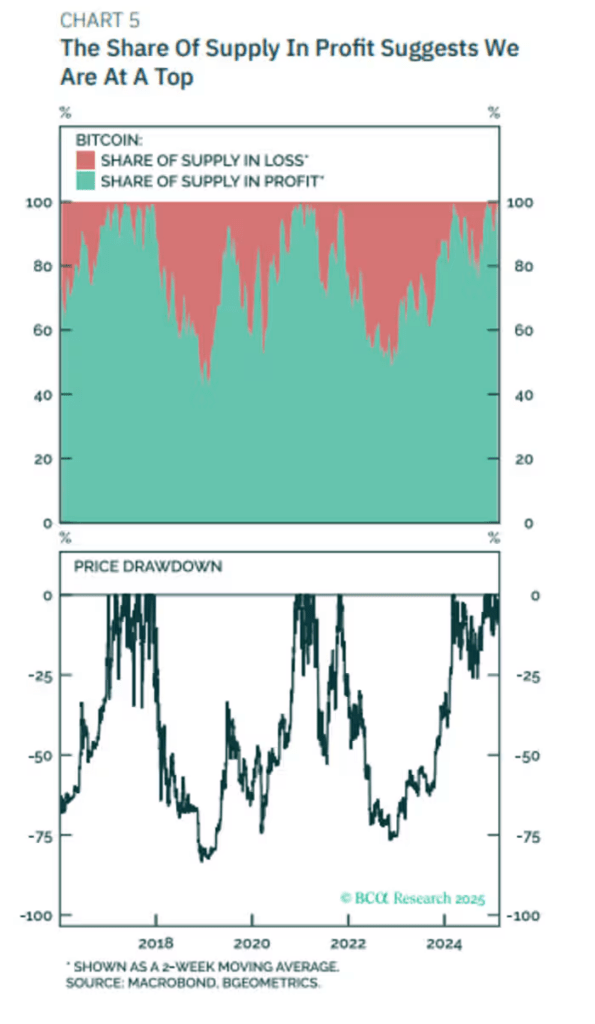
BCA Research Signals Bitcoin May Have Peaked as Profitability Hits Historic Levels Bitcoin’s recent price action suggests a potential market top, according to analysts at BCA Research. They highlight that the percentage of bitcoin in profit has reached levels historically associated with previous peaks. After hitting a record high on Jan. 20—coinciding with former President Donald Trump’s inauguration—bitcoin has since declined 10%. While such volatility is common, BCA Research, which has maintained a bullish stance over the past two years, is now expressing caution. Juan Correa, a strategist for global asset allocation at BCA, points to several red flags. One is Trump’s direct involvement in launching two low-float memecoins, which BCA analysts see as a sign of speculative excess rather than a broadening of crypto adoption. Although memecoins account for less than 2% of the total crypto market and are largely avoided by institutional investors, their rise reflects a broader surge in optimism toward digital assets. Bitcoin ETFs have become the most successful in history, and BlackRock CEO Larry Fink has suggested that major investors may allocate up to 5% of their portfolios to bitcoin, even speculating on a potential price target of $700,000. “We are concerned that this level of euphoria signals we are near a top,” BCA analysts warn. They emphasize that over 90% of bitcoin supply is currently in profit, a historical marker that has often preceded market peaks. Additionally, eight of the ten most downloaded financial apps are crypto trading platforms, further indicating speculative fervor. Macroeconomic risks also loom. BCA notes that if government deficit spending is lower than expected, it could dampen bitcoin’s rally. “A U.S. economy that is both cooler and more fiscally responsible than anticipated may not support bitcoin’s recent surge,” they explain. Despite their cautious outlook, BCA remains structurally positive on bitcoin’s long-term role in a diversified portfolio. However, they caution that sentiment-driven rallies can lead to unsustainable price levels. “We would be more enthusiastic buyers at $75,000,” they state. One factor that could challenge their bearish view is Trump’s proposal for a strategic bitcoin reserve, which would involve holding crypto assets seized by law enforcement. “While this might provide a short-term boost, in our view, it would likely mark the top of the cycle,” BCA notes. Reflecting the current speculative environment, BCA has even launched its own satirical memecoin, Liquidity Trap. “The name is both a nod to our firm’s historic work on liquidity and a literal warning—any money put into this coin will almost certainly be lost forever,” they quip. John PaulJohn Paul is the founder of DayTradeToWin, a trading education and software company established in 2008, supporting traders worldwide. His expertise focuses on price action-based futures trading strategies and structured market analysis. DayTradeToWin delivers trading education, indicators, and software tools designed to help traders apply disciplined, rule-based decision-making across global futures markets. He is the creator of multiple trading methodologies, including the Sonic System, Atlas Line, and Trade Scalper, which help traders identify structured opportunities in markets such as the E-mini S&P 500 (ES), Nasdaq (NQ), crude oil (CL), and gold (GC). Official website: https://daytradetowin.com daytradetowin.com

Scroll to Top