

Market News

risk-to-reward
Market News

Master Risk-to-Reward with NinjaTrader

Successful trading hinges on effective risk-to-reward trade management. At Day Trade to Win, we emphasize price action strategies that empower traders to make informed decisions without relying on conventional indicators like moving averages or MACDs. In this post, we’ll explore essential aspects of risk management, trade entries, profit target multiples, and common mistakes to avoid. Understanding Risk-to-Reward Ratio Before placing a trade, it’s vital to assess potential risk versus reward. The goal is to ensure that the potential reward is equal to or greater than the risk. This principle, often referred to as the 50/50 rule, suggests placing stop-loss and target levels equidistant from the entry point. Some traders adopt a 60/40 approach, where they accept slightly higher risk for lower rewards. The key is finding a balance that suits your strategy and market conditions. Optimizing Trade Entries Entering a trade at the right time is crucial. Instead of rushing in at the market price, traders should analyze price action for a better entry, reducing slippage and improving trade outcomes. Taking a few extra seconds to assess the market can significantly enhance profitability. Dynamic Targets and Stop-Loss Adjustments Since markets constantly change, using fixed stop-loss and target levels for every trade is not always effective. Instead, traders should adjust their stop-losses and targets based on market volatility. High volatility may warrant wider targets, while low volatility conditions may favor smaller targets. Setting Profit Target Multiples Instead of arbitrarily setting profit targets, traders should use structured approaches like the Sonic system to identify realistic price targets. Utilizing price action indicators ensures traders are making calculated decisions rather than guessing market movements. Scalp vs. Swing Trading Traders may adopt different styles based on their goals: Merging Strategies for Higher Probability Trades Combining different trading techniques can enhance success rates. When multiple strategies align, confirming trade direction, the likelihood of a favorable outcome increases. Conversely, conflicting signals serve as a warning to avoid a trade. Avoiding Common Trading Mistakes Traders should steer clear of these pitfalls: Leveraging Price Action for Trade Decisions Traditional indicators often fail to adapt to market shifts because they rely on historical data. In contrast, price action strategies, such as the Roadmap software, track real-time price movements, helping traders spot entry opportunities and avoid false signals. Precision in Entry and Exit Points A single tick variation in entry price can cover commissions and boost profitability. Entering a tick or two better than the provided signal minimizes stop-loss size and enhances potential profits. Live Trading & Market Adjustments Live trading sessions on YouTube and the Day Trade to Win blog allow traders to see real-time market fluctuations. Entry positions should be adjusted based on retracement expectations. While predicting exact retracements is difficult, improving entry price by a few ticks can significantly improve risk management. Managing Risk and Avoiding Overtrading With the Sonic system, traders must recognize when to stop. A general rule of thumb: ATR-Based Profit Targets Average True Range (ATR) dynamically adjusts profit targets based on market conditions. A four-period ATR offers the most up-to-date market volatility insights to: Traders can tailor ATR settings to match their trading styles: Trade Timing & Management Utilizing the Roadmap Software The Roadmap software helps traders avoid false signals by pinpointing profit-taking levels. If a market shows signs of profit-taking, it’s best to avoid entering trades in that direction. The software also identifies critical zones where large traders exit positions, preventing unnecessary risks. Recognizing and Preventing Overtrading One of the biggest trading mistakes is overtrading. Traders should limit themselves to three to five trades per session to maintain profitability and avoid unnecessary risks. Understanding Market Retracements If the market moves sharply without retracing, it’s better to let the trade go rather than chasing it. The Sonic system is designed to offer better price entries. If a retracement doesn’t occur, waiting for the next opportunity is the smarter approach. Conclusion Applying these risk-to-reward trade management principles, such as optimal entry points, ATR-based trade strategies, profit-taking awareness, and disciplined trade frequency, can significantly improve trading performance. The combination of the Sonic system and Roadmap software equips traders with the tools needed to navigate the markets effectively. For more expert insights, visit Day Trade to Win and sign up for a free membership to access valuable trading resources. John PaulJohn Paul is the founder of DayTradeToWin, a trading education and software company established in 2008, supporting traders worldwide. His expertise focuses on price action-based futures trading strategies and structured market analysis. DayTradeToWin delivers trading education, indicators, and software tools designed to help traders apply disciplined, rule-based decision-making across global futures markets. He is the creator of multiple trading methodologies, including the Sonic System, Atlas Line, and Trade Scalper, which help traders identify structured opportunities in markets such as the E-mini S&P 500 (ES), Nasdaq (NQ), crude oil (CL), and gold (GC). Official website: https://daytradetowin.com daytradetowin.com

market
Market News

Market Rally Stalls – What Now?

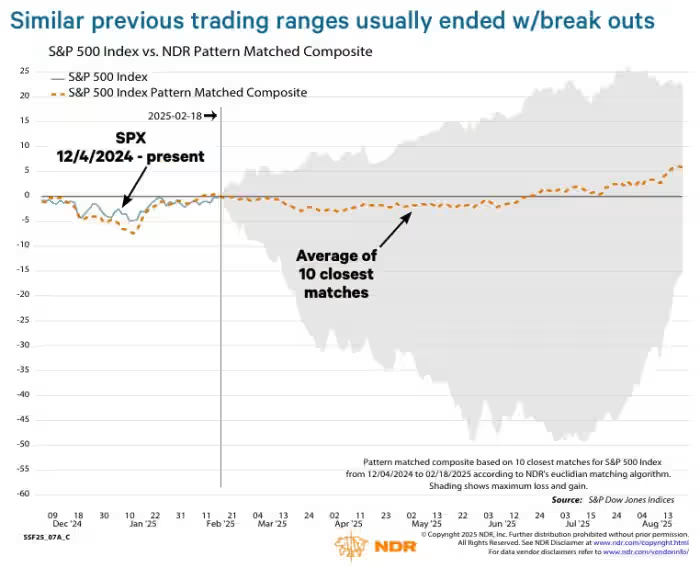
A team of strategists at Ned Davis Research has been analyzing market trends, and their findings suggest U.S. stocks are pausing for breath after two blockbuster years—much to investors’ frustration. For the past two and a half months, the S&P 500 (SPX) has been stuck in a tight trading range, signaling a period of “consolidation,” according to the Ned Davis team. Despite this, the index has still managed to reach new record highs, most recently on Wednesday, per FactSet data. However, the pace of gains has slowed considerably compared to 2024, while European and Chinese stocks have surged ahead. Given ongoing concerns over tariffs, widespread federal layoffs, and high stock valuations, the market’s resilience has been notable. “So far, markets have largely brushed off the tariff threats and [President Donald] Trump’s geopolitical drama this year,” said Burns McKinney, portfolio manager at NFJ Investments, in an email to MarketWatch on Thursday. Still, investor sentiment is beginning to show signs of strain. Vanguard’s investor confidence metrics recently saw their steepest drop since 2022, according to Andy Reed, head of investor-behavior research at the firm. He noted that concerns over record-high egg prices are overshadowing enthusiasm for the stock market. However, history suggests that indecisive trading periods like this often resolve quickly—typically followed by stronger gains. The Ned Davis team analyzed the S&P 500’s performance since early December, comparing it to past episodes of sideways trading. While historical patterns show some variability, they suggest that choppy trading could persist in the short term before stocks resume their upward momentum. “Whether the past 2.5 months mark a consolidation phase within an ongoing bull market or the start of a downturn depends on factors like inflation and earnings,” said Ed Clissold, chief U.S. strategist at Ned Davis, in a report shared with MarketWatch. “Right now, the data still supports the bull market case—until proven otherwise.” Investors’ concerns were evident in Thursday’s market action, as disappointing earnings guidance from Walmart Inc. (WMT) rattled confidence in consumer strength. The S&P 500, Nasdaq Composite (COMP), and Dow Jones Industrial Average (DJIA) all ended the day lower. John PaulJohn Paul is the founder of DayTradeToWin, a trading education and software company established in 2008, supporting traders worldwide. His expertise focuses on price action-based futures trading strategies and structured market analysis. DayTradeToWin delivers trading education, indicators, and software tools designed to help traders apply disciplined, rule-based decision-making across global futures markets. He is the creator of multiple trading methodologies, including the Sonic System, Atlas Line, and Trade Scalper, which help traders identify structured opportunities in markets such as the E-mini S&P 500 (ES), Nasdaq (NQ), crude oil (CL), and gold (GC). Official website: https://daytradetowin.com daytradetowin.com
Market News

Boost Your Trading Success with This Proven Strategy

Today, February 20th, I’m excited to share my hands-on experience using the Sonic Trading System by Day Trade to Win. I will walk you through four to five consecutive trade signals, demonstrating the system’s effectiveness and how it can enhance your daytrading precision. Trading carries risks, so only use funds you can afford to lose. Proper risk management is crucial to long-term success. How the Sonic Trading System Works I am utilizing the Sonic System with a 1-minute chart to track trade signals in real time. The system provides audible alerts, guiding me through the best possible trade entries. My approach involves: Real-Time Trading Breakdown Trade 1: Short Position Trade 2: Long Position Trade 3: Another Long Setup Trade 4: Short Signal Execution Performance Review With four to five successful trades in a row, the Sonic System proves to be an excellent trading tool. Traders using one contract could earn a few hundred dollars, while those using multiple contracts could see $1,000+ gains. Join the Day Trade to Win Community If you want to refine your skills with the Sonic System, visit daytradetowin.com to create a free member account. Benefits include: Final Thoughts The Sonic System is a game-changer for traders looking for structured, rule-based trading. Whether you’re new or experienced, this system can help you navigate the markets with confidence. Join the Day Trade to Win Family today and elevate your trading journey! See you at the next webinar! Stay focused, trade smart, and happy trading! John PaulJohn Paul is the founder of DayTradeToWin, a trading education and software company established in 2008, supporting traders worldwide. His expertise focuses on price action-based futures trading strategies and structured market analysis. DayTradeToWin delivers trading education, indicators, and software tools designed to help traders apply disciplined, rule-based decision-making across global futures markets. He is the creator of multiple trading methodologies, including the Sonic System, Atlas Line, and Trade Scalper, which help traders identify structured opportunities in markets such as the E-mini S&P 500 (ES), Nasdaq (NQ), crude oil (CL), and gold (GC). Official website: https://daytradetowin.com daytradetowin.com
U.S. Stocks
Market News

New Highs for U.S. Stocks—Boom or Bubble?

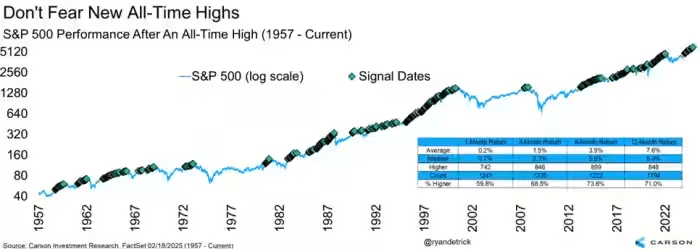
Investors Should Embrace Stocks Record Highs While Staying Vigilant For the first time in nearly four weeks, the S&P 500 reached a new closing high on Tuesday. Investors who have remained on the sidelines may now be wondering: Is it too late to enter the market? After two years of strong gains, it’s natural to question whether to invest now or wait for a potential pullback. As the saying goes, “trees don’t grow to the sky”—markets don’t rise indefinitely without pauses or corrections. New market highs can shape investor sentiment, but history shows they are not unusual. Ryan Detrick, chief market strategist at Carson Group, notes that since 1957, the S&P 500 has reached a new record high roughly every three weeks on average. This doesn’t mean stocks are immune to downturns. While bear markets occur, they have historically been infrequent. Investors who remain on the sidelines often miss out on significant long-term gains. “Should you buy at all-time highs? That’s a frequent question,” Detrick shared on X. “My take: Don’t fear new highs. The S&P 500 has risen a year later 71% of the time after reaching a record, with a median return of 8.3%—essentially normal returns.” Of course, exceptions exist. The S&P 500 hit a record of 4,796.56 on January 3, 2022, before declining 25% in a bear market. It took over two years to surpass that peak. However, such downturns are the exception, not the rule. Historically, stocks trend upward over time, particularly following the recovery from the 2008 financial crisis. Key Risks to Consider Despite market resilience, investors should remain mindful of emerging risks. Several challenges have surfaced at a time when U.S. large-cap valuations are historically high. Additionally, seasonal trends indicate that the first quarter of a new presidential term is often one of the weakest in the four-year cycle, according to Detrick. Potential concerns include: Thus far, investors have largely brushed off these risks, but sentiment can shift quickly. Market Breadth and Leadership While the “Magnificent Seven” megacap tech stocks have struggled in early 2025, other stocks have gained ground, broadening the market rally. This diversification reduces the market’s vulnerability to single-stock declines, such as Nvidia Corp.’s sharp 17% drop in late January, which caused the S&P 500 to fall nearly 1.5%, despite gains in most other index components. The S&P 500’s rise has slowed in 2025, but broader participation suggests a more stable rally. Year to date, the index is up 4.2% as of midday Wednesday. The Invesco S&P 500 Equal Weight ETF (RSP), which better reflects the performance of the average S&P 500 stock, has gained 4%, according to FactSet. Looking Back and Moving Forward Exactly five years ago, on February 19, 2020, the S&P 500 hit a record before the COVID-19 pandemic disrupted global markets. Since then, the index has climbed more than 80%, according to FactSet data. By late summer 2020, it had fully recovered from the pandemic-induced selloff. As of Wednesday’s trading session, the S&P 500 was down 6 points, or 0.1%, at 6,122. The Nasdaq Composite declined 53 points, or 0.3%, to 19,990, while the Dow Jones Industrial Average dropped 144 points, or 0.3%, to 44,413. While new highs may seem concerning, history suggests they are a natural part of market cycles. Investors who take a measured approach and maintain a long-term perspective are often rewarded over time. John PaulJohn Paul is the founder of DayTradeToWin, a trading education and software company established in 2008, supporting traders worldwide. His expertise focuses on price action-based futures trading strategies and structured market analysis. DayTradeToWin delivers trading education, indicators, and software tools designed to help traders apply disciplined, rule-based decision-making across global futures markets. He is the creator of multiple trading methodologies, including the Sonic System, Atlas Line, and Trade Scalper, which help traders identify structured opportunities in markets such as the E-mini S&P 500 (ES), Nasdaq (NQ), crude oil (CL), and gold (GC). Official website: https://daytradetowin.com daytradetowin.com
Goldman
Market News

Goldman: AI Could Add $200B to China—But Wait

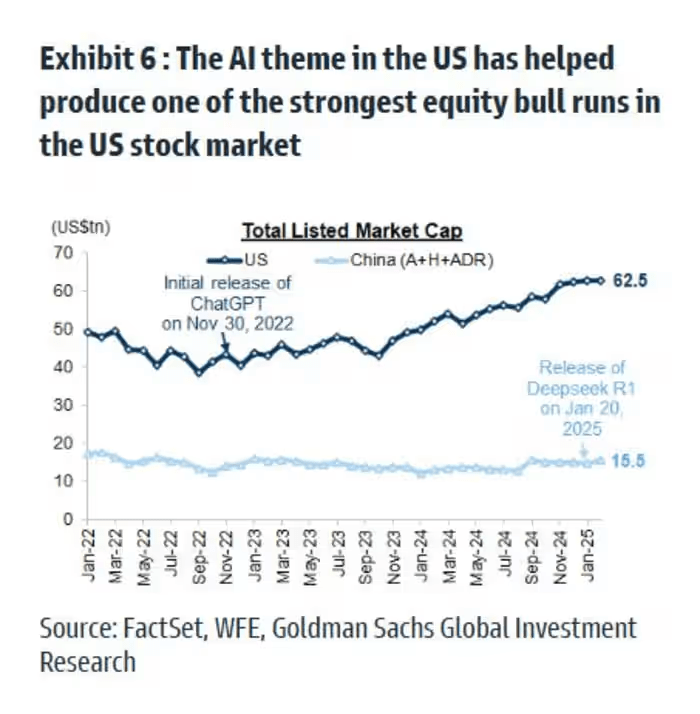
Fiscal Stimulus: The Key to Sustaining China’s Market Rebound Chinese stocks are regaining momentum, fueled by a transformative artificial intelligence (AI) breakthrough that could draw up to $200 billion in investor inflows this year. Goldman Sachs strategists, led by Kinger Lau, have raised their target for China’s CSI 300 index from 4,600 to 4,700, signaling a potential 19% price return. Goldman estimates that widespread AI adoption could enhance Chinese earnings per share by 2.5% annually over the next decade. This technological shift, coupled with renewed investor confidence, could elevate the fair value of Chinese equities by 15-20%, triggering substantial capital inflows. Despite this optimism, analysts stress that AI alone cannot sustain long-term growth. Strong fiscal stimulus is essential to address macroeconomic challenges and drive sustainable equity gains. Specifically, China must implement policies to counter tariff-related headwinds, stimulate domestic demand, curb deflationary pressures, and correct economic imbalances—all crucial for bolstering corporate earnings and extending market gains. The CSI 300 rose 14% last year after three years of losses, compared to a 23% gain in the S&P 500. Meanwhile, the Hang Seng Tech Index, home to many of China’s leading AI and tech firms, has surged 23% year-to-date, with an ETF tracking the index up 19% in 2024—the first annual gain in four years. Goldman Sachs identifies strong potential for later-cycle AI beneficiaries, favoring companies in data, cloud computing, software, and applications as AI monetization and practical use cases expand. Their analysis reveals a valuation gap between U.S. and Chinese AI stocks, drawing comparisons between major firms like Apple and Tencent. Since ChatGPT’s launch in late 2022, U.S. stocks have surged 50%, adding $13 trillion in market capitalization. Over the past year, U.S. and global investors have funneled $660 billion into U.S. equities, fueling double-digit gains in the S&P 500 and Nasdaq Composite and generating over $10 trillion in market value. Optimism surrounding DeepSeek is now driving significant inflows into Chinese stocks. If Chinese firms can grow their market cap by $3 trillion in the next year, AI-related investments could contribute up to $200 billion in global net buying, potentially reversing the underweight positioning of Chinese equities among asset managers. However, Goldman Sachs warns of risks to China’s AI-driven growth, including regulatory uncertainties, data privacy concerns, national security considerations, disinflationary pressures, and potential Western tech export restrictions. While these risks are currently overshadowed by AI enthusiasm, they remain crucial factors for investors to monitor moving forward. John PaulJohn Paul is the founder of DayTradeToWin, a trading education and software company established in 2008, supporting traders worldwide. His expertise focuses on price action-based futures trading strategies and structured market analysis. DayTradeToWin delivers trading education, indicators, and software tools designed to help traders apply disciplined, rule-based decision-making across global futures markets. He is the creator of multiple trading methodologies, including the Sonic System, Atlas Line, and Trade Scalper, which help traders identify structured opportunities in markets such as the E-mini S&P 500 (ES), Nasdaq (NQ), crude oil (CL), and gold (GC). Official website: https://daytradetowin.com daytradetowin.com

UBS & Goldman Sachs
Market News

UBS & Goldman Sachs Boost Gold Targets—What It Means

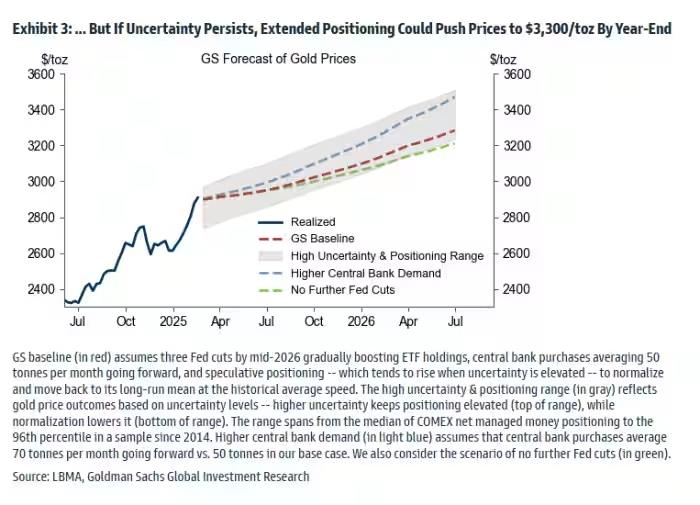
UBS and Goldman Sachs Raise Gold Price Forecasts, Citing Investor Sentiment and Central Bank Demand Strategists at UBS and Goldman Sachs have revised their gold price targets upward, pointing to strong investor sentiment and rising central bank demand as key drivers of the metal’s ongoing rally. UBS strategist Joni Teves acknowledged the difficulty of chasing a strong market but argued that it would be premature to call an end to gold’s bull run simply because prices have repeatedly hit record highs. She raised her year-end forecast to $2,900 from $2,800 and increased her 2026 target to $2,900 from $2,850. Similarly, Goldman Sachs analysts, led by Lina Thomas, boosted their year-end target to $3,100 from $2,890. Gold futures (GC00 +0.82%) climbed 1% on Tuesday, reaching $2,923.80 per ounce, continuing a year in which the metal has outperformed U.S. stocks, bonds, the Swiss franc, and the Japanese yen. What’s Driving the Rally? Teves sees gold potentially reaching $3,200 later this year, attributing the rise to strong investor sentiment in the face of macroeconomic uncertainty. She also noted that low positioning in the market leaves ample room for further accumulation. Additionally, official purchases and tightening liquidity—especially in London—could amplify price movements. Over the long term, UBS expects gold to stabilize around $2,500, reflecting elevated production costs and capital expenditures. Teves also pointed to broader concerns such as fiat currency debasement, the worsening U.S. fiscal deficit, and geopolitical risks, all of which could keep gold attractive as a hedge. While UBS left its silver forecast unchanged at $35.40 per ounce by year-end, Teves suggested that silver could outperform gold if weaker economic growth prompts a more dovish Federal Reserve. Goldman Sachs echoed UBS’s bullish outlook but emphasized rising central bank demand as a key factor. The bank estimates this structural demand could push gold prices up by 9% by year-end. If policy uncertainty remains high, Goldman sees the potential for gold to surge as high as $3,300. John PaulJohn Paul is the founder of DayTradeToWin, a trading education and software company established in 2008, supporting traders worldwide. His expertise focuses on price action-based futures trading strategies and structured market analysis. DayTradeToWin delivers trading education, indicators, and software tools designed to help traders apply disciplined, rule-based decision-making across global futures markets. He is the creator of multiple trading methodologies, including the Sonic System, Atlas Line, and Trade Scalper, which help traders identify structured opportunities in markets such as the E-mini S&P 500 (ES), Nasdaq (NQ), crude oil (CL), and gold (GC). Official website: https://daytradetowin.com daytradetowin.com

Scroll to Top