trading
Market News

Seasonal Trading Trends Favor the Day After Christmas

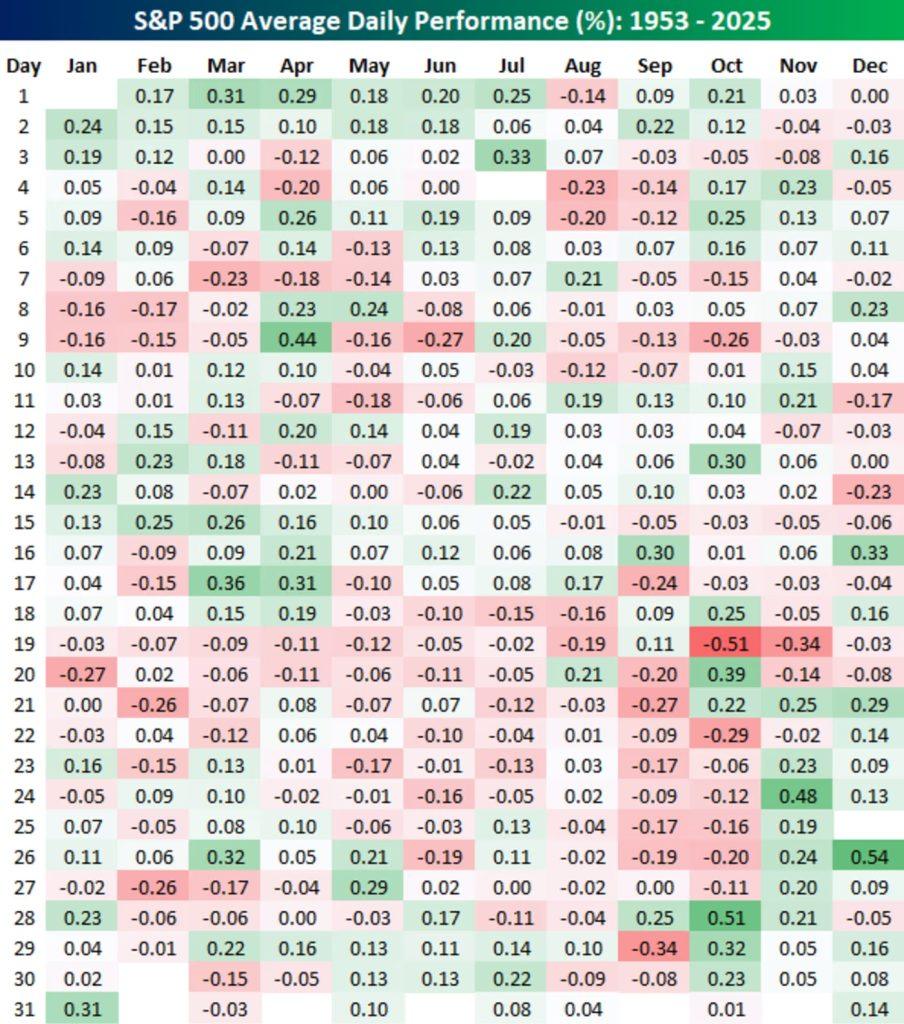
Dec. 26 is historically the market’s strongest trading day, according to Bespoke Investment Group. U.S. stocks rallied into the Christmas holiday on Wednesday, with the S&P 500 hitting a new intraday record during the shortened Christmas Eve session. For investors, however, the real holiday gift from Wall Street often comes after Christmas. Bespoke Investment Group data show that Dec. 26 has been the most reliably positive session of the year for the S&P 500. Since 1953, when markets were open the day after Christmas, the index has declined only six times over 39 years — and never by more than 0.5%. When trading takes place on Dec. 26, the S&P 500 also records its strongest average gain of the year at 0.5%, along with the highest median gain at 0.4%. “Seasonal trends should never be the sole basis for bullish or bearish positioning, but this is an unusually consistent pattern,” Bespoke said in commentary shared with MarketWatch. Friday’s session marks the second day of the Santa Claus rally, the seven-day stretch covering the final five trading days of one year and the first two of the next. The rally carries extra importance this year after delivering negative returns in each of the past two years. According to Dow Jones Market Data, Santa has never skipped three years in a row. Stocks were broadly higher Wednesday, with the S&P 500 up 0.3%, the Nasdaq edging 0.2% higher, and the Dow Jones Industrial Average leading with a 0.6% gain.

christmas
Market News

Christmas Week: Who’s Open, Who’s Closed

Expect widespread schedule changes across financial markets, mail delivery, government offices, and retailers as Christmas approaches. Christmas Day falls on Thursday, Dec. 25, with Christmas Eve bringing a surge in last-minute shopping and deliveries. With holiday activity ramping up, many services will operate on reduced schedules or shut down entirely. Here’s what to know. Financial markets U.S. stock markets, including the New York Stock Exchange and Nasdaq, will close early at 1 p.m. Eastern on Wednesday, Dec. 24, and remain closed on Thursday, Dec. 25. Bond markets will close at 2 p.m. on Dec. 24 and stay closed on Christmas Day. Normal trading resumes Friday, Dec. 26. Mail and shipping services The U.S. Postal Service will deliver mail on Dec. 24, with post offices open for limited hours depending on location. There will be no regular mail delivery on Dec. 25, except for Priority Mail Express. Post offices will be closed. UPS will operate on a normal schedule on Dec. 24 but will limit service on Dec. 25, except for UPS Express Critical. UPS Store locations may be closed on Christmas Day. FedEx will provide modified service on Dec. 24 and suspend most operations on Dec. 25, excluding FedEx Custom Critical. FedEx Office locations will have reduced hours on Christmas Eve and close on Christmas Day. Banks Banks are generally closed on Dec. 25. ATMs and digital banking will remain available, though transaction posting may be delayed. Some branches may operate with shortened hours on Dec. 24. Government offices Nonessential federal government offices will be closed on Christmas Day. In addition, a presidential executive order mandates the closure of federal agencies on Dec. 24 and Dec. 26. State offices follow their own schedules, so closures may vary. Retailers Most stores and supermarkets will be open on Dec. 24, though many will close early. On Dec. 25, major retailers such as Costco, Walmart, and Target will be closed, while online shopping remains available. Some pharmacies may remain open with modified hours. Checking local hours in advance can help avoid disruptions during the holiday period.

gold
Market News

Gold Gains Shine as Stocks Stall in December

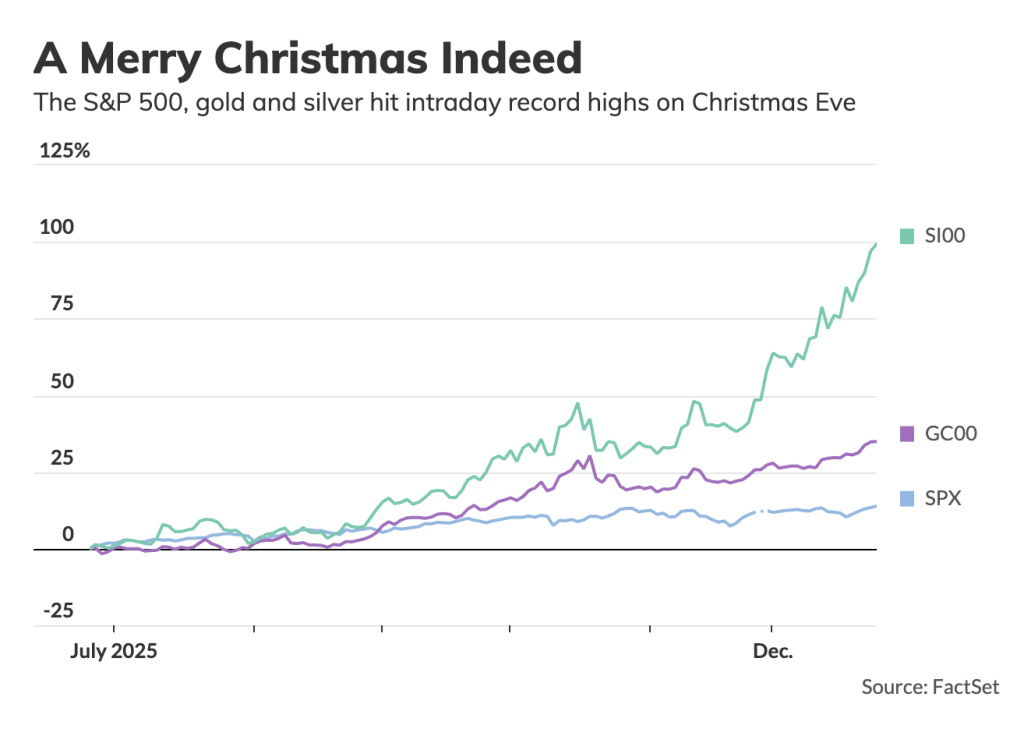
Yardeni: Investor anxiety over the federal deficit is well founded Stocks are heading for a quiet session on the final full trading day before the Christmas holiday, despite a heavy slate of economic data. The market is also just one day away from the official start of the Santa Rally — defined by the Stock Trader’s Almanac as the last five trading days of the year and the first two of the next. Equities could use the seasonal boost, as December has been lackluster for the S&P 500, which is up only 1.6%. That muted performance stands in sharp contrast to another powerful month for precious metals. Gold has climbed 9% in December, while silver has surged 36%, with fresh record highs for the complex appearing increasingly likely. Against this backdrop, Yardeni Research has lifted its outlook for gold. The firm noted that when gold broke above $3,000 earlier this year, it projected prices would reach $4,000 by year-end and $5,000 by the end of next year. With gold now trading above $4,500, Yardeni has raised its year-end 2026 target to $6,000 and reiterated its expectation that prices could reach $10,000 before the decade ends. That forecast surpasses even some of Wall Street’s most bullish calls. JPMorgan, for example, expects gold to peak near $5,055 an ounce by the end of next year. Yardeni argues that while gold and the S&P 500 often move in opposite directions over short periods, both have followed a similar upward trajectory over the long run — a relationship that supports its longer-term bullish thesis. “The price of gold is rapidly converging with the S&P 500 index,” the firm said. “If the S&P 500 reaches 10,000 by the end of 2029, as we expect, gold should also be trading near $10,000, assuming historical trends hold.” The research house turned bullish on gold in early 2024, when prices broke above $2,000, citing a surge in central-bank buying after the U.S. and EU froze Russia’s foreign reserves. More recently, geopolitical risks — including tensions between the U.S. and Venezuela and renewed Ukrainian attacks on Russian ports — have added momentum to gold’s rally. Yardeni also agrees with the view that concerns over money printing to erode government debt are underpinning demand. Although gold has lagged other precious metals this year — trailing silver by 139%, platinum by 133% and palladium by 95% — Yardeni says the move is unlikely to reflect a rebound in global economic growth, given the relatively modest gains in industrial metals. Instead, the firm believes precious metals are signaling growing unease about an overly stimulative mix of U.S. fiscal and monetary policy in the year ahead. Even if the Federal Reserve pauses rate cuts in early 2026, it remains committed to purchasing roughly $40 billion in Treasury bills per month through April, according to the New York Fed. Add to that expectations for potential $1,000–$2,000 government refunds to households and proposals for $2,000 “tariff dividend” checks, and the risk becomes clear: the federal budget deficit could balloon in early 2026. That, Yardeni warns, could push bond yields higher and leave stocks vulnerable to a pullback.

gold
Market News

Gold Surges on Central Bank Debasement Fears

Concerns that central banks will eventually print money to erode the real value of government debt remain the primary force behind gold surge, while geopolitical tensions are reinforcing its safe-haven appeal. Gold’s move to a new record high signals the return of the so-called “great debasement trade,” according to Robin Brooks, senior economist at the Brookings Institution and former chief currency strategist at Goldman Sachs. His remarks came as bullion climbed above $4,400 an ounce. In a Substack post, Brooks said the rally reflects the Federal Reserve’s recent rate cut and growing fears of debt monetization — the risk that central banks will absorb government bond issuance. Gold is now up 68% in 2025, while silver, driven by many of the same dynamics, has surged 140% after also setting a fresh high this week. Geopolitical risks have added further momentum. Escalating tensions in Venezuela and Ukrainian attacks on Russian ports and shipping have heightened gold’s appeal as a store of value. Brooks traces the breakout in precious metals to Chair Jerome Powell’s dovish Jackson Hole speech on Aug. 22 and the Fed’s 25-basis-point rate cut on Dec. 10. Markets are now pricing in further easing by the central bank. He argues that the debasement trade is spreading beyond precious metals. Currencies with relatively low debt burdens, including the Swedish krona and the Swiss franc, are increasingly moving in line with gold and silver. A comparison of G10 currencies against the dollar shows rising correlations with precious metals. The krona’s strength, Brooks notes, is particularly striking given its history as a volatile currency rather than a traditional safe haven. He also cautions that the dollar’s apparent stability is misleading, as its strength against the weak Japanese yen masks broader softness against a wider basket of currencies. Jeroen Blokland, economist and manager of the Blokland Smart Multi-Asset Fund, highlights the ongoing Japanese yen carry trade as another pillar supporting gold. Investors continue to fund positions in higher-risk assets by borrowing yen, with precious metals among the favored destinations. Blokland wrote on X that last week’s Bank of Japan rate hike — taking policy rates to 0.75%, the highest since 1995 — has failed to unwind the carry trade. Inflation is likely to remain structurally elevated, while the interest-rate gap between Japan and the U.S. remains wide enough to sustain yen-funded trades. Japanese 10-year government bond yields have continued to climb and have nearly doubled this year, reaching around 2.08%.

AI
Market News

AI Investing Enters a More Critical Phase, Says Nomura

Nomura: A more critical take on AI winners is healthy Investors looking for a year-end rally to fresh record highs have had to temper their expectations. Since the start of December, the S&P 500 has moved sideways in a tight range, hovering just below new highs. Part of the drag on sentiment comes from recent stumbles in some of the market’s biggest winners. Heavyweights such as Nvidia, Microsoft and Broadcom have lost momentum, while smaller-cap former favorites — including CoreWeave, along with energy- and quantum-related stocks — have also struggled. That weakness has fueled concerns that the pullback in momentum stocks could signal a broader shift in market sentiment, particularly toward AI plays, with negative implications for 2026. But Charlie McElligott, Nomura’s cross-asset strategist, says this pattern is typical for this time of year — and argues the AI trade is far from over. McElligott says the AI investment story has entered a more turbulent phase, as markets move beyond early capital-expenditure excitement and toward a more disciplined evaluation of fundamentals. Investors are now paying closer attention to balance sheets, return on investment, margin pressure and energy constraints — a development he views as constructive. Still, McElligott believes much of the recent selling reflects routine profit-taking after a strong run, made messier by the high levels of leverage tied to momentum trades. Historically, December has been a difficult month for momentum strategies. Since 1995, the momentum factor has averaged a 1.1% pullback during the month, and it is the worst median month for one-year momentum over the past 30 years. Since 2016, the median decline has been closer to 2.7%, as investors rotate ahead of the “January effect” and into prior laggards. In effect, investors are using last year’s winners as a funding source to broaden exposure to stocks expected to benefit from stronger economic conditions in 2026. Importantly, McElligott says recent selling does not suggest investors are abandoning AI-linked stocks. Options market activity during the latest equity selloff shows traders selling downside protection on AI proxies such as Broadcom, Eaton, Alphabet, Nvidia and Vistra — a sign the market does not expect much further downside and may be approaching an inflection point.

AI
Market News

AI Market Shaken by Data-Center Debt Worries

The AI trade is showing signs of strain as investors grow increasingly uneasy about the heavy debt loads companies such as Oracle and CoreWeave are taking on to fund massive data-center expansions. Concerns over whether these firms can continue financing AI infrastructure have rattled the sector in recent weeks, with selling pressure intensifying on Wednesday following renewed worries tied to Oracle. Broadcom shares sank 4.5% on the day, extending their decline to more than 21% over the past five sessions — the stock’s worst five-day stretch since late March 2020, according to Dow Jones Market Data. Other semiconductor names also moved lower. Nvidia, Advanced Micro Devices and Micron Technology all fell, with Micron slipping ahead of its fiscal first-quarter earnings report after the close. The PHLX Semiconductor Index dropped for a fifth straight session and is now down more than 10% over that period. “The growing concern about whether neoclouds like Oracle and CoreWeave can finance their data-center buildouts is weighing on the entire AI sector,” D.A. Davidson analyst Gil Luria said. If these companies are unable to raise additional debt, their spending on chips would likely stall, he added. Oracle shares slid more than 5% after a report suggested talks with alternative-asset manager Blue Owl Capital for a $10 billion data-center project had stalled. The Financial Times reported that the proposed 1-gigawatt Michigan data center, intended to support OpenAI, had hit a snag. Oracle disputed the report, saying it is working with Related Digital and that final equity negotiations are proceeding as planned. Mizuho analyst Jordan Klein echoed that funding concerns around Oracle are pressuring AI stocks, noting that thin year-end trading volumes are amplifying market moves. CoreWeave shares also dropped sharply, falling more than 7% after criticism from prominent short seller Jim Chanos and reports of data-center delays. Speaking on the Monetary Matters podcast, Chanos described neocloud providers like CoreWeave as operating a “commodity business,” arguing that they capture little of the long-term value generated by AI workloads. He also warned that the rapid depreciation of AI chips poses a major risk, particularly for companies relying heavily on debt to acquire Nvidia hardware. Adding to the pressure, The Wall Street Journal reported that CoreWeave is facing months-long delays at a Texas data-center cluster intended for OpenAI. Still, not all analysts are bearish. Futurum CEO Daniel Newman said he sees “little to no evidence of a slowdown in the AI buildout.” While debt financing concerns represent “the biggest market overhang right now,” he believes investor fears are overstating the risk of a collapse in AI demand. “The selloff is more of a speed bump as investors digest capital spending, leverage and buildout risk,” Newman said. “The fundamentals remain intact, and AI demand is still insatiable.”

Scroll to Top