trading
DayTradeToWin Review

Trading With Rules: The Fastest Path to Consistency

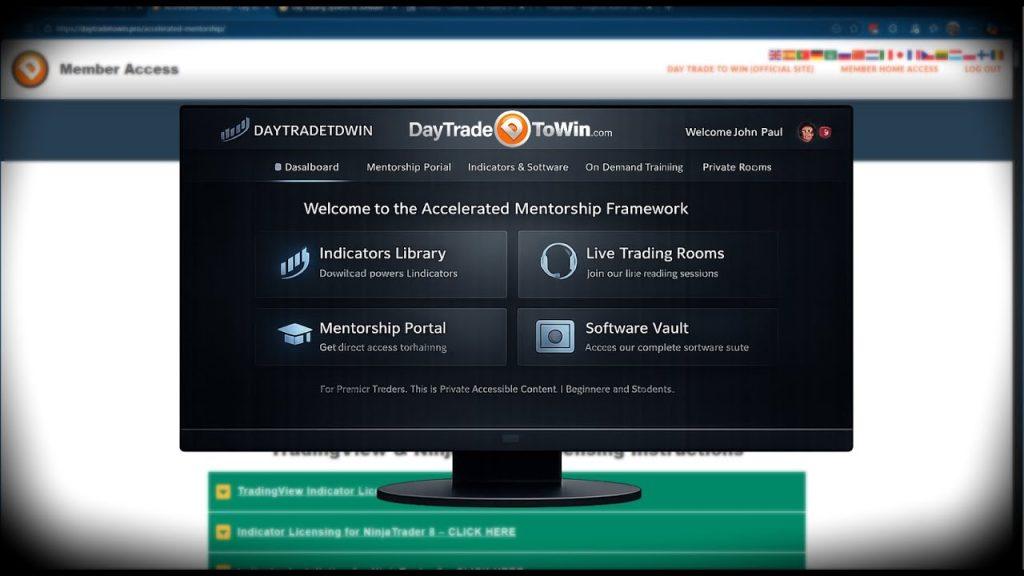
If you’ve been trading for months or years and consistency still feels impossible, it’s not because you’re failing—it’s because you were never given a complete trading system. Most traders struggle without structure. No clear entry confirmation. No defined stop losses. No profit targets. No way to filter low-quality signals. That’s exactly what Accelerated Mentorship Plus was designed to solve. This is the same proprietary trading methodology and software used by private traders to remove guesswork and replace it with rules, precision, and confidence. From at-the-open breakout strategies that catch early market momentum, to the Atlas Line that keeps you aligned with market direction, every tool works together as one unified framework. You’ll also gain access to the Trade Scalper, a trader-favorite tool delivering real-time signals, alerts, and confirmations—so you don’t just trade signals, you learn the method behind them. Available on TradingView and NinjaTrader, Accelerated Mentorship Plus includes lifetime licenses, live training, and strategies for breakouts, swing & day trading, and scalping. If you’re ready to stop guessing and start trading with structure, Accelerated Mentorship Plus is the fastest path we’ve built for developing and funded traders.

stocks
Market News

U.S. Stock Market Overvaluation vs Non-U.S. Stocks: A Safer Bet?

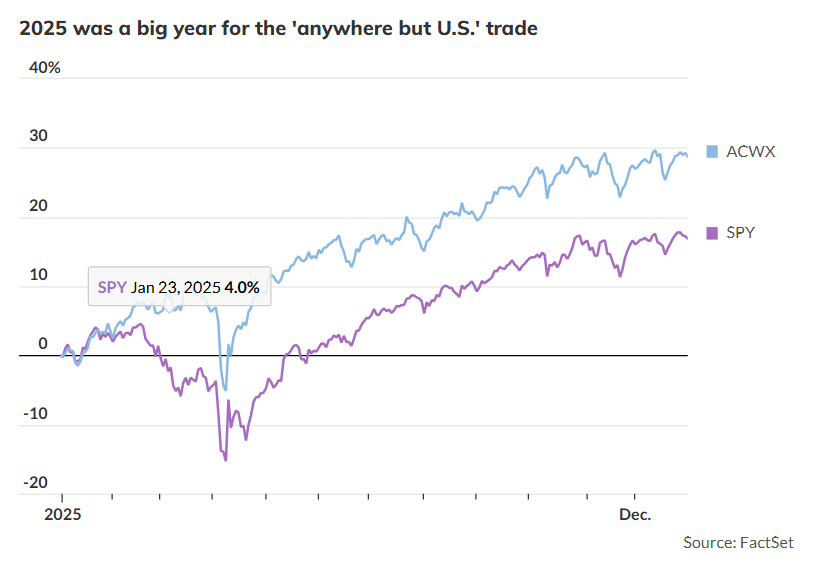
Valuation signals are flashing deep red for U.S. stocks, while non-U.S. markets appear far more attractive. It’s hard to imagine valuation indicators painting a more bearish picture for U.S. equities than they do today. By nearly every measure, U.S. stocks are priced at extreme levels. Meanwhile, non-U.S. stocks have already delivered more than twice the return of the S&P 500 this year, and there’s a compelling case that their strong performance will continue into 2026. For investors who want to stay invested in equities but are increasingly uneasy about lofty U.S. valuations, global markets offer a more appealing alternative. Many U.S. investors may not realize how strong non-U.S. performance has been in 2025, as headlines have been dominated by the “Magnificent Seven” and the AI-driven rally. Yet through Dec. 26, the S&P 500 is up 16.3%, while non-U.S. stocks have surged 33.1%, based on the MSCI All-Country World ex-U.S. index. A weaker U.S. dollar helped fuel some of that outperformance, boosting dollar-based returns for overseas assets. Even so, non-U.S. equities remain significantly cheaper than U.S. stocks after their rally. That valuation gap suggests non-U.S. markets could continue to outperform in 2026, even if the dollar stops falling. The contrast becomes even clearer when looking at cyclically adjusted CAPE ratios, which compare current market levels to the past 10 years of inflation-adjusted earnings. This valuation metric, popularized by economist Robert Shiller, highlights how stretched U.S. equities have become. According to Barclays Indices, the U.S. CAPE ratio is higher than those of roughly two dozen other global markets. On average, those countries trade at just over half the valuation of the U.S. Overvaluation warnings The CAPE ratio is just one of 10 valuation indicators tracked monthly for their ability to forecast long-term, inflation-adjusted returns. Today, all 10 point to the same conclusion: U.S. stocks are extremely overvalued. The latest readings place the average valuation percentile at 98%, meaning the market is more expensive than at nearly any other point in U.S. history. It’s difficult to envision a more cautionary signal. That leaves investors with a critical question: Will U.S. stocks once again defy gravity in 2026, or will far cheaper non-U.S. markets prove to be the safer — and stronger — bet?

market
Market News

Why Treasury Yields Are a Red Flag for the Market

Samantha LaDuc: Rising Treasury Yields Could Be a Warning Sign for Stocks in 2026 Samantha LaDuc, founder of LaDucTrading, was among the market strategists who correctly anticipated this year’s S&P 500 trajectory — a sharp selloff followed by a strong rebound. A veteran trader since 2008, LaDuc warned clients in early December 2024 that equities were heading for a “bloodbath,” forecasting a roughly 20% decline in the first half of 2025. Her view was based on tariffs not being priced in and a weakening U.S. dollar. The equity pullback arrived on Liberation Day, while the dollar has yet to recover from its early-year slump. In a recent MarketWatch interview, LaDuc said she turned bullish around April 9, projecting an upside target of “hellbent on 6,666” for the S&P 500. By June, she outlined two potential paths: if the index could reach and hold above 6,100, she saw 7,000 as the next milestone. Sustained strength above 7,000, she said, could ultimately pave the way toward 8,200. The S&P 500 has already moved close to that level, recently topping out at 6,945.77. LaDuc has built a reputation for timely market calls. In 2022, she warned of an impending “tech wreck,” a year that proved difficult for the Nasdaq. In early 2024, she urged investors to stay invested in equities — advice that aligned with a record-setting year for the S&P 500. Looking ahead to 2026, LaDuc expects a challenging but upward-trending market. “My core theme is a recession into all-time highs,” she said. “Stocks can continue to rise even as unemployment increases.” She added that concerns about stagflation are already surfacing within the Federal Open Market Committee. For the S&P 500 to reach 8,200, LaDuc believes two forces must work together. The first is continued enthusiasm around artificial intelligence. With several major AI-related IPOs potentially arriving in 2026 — including OpenAI, SpaceX and Anthropic — she argues it’s difficult to envision a sustained market breakdown. The second factor is a weaker U.S. dollar. “A falling dollar is extremely supportive for inflationary assets and equities,” she said. Combined with AI-driven excitement, LaDuc believes this could fuel a melt-up toward the 8,200 level. She estimates current AI revenues at around $60 billion and says meaningful productivity gains and margin expansion — even if driven by layoffs — would be key to justifying higher equity valuations. That upside, however, could come alongside labor market stress and persistently high inflation. With Wall Street projecting a roughly 16% gain for the S&P 500 by the end of 2026, LaDuc cautions that stocks are “priced for perfection.” In her view, elevated valuations leave little room for macroeconomic shocks. Her biggest concern for equities is rising Treasury yields. LaDuc sees the 10-year yield as a major risk, arguing that higher unemployment and inflation would push yields higher as investors demand greater term premiums. “Rising yields tend to pull capital away from growth assets and into safety,” she said. The key level she’s watching is 4.6%. “If yields reach that level and hold, the move higher likely continues,” she warned. Overall, LaDuc expects 2026 to be a “hold-your-nose” market — one where stocks grind higher but experience pullbacks due to stretched valuations. She also notes that midterm election years are typically supportive for equities, as policymakers prefer to avoid weak markets ahead of elections. Beyond stocks, LaDuc remains bullish on commodities, a stance she’s held since spring 2024. She describes the trend as “phenomenal,” particularly for miners, though she excludes oil. In April 2024, she made the contrarian call that crude would fall from around $80 a barrel into the $60–$40 range, easing energy costs for miners. Her long-term optimism on precious metals is driven by falling energy costs and a weaker U.S. dollar. “The big-picture trend in precious metals isn’t going away,” LaDuc said. “The only thing that would change it is the U.S. government balancing its budget — and the odds of that are slim.”

trading
DayTradeToWin Review

First Trading Week of 2026: Volatility and Big Setups

As the final days of 2025 wind down, traders are already turning their attention to the year ahead. One of the most important periods to understand is the first trading week of January, which historically delivers elevated volatility and expanded trading ranges. By studying how markets have behaved at the start of past years, traders can better prepare for what’s likely to unfold as 2026 begins. January’s Opening Week Is Known for Increased Volatility The first week of the new year consistently brings a surge in market activity. As traders return from the holidays and institutions begin repositioning, volatility increases sharply across major indexes. Historical data shows that during the opening sessions of January, markets such as the E-mini S&P 500, Nasdaq, Dow, and micro contracts often experience: These are not quiet or low-volume sessions. The first week of January is typically one of the most active periods of the year. Direction Changes Are Common—Don’t Lock Into a Bias While volatility is high, the market does not usually move in just one direction for the entire week. Looking back at January price action from 2020 through 2025, a recurring pattern emerges: This back-and-forth behavior means traders should avoid committing too early to a bullish or bearish outlook. The opening week often alternates direction from day to day, even though each individual session may trend strongly. Large Daily Ranges Create Strong Intraday Trends Despite frequent day-to-day reversals, each trading session often develops a clear intraday trend. Once price begins to move decisively—either higher or lower—it commonly continues in that direction for the remainder of the session. This pattern has appeared consistently across multiple years, including 2020, 2021, 2022, 2023, 2024, and 2025. For day traders, this environment favors: The First Week of January Rewards Reaction, Not Prediction The biggest mistake traders make during the first week of the year is trying to predict what the market should do. High volatility quickly reveals direction. When a session begins to trend, that movement often persists long enough to offer high-probability trading opportunities—but only for traders who remain flexible. Successful traders focus on: How to Prepare for the First Trading Week of 2026 As January 2026 approaches, traders should keep the following in mind: Bottom Line The first trading week of the year consistently delivers big moves, fast markets, and real opportunity. History shows that while direction may shift from day to day, intraday trends often provide excellent setups for prepared traders. By staying flexible, respecting volatility, and letting price action lead the way, traders can start 2026 on solid footing.

silver
Market News

Silver Outlook: Volatility Now, Upside Ahead

“This is where it’s fun. This is where it’s scary,” says veteran commodities analyst Alexander Campbell. The former head of commodities at hedge-fund giant Bridgewater warns that silver faces several near-term hurdles that investors may want to see cleared before buying. That’s how Campbell — once a global macro investor at Bridgewater and now founder and CEO of Black Snow Capital — describes the current trading environment for silver, which has rallied roughly 25% in December alone. Silver is up an extraordinary 156% so far in 2025, though prices pulled back on Monday after logging their largest one-day dollar gain on record last Friday. Campbell argued as early as February that booming solar demand had already pushed the silver market into a structural deficit. Even so, Campbell acknowledges in a recent Substack post that short-term risks are meaningful. The most immediate is the potential for tax-driven selling once trading resumes in the new year, particularly for positions held longer than 12 months. Capital gains taxes fall at that threshold, especially for deep-in-the-money options expiring Dec. 31, giving traders an incentive to hold through the final three trading sessions of 2025 before taking profits. Another headwind could come from the U.S. dollar, which Campbell expects may strengthen in the near term after a solid third-quarter GDP report. A firmer dollar typically pressures dollar-denominated commodities. He also highlights the Chicago Mercantile Exchange’s decision to raise margin requirements on silver trades effective Dec. 29, a move that reduces leverage and speculative appetite. Campbell also notes growing commentary around silver’s “overbought” condition and concerns that its sharp rise this year could encourage substitution with copper in industrial applications. Despite these factors, his bullish outlook remains firmly intact. On copper substitution, Campbell argues that while the case may hold over the long term, the roughly 18-month payback period required to retool facilities is too long for solar manufacturers to justify today. He adds that the solar industry — one of silver’s largest sources of demand — remains economically viable even with silver priced at $134 an ounce, roughly 70% above current spot levels. A major development on the immediate horizon is China’s new export-licensing rules, set to take effect Jan. 1. As a key net exporter, China’s annual silver output of about 121 million ounces will now require government approval to leave the country. Campbell sees today’s elevated physical premiums as especially telling. Physical silver is trading near $91 an ounce in Dubai and $85 in Shanghai, compared with around $75 on COMEX futures. “When physical diverges this sharply from paper,” he says, “one of them is wrong — and historically, it’s not physical.” Backwardation in London’s over-the-counter silver market — where spot prices exceed forward prices — is now the steepest in decades, according to Campbell. At the same time, options markets are pricing in significant upside tail risk. Technical signals also support higher prices. Commodity Futures Trading Commission data show no extreme positioning, suggesting there is still “fuel left,” while silver-backed ETFs such as the iShares Silver Trust are still catching up to underlying demand. Ultimately, Campbell says silver’s most powerful drivers are structural. He points to “inelastic” demand from solar — estimated at 290 million ounces in 2025 and rising to 450 million ounces by 2030 — alongside growing data-center needs. “Every AI query needs electrons,” he says. “The marginal electron is silver. Solar needs silver.”

stocks
Market News

Stocks Hit Fresh Records on Christmas Eve Trading Session

Investors had plenty to smile about this Christmas as stocks, gold and silver all surged further into record territory. Markets delivered a holiday boost on Wednesday, with U.S. equities and precious metals extending their rallies. The S&P 500 posted a fresh record close during the shortened Christmas Eve session — its first such close on that day since 2013, according to Dow Jones Market Data. The benchmark ended at 6,932.05 and also set a new intraday high, its first on Christmas Eve since 2014, FactSet data showed. Gold and silver joined the rally, each touching new intraday records earlier in the session. The most active gold futures climbed to $4,555.10 an ounce, while silver futures jumped as high as $72.75, Dow Jones Market Data showed. Both metals later pulled back from those highs by the time the stock market closed at 1 p.m. Eastern. The gains cap a resilient year for markets. After weathering a period of volatility — including the tariff-driven selloff in April — stocks have powered higher in 2025, with the S&P 500 on pace for a third straight year of double-digit gains. As 2026 approaches, investors are increasingly focused on signs the U.S. economy may be regaining momentum, even as a soft labor market continues to fuel concerns about consumer health. “It’s been a good year,” said Thomas Martin, senior portfolio manager at Globalt Investments. “There was a lot of uncertainty coming into it. After Liberation Day, it looked like things could turn ugly. But the economy and the consumer held up better than expected, and S&P 500 earnings growth also surprised to the upside. That’s why we’re here.” Wednesday’s advance was broad-based. Ten of the 11 S&P 500 sectors finished higher, with energy the lone laggard, according to FactSet. After climbing steadily through the spring and summer, stocks hit turbulence in November when pressure on the artificial-intelligence trade caused the Nasdaq Composite to snap a seven-month winning streak. More recently, however, delayed economic data released after the government shutdown has reinforced expectations that the economy will land in a “Goldilocks” zone in 2026. “The economic data over the past few weeks has been mixed, allowing investors to remain confident the Fed will continue easing into 2026,” said Gina Martin Adams, chief market strategist at HB Wealth. “It’s not weak enough to spark recession fears and not strong enough to force the Fed to tighten or halt the easing cycle.” She added that oil prices holding below $60 a barrel have also helped support stocks by easing pressure on consumer spending. “All of these factors have pushed equities to new highs in recent weeks,” Adams said. The Nasdaq, Dow Jones Industrial Average and Russell 2000 all finished higher on Wednesday as well, though each remains below recent record levels. Meanwhile, market volatility continued to retreat. The Cboe Volatility Index, Wall Street’s so-called fear gauge, slipped below 14 for the first time since Dec. 13, 2024, signaling a calm market mood heading into the holiday.

Scroll to Top