daytrading
DayTradeToWin Review

Four Essential Rules for Trading Success

Hello Traders! Today, I’m going to share four essential rules for trading success. Whether you’re trading crypto, stocks, futures, Forex, or any other asset, these rules are fundamental. I’ll also demonstrate how the Roadmap software on TradingView charts, also available for NinjaTrader, can help you in your trading journey. Before we begin, remember that trading is risky. Please do not trade with funds you cannot afford to lose. Always be aware of the risks involved. Rule 1: Price Action Trading The first rule is price action trading. What exactly is price action trading? Price action is the movement of a security’s price over time. This movement forms the foundation for all technical analysis of stocks, commodities, or other assets. Essentially, price action trading involves analyzing price changes over time to make informed trading decisions. With the Roadmap software, we can identify specific zones—Zone A, Zone B, and so on—where support and resistance levels are significant. When the market enters these zones, we can decide whether the price action suggests a continuation or a reversal. This helps us pinpoint critical points where the market might not continue higher or lower, providing valuable insights for our trading strategy. Rule 2: Filtering Trades Effectively The second rule is filtering trades effectively. Many traders neglect to filter their trades, which can significantly impact their success. Knowing when to stay out of the market is just as important as knowing when to enter. Filtering trades involves using different methodologies to confirm trading signals. For instance, the Roadmap software helps us identify zones where we should avoid going long or short. These zones act as filters. If multiple methodologies—like the Trade Scalper, At The Open, and Atlas Line—agree on a trade direction, it’s a strong signal to take that trade. However, if the methods give conflicting signals, it’s best to stay out of the market. This approach ensures we only take high-probability trades, improving our overall trading performance. Rule 3: Using Exact Trade Entries Using exact trade entries is the third rule. It’s crucial to have a precise entry price for your trades, whether you’re going long or short. Instead of impulsively entering the market, wait for the right conditions. For example, when the market enters a zone on the Roadmap, we look for specific price action to determine our entry point. We might wait for two candles to close in our direction, solidifying the price action and giving us a precise entry price. This disciplined approach ensures we are not just jumping into the market based on a hunch but are entering with a clear strategy and purpose. Rule 4: Importance of Patience in Trading The fourth and final rule is the importance of patience. Patience is crucial in trading. It’s about waiting for the right opportunity and not forcing trades when conditions aren’t favorable. When the market is in a zone, we must be patient and wait for it to either break through the zone or reverse direction. This waiting period can be challenging, but it’s essential to avoid making impulsive decisions. For instance, if the market breaks below a support zone, it might signal a short trade. Conversely, if it reverses and moves above the zone, it could be a long trade opportunity. By being patient, we ensure we only enter trades when conditions are optimal. Conclusion Following these four rules—price action trading, filtering trades effectively, using exact trade entries, and being patient—can significantly enhance your trading success. The Roadmap software on TradingView and NinjaTrader can be an invaluable tool in implementing these rules. If you like these tips, subscribe to the DayTradetoWin YouTube channel for more insights and strategies. We also offer free software for TradingView and NinjaTrader for our members on daytradetowin.com. For more comprehensive training, consider joining our accelerated mentorship class, which includes all our software packages and personalized guidance. Until next time, good trading! For more information and to get the Roadmap software, visit daytradetowin.com.

U.S. stocks
Market News

Nasdaq Reaches Record Peak as U.S. Stocks Climb Before Holiday

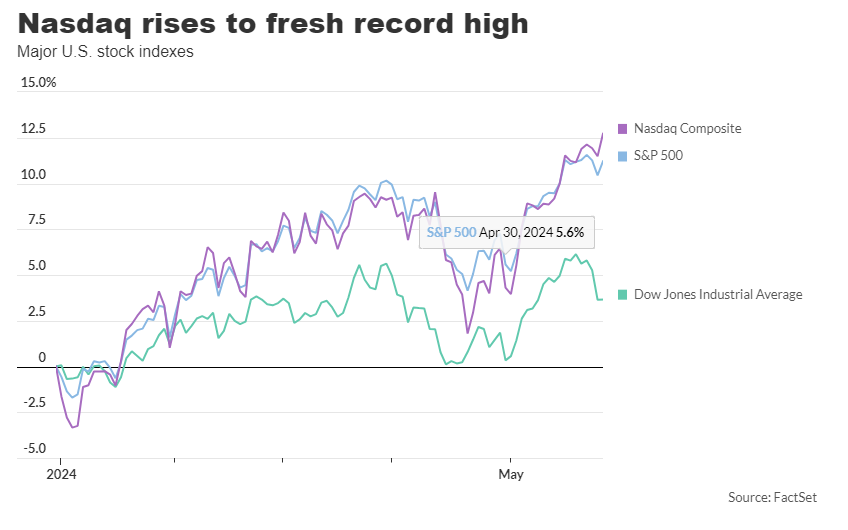
The market is highly responsive to economic data that disrupts the ‘Goldilocks scenario,’ says Anthony Saglimbene of Ameriprise Financial. On Friday, major U.S. stock indexes rose, with the tech-heavy Nasdaq Composite hitting a fresh record peak ahead of the Memorial Day weekend. Nvidia Corp.’s quarterly earnings were “the most important report of the week,” according to Saglimbene, chief market strategist at Ameriprise Financial. He stated, “I don’t think investors could have asked for a better report and outlook from the leader of AI,” suggesting that “the AI theme has legs.” Both the Nasdaq and the S&P 500 secured their fifth consecutive week of gains on Friday, while the Dow Jones Industrial Average ended its five-week winning streak. Investors were buying the dip amid rising profits and a strong economy, said Saglimbene. Although Nvidia surged Thursday following its robust earnings, U.S. stocks dropped that day due to concerns over economic data from S&P Global’s flash survey of U.S. services. The stronger-than-expected reading sparked “inflation anxiety,” Saglimbene explained. Sticky inflation in the services component of the consumer-price index has been a concern, but Saglimbene believes investors overreacted, as the data likely didn’t significantly alter the Federal Reserve’s policy outlook. “It shows how sensitive the market is to economic data that challenges the narrative of Fed rate cuts this year,” Saglimbene noted, with investors hoping for a “Goldilocks scenario” where economic activity declines just enough to justify rate cuts. On Friday, U.S. stocks finished higher, with the Dow Jones Industrial Average rising less than 0.1%, the S&P 500 gaining 0.7%, and the Nasdaq Composite climbing 1.1%. The Nasdaq closed at a record 16,920.79, while the S&P 500 ended at 5,304.72, just 0.3% below its record close. Traders are debating whether the S&P 500’s current level around 5,300 is a ceiling or a support level for further gains. Saglimbene believes the S&P 500 can “gravitate” higher due to the positive earnings outlook for U.S. companies. Next week’s key economic report will be the U.S. inflation reading for April from the personal-consumption expenditures price index, due May 31. The U.S. stock market will be closed Monday, May 27, for Memorial Day.

Dow
Market News

Stocks Slip from New Highs: Understanding the Dow’s Sudden Decline

In Wednesday’s session, Nvidia Corp. could not counteract the negative stock-market sentiment stemming from the minutes of the May policy meeting of the Federal Reserve. Despite Nvidia’s strong performance in the quarter, the stock markets were unable to rebound on Thursday. Although Nvidia’s stocks soared to over $1,000, both the S&P 500 and Nasdaq Composite saw declines for the day. The DJIA hit 40,000 for the first time last week but fell by 605.78 points on Thursday to close at 39,065.26. This was the biggest percentage drop since March 22, 2023, and the largest point decline since Feb. 21, 2023, according to Dow Jones Market Data. Keith Lerner, who is the chief market strategist at Truist Advisory Services, likened the response to Nvidia’s eagerly awaited report to the market fluctuations typically observed when important economic data, such as employment or CPI figures, is made public. Experts in technical analysis mentioned that the decrease in stock prices that occurred recently, while not appealing, was not completely unexpected due to the market reaching new highs in May after a fall in April. Mark Arbeter, the president of Arbeter Investments and a technical analyst, noted that there was widespread involvement of individual stocks in the market rebound from April 19 to May 15. However, he observed a decrease in this participation in the past six days. He noticed that during the past week, only the technology sector saw growth in value, while other sectors like real estate, energy, financials, discretionary, utilities, and staples all saw declines ranging from 1.3% to 2.7%. The mid- and small-cap indexes had peaked six days ago and were now dropping quickly. Also, indicators of sentiment suggested that optimism was rising to levels that often signal caution for investors. Arbeter informed MarketWatch that after a large rise in the major stock indices, followed by a slight new high, the chart pattern could lead to adverse outcomes. What about the fundamentals? Investors who were already anxious because of the Federal Reserve meeting minutes may have been further worried by the increase in the purchasing managers index, which signaled higher activity in the services sector. The minutes revealed that policymakers were not inclined to decrease interest rates, and in certain cases were even considering raising them if necessary. After economic data was released, Lerner observed that the 10-year Treasury yield rose from a previous low, resulting in downward pressure on sectors like small caps and real estate that are influenced by interest rate fluctuations. He elaborated that our attention is now on the Federal Reserve’s direction. In addition, with the market being relatively calm before Memorial Day, any changes in the market may have a greater impact. Rather than Nvidia’s strong performance influencing the market, it may have been more focused on simply getting the earnings report from the top chip company out of the way. He explained that those who have been betting against the market or holding a negative outlook can now breathe a sigh of relief, as Nvidia’s dominance is no longer a concern. Nobody was willing to go against Nvidia. Some individuals also noted the importance of the approaching extended weekend. Bond markets will have early closures on Friday, and all U.S. markets will be shut on Monday in observance of Memorial Day. In an email, Jamie Cox, a managing partner at Harris Financial Group, mentioned that markets tend to slow down before a long holiday weekend. The release of the Fed minutes caused this slowing down, and not even news from Nvidia could redirect focus to the positive aspects of the market. At the same time, it was not practical to expect Nvidia to save the market, despite high expectations due to its position as the top-performing stock globally, due to deteriorating market conditions. Arbeter humorously mentioned that having a group of five to seven very large stocks could potentially lift the market, but he is skeptical that a single stock alone could have the same impact.

nvidia
Market News

Nvidia Poised to Reach Market Cap Equal to Total of German Stocks

Nvidia’s exceptional first-quarter results have placed the chipmaker at the forefront of the AI revolution, with its market value set to rival the combined value of all German listed companies. According to FactSet, as of Wednesday, companies with primary listings in Germany have a total market value of €2.315 trillion ($2.51 trillion). Nvidia’s after-hours surge to $1,007 per share positions the company to achieve a market value of $2.5 trillion. German companies, from A.S. Creation Tapeten to Zooplus, including BMW, SAP, and Volkswagen, collectively earned €121.56 billion on sales of €2.96 trillion last year, per FactSet data. In comparison, Nvidia earned $42.6 billion on sales of $79.7 billion over the past 12 months, with its first-quarter results exceeding expectations. Nvidia’s revenue and profit growth are impressive, with adjusted earnings per share up 461% year-on-year and sales growth of 262%. For investors looking for broader exposure to the German market rather than a single company like Nvidia, the iShares MSCI German ETF (EWG) tracks an index covering about 85% of the German market cap.

S&P 500
Market News

Navigating ‘S&P 500 Envy’: Balancing Your Portfolio in a Bull Market

When stocks are climbing and bonds are lagging, it can be difficult to convince investors of the importance of diversification. With the S&P 500 up nearly 12% year-to-date in mid-May and the Dow Jones Industrial Average reaching 40,000, many investors experience “S&P 500 Envy,” comparing their returns to these impressive benchmarks. In recent years, when both stocks and bonds were down, this wasn’t as much of an issue. However, similar conditions in 2018 also sparked “S&P 500 Envy.” BlackRock addressed this by creating a presentation for financial advisors to show that despite sometimes lower short-term returns, diversified portfolios often perform better over the long run. An updated graphic from 2023 illustrates that during years like 2000-2002, 2008, 2020, and 2022, when the S&P was down, diversified portfolios lost less. Conversely, from 2009-2019 and in 2023, when the S&P rose significantly, diversified portfolios grew slightly less. Over time, however, these portfolios outperformed the S&P, proving that “diversification can work, even when it feels like it’s losing.” Nicholas Olesen from Kathmere Capital Management highlights that advising clients on diversification is tougher when the S&P performs well over a long period. He addresses “recency bias,” the tendency to believe that recent trends will continue indefinitely. This bias can lead investors to abandon their diversified portfolios in favor of the booming S&P, only to suffer during downturns. Olesen argues that a mix of investment types is best for the long term, hedging against economic fluctuations. He explains that diversification isn’t about having the top-performing portfolio right now but achieving long-term financial goals. Ross Haycock from Summit Wealth Group echoes this sentiment, reminding clients not to “put all your eggs in one basket.” When investors shy away from diversification, they’re often avoiding bonds due to recent poor performance. However, they overlook the consistent, guaranteed yields bonds provide. Despite short-term market value fluctuations, holding bonds to maturity ensures they retain their value and generate income. This “statement shock” from seeing lower short-term returns compared to the S&P can drive emotional decisions. Advisors stress the importance of focusing on long-term, time-weighted returns and sticking to a well-considered investment plan, rather than reacting to daily market changes. In summary, while the allure of high stock returns is strong, maintaining a diversified portfolio is crucial for long-term financial health, helping to mitigate risks and smooth out the ups and downs of the market.

S&P 500
Market News

Wall Street Strategists Scramble to Update S&P 500 Projections Amid New Highs

Wall Street’s top strategists have been caught off guard by the stock market’s record-setting rally, leading many to quickly revise their year-end S&P 500 targets. In 2024, at least 11 firms have raised their forecasts, with BMO Capital Markets and Deutsche Bank recently increasing their targets to 5,600 and 5,500, respectively. BMO’s forecast, the most optimistic among major banks, suggests a potential rise of more than 5% from current levels. As 2024 began, Wall Street expected modest gains after a strong 2023. Despite a brief dip in April, stocks have continued to climb, driven by significant gains in large-cap tech stocks, hitting multiple all-time highs. This surge has even turned notable bear Mike Wilson of Morgan Stanley bullish, now projecting the S&P 500 will reach 5,400 by mid-2025, a sharp shift from his previous forecast of 4,500 by year-end. Currently, J.P. Morgan’s Dubravko Lakos-Bujas stands as one of the few remaining bears, with a year-end target of 4,200, indicating a potential 21% drop from current levels. The average year-end target from strategists is now 5,289, a slight decline from current levels, up from an earlier average of 5,117. Despite some strategists revising their forecasts upward, Wall Street generally remains cautious due to the uncertain interest-rate environment. Andrew Greenebaum of Jefferies notes that historically, the S&P 500 performs well when Wall Street forecasts downside, averaging 6.3% gains over the next six months and 13% over the next year. Bottom-up estimates, which aggregate median target prices from industry analysts, are more optimistic. FactSet’s John Butters projects an 11% increase in the S&P 500 over the next 12 months, with a target price of 5,856.09. Consumer discretionary and energy sectors are expected to see the largest gains, while utilities are forecasted to lag. On Monday, U.S. stocks were mostly higher, beginning a quiet week for economic data. The Dow Jones dipped 0.5% after surpassing 40,000, while the S&P 500 rose slightly to 5,306, and the Nasdaq Composite increased by 0.6%.

Scroll to Top