DayTradeToWin Review

Price Action Mastery: Advanced Techniques for Seasoned Traders

Today, I aim to delve into an educational discussion centered on price action. Understanding price action is pivotal for foreseeing the type of trading day ahead and making well-informed decisions, regardless of whether you’re trading the E-mini S&P, Dow, Nasdaq, currencies like the Euro or Australian Dollar, or commodities like crude oil. The principles of price action remain universally applicable. Risk Disclaimer: Before delving into our discussion, let’s reiterate a crucial point: Trading inherently carries risks. Never invest funds beyond your means, and always consult your broker to fully comprehend the risks involved. Price Action Basics: Price action analysis involves scrutinizing raw price movements on a chart to inform trading decisions. It revolves around comprehending market dynamics and interpreting price movements without leaning on indicators or intricate tools. Identifying Market Types: A key aspect of mastering price action is discerning different market conditions, notably distinguishing between trending days and choppy, range-bound days. The ABC Strategy: Now, let’s explore a simple yet effective strategy for identifying and navigating various market conditions: the ABC strategy. Implementing the Strategy: Here’s how to put the ABC strategy into practice: Real-Life Examples: Let’s scrutinize recent market sessions to illustrate the ABC strategy in action. By dissecting past price action, we can better grasp how to apply this approach to future trades. Conclusion: Mastering price action is crucial for any trader striving for consistent success in the markets. By understanding market types and employing strategies like the ABC method, traders can adapt to varying conditions and make informed decisions. Remember, successful trading demands patience, discipline, and continuous learning. If you’re new to day trading or seeking to refine your skills, consider joining our mentorship program at DayTradeToWin.com. Our comprehensive approach revolves around price action fundamentals and offers valuable resources to help you thrive in the markets. Happy trading!

Market News

The Bitcoin Factor: Citi’s Guidelines for a Balanced 60/40 Portfolio

In today’s U.S. trading landscape, an alternative investment strategy to the traditional 60/40 portfolio is gaining attention. Alex Saunders and David Glass of Citi propose a portfolio allocation of 55% stocks, 40% bonds, and 5% bitcoin. This suggestion becomes more feasible with the introduction of spot bitcoin ETFs, offering easier access to bitcoin investment without the complexities of custody or liquidity associated with physical or futures-based holdings. While not endorsing cryptocurrencies’ intrinsic value, Citi’s analysts present a compelling argument for incorporating bitcoin. Their analysis indicates that adding a 5% bitcoin allocation can enhance overall portfolio returns without significantly increasing maximum drawdowns. Historical data supports this notion, showing a notable improvement in the Sharpe ratio during the early years. Even after the launch of bitcoin futures and SEC approval, allocating up to 12% to bitcoin could be optimal, catering to investors with varying risk tolerances. However, future expectations are critical. For a 5% bitcoin allocation to be justified, bitcoin would need to deliver returns surpassing those of traditional asset classes. With bitcoin’s recent performance and Citi’s model target, there is optimism for meeting or exceeding these expectations.

Market News

Tesla Stock Defies Gravity After Yet Another Downgrade”

On Monday, Tesla’s stock showed uncertainty, initially dropping after another downgrade before recovering to enter positive territory. By midmorning, its shares had stabilized. This downgrade, the fourth from a major brokerage firm this year, reflects a broader skepticism on Wall Street towards Tesla amid a slowdown in demand for electric vehicles. Mizuho analyst Vijay Rakesh downgraded Tesla, NIO, and Rivian Automotive to a “Hold” rating from “Buy.” Rakesh adjusted Tesla’s price target to $195 from $270. Market reaction was mixed: Tesla initially dropped over 1% in premarket trading but recovered to gain 1.2% in early trading. NIO and Rivian followed a similar pattern, initially down but rebounding by 2% and 1.7%, respectively. Investors may find comfort in the fact that much of the negative sentiment surrounding Tesla’s stock has already been factored in. Analysts’ repeated downgrades have taken their toll, with Tesla shares down 31% for the year. Adding to the pressure are revised delivery estimates, now pegged around 2 million units for 2024, down from an initial consensus of 2.1 million. Earnings forecasts for the year have also been tempered, with analysts projecting earnings per share just below $3 compared to an initial estimate of $3.81. The average analyst target price has dropped to around $203 from $240 at the beginning of the year. Only 33% of analysts now rate Tesla stock as a Buy, the lowest ratio since March 2021. NIO and Rivian face similar challenges, though they enjoy more positive sentiment from analysts, with 60% and 54% of analysts respectively rating their stocks as Buy. The electric vehicle landscape is further complicated by developments from competitors. BYD reduced the price of its Seal sedan by 5%, while Nissan announced plans for a dozen new EV models and a 30% reduction in production costs for its electric vehicles by 2030. Meanwhile, Lucid stock surged nearly 20% following a significant capital injection from Saudi Arabia, highlighting the interconnectedness of stocks within the EV sector. Overall, Tesla and its counterparts navigate a landscape of shifting analyst sentiment, revised forecasts, and intensified competition, making for a volatile trading environment.

Market News

Market in Peril: John Hussman Warns of 1929-like Bubble, Anticipates Steep Crash Ahead

Investor John Hussman is sounding the alarm on the current stock market, comparing it to historic bubbles like those before the 1929 crash and the peak in 2021. He warns that stock valuations now mirror those preceding past market downturns, signaling a looming correction. Despite the market hitting record highs due to optimism about the Federal Reserve’s recent policy update, Hussman believes this enthusiasm has put the market in a dangerous position akin to previous crash scenarios. He points to various valuation metrics, including his firm’s measure of the ratio of nonfinancial market capitalization to gross value-added, which is now at its highest level since the 1929 peak before the subsequent crash. Expressing concern over what he sees as the “double-top of the most extreme speculative bubble in US financial history,” Hussman emphasizes the risks of over-speculation. He notes that in previous instances, stocks have hit a speculative limit before facing sharp declines. Hussman’s bearish outlook contrasts with the prevailing bullish sentiment among investors during the market’s prolonged rally. Despite refraining from making an official forecast, he has warned of the potential for a significant market downturn, suggesting that a defensive stance is wise given current market conditions.

Market News

S&P 500 Investment Advice: Follow Wall Street’s Most Bullish Bank to 5,500

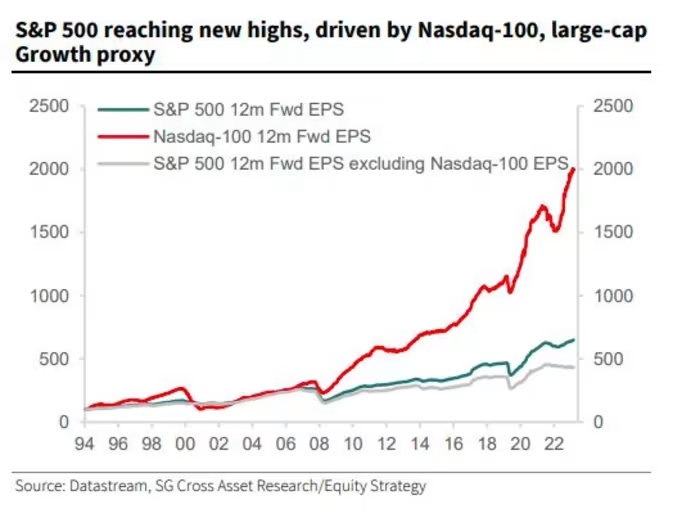
Societe Generale predicts that ‘U.S. exceptionalism’ will be the driving force behind gains in the S&P 500, as per their latest analysis. They have revised their year-end target to 5,500, indicating a modest increase of just over 5% from current levels. This projection stands out as one of the most bullish among major financial institutions tracked by MarketWatch, surpassing previous estimates set in 2023. Societe Generale cites ongoing macroeconomic improvements in the United States, including the resurgence of industries, advancements in artificial intelligence, and strengthened credit conditions, as key factors supporting their optimism. While acknowledging the rationality of current market optimism, the analysts caution against potential challenges ahead. These include rising bond yields, escalating gas prices, and the possibility of Fed rate hikes resuming in the future, all of which could undermine their forecast. Conversely, they highlight the potential for even greater upside if market sentiment continues to be buoyed by factors such as sustained Fed rate cuts and controlled bond yields. In summary, Societe Generale’s bullish outlook on the S&P 500 reflects a balanced assessment of both positive and negative factors, with a focus on continued growth tempered by potential risks.

Market News

Stocks Soar to Unprecedented Levels Following Fed’s Rate Decision

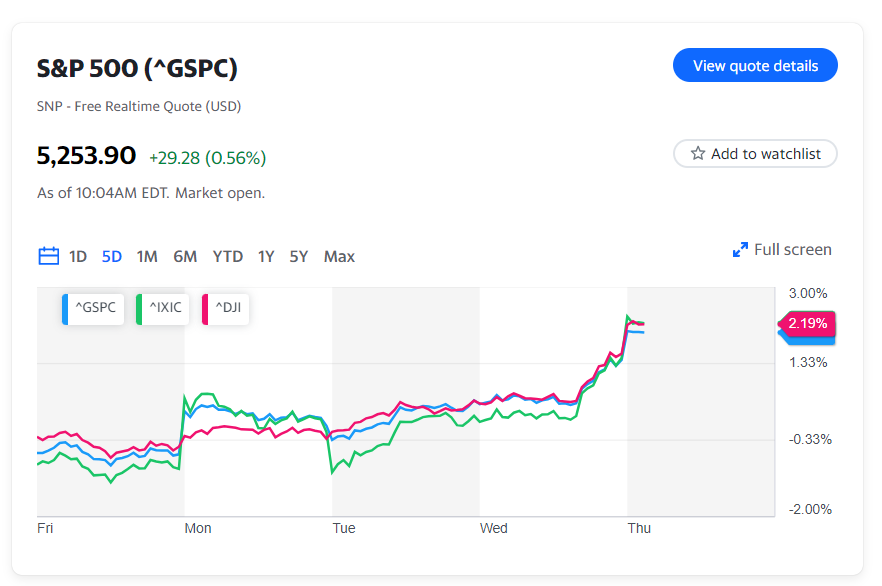
US stock indexes reached record highs on Wednesday after the Federal Reserve opted to keep interest rates steady and reaffirmed its forecast of three rate cuts for the year ahead. The S&P 500 (^GSPC) climbed 0.8%, closing above 5,200 for the first time at 5,224.62. Similarly, the Dow Jones Industrial Average (^DJI) rose about 1% to a record close of 39,512. The Nasdaq Composite (^IXIC), dominated by tech stocks, led the gains with a more than 1% increase, ending the day at a new peak of 16,369. All three major indices bounced back from slight declines before the Fed’s decision. In addition to its policy statement, the Fed released updated economic projections in its Summary of Economic Projections (SEP), including its “dot plot” illustrating policymakers’ anticipated future interest rate paths. Fed officials foresee the fed funds rate dropping to 4.6% by the end of 2024, indicating a potential 0.75% reduction this year, consistent with market expectations. Bond markets saw limited movement in response, with yields on the 10-year Treasury (^TNX) edging slightly lower to around 4.28% following a notable increase over the past two weeks. Overall, the market’s reaction to the Fed meeting highlighted a broadening participation in the market rally, as evidenced by the nearly 2% surge in the small-cap benchmark index (^RUT) and gains of over 1% in six of the 11 S&P 500 sectors.

Scroll to Top