DayTradeToWin Review

Single Trade Triumph: Unveiling the Potential of Autopilot Trading for $500 Gains

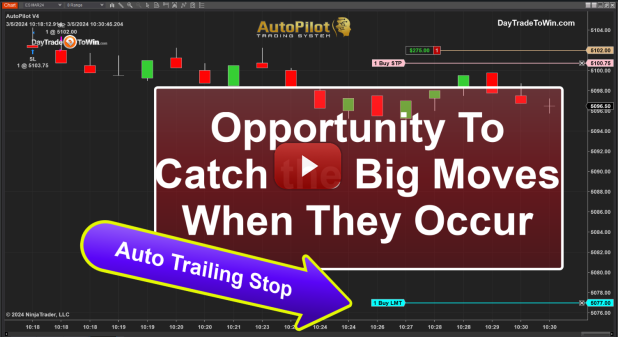
Welcome to another enlightening session where we delve into the realm of autopilot trading. Today, on this fine Tuesday, March 5th, we’re poised to unravel the intricacies of autopilot trading systems, shedding light on their capabilities, benefits, and the optimal strategies to harness their power. Before we embark on this journey, let’s emphasize a crucial point: trading inherently involves risks. Never invest funds you can’t afford to lose. With that disclaimer out of the way, let’s dive into the fascinating world of autopilot trading. One of the standout features of autopilot trading system is their proficiency in implementing trailing stop and break-even mechanisms. Imagine this scenario: you enter a trade, it initially falters, but eventually emerges as a profitable venture. These fluctuations are common in trading, but what truly matters are sustained market movements that yield significant gains. The beauty of autopilot system lies in their ability to navigate these fluctuations while seizing profitable opportunities. The trailing stop feature serves as a safety net, ensuring that once a trade moves in your favor, profits are secured, and potential losses are minimized. It’s a dynamic tool that adapts to market conditions, offering a tailored approach to risk management. However, it’s essential to acknowledge that losses are an inherent part of trading. Successful traders distinguish themselves by their ability to rebound from setbacks and capitalize on subsequent opportunities. Now, let’s discuss customization. Autopilot trading system are not one-size-fits-all. They can be tailored to align with your trading style and risk tolerance. Whether you prefer tight trailing stops for immediate protection or a more relaxed approach, these systems can be adjusted to suit your preferences. At this point, let’s shift gears and delve into the practical aspects of adjusting system settings. By fine-tuning trailing stops and break-even points, you can create a trading environment that resonates with your risk appetite. The best part? All of this happens automatically, liberating you from manual intervention and enabling you to capitalize on market movements with precision and efficiency. If you’re intrigued by the concept of autopilot trading, I encourage you to explore further. Visit daytradetowin.com for a wealth of resources, including videos and a free member account to kickstart your journey. Immerse yourself in the world of ninja Trader, acquaint yourself with the intricacies of autopilot systems, and unlock your trading potential. Don’t forget to subscribe to our YouTube channel for regular updates and live events where you can learn and trade alongside seasoned professionals. The path to trading mastery begins with knowledge and practice, and we’re here to guide you every step of the way. Until next time, happy trading!

Market News

Nasdaq’s Pullback-Free Run: Time to Brace for a Shakeout?

Jonathan Krinsky, the chief market technician at BTIG, highlights that the Nasdaq-100, heavily weighted towards tech, has not seen a pullback of 2.5% or more in 303 trading sessions, marking it as the third-longest streak since 1990. While this streak does not necessarily indicate an immediate downturn in the AI-driven surge in U.S. stocks, Krinsky suggests that the market is overdue for some volatility. Krinsky notes that the Invesco QQQ Trust Series ETF (QQQ), which mirrors the Nasdaq-100, has reached 14 consecutive record highs in 2024, with the latest on Friday, closing at $445.61 with a 1.5% increase. However, according to FactSet data, the last significant pullback of 2.5% or more occurred on Dec. 15, 2022, when QQQ dropped 3.4%. Interestingly, despite Apple Inc.’s historical significance in the index, its current performance tells a different story. While Apple’s shares fell 9.1% year-to-date, the Nasdaq-100 climbed 8.3%, according to FactSet. This divergence among megacap tech stocks, dubbed the Magnificent Seven, has been evident since the beginning of 2024, as seen in Monday’s trading session: Nvidia Corp. surged 3.6%, Tesla Inc. declined 7.2%, Alphabet Inc. dipped 2.8%, and Apple slipped 2.5%. Krinsky emphasizes the importance of recognizing the disparity beneath the surface, suggesting that while it’s positive to observe a broadening beyond the ‘AI’ trade, the continued momentum in certain names may lead to consequences, even if only in the short term. On Monday, weakness in several megacap names affected the Nasdaq, leading both the Nasdaq-100 (NDX) and the Nasdaq Composite (COMP) to finish 0.4% lower. The S&P 500 also experienced a slight decline after briefly turning positive, while the Dow Jones Industrial Average ended the day in negative territory as well.

DayTradeToWin Review

Defeating Market Manipulation: Your Guide to $500 Wins with a 5-Minute Chart

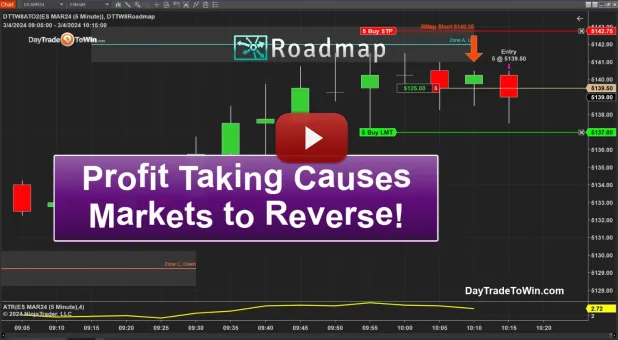
Greetings, traders! Welcome to another thrilling day in the world of trading. It’s March 4th, and we’re diving deep into the Monday market action. Today, I’ve got an exciting opportunity to share with you, courtesy of the Roadmap software. Now, I know Mondays might not be everyone’s favorite, but trust me, there’s always a chance to make some magic happen. And today, I’m particularly jazzed about a shorting opportunity that’s caught my eye. But before we jump into the trade specifics, let’s talk about the elephant in the room: risk. Trading comes with its fair share of risks, so it’s crucial to only play with funds you can afford to lose. Safety first, folks. Now, onto the meaty stuff. I’ve got my trusty Average True Range (ATR) indicator by my side, and let me tell you, it’s a game-changer. This little tool gives us key insights into market volatility, and today, it’s telling us we’re in for a ride. So, let’s talk trade. The Roadmap signal is flashing bright, signaling a short entry point at 5140.25. Sure, it might not be the perfect entry, but close enough to make a move. Timing is everything in this game, after all. Now, let’s break down this trade. The market’s been dancing around the Roadmap Zone, encountering resistance along the way. This resistance indicates profit-taking and a potential shift in market sentiment. It’s like having a crystal ball for market movements. Speaking of tools, if you’re eager to get your hands on the Roadmap and other top-notch resources, look no further than our Accelerated Mentorship program. It’s the ultimate trading package, complete with lifetime software licenses and access to our live trading room. Trust me, it’s worth every penny. But before you dive headfirst into trading, remember a few golden rules: don’t overtrade, resist the urge to double down on the same trade, and always know when to cut your losses. Discipline is the name of the game. And just like that, we’re out of the trade, locking in profits based on our predetermined targets. The ATR keeps us grounded, helping us navigate the market with confidence. If you’re craving more trading wisdom, head over to Daytradetowin.com and sign up for a free member account. Dive into the world of price action trading and take your skills to the next level. Until next time, happy trading, and may the markets be ever in your favor. Click on the next video to uncover more strategies and tools for mastering the art of trading. And don’t forget to check out the links in the description for direct access to our top-notch trading software. Stay sharp, stay curious, and keep on trading. Cheers!

Market News

Bank of America Sets S&P 500 Target at 5,400: A Breakdown of the Forecast

Today’s U.S. trading day is expected to start cautiously, with futures signaling a subdued opening for Wall Street despite the major stock indices maintaining their record highs. Over the past three months, both the Nasdaq Composite and the S&P 500 have seen significant gains, raising concerns among some about the possibility of market bubbles. Bank of America’s team, led by Savita Subramanian, remains optimistic, having revised their end-of-year S&P 500 target upward to 5,400. However, they also acknowledge the likelihood of a market pullback, citing historical patterns of regular 5% pullbacks and 10% corrections. Subramanian highlights bearish signals from technical analysis and an uptick in the volatility gauge (CBOE VIX), indicating growing uncertainty as elections approach. Nevertheless, historical trends suggest that post-election periods often lead to year-end rallies due to reduced uncertainty. Despite potential short-term setbacks, Subramanian forecasts a modest 5% upside for the S&P 500 this year. This projection is based on a thorough analysis of five different forecasting methods, each weighted differently depending on prevailing market conditions and investor sentiment. Currently, the most optimistic method, the sell-side indicator, suggests a target of 5,706, though its weight has been slightly reduced due to potentially overly optimistic analyst forecasts. Other factors such as price momentum, earnings surprises, and long-term valuation also contribute to the overall target. The increase in the fair value model, reflecting a shift towards higher-margin, lower-risk industries, is a key driver behind the revised S&P 500 target. Despite concerns about market exuberance in certain sectors, Subramanian anticipates a broader market expansion beyond these themes. While sentiment among sell-side analysts leans bullish, overall allocations to public equity remain low, and positioning in certain sectors indicates bearish sentiment. This suggests potential for further market growth beyond current trends, provided broader market participation increases.

Market News

Analyzing March Momentum: U.S. Stock Market Post-Strong February

Bespoke observes that March typically delivers moderate results for U.S. stocks, lacking the standout gains seen in other months. Despite a successful February for U.S. stocks, there’s speculation over whether investors might opt to cash in on those gains at the beginning of March. Reflecting on historical data since 1953, Bespoke finds a varied response in stock performance following a February rally of over 4% in the S&P 500. The first day of March typically yields modest gains, with the index closing higher just over half the time. However, the trend tends to shift afterward, with the fourth and fifth trading days of March historically showing slight declines compared to other March months. While these patterns aren’t definitive, Bespoke suggests that some early weakness in March wouldn’t be surprising. As March begins, U.S. stocks opened in a subdued manner, with the Nasdaq Composite continuing to outperform, having settled at a record high in the previous session. Looking back at historical trends, March’s performance for the S&P 500 has been fairly average since 1928, with gains that don’t particularly stand out. However, when March follows strong performances in January and February, the results tend to be weak. In such instances since 1928, the S&P 500 has experienced significant monthly declines, according to Bespoke’s data.

Market News

Dalio’s Assessment: Stock Market Resists Bubbling Tendencies

In evaluating the U.S. stock market with these parameters, Ray Dalio, founder of Bridgewater Associates, suggests that it doesn’t appear excessively bubbly, despite notable rallies and media attention on specific segments. Stocks have surged significantly since their October lows, marking four consecutive months of gains and propelling both the S&P 500 and Dow Jones Industrial Average to consecutive record highs. This surge, primarily driven by a narrow focus on technology, has prompted discussions about a potential bubble reminiscent of the late 1990s dot-com boom and subsequent bust. However, Dalio argues in a recent LinkedIn post that concerns about a bubble may be misplaced, citing his six-part checklist to assess the situation. He elaborates on his criteria for the “bubble gauge” as follows: Based on Dalio’s equity bubble gauge, the current market situation falls within the middle range, at the 52nd percentile, a level historically not associated with past bubbles. Regarding the “Magnificent Seven,” the group of mega-cap tech stocks fueled by enthusiasm over artificial intelligence, Dalio acknowledges their notable surge, with their combined market capitalization growing over 80% since January 2023, now representing more than a quarter of the S&P 500’s total market capitalization. Dalio suggests that while these stocks may appear somewhat inflated, they do not reflect a full-fledged bubble. Valuations, while slightly high relative to current and projected earnings, are not excessively so, and sentiment does not indicate extreme bullishness. Furthermore, there’s no evidence of excessive leverage or an overwhelming influx of new and inexperienced buyers. However, Dalio cautions that a significant correction in these stocks could occur if the anticipated impact of generative AI fails to materialize as priced in.

Scroll to Top