Market News

Bank of America Sets S&P 500 Target at 5,400: A Breakdown of the Forecast

Today’s U.S. trading day is expected to start cautiously, with futures signaling a subdued opening for Wall Street despite the major stock indices maintaining their record highs. Over the past three months, both the Nasdaq Composite and the S&P 500 have seen significant gains, raising concerns among some about the possibility of market bubbles. Bank of America’s team, led by Savita Subramanian, remains optimistic, having revised their end-of-year S&P 500 target upward to 5,400. However, they also acknowledge the likelihood of a market pullback, citing historical patterns of regular 5% pullbacks and 10% corrections. Subramanian highlights bearish signals from technical analysis and an uptick in the volatility gauge (CBOE VIX), indicating growing uncertainty as elections approach. Nevertheless, historical trends suggest that post-election periods often lead to year-end rallies due to reduced uncertainty. Despite potential short-term setbacks, Subramanian forecasts a modest 5% upside for the S&P 500 this year. This projection is based on a thorough analysis of five different forecasting methods, each weighted differently depending on prevailing market conditions and investor sentiment. Currently, the most optimistic method, the sell-side indicator, suggests a target of 5,706, though its weight has been slightly reduced due to potentially overly optimistic analyst forecasts. Other factors such as price momentum, earnings surprises, and long-term valuation also contribute to the overall target. The increase in the fair value model, reflecting a shift towards higher-margin, lower-risk industries, is a key driver behind the revised S&P 500 target. Despite concerns about market exuberance in certain sectors, Subramanian anticipates a broader market expansion beyond these themes. While sentiment among sell-side analysts leans bullish, overall allocations to public equity remain low, and positioning in certain sectors indicates bearish sentiment. This suggests potential for further market growth beyond current trends, provided broader market participation increases.

Market News

Analyzing March Momentum: U.S. Stock Market Post-Strong February

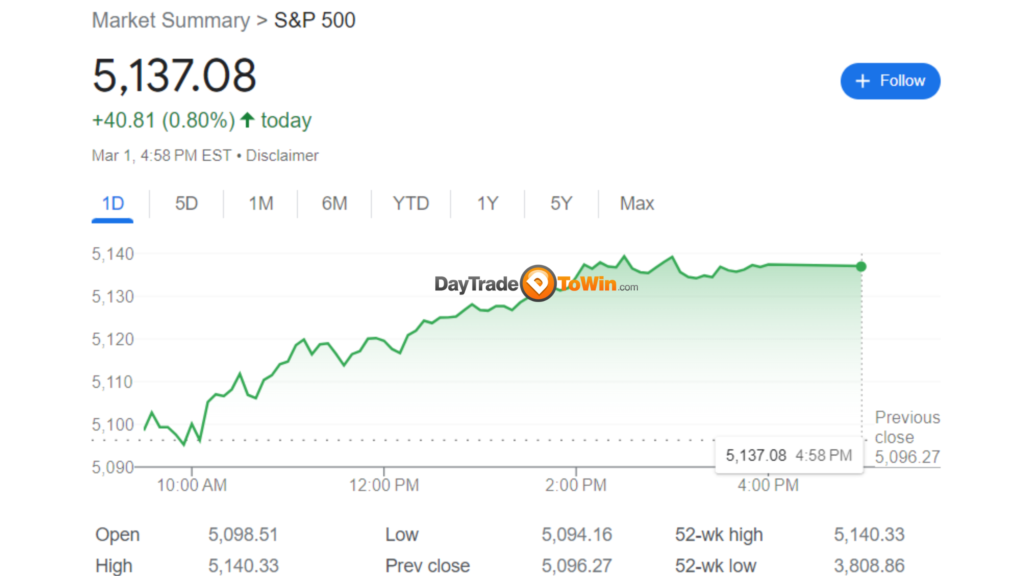
Bespoke observes that March typically delivers moderate results for U.S. stocks, lacking the standout gains seen in other months. Despite a successful February for U.S. stocks, there’s speculation over whether investors might opt to cash in on those gains at the beginning of March. Reflecting on historical data since 1953, Bespoke finds a varied response in stock performance following a February rally of over 4% in the S&P 500. The first day of March typically yields modest gains, with the index closing higher just over half the time. However, the trend tends to shift afterward, with the fourth and fifth trading days of March historically showing slight declines compared to other March months. While these patterns aren’t definitive, Bespoke suggests that some early weakness in March wouldn’t be surprising. As March begins, U.S. stocks opened in a subdued manner, with the Nasdaq Composite continuing to outperform, having settled at a record high in the previous session. Looking back at historical trends, March’s performance for the S&P 500 has been fairly average since 1928, with gains that don’t particularly stand out. However, when March follows strong performances in January and February, the results tend to be weak. In such instances since 1928, the S&P 500 has experienced significant monthly declines, according to Bespoke’s data.

Market News

Dalio’s Assessment: Stock Market Resists Bubbling Tendencies

In evaluating the U.S. stock market with these parameters, Ray Dalio, founder of Bridgewater Associates, suggests that it doesn’t appear excessively bubbly, despite notable rallies and media attention on specific segments. Stocks have surged significantly since their October lows, marking four consecutive months of gains and propelling both the S&P 500 and Dow Jones Industrial Average to consecutive record highs. This surge, primarily driven by a narrow focus on technology, has prompted discussions about a potential bubble reminiscent of the late 1990s dot-com boom and subsequent bust. However, Dalio argues in a recent LinkedIn post that concerns about a bubble may be misplaced, citing his six-part checklist to assess the situation. He elaborates on his criteria for the “bubble gauge” as follows: Based on Dalio’s equity bubble gauge, the current market situation falls within the middle range, at the 52nd percentile, a level historically not associated with past bubbles. Regarding the “Magnificent Seven,” the group of mega-cap tech stocks fueled by enthusiasm over artificial intelligence, Dalio acknowledges their notable surge, with their combined market capitalization growing over 80% since January 2023, now representing more than a quarter of the S&P 500’s total market capitalization. Dalio suggests that while these stocks may appear somewhat inflated, they do not reflect a full-fledged bubble. Valuations, while slightly high relative to current and projected earnings, are not excessively so, and sentiment does not indicate extreme bullishness. Furthermore, there’s no evidence of excessive leverage or an overwhelming influx of new and inexperienced buyers. However, Dalio cautions that a significant correction in these stocks could occur if the anticipated impact of generative AI fails to materialize as priced in.

DayTradeToWin Review

Accelerate Your Trading Game: Pre-Market Techniques Revealed

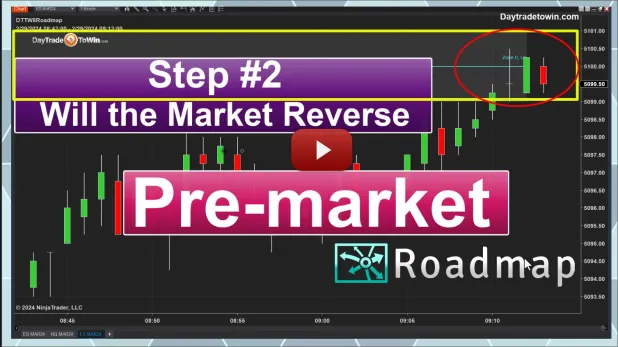
Greetings traders, and a happy Leap Year to you all! Today, on this unique Thursday, February 29th, I’m excited to explore a pre-market trading opportunity that has captured my attention. But before we delve into the specifics, let’s remember the cardinal rule of trading: only invest what you can afford to lose, as trading inherently carries risks. As I’m speaking, it’s approximately 9:00 AM, and I’m actively monitoring the market’s movements. The opportunity I’m honing in on resides within a distinct zone outlined on the roadmap, a specialized tool provided by Day Trade to Win. This particular zone, Zone D, presents an enticing chance for a potential short position, contingent upon certain conditions falling into place. The roadmap indicates a trajectory towards Zone D, yet the pivotal question remains: will the market undergo a reversal once it reaches this zone? A fundamental aspect of my strategy is exercising patience and waiting for confirmation before executing any trades. This confirmation typically materializes in the form of a reversal signal, such as the emergence of a red candle, signaling profit-taking and a potential shift in market direction. Once the necessary conditions align and the roadmap signals a short entry, I enact a meticulously planned strategy. This involves implementing stop-loss orders to mitigate risk and establishing a specific target for potential profits. Furthermore, I stress the importance of steering clear of emotional trading behaviors, such as revenge trading or augmenting losing positions. While my focus lies on E-mini S&P price action trading in this scenario, the underlying principles can be universally applied across diverse markets. Day Trade to Win offers an array of price action methods, including the Trade Scalper and the Atlas Line, catering to traders across various market sectors. For those eager to deepen their understanding of price action trading and gain access to invaluable tools like the roadmap, Day Trade to Win offers an Accelerated Mentorship program. This comprehensive program provides lifetime licenses for essential trading software and grants entry into a supportive trading community. As the pre-market trade unfolds successfully, I exit the position with a profitable outcome, underscoring the efficacy of a disciplined trading approach. With the market poised to open, I remain vigilant for future opportunities, poised to apply the same principles of price action trading. Should you have any inquiries or wish to explore further, feel free to visit DayTradeToWin.com. Until our next encounter, may your trades be prosperous and your strategies sound. Happy trading!

Market News

Into the Unknown: Traders’ Exploration of an Essential, Yet Little-Known, Financial Realm

Investors are acutely aware of potential shifts brewing in the background over the past 1.5 to 2 years, signaling the possibility of messy adjustments ahead, notes a strategist. While Federal Reserve officials may take months before considering any action on interest rates, traders are directing their attention to the often-overlooked dynamics of funding markets, which are crucial for sustaining confidence in the U.S. banking system. These markets, particularly the mechanisms like the Federal Reserve’s reverse repurchase facility, play a pivotal role in managing the central bank’s main policy rate target and ensuring the smooth operation of financial markets. However, concerns are mounting that certain scenarios could trigger disruptions akin to those witnessed in September 2019, when volatility rattled the overnight funding market due to a sharp decline in bank reserves. Economist Derek Tang underscores the challenges faced by Fed officials during such episodes, highlighting the uncertainty surrounding the effectiveness of their measures in mitigating risks. Presently, the usage of the reverse-repo facility is on the decline, raising apprehensions that a complete cessation could lead to a shortage of reserves in the banking sector, echoing the events preceding the collapse of Silicon Valley Bank. Despite these concerns, funding markets have exhibited resilience this year, with no indications of strain comparable to those seen in late 2023. With ample bank reserves intact, the Fed retains the flexibility to continue its quantitative tightening efforts, though worries persist regarding potential disruptions once reverse repo usage hits zero. The concentration of these issues on the Fed’s balance sheet is capturing market attention, with many fearing a period of calm before a storm. Tang suggests that while the Fed may not be adjusting interest rates, the focus on these matters in 2024 aligns with expectations for a reevaluation of balance-sheet plans. While some policymakers have earmarked March for discussions on adjusting the pace of quantitative tightening, analyst John Velis questions the urgency, pointing to the current stability in funding markets and policy uncertainty delaying rate cut expectations. Nonetheless, developments in various market indicators, including Treasury prices and yields, underscore the evolving landscape that investors are monitoring closely.

DayTradeToWin Review

Roadmap Secrets: Unveiling Profitable Trade Setups

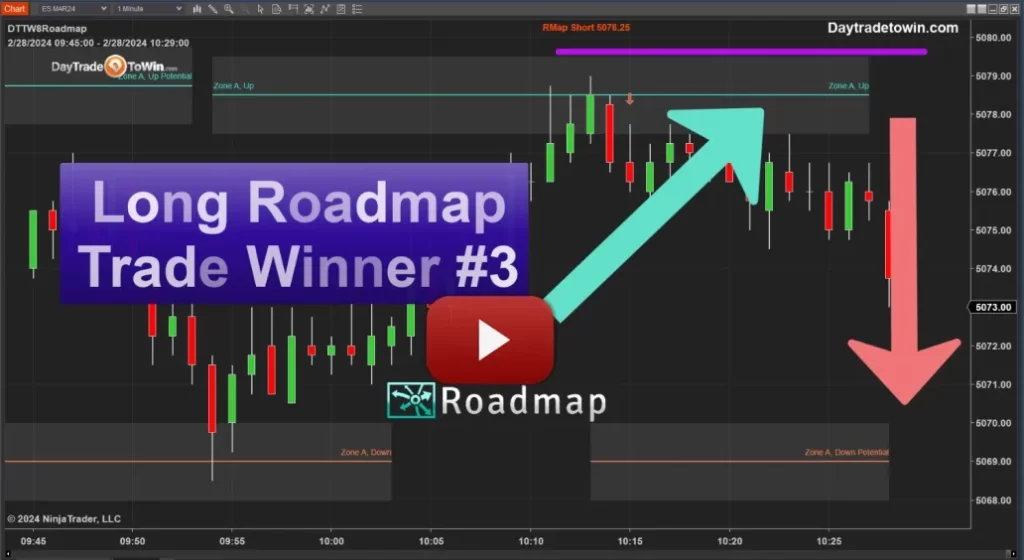
Greetings, fellow traders! Today, let’s explore the intricate realm of price action trading, focusing on a recent trading session powered by the robust Roadmap software from Day Trade to Win. Join me as we analyze market movements, spot trade opportunities, and unravel the intricacies of this dynamic trading approach. On Wednesday, February 28th, the trading day unfolds with a promising setup identified through the Roadmap software. Recognizing signs of market manipulation, we seize a long trade opportunity as the market reverses from the Roadmap level. This proprietary tool equips traders with a clear roadmap of market dynamics, ensuring everyone can capitalize on the same opportunity. With precision, we enter the trade, aiming for a modest gain of approximately 7-8 ticks. The volatility at market open amplifies the opportunity, showcasing the effectiveness of price action trading. However, it’s essential to acknowledge the inherent risks associated with trading, especially when dealing with leveraged instruments. Leveraging the Roadmap software, we navigate subsequent market movements, evaluating potential trade setups while adhering to predefined rules. As the market nears a critical zone, we exercise patience, awaiting confirmation before considering short trade opportunities. Throughout our analysis, we stress the significance of discipline and risk management. Throughout the trading session, we witness the Roadmap’s prowess in identifying high-probability trade setups. Whether it’s employing trailing stops, semi-automation strategies, or pivotal stop placements, traders have an arsenal of tools to navigate the markets effectively. Additionally, Day Trade to Win’s commitment to trader success is evident through live trading rooms, mentorship programs, and ongoing support. In conclusion, reflecting on the day’s trading activities underscores the importance of seizing profitable opportunities while diligently managing risks. Price action trading, complemented by innovative software solutions like the Roadmap, provides traders with a competitive edge in today’s dynamic markets. Success in trading necessitates a blend of skill, discipline, and continuous learning. Until our next trading endeavor, happy trading! Don’t forget to explore daytradetowin.com for valuable resources and membership access to enhance your trading journey. Stay tuned for more insightful content and trading updates!

Scroll to Top