tax refunds
Market News

Tax Refunds Forecast: A Major Tailwind for the Economy

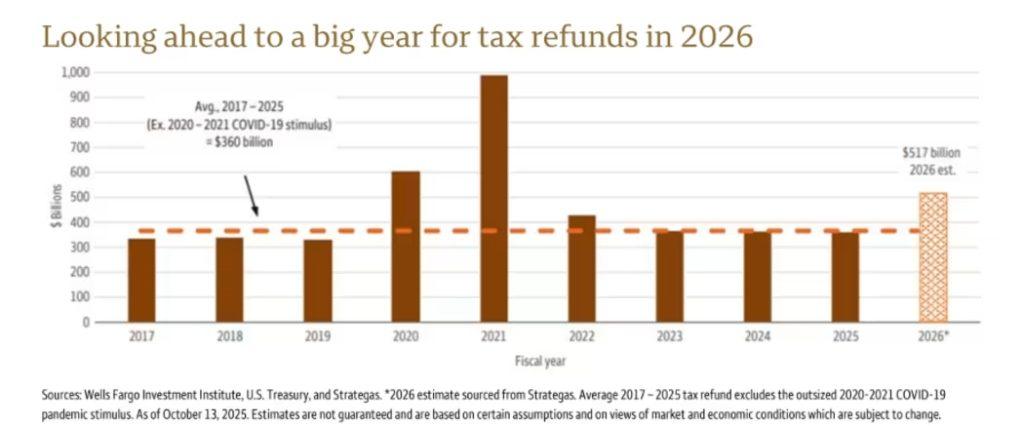
Tax-rebate checks are expected to start arriving in the second quarter, but most of the relief from Trump’s One Big Beautiful Bill Act is directed toward businesses. Stocks could see another leg higher next year as taxpayers begin receiving refunds tied to President Donald Trump’s major tax-and-spending package signed this summer. White House National Economic Council Director Kevin Hassett said Monday that typical workers, now exempt from taxes on tips or overtime, could receive an extra $1,600 to $2,000 next year. “A lot of that will come as tax refunds at the beginning of the year,” he told CNBC. Hassett is also viewed as a top contender to replace Fed Chair Jerome Powell in May. Analysts at the Wells Fargo Investment Institute expect about $517 billion in tax refunds next year — a surge they believe will help “reignite broad consumer spending” and support both the economy and markets. If accurate, it would be one of the largest refund years since 2017, excluding the pandemic-stimulus years. “We expect the nearly 44% year-over-year increase to meaningfully boost consumer spending and help the U.S. economy gather renewed momentum in 2026,” wrote Jennifer Timmerman, an investment-strategy analyst at Wells Fargo. Wells Fargo forecasts the S&P 500 ending 2025 in the 7,400–7,600 range, while the 10-year Treasury yield is expected to stay between 4% and 5%. On Wednesday, the 10-year yield was at 4.15% and the S&P 500 closed just below record highs at 6,886 — poised for a 17.1% annual gain. Will stocks stumble early next year? Meghan Shue, chief investment strategist at Wilmington Trust, expects the current rally to continue through December but is more cautious about the first quarter. After a strong 2025 — especially for AI-related stocks — she anticipates more volatility, selling, and profit-taking as investors rebalance. She also notes tariff uncertainty. Many businesses may be holding off on passing higher import costs to consumers during the critical holiday season. “There could be more supply-chain pressure and more tariff price increases to come in the first quarter,” she said. The outlook brightens in the second quarter as clarity around tariffs and tax relief improves. For consumers, that’s when tax refunds arrive. For businesses — the biggest winners under the new tax law — the payoff will depend more on capital-expenditure incentives than timing.

CTA
Market News

UBS Warns CTA Positioning Could Intensify Market Drop

UBS warns that CTA positioning could sharply amplify any market downturn. With a major U.S. options expiration approaching on Dec. 19, markets are heading into a dense cluster of risk events — the Fed decision on Wednesday, nonfarm payrolls on Dec. 16, and the CPI report on Dec. 18. UBS analysts say that given current positioning and the size of outstanding options, even a small pullback could morph into a much steeper decline. Their analysis shows that a drop in the S&P 500 to around 6,500 — about 5% below current levels — could trigger a critical downside inflection point. UBS’s proprietary model, built to track macro hedge fund behavior around expiration, highlights major sensitivity near 6,850. If the index weakens toward 6,500, commodity trading advisors (CTAs), who follow momentum-driven, algorithmic strategies, would be forced to sell into the decline, accelerating the move lower. The Dec. 19 expiration carries unusually heavy risk, with large open interest at the 5,000, 6,000, 6,850, and 8,000 S&P 500 strikes. Because CTAs rely on systematic trend-following and delta hedging intensifies into expiry, their positioning can significantly exaggerate market swings. December’s expiry is even more consequential because it caps both the quarter and the year. UBS finds CTAs have recently added risk but remain skewed toward selling. A slide toward 6,500 would likely force them to unload increasing amounts of futures to manage directional exposure. In Europe, CTAs are very long Eurostoxx 50 near 5,700, and a move toward 5,600 could trigger heavier selling. UBS also highlights other areas of sensitivity: CTAs are near max short the Japanese yen ahead of the Dec. 19 BOJ meeting, heavily long the Chinese yuan, and holding notable long positions in U.S. 10-year Treasurys that could come under pressure if yields rebound toward 4.25%.

mortgage
Market News

Mortgage Rates Rise: What Homeowners Can Do Now

How Homeowners and Buyers Can Still Beat High Mortgage Rates With Two Smart Moves Mortgage rates are rising sharply even though the Federal Reserve is widely expected to cut rates this week — a break from the usual pattern. Typically, when markets anticipate Fed cuts, the 10-year Treasury yield falls, pulling 30-year mortgage rates down with it. This time, the opposite happened. On Monday, the average 30-year mortgage rate jumped nine basis points to 6.36%, its highest level in two weeks, according to Mortgage News Daily. The 10-year Treasury also climbed to 4.17%, signaling that markets aren’t reacting the way they normally do ahead of a rate cut. Jeffrey Ruben, president of WSFS Home Lending, said the 10-year and 30-year yields “are not behaving as they traditionally would,” pointing to two main reasons: Fed Cuts Aren’t Pushing Mortgage Rates Lower The spike in mortgage rates works against the Trump administration’s goal of reducing borrowing costs to revive the housing market. High prices and elevated mortgage rates continue to sideline buyers, while homeowners are still waiting for the right moment to refinance and ease monthly expenses. Despite multiple Fed cuts in 2025, the 30-year fixed mortgage rate hasn’t dipped below 6% all year. Its lowest point was 6.13% in September and October — and it hasn’t been under 6% since February 2023. Two Practical Mortgage Moves You Can Make Right Now Even in this tough rate environment, homeowners and buyers still have options to lower monthly housing costs: 1. Consider an Adjustable-Rate Mortgage (ARM) ARMs offer much lower initial rates compared to 30-year fixed loans. As of Nov. 28, the average 30-year fixed rate was 6.32%, while the five-year ARM averaged just 5.4%, according to the Mortgage Bankers Association. While ARMs carry some risk, they can help buyers secure a lower entry rate. If mortgage rates fall in the next few years, borrowers can refinance into a lower, fixed-rate mortgage later on. 2. Ask Your Lender for a Rate Modification Homeowners can also request a rate adjustment from their lender. A rate modification lowers your existing mortgage rate without refinancing — meaning your loan terms stay the same and your credit isn’t affected. Lenders often agree because it keeps the loan with them rather than losing the borrower to another lender.

forecast
Market News

Oppenheimer’s Bold 8,100 S&P 500 Forecast

Oppenheimer strategists now see the S&P 500 reaching 8,100 by the end of 2026, the most bullish call on Wall Street. On Dec. 9, 2024, the team led by John Stoltzfus set a 7,100 target for the S&P 500 — a level now less than 3% away. But after markets sank following April’s “Liberation Day” tariff announcement, they briefly cut the target to 5,950 before restoring the original 7,100 outlook by late July. Even with the back-and-forth, their forecast held up well. Now they are pushing expectations higher, surpassing Deutsche Bank’s 8,000 target and the MarketWatch median of 7,500. Their bullish stance comes down to one thing: the economy and corporate earnings proved far stronger than anticipated. “Resilient economic data and S&P 500 companies consistently topping expectations suggest more earnings strength ahead in 2026,” the team said. Oppenheimer expects the Federal Reserve to cut rates on Wednesday, followed by one or two more cuts in 2026. Markets broadly expect at least two next year. They argue that monetary and fiscal policy, continued innovation, and steady earnings growth remain the foundation for hitting their 2026 target. Sector-wise, they are overweight: And underweight: They also reject the idea of a weakening U.S. consumer: While sentiment surveys show near-term caution, hard sales data indicates consumers are still spending — more selectively and with greater price sensitivity.

market
Market News

Global Market Forecast: The Top Shifts Expected to Shape 2026

Byron Wien, who died in 2023, was one of Wall Street’s most influential strategists. During his long tenure at Morgan Stanley, he became famous for his annual “10 Surprises” list — predictions he believed had better than a 50% chance of happening, even though the market assigned them odds below one-third. Several firms have attempted to continue Wien’s legacy, and U.K. research house Variant Perception has now embraced the tradition for a second straight year, sticking to Wien’s original 50% likelihood vs. 33% consensus framework. Their big-picture view for next year: the economy should hold up reasonably well. Variant Perception expects U.S. nominal GDP to grow more than 5%, a mix of real growth and inflation. Historically, that environment has supported equities, put a floor under yields, and boosted the U.S. dollar — trends already visible over the past two months. This also tends to be the point in the cycle where earlier declines in oil, the dollar, and yields begin to revive manufacturing. Still, despite a constructive macro backdrop, Variant Perception warns that stretched valuations and thin risk premiums in both credit and equities are a challenge. That’s why they favor rotations into emerging markets, value stocks, and other laggards. In their words: there’s a “valuation problem,” not a “macro problem.” Here are their ten surprises for the coming year: The capex story is especially noteworthy. With tariff policies mostly set, bank lending surveys show easier commercial lending standards and stronger loan demand. Corporates may also tap newly favorable tax rules — including full bonus depreciation and immediate R&D expensing. Combined with last year’s declines in oil, the dollar, and yields, these factors typically provide a tailwind for manufacturing. But this rebound may not lift employment. Variant Perception sees similarities to the 2002–2003 era, when productivity gains and easy Fed policy drove a “jobless recovery.” Their oil outlook also deserves attention. While consensus expects a supply glut, the firm believes the balance of risks points to a highly volatile oil market in 2026. They stress that this isn’t contrarian for its own sake — just where the data leads.

sonic
DayTradeToWin Review

Sonic Market Update: Long and Short Opportunities

Hello traders! Today is December 4, and in this update we’ll break down the latest movement in the E-mini S&P 500 (ES), Dow futures (YM/MYM), and NASDAQ futures (NQ/MNQ). We’ll also look at how to approach today’s setup using price action and tools like the Sonic System. Before we dive in, a quick reminder: trading involves risk. Only trade with capital you can afford to lose. Market Outlook: Momentum Still Points Higher Major U.S. indices continue to move largely in sync. While intraday pullbacks are expected, the broader trend still aligns with the forecast issued about one to two weeks ago:➡️ A move higher toward the most recent swing highs. Why the Highs Matter The market tends to accelerate when breaking through key resistance: A double top is possible, but historically, clean breaks above recent highs favor continuation strength. E-mini S&P 500 (ES): Bullish Bias Above the 50% Level Using a simple 50% midpoint tool on any charting platform: Even with this morning’s pullback, ES continues to form higher highs, showing buyers remain in control. The larger target remains a retest of recent highs, with the potential for continuation. Dow Futures (YM & MYM): Same Structure, Same Play The Dow is following the same pattern as the ES: When price returns to the highs:➡️ Expect another potential breakout pop. Traders using MYM can apply the exact same strategy. NASDAQ Futures (NQ & MNQ): Strongest Upside Potential The NASDAQ continues to show powerful structure: Projected upside for the micro NASDAQ sits around 1,300 points, possibly more depending on market momentum. Intraday Trading with the Sonic System On the 1-minute chart, the Sonic System is currently signaling short trades. However: The Sonic System provides: A live example in the transcript demonstrated a short trade taken immediately as the signal appeared — simple, fast, and rules-based. What to Focus on Today ✔ Overall trend favors the upside✔ Watch for a retest and breakout of recent highs✔ Intraday signals may vary, but big-picture bias is bullish✔ Sonic System signals are straightforward—follow stop, target, and trend shift✔ Price action remains the most reliable guide across all three indices Final Notes If you’re serious about improving your price-action skills: Trade smart, stay disciplined, and see you in the next update.

Scroll to Top