Market News

Red Sea Shipping Incidents Shake Financial Markets with Inflation Apprehensions

Recent attacks on commercial shipping in the Red Sea are raising broader concerns about the potential resurgence of inflation, especially in Europe, posing a threat to the central narrative in the financial markets for the new year. This narrative gained traction after the Federal Reserve’s recent shift towards a more dovish stance, continuing to unfold on Tuesday, indicating that inflation is expected to ease enough to prompt a series of interest-rate cuts in 2024. Financial markets positioned themselves for this optimistic scenario in various ways: Treasury yields mostly decreased, traders maintained expectations for five to seven quarter-point rate cuts in the U.S. next year, and stocks closed higher, with the S&P 500 SPX just falling short of breaking a record set in January 2022. The developments in the Red Sea prompted the U.S. to announce a new international effort to counter the attacks on Monday, causing oil prices CL.1, +1.26% CLG24, +1.26% to rise for a second consecutive day on Tuesday as shipping companies rerouted their cargoes. Investors were reminded of the world’s heavy reliance on what Deutsche Bank strategists have termed a network of invisible connections spanning seas, skies, and land. Derek Tang, an economist at Monetary Policy Analytics in Washington, noted that the Red Sea events primarily impact Europe, but if they persist over a three- to six-month period, the U.S. could also be affected, triggering a domino effect on various fronts. BMO Capital Markets strategists Ian Lyngen and Ben Jeffery emphasized that “further disruptions in the Red Sea or any other major channels of commerce present potential upside inflationary impulses,” complicating efforts to keep the 10-year Treasury yield BX:TMUBMUSD10Y below 4%. Investors face significant implications, including the potential need to recalibrate their inflation outlook and expectations for lower interest rates in the coming year. Despite a decline from the peak of 9.1% in June 2022, inflation has consistently remained above the Fed’s 2% target. If inflation is perceived to resurface, akin to the period between 1966-1982, market-implied rates may rise, leading policymakers to reconsider recent plans to refrain from further rate hikes. Fed Gov. Chris Waller even flagged the possibility of the U.S. central bank cutting borrowing costs simply due to falling inflation, irrespective of economic growth. Macro strategist Will Compernolle of FHN Financial in New York highlighted that the recent Fed pivot was driven by sustained improvement in inflation, and markets may have prematurely embraced the significant narrative shift. The potential return of inflation could also influence investors’ decisions regarding the nearly $6 trillion cash pile in money-market accounts. Debates are ongoing about whether a portion of this pile will remain, flow back into stocks, or return to bond funds, depending on whether the Fed cuts rates or maintains them at a 22-year high of between 5.25%-5.5%. On Tuesday, the Treasury market remained relatively stable, with the benchmark 10-year yield BX:TMUBMUSD10Y finishing at 3.921%, the lowest level since July 26. Meanwhile, stocks rallied, with the Dow Jones Industrial Average DJIA and Nasdaq Composite COMP both gaining almost 0.7%. Bank of America’s latest survey of sentiment among global fund managers indicated that one of the major perceived risks is the potential for high inflation, compelling central banks to keep interest rates elevated.

Market News

S&P 500’s Last Stand in 2023: Bearish ‘Doji’ Sparks Battle Between Bulls and Bears

A pair of ‘doji’ formations has surfaced on the S&P 500’s candlestick charts, indicating the potential for a significant market move, although the direction remains uncertain. Despite a notable surge, signs of bearish sentiment are emerging in a key U.S. index. The S&P 500 is poised within 2% of its previous record high from January 3, 2022, while the Dow Jones Industrial Average has secured three consecutive all-time highs and is eyeing a fourth on Monday. Nevertheless, a time-honored charting technique has unveiled a cautionary signal, hinting at a possible reversal in the prevailing bullish trend in the widely monitored stock-market index. Following a robust post-Federal Reserve meeting rally, the S&P 500 displayed a classic doji chart on Thursday, followed by a less conventional doji formation on Friday. In the realm of candlestick charts, the “doji” pattern, originating from Japan over 200 years ago, is interpreted by market analysts as a potential harbinger of future market movements based on investor psychology. Dojis, characterized by their thin bodies reflecting closely aligned opening and closing prices, along with equal-length vertical lines or “wicks,” denote the day’s trading range. Drawing parallels to a frozen ball midair before descending after being thrown upward, MarketWatch‘s Tomi Kilgore underscores the significance of doji patterns, particularly after substantial gains like the S&P 500’s 1.4% rise on Wednesday and the Dow Jones breaching 37,000 for the first time. The importance of the doji lies in its capacity to assist in gauging whether an asset has reached its peak, signaling a potential reversal of gains, or if there is still room for growth. Steve Nison, credited with introducing candlestick charts to the West, emphasizes that a doji in an extended rally indicates buyer indecision and potential for a reversal. However, it is essential to underscore that a doji does not guarantee a reversal in momentum but rather provides insights into market psychology. In the view of Vladimir Ribakov, writing for TradingBud, the doji pattern signifies a temporary equilibrium of power between buyers and sellers before an impending significant move. The occurrence of two consecutive dojis, observed in the S&P 500 on Thursday and Friday, heightens the probability of a substantial move in either direction. Ribakov suggests a powerful move may follow, leaving the outcome uncertain between bullish and bearish forces. Market optimism stems from investor expectations that the Federal Reserve will not only cease interest rate hikes but also implement significant rate cuts, potentially lowering benchmark rates from the current 5.25%-5.5%. The Fed’s dot plot anticipates approximately three rate reductions, implying at least a 0.75% cut. While the Fed’s shift from rate hikes has led to decreased yields for benchmark bonds, reducing overall borrowing costs, the battle between stock bulls and bears hinges on the success of the Fed’s soft landing attempt in 2024. Although the odds seem favorable, the prospect of multiple rate cuts raises concerns about the economy’s stability in the coming year.

DayTradeToWin Review

Unleashing the Power of Atlas Line Software: A Trader’s Guide to Profits

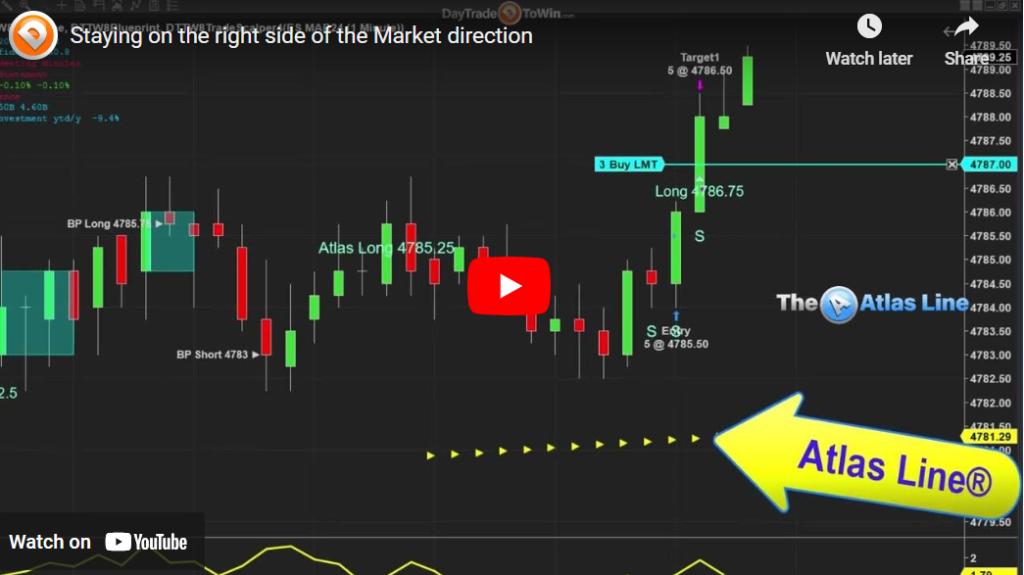
Hi, Traders! As we delve into the heart of December 18th, our spotlight is on a revolutionary tool in the trading arena – the Atlas Line software. Crafted to deliver precise signals, this exceptional tool serves as your guide, indicating whether to take the long or short route. Before we embark on this trading journey, let’s heed a gentle reminder: trading carries risks, so only engage with funds that you can comfortably afford to lose. Unveiling the Atlas Line Indicator Now, let’s roll up our sleeves and get to the essence. Why consider a long position today? The Atlas Line is our North Star. As the candlesticks gracefully waltz above the Atlas Line, a compelling signal emerges – the green light to go long. Employing the ATM strategy for funded account users, we orchestrate the scene for a swift one-point trade. To fortify our trading stance, we’ve enriched our toolkit with extra artillery. The Blueprint and Trade Scalper indicators seamlessly merge with the Atlas Line. Together, these supplementary signals harmonize like a chorus, reinforcing our commitment to the long position. Exploring Strength and Pullback Trades The Atlas Line isn’t just about primary signals; it introduces strength and pullback trades. Recognizing these subtleties can significantly elevate your trading acumen. In our scenario, the appearance of ‘S’ signals a strength trade, further solidifying our resolve to go long. Diversify Your Analytical Arsenal A cardinal rule for traders: diversify your methodologies. Avoid dependence on a singular indicator or strategy. Mix and match criteria, strategies, or indicators for a holistic grasp of market conditions. Remember, adopting a flat position – staying out of the market – is a strategic choice in itself. Navigating Trading Dynamics and Target Adjustments As market dynamics sway, so should your approach. Adapt your targets and stops according to the market’s tempo and volatility. ATR (Average True Range) acts as your guiding compass, facilitating the setting of pragmatic profit targets and stops in sync with the market’s dynamic nature. In a live demonstration, we execute a brisk trade, capitalizing on Atlas Line signals. With precision and confidence, we hit our four-tick target swiftly, showcasing the Atlas Line’s prowess in navigating a dynamic market. In Conclusion To sum it up, the Atlas Line software emerges as a valuable ally for traders, providing lucid signals and invaluable insights. If you’re intrigued and eager for more exploration, consider subscribing to our YouTube channel, Day TradetoWin. For a deeper dive, our accelerated mentorship program encompasses the Atlas Line and other potent tools. Don’t forget to subscribe, hit the notification bell, and stay tuned for more live streams and educational content. Happy trading, and catch you in the next video!

Market News

S&P 500 Futures Approach 2023 Highs as Last Full Week Unfolds

On Monday, U.S. stock futures flirted with reaching their peak for the year, buoyed by benchmark borrowing costs lingering near their summer lows. Here’s a snapshot of how stock-index futures are performing: In the previous session, the Dow Jones Industrial Average rose by 57 points, or 0.15%, to 37305, the S&P 500 remained unchanged at 4719, and the Nasdaq Composite gained 52 points, or 0.35%, reaching 14814. Driving market trends: Stock-index futures are displaying modest strength as the final full trading week of the year commences, with the S&P 500 hovering near its highest level in nearly two years and within 2% of its record high. The equity benchmark has sustained a seven-week winning streak, marking its most robust run in six years, with a 14.6% gain amid optimism that the Federal Reserve will initiate interest rate cuts next year. The 10-year Treasury yield (BX:TMUBMUSD10Y), which surpassed 5% in October, is presently around 3.9%, reflecting a recent decline following the Fed’s indication of a more dovish monetary policy last week. However, early Monday trading in stock futures and bonds demonstrated less enthusiasm following recent statements from Fed officials, including New York Federal Reserve Bank President John Williams and Chicago Fed President Austan Goolsbee, tempering expectations of imminent rate cuts. Stephen Innes, managing partner at SPI Asset Management, remarked, “The surge in risk appetite, fueled by the U.S. Federal Reserve’s recent stance, has paused as [S&P 500] bulls are likely catching their breath at the open.” Innes added, “Despite some pushback from Fed officials, interest rate futures markets are still currently pricing 150 basis points of rate cuts from the Federal Reserve next year. So, the recent decline in bond yields and the dollar is expected to underpin risk assets throughout the week.” Remaining optimistic, Tom Lee, head of research at Fundstrat, anticipates support for stocks from fund managers who, until recently, had defensively positioned themselves due to macroeconomic concerns. Lee foresees performance chasing into year-end, coupled with retail investors withdrawing $240 billion from ETF and mutual funds, contributing to the underlying demand for equities. Economic updates expected on Monday include the release of the homebuilder confidence index for December at 10 a.m. Eastern.

Market News

S&P 500 Shines: Clocks Longest Weekly Winning Streak in Six Years

U.S. stock markets capped off their seventh consecutive week of gains as they closed mostly higher on Friday, following the Federal Reserve’s policy meeting. According to Dow Jones Market Data, the S&P 500 achieved its lengthiest weekly winning streak since November 2017. Breaking down the performance of key indices on Friday: The week witnessed a broad market rally fueled by positive responses to crucial U.S. inflation data, the Federal Reserve’s policy statement, and interest rate projections. The Dow, S&P 500, and Nasdaq Composite all secured a seventh straight week of gains. Russell Price, Chief Economist at Ameriprise Financial, expressed confidence in the market’s optimistic tone, attributing recent positive trends to potential rate cuts by the Federal Reserve in 2024, supported by declining 10-year Treasury yields. Price predicted a potential start to rate cuts in June, leading to sustainable economic growth in 2024, with a projected real GDP increase of 1.8% to 1.9% next year. The majority of S&P 500 sectors saw gains, with small-cap stocks, represented by the Russell 2000 index, outperforming large-cap equities with a weekly gain of approximately 5.6%. While Federal Reserve Chair Jerome Powell hinted at a favorable trajectory for inflation and possible lower rates in the coming year, caution emerged as traders appeared overly optimistic about rate cuts. Federal-funds futures suggested a potential rate reduction starting as early as March, according to the CME FedWatch Tool. Friday’s trading session encountered a brief setback after New York Federal Reserve Bank President John Williams downplayed expectations of imminent rate cuts, stating, “We aren’t really talking about cutting interest rates right now.” In terms of economic indicators, the consumer-price index showed a year-over-year inflation rate of 3.1% in November, a notable decrease from the peak of 9.1% in June. Powell emphasized the Fed’s commitment to its 2% inflation target. Mark Hackett, Chief of Investment Research at Nationwide, interpreted Powell’s statements as signaling a soft landing without the need for a recession. Economic data from Friday highlighted challenges in U.S. manufacturing, while the 10-year Treasury yield experienced its largest weekly drop since November 2022. Despite Friday’s flat close, the S&P 500 remained just 1.6% below its record close on January 3, 2022, reflecting the market’s robust momentum. Companies in focus included Palantir Technologies Inc., Steel Dynamics Inc., Costco Wholesale Corp., JD.com, and Alibaba Group Holding Ltd., each experiencing notable stock movements based on various news and earnings reports.

Market News

Wall Street’s Complex Insights into the Surge of U.S. Stocks in 2023

As the year approaches its conclusion, financial professionals can enumerate a range of reasons for the continued ascent of the U.S. stock market. Nevertheless, a faction of Wall Street strategists contends that attributing the market gains solely to the possibility of a “soft landing” for the U.S. economy or potential Federal Reserve interest rate cuts oversimplifies the situation. Instead, a meticulous examination of the balance sheets of major central banks, with a particular focus on the Federal Reserve, reveals a more nuanced explanation. Despite the Fed reducing the size of its balance sheet, central banks globally have increased market support by allowing the expansion of bank reserves. This surge in reserves enhances the available capital for deployment in both markets and the broader economy, historically leading to a rise in securities prices, even when economic strength or corporate earnings outlooks don’t fully justify such advances. Research conducted by former Citigroup strategist Matt King, now heading Satori Insights, underscores that changes in reserves correlate most strongly with market movements. King emphasizes that the correlation extends to equity changes and credit spread adjustments, with a noticeable lag that rules out a reverse causality. The apparent contradiction of injecting more liquidity while reducing the balance sheet size arises from a crucial distinction. Rather than focusing solely on the reduction of the Fed’s bondholdings to $7.8 trillion from its peak of $9 trillion last year, King underscores the importance of the $500 billion increase in reserves within the U.S. banking system since January. This liquidity boost isn’t exclusive to the Fed; major central banks, instead of withdrawing $1 trillion in liquidity as anticipated in the fight against inflation, injected a roughly equivalent amount, according to King’s findings. Factors contributing to rising bank reserves include the ongoing drainage of the Fed’s reverse-repo facility, which saw counterparties removing over $1 trillion since April. The liquidity support for markets initiated late last year, initially driven by the Bank of Japan, People’s Bank of China, and European Central Bank. The Fed intensified its involvement in the spring to support the U.S. banking system after the collapse of Silicon Valley Bank, and the recent drain from the Fed’s reverse-repo facility has become a primary driver. Prominent financial institutions, including Morgan Stanley and Goldman Sachs Group, have taken notice of this liquidity trend, with analysts discussing its impact on markets. Goldman Sachs’ cross-asset analysts note the expanding U.S. liquidity trend in December and anticipate continued support for risk assets and tight credit spreads into year-end. King suggests that if the liquidity impulse weakens, stocks may face challenges. Regardless of future developments, King underscores the “QE-like” nature of the market rebound in 2023, drawing parallels to the Federal Reserve’s post-crisis and post-pandemic bond-buying programs. U.S. stock indexes have now fully recovered from the previous year’s losses, with the Dow Jones Industrial Average reaching a fresh record above 37,000. The S&P 500 and Nasdaq Composite have also posted substantial gains. King emphasizes the potency of quantitative easing (QE), noting its ability to create new money in the form of reserves, withdraw bonds and bills from the market, and influence the balance between private investors’ funds and available securities—an interplay that impacts market prices.

Scroll to Top