DayTradeToWin Review

From Zero to $500: Assessing the Quickness of Trading System Profits

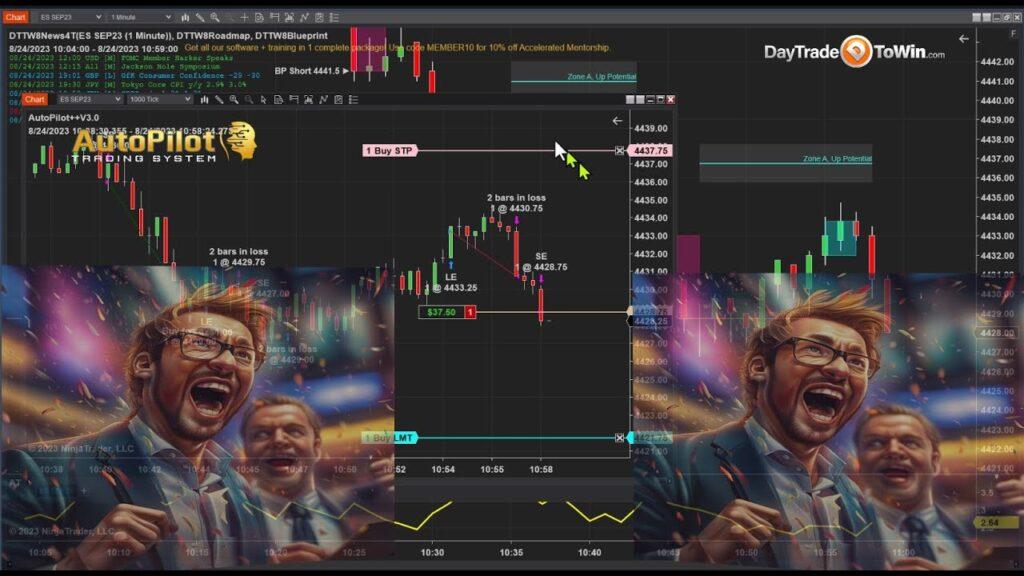
In the ever-evolving realm of trading, the aspiration to swiftly amass profits often clashes with the pragmatic challenges of market unpredictability. Enter AutoPilot, a cutting-edge automated trading system renowned for its amalgamation of precision, risk calibration, and user-friendly convenience. This article embarks on a journey to unravel the mechanics of AutoPilot, explore its distinctive attributes, and shed light on its potential to yield a $500 profit. Capitalizing on AutoPilot’s Unique Edge In a landscape teeming with automated trading platforms, AutoPilot shines by virtue of its strategic approach. Contrary to the ceaseless trading some systems engage in, AutoPilot strategically hones in on specific timeframes within the trading day. This strategy not only shields trading accounts from the full brunt of market fluctuations but also curbs the heightened risk associated with round-the-clock trading. AutoPilot’s unique approach strikes a harmonious equilibrium between seizing opportune moments for profit and taming potential losses. This deliberate restraint underscores AutoPilot’s commitment to catering to a diverse array of traders, encompassing those who may lack extensive experience or substantial capital. Customized Compatibility for Optimal Results AutoPilot’s prowess is optimized for E-mini and Micro E-mini charts, revered choices among traders. These charts provide the essential data bedrock for AutoPilot’s intricate decision-making processes. Furthermore, AutoPilot’s adaptability extends to Nasdaq charts (NQ and MNQ), augmenting the system’s versatility and expanding its potential applications. A Decade-Plus of Finesse AutoPilot’s brainchild, DayTradeToWin, has dedicated over 13 years to meticulously refining its approach to automated trading. This meticulousness is evident in the extensive backtesting and live trials that AutoPilot has undergone. Only when the creators were unequivocally convinced of its capability to deliver consistent results did they deem it ready for public use. Democratizing Success in Trading A hallmark feature of AutoPilot lies in its inclusivity. The system is impeccably designed for everyday individuals harboring an interest in trading, irrespective of their prior trading acumen or financial standing. At its core, AutoPilot champions simplicity: users can activate the system to autonomously execute trades or actively manage trades based on AutoPilot’s recommendations. This hands-free modus operandi empowers traders, as the system handles trade executions while they concentrate on other pursuits. Underpinnings of Distinctive Methodology AutoPilot’s distinctiveness is rooted in its steadfast adherence to solid price action principles. Rather than relying on convoluted algorithms or speculative strategies, AutoPilot’s methodology revolves around deciphering and responding to market movements grounded in established price patterns. This pragmatic approach endeavors to minimize reliance on guesswork, furnishing users with a more dependable trading journey. Conclusion AutoPilot stands as a remarkable leap forward in the realm of automated trading systems. By concentrating on targeted trading windows, upholding compatibility with prevailing charts, and incorporating an intuitive interface, it presents a distinct proposition for traders in search of equilibrium between profit potential and risk moderation. Fortified by years of diligent development and battle-tested experience, AutoPilot introduces a novel perspective on realizing trading objectives. Whether one is a neophyte or a seasoned trader, AutoPilot’s potential to potentially amass a $500 profit exemplifies its promise in the dynamic universe of automated trading.

Market News

Analyzing the Odds: Will the Stock Market Crash?

The probability of a stock market crash on par with the 1987 event in the upcoming months seems to be significantly exaggerated, even as contrarians find reasons to smile. While the fear of a crash is justified due to the buzz about a potential market bubble, the reality is that the likelihood of a crash similar to 1987 is quite low—just 0.33%. We can assess the general sentiment through a survey conducted by Robert Shiller of Yale University, where participants indicate the chances of a crash with less than a 10% probability within six months. The latest survey indicates that 33.9% of respondents fall into this category, revealing that 66.1% perceive the risk as higher than 10%. This perception has been on an upward trend, with a rise from 64% in 2015 to 74% today in the 24-month moving average, slightly below last year’s peak of 77%. The real probabilities have been studied by Xavier Gabaix of Harvard University and researchers from Boston University’s Center for Polymer Studies, revealing a formula predicting crash frequencies. When applying this to the one-day 22.6% decline on Black Monday in 1987, the probability of such an event is 0.33%. The heightened concerns among investors have roots in the occurrence of two bear markets in rapid succession—early 2020 and 2022. This occurrence is rare and has cast a shadow on long-term investor outlooks. Psychological studies by Camelia Kuhnen from the University of North Carolina underscore how losses trigger more pessimism compared to the optimism generated by gains. This tendency, termed the “pessimism bias,” persists even when markets recover well. Shiller’s crash-confidence index, potentially a contrarian indicator, has shown that higher worries about a crash correlate with better market performance over one-, three-, and five-year periods. While the crash-confidence index may not predict short-term market moves, its strength lies in forecasting robust market performance over the span of several years.

DayTradeToWin Review

Missed the Live Action? Catch the Replay of AutoPilot, Blueprint, and Roadmap in DayTradeToWin!

? Elevate Your Day Trading Experience ? Imagine harnessing the cutting-edge capabilities of AutoPilot, Blueprint, and Roadmap to navigate the trading landscape with precision and confidence. ? Relive our dynamic live stream event and explore how these strategies can propel your trading to new heights! ? AutoPilot: Let Technology Work in Your Favor! Discover how AutoPilot employs advanced algorithms for real-time, informed trading decisions. Bid farewell to emotional trading and embrace calculated, automated strategies. ?️ Blueprint: Lay the Foundation for Your Trading Success! Dive into Blueprint—a systematic approach to craft a tailored trading plan aligned with your goals and risk tolerance. Follow a well-defined roadmap to achieve success. ?️ Roadmap: Navigate Like a Pro! Roadmap serves as your guide through various market scenarios, assisting you in anticipating potential turns. Stay ahead of the curve and make well-informed decisions. ? What Awaits You: Insightful Discussions: Gain an in-depth grasp of how AutoPilot, Blueprint, and Roadmap synergize for a winning strategy. Live Demonstrations: Observe these strategies in action as we analyze real-time market data and make informed choices. Q&A Session: Engage with our experts and obtain answers to your burning questions. Exclusive Offers: Unlock special discounts on these tools that have the potential to reshape your trading journey. ? Don’t Miss Your Chance! Mark your calendar, invite your fellow traders, and relive this exhilarating live stream event that could revolutionize your trading journey! Stay tuned for updates about our Live Stream Day Trade To Win event. Together, let’s navigate the markets and unlock new dimensions of trading success! ⚡?

Market News

The Dark Side of Buybacks: Examining Wealth Inequality and Innovation Suppression

“Reevaluating Stock Buybacks: A Force behind Wealth Inequality and Innovation Suppression?” An ongoing debate questions the role of stock buybacks in perpetuating wealth inequality and stifling innovation within the U.S. economy. Should there be a definitive ban on these practices, especially when executed as open-market repurchases? According to William Lazonick, an esteetock marketmed figure hailing from the University of Massachusetts Lowell and also the President of the Academic-Industry Research Network, the answer is a resounding “yes.” Lazonick, a long-standing critic of corporate stock buybacks, recently unveiled his book “Investing in Innovation: Confronting Predatory Value Extraction in the U.S. Corporation,” in which he contends that these buybacks form a critical component of what he labels as “predatory value extraction.” The concept of predatory value extraction centers on the idea that senior executives, Wall Street financiers, and hedge fund managers manage to extract a disproportionately larger amount of value from corporations where they hold shares, in comparison to their actual contributions to value creation within those organizations. However, the ramifications extend beyond this. These stock buybacks have inadvertently rendered American corporations more susceptible to foreign competitors, particularly in sectors critical to national security and productivity, like aviation, communications, semiconductors, and alternative energy. This vulnerability stems from businesses opting to allocate profits to buybacks instead of investing in innovation and infrastructure. As a result, these companies are compelled to procure essential technologies from foreign rivals, predominantly in Asia. Before the widespread adoption of buybacks in the 1980s, companies typically reinvested the bulk of their profits to foster growth or reward employees for their contributions to value creation. This narrative shifted drastically as buybacks gained momentum, becoming a popular strategy for elevating share prices by reducing the number of outstanding shares. Between 2012 and 2021, the 474 firms listed in the S&P 500 (as of January 2022) channeled a staggering $5.7 trillion into the stock market through buybacks, equating to 55% of their collective net income. Additionally, another $4.2 trillion was distributed as dividends, consuming an additional 41% of net income. While dividends offer benefits to all shareholders, buybacks predominantly benefit those selling shares, including senior managers whose compensation often involves stock holdings and hedge fund managers aiming to capitalize on market timing. Lazonick’s book offers various examples illustrating the shift from a strategy focused on “retain and invest” to “dominate and distribute,” and its consequences for the workforce. The table below highlights the top 20 purchasers of their own stock from 2010 to 2019, along with distributions made during pandemic years. Eleven companies followed the “dominate and distribute” approach before the pandemic, encompassing major players like Apple, Oracle, Microsoft, Cisco, Walmart, Intel, Home Depot, Johnson & Johnson, Amgen, Qualcomm, and Gilead. These companies utilized profits from their commanding market positions to bolster stock prices. On the other hand, seven firms including Exxon Mobil, IBM, Procter & Gamble, General Electric, Merck, McDonald’s, and Boeing pursued a “downsize and distribute” strategy, allocating funds to shareholders as they downsized their workforces. The remaining two, Pfizer and Disney, ceased buybacks in 2019 to return to a “retain and invest” strategy. Lazonick underscores that companies such as Disney, Home Depot, McDonald’s, Procter & Gamble, and Walmart employ a significant number of low-wage workers. These workers could potentially benefit from substantial pay raises funded by capital allocated to buybacks. Elevating wages and benefits for low-paid workers at profitable firms can have a ripple effect, boosting incomes across the broader economy. Even the pharmaceutical sector, represented by companies like Amgen, Gilead Sciences, Johnson & Johnson, Merck, and Pfizer, faces scrutiny. Despite advocating for high drug prices to support research and development, these firms distributed a significant 110% of their net income to shareholders and share sellers between 2012 and 2021. Buybacks alone accounted for 55% of net income, surpassing other sectors. Lazonick also highlights the technology sector, using Cisco Systems as an example of a company favoring buybacks over investment in learning that fuels innovative communication-infrastructure products. Since 2001, Cisco’s management has allocated a staggering $159.7 billion to buybacks, equivalent to 93% of net income. Concurrently, the U.S. has fallen behind global competitors in areas like 5G and the Internet of Things. Apple’s trajectory follows a similar narrative. Initially relying on Samsung Electronics to fabricate chips for iPhones, Apple shifted its outsourcing to TSMC, catalyzing the latter’s ascent to prominence in advanced nanometer chip fabrication. According to Lazonick, five steps are crucial to curbing predatory value extraction: The implications are substantial. An Oxfam report revealed that by 2022, inflation had eroded the earnings value for 32% of the U.S. labor force, leaving them with hourly wages of $15 or less. In his 2022 State of the Union address, President Joe Biden proposed a 4% tax on buybacks. However, Lazonick argues that this is insufficient. If the administration opts for taxation instead of a ban, Lazonick suggests a 40% surcharge, accompanied by a prominent message on corporate repurchasers’ websites: “STOCK BUYBACKS DESTROY THE MIDDLE CLASS.”

stock market
Market News

Nasdaq Futures React to Nvidia Earnings with a Jump; Dow Futures Experience Dip

In the early hours of Thursday, U.S. stock index futures demonstrated a positive trend, led by Nasdaq futures, as Nvidia’s exceptional quarterly earnings performance exceeded high expectations. In contrast, Dow futures experienced a slight decline due to a drop in Boeing shares. Here’s a snapshot of the current stock-index futures trading: In the trading session of the previous day, the Dow Jones Industrial Average registered a gain of 184 points, marking a 0.54% increase to reach 34,473. The S&P 500 saw a rise of 48 points, translating to a 1.1% increase and reaching 4436. Meanwhile, the Nasdaq Composite gained 215 points, presenting a notable 1.59% surge and reaching 13,721. Key market dynamics include: With the Jackson Hole central bankers’ economic policy symposium commencing on Thursday, the focal point remains on the upcoming speech by Fed Chair Jerome Powell on Friday. In addition, investors were privy to a fresh batch of U.S. economic data on Thursday, including weekly jobless benefit claims numbers. This data revealed a decline of 10,000 claims, reaching a three-week low of 230,000, providing further evidence of a robust labor market. Data on durable-goods orders for July indicated a 0.5% increase, excluding specific sectors like transportation and autos. Notable companies in focus include:

Market News

U.S. Stock Futures Inch Upward as Bond Yields Dip; Nvidia Earnings Awaited

On Wednesday, U.S. stock futures showed a slight upward movement, coinciding with a decline in bond yields. All eyes were on Nvidia Corp. as investors eagerly awaited the company’s earnings report. Nvidia, a leading player in the artificial intelligence software realm, was scheduled to release its results after the market’s closing. Key Highlights: Market Dynamics: The uptick in stock futures coincided with a reduction in bond yields, both in Europe and the U.S. This was triggered by news of a larger-than-expected contraction in eurozone economic activity, leading to a 33-month low. However, the day’s primary focus was on Nvidia’s (NVDA, -2.77%) earnings outcome, eagerly anticipated after the market’s close. With Nvidia’s shares having surged by 212% in the current year, in contrast to the S&P 500’s gain of 14.3%, the company epitomized the enthusiasm surrounding major tech stocks and the excitement around artificial intelligence, both of which had been instrumental in driving up equity indices for much of 2023. The reception of Nvidia’s financial results and projections was expected to significantly shape the short-term market sentiment. Ipek Ozkardeskaya, Senior Analyst at Swissquote Bank, commented, “Investors will focus on whether Nvidia’s Q2 sales meet the $11 billion estimate. Anything less than absolutely fantastic could trigger a sharp downside correction in Nvidia’s stock price which rallied 345% since the October dip.” Traders were anticipating a potential 10% movement in Nvidia’s shares for the remainder of the week, as indicated by the pricing of the company’s stock options. Susannah Streeter, Head of Money and Markets at Hargreaves Lansdown, noted, “A jolt [of] volatility is set to be sparked by the chip giant’s numbers and outlook.” Economic Updates and Corporate Focus: The day’s U.S. economic updates included the S&P services and manufacturing PMIs for August, set for release at 9:45 a.m. Eastern, followed by the July new home sales report at 10 a.m. Key Companies in the Limelight:

Scroll to Top