DayTradeToWin Review

Time and Volatility: The Secret Weapons of Adaptable and Smart Traders

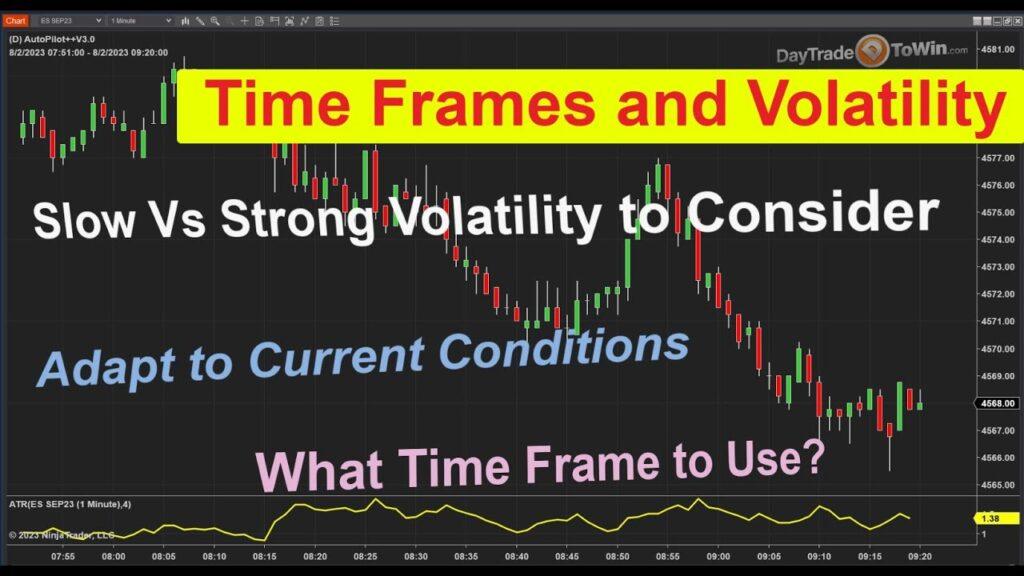
In the world of trading, where uncertainty and rapid shifts are the norm, successful traders are akin to skilled navigators, charting a course through turbulent waters. Among the many tools in their arsenal, two stand out as their secret weapons: time and volatility. In this blog post, we unveil the power of time and volatility and how adaptable traders wield them to their advantage. The Dynamics of Time and Volatility Time and volatility are the twin engines that drive the financial markets. Time represents the ebb and flow of market movements, while volatility measures the speed and intensity of price fluctuations. By understanding and harnessing the dynamics of these factors, traders gain a competitive edge in the ever-evolving landscape. Mastering Time: Strategies for Adaptation Leveraging Volatility: A Trader’s Playground The Mental Fortitude Conclusion Time and volatility are not mere concepts; they are dynamic forces that shape the trading landscape. Adaptable and smart traders recognize their potency and leverage them to their advantage. By mastering the art of time and volatility, traders gain insights into market behavior, identify opportunities amidst chaos, and cultivate the mental resilience needed for success. As you embark on your trading journey, remember that time and volatility are not adversaries to be feared but allies to be embraced. Emulate the adaptable and smart traders by understanding these secret weapons and integrating them into your trading toolkit. With time and volatility as your allies, you’ll find yourself well-equipped to navigate the unpredictable seas of the financial markets.

Market News

Deciphering Success: Goldman Sachs Sheds Light on the Underlying Secret of U.S. Stock Market Dominance

A team of U.S. equity analysts at Goldman Sachs has unveiled the secret underpinning the consistent outperformance of the U.S. stock market compared to international counterparts. The concept is elegantly simple: U.S. corporate managers possess a unique skill in maximizing returns from each dollar of equity investment. This performance metric, referred to as “return on equity” (ROE), involves dividing a company’s net income by its shareholders’ equity. Headed by Goldman’s chief U.S. equity strategist, David Kostin, the team has presented data illustrating that U.S. companies consistently surpass their peers in Japan, Europe, and Asia in terms of ROE. In the first quarter’s conclusion, the trailing return on equity for S&P 500 index companies stood at an impressive 20.4%, placing it in the 97th percentile since 1975. However, the true significance lies in the changes observed over the past decade. Here, the U.S. market truly shines: during this period, the S&P 500 has elevated its ROE by a substantial 480 basis points, compared to 370 basis points for European stocks in the Stoxx 600 and 310 basis points for Japanese stocks in the TOPIX index. The Goldman Sachs team highlights the substantial progress made by U.S. publicly-traded companies in enhancing shareholder returns over the past decade, outpacing their European, Japanese, and Asian counterparts. This remarkable rate of expansion has enabled the S&P 500 to achieve annualized total returns of 7% since 2000, while Japan and Europe have achieved only 3% and 4%, respectively. However, while Goldman foresees continued U.S. equity dominance over the long term, a surge in valuations this year has introduced certain complexities into the near-term outlook. As U.S. equity prices have surged relative to projected earnings, portfolio managers find themselves grappling with what Goldman terms “the triumph of hope over experience,” reminiscent of the dotcom boom era. The team underscores the importance of generative Artificial Intelligence (AI) and its potential for disruption, noting that while certain firms may yield substantial AI profits, the returns on AI capital expenditure for many others remain uncertain. Goldman’s projection suggests that due to the significant contribution of AI-related stocks to this year’s multiple expansion, the S&P 500’s performance will deviate from its historical pattern and underperform in the next 12 months. “While a high starting valuation is often perceived as an obstacle to robust future returns, our 12-month global equity forecasts indicate that the U.S. will trail other regions. Nevertheless, the persistent focus on enhancing ROE implies that over time, U.S. stocks should outperform their global peers,” affirms the Goldman team. As August commences, U.S. stocks are experiencing a dip, with the S&P 500 down 0.2% at 4,579. The Nasdaq Composite has also decreased by 0.5% to 14,269. In contrast, the Dow Jones Industrial Average is performing relatively well, having gained 72 points or 0.2%, reaching 35,634 during the initial half-hour of U.S. trading.

stock market
Market News

Beware the Bear: Technician Warns of Potential Stock Market Recession

As U.S. stocks continue to soar to fresh yearly highs, concerns loom over the possibility of an impending recessionary bear market, as brought to light by Tyler Richey, co-editor at Sevens Report Research. According to Dow Jones market data, the Dow Jones Industrial Average (DJIA) and S&P 500 index recently achieved record highs in 2023, hovering within a 4.5% range of their all-time peaks. Despite recognizing the ongoing rally and positive equity trend, Richey takes a cautious approach, dubbing it “patient bears” due to the deeply inverted yield curve. This observation sounds an alarm, with most Treasury spreads now inverted to levels unseen since the early 1980s. This inversion suggests that the Federal Reserve’s more than 500 basis points of rate hikes in less than 18 months might have been excessive for the economy to endure. Richey points out five critical signs that can aid investors in detecting potential early signals of a recessionary bear market for stocks: In an ever-changing market landscape, vigilance and awareness of these indicators can be instrumental in guiding investors through potential shifts in market conditions.

DayTradeToWin Review

Stay Ahead of the Game: Creative Approaches for Successful Day Traders

Are you a day trader looking for a creative and effective way to navigate the fast-paced world of scalping? Just as you rely on a GPS to guide you on the roads, why not have a roadmap to steer your trading journey? In this blog post, we introduce the powerful and exclusive Roadmap Trading Method – the key highlight of our DayTradeToWin Accelerated Mentorship Program. What is the Roadmap Trading Method? The Roadmap is a comprehensive and leading-edge trading method designed to provide day traders with a structured approach to their trades. Developed by seasoned professionals with years of trading experience, the Roadmap offers a strategic framework that can lead to more consistent profits in the markets. Exclusive Access through Mentorship The Roadmap Trading Method has traditionally been exclusively available through our DayTradeToWin Accelerated Mentorship Program. This comprehensive program equips traders with the necessary tools, knowledge, and personalized guidance to master the art of day trading. Introducing the Standalone Roadmap Recognizing the demand and the growing interest in the Roadmap, we have decided to make this powerful trading method available as a standalone product. Now, you have the opportunity to access the Roadmap and utilize its potential benefits independently or as a complementary addition to your existing trading approach. What Makes the Roadmap Stand Out? Unlock Your Scalping Potential with the Roadmap Scalping demands precision and a well-defined strategy. The Roadmap Trading Method can be your guiding light in the world of scalping, providing you with a reliable system to navigate the markets. Whether you are a seasoned trader or just starting, the Roadmap can complement your trading style and help you take your trading to new heights. Are you ready to embrace the Roadmap? Take the first step towards improving your trading success by unlocking the potential of this exceptional trading method.

stock market
Market News

Treading Carefully: How the Soaring Stock Market Valuation is Making Heads Spin

Zooming in on Valuations: U.S. Stock Market Nears 2022 Bull Market Highs The U.S. stock market’s current valuation is edging ever closer to the lofty levels witnessed during the bull market’s peak in early 2022. This undeniable fact emerges from a comprehensive monthly review of eight valuation models, each with a track record of accurately forecasting subsequent returns in the U.S. market. While these eight theoretical approaches vary in methodology, their collective message paints a remarkably consistent picture of the U.S. market’s current state. Acknowledging the diversity of these approaches is vital, as individual indicators may be open to criticism due to their inherent limitations. For instance, price/book and q-ratios may be affected by inadequate GAAP accounting for intangible assets, and evaluating the dividend yield may not fully capture the increasing preference of corporations for share repurchases over dividends. To challenge the bearish signals from all eight indicators, proponents of bullish sentiment would need to demonstrate flaws in each indicator. While theoretically possible, such an argument becomes increasingly difficult and less plausible. The chart below presents a comparison of the S&P 500’s current valuation with levels observed at the peak of the bull market in early January 2022. Each column represents the percentage of past months in which valuations were lower, with higher columns indicating higher relative valuations. Across different comparison periods, whether reaching back to 2000, 1970, or 1950, the consistent message prevails: U.S. stocks are presently nearly as overvalued as they were during the previous bull market peak. This development raises concerns, as bear markets are expected to significantly reduce valuations, providing a sturdier foundation for the subsequent bull market to reach even greater heights. However, the most recent bear market defied expectations, leaving us short of a return to early-2022 peak valuations, yet today’s S&P 500 valuation remains highly stretched. Predictive Power of Valuation Models For bullish investors, some consolation can be found in the realization that these valuation indicators offer limited insight into the market’s short-term direction. Instead, their predictive abilities shine on a longer horizon, typically spanning five to ten years. Consequently, despite the current market overvaluation, it is plausible for stocks to continue their ascent in the coming months. However, this scenario would entail the S&P 500 resting on an even more precarious foundation than it currently does.

wall st
Market News

Stock Market Rally: Analyzing the Potential Duration and Factors Influencing Its Length

Investing in the stock market can be a rollercoaster ride, especially during seemingly unending rallies. Yet, resisting the urge to sell when the market declines is essential, as hindsight often reveals regrets. Discover why attempting to time the stock market is generally not a wise strategy for most investors, aiming for better outcomes. Interestingly, corporate chief financial officers appear to possess a unique ability to time their purchases and sales of company shares, a skill highlighted by Mark Hulbert. The Dow Jones Industrial Average recently broke its 13-session winning streak due to spooked investors reacting to strong economic numbers. Despite the Federal Reserve’s interest-rate increases contributing to lower official inflation figures, the U.S. economy continues to show accelerated growth, according to government data. Interviews with money managers, conducted by Vivien Lou Chen, now point towards expectations of a “soft landing” instead of a recession. Insights shared by Denise Chisholm, Fidelity’s director of quantitative market strategy, suggest that the rally in technology stocks might have the potential to continue based on specific market patterns. Amidst these positive signals, it’s important to be cautious as consumer confidence surveys raise concerns about the overall health of the stock market, as emphasized by Mark Hulbert.

Scroll to Top