DayTradeToWin Review

Day Trading Strategies: Rules, Profits, and Stops Explained

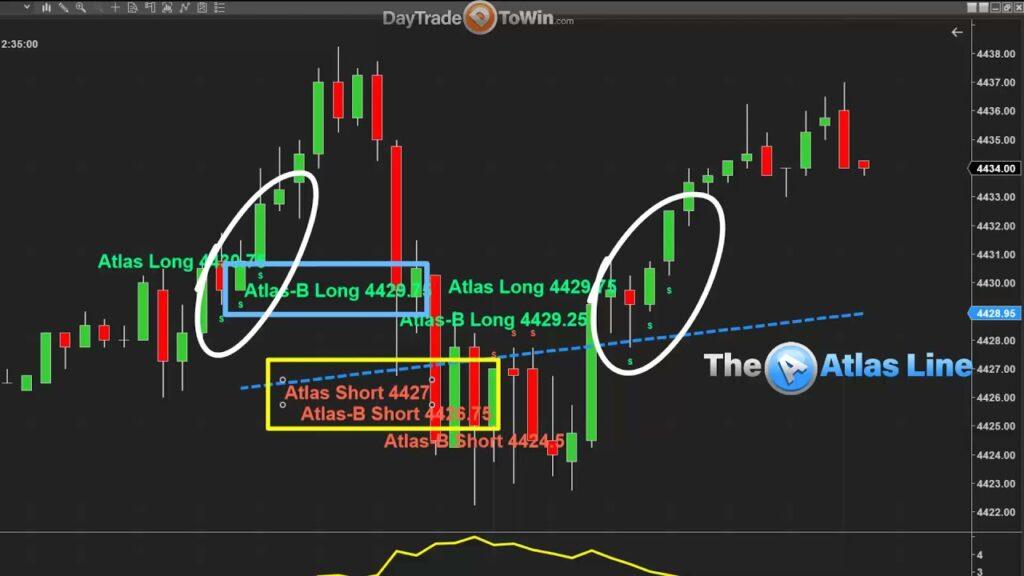
You may be happy to know that we have another video lined up for you with plenty of signals, day after day, showing the Atlas Line performance. For many years, the Atlas Line has been one of the most popular day trading methods offered by DayTradeToWin. Why? That’s because it can be used in many ways. Mainly, there are three: The main signals, long and short The line itself, providing an overall indication for whether you should be looking to buy or sell the market, which is useful to guide other trading methods. The smaller Strength (S) and Pullback (P) signals, which can be thought of as scalping signals. (They are different than the Trade Scalper signals). The video is a recording from a webinar. This helps you get a better sense of what it may be like trading the strategy live. The goal of DayTradeToWin is to help new and advanced traders succeed consistently. Sharing signals regularly may help inform you of how the systems work. How does one learn how to use the Atlas Line and other trading systems from DayTradeToWin? By attending the live training, watching the training video(s), reading the digital course, and emailing questions, etc. Do you find these videos repetitive? If so, good. If not, that’s also good! Why? Because without repetition, it would not be so easy to provide a sense of what it’s like to trade these methods under real-time conditions. DayTradeToWin regularly has traders who purchase one of their products after having watched dozens or more of their videos. And in any industry that relies on online content, it’s important to regularly share that content so people see it. Did you know that it helps to produce new videos on a regular basis? Yes, fresh content is important – especially when people are discovering your trading methods on YouTube. If you have something worth sharing and you feels it’s quality, unique, and useful, why not share it?

DayTradeToWin Review

Best Way to Trade Multiple Chart Types in NinjaTrader 8

Want to have multiple chart types in a single chart? It’s possible. Some traders prefer to trade this way rather than using multiple chart windows. The benefit, here, is that you can vertically compare candles and signals. Traders who use DayTradeToWin trading strategies often look for multiple indications the market is expected to move in a certain direction. These indications could be signals or other visual cues. It’s not uncommon for the Atlas Line, ATO 2, and Trade Scalper to provide signals that line up. Thus, the benefit of this chart setup is known. The example provided here is a 2-Range chart and a 1-Minute chart. The 2-Range chart can move very quickly. It’s imperative to place an order quickly. If you were using multiple tabs, for instance, cycling among the tabs may take away from valuable time. If you ever wanted to know what the powerful X-5 trading method is, jump to 9:48 for a description. It’s also called the Floor Trader Secrets Manual. There were once floor traders and they came together to manipulate the market in various ways. The X-5 capitalizes on those patterns that still occur without human traders in the Chicago pit. Another piece of software you’ll see in this video is the Roadmap, which is very important to the price action trading approach taught by John Paul at DayTradeToWin. As its name indicates, it provides a forward-looking plan as to guide the direction of your trading. Price Zones indicate either speed bumps or acceleration opportunities. The signals generated by the Roadmap are unique as well. In the 8-Week Mentorship Program, students are taught how the Roadmap can be a primary filter. If the Roadmap and Atlas Line match up – great! If the ATO 2 does, too – even better!

DayTradeToWin Review

Trends: How Many of Us “Have Them?”

While the title of this post is a play on words from a popular 1984 hit by the group, Whodini, there is no illusion here. Rather, we’re focusing on clear and concise price action rules you can use to identify and manage trends on your day trading charts. As a matter of fact, this part one of a two-part webinar series that was recorded in front of a live audience. As with the case with actual good friends, the same may be said for trends: most of us would probably prefer having more of them than less. In reality, trending days are less common than those with rather spontaneous chop. If you’re brand new to price action concepts or DayTradeToWin, then start with the first video. If you’ve seen some of John Paul’s footage in the past, you can probably skip the first video and go right into the second. Both are posted below. Part 1: Applying the ATR correctly, live Trade Scalper signals, and chart types Part 2: Identifying trends and counter-trends, mitigating loss with pivot stops, handling reversals, and examples While you may become an expert in identify areas of where not to trade, what about finding those potential winners? John Paul believes his trading methods are best suited for that purpose, whether that be the Trade Scalper, Atlas Line, ATO 2, Roadmap, Blueprint, or any of the methods taught in the 8-Week Mentorship Program. Mentorship is the only way to get all courses and software in one complete package. Though you may not have any more friends by the time you’re done reading this, you may be able to find more trends. At least, that is the goal of these two webinar recordings. If you want to attend the next live webinar or learn more about price action trading, head on over to the DayTradeToWin official website and sign up: https://daytradetowin.com.

DayTradeToWin Review

Learn a Free Price Action Filtering Method: Beware Large Candles

In the beginning of this video, John Paul says he’s going to show something that many traders do not realize when it comes to price action. He soon applies his Atlas Line indicator to a chart and describes conditions related to the Long Atlas Line signal. The ATR indicator with a period value of four showed an ATR value of three at that point in time. Thus, the profit target was three points. He seems to indicate this profit target was reached with a large green arrow pointing up and to the right, roughly characterizing the increase in price seen over eight bars. He said the overall move was up to 10 points, but that was not the actual goal (three points was the goal). Moving along, he next shows the Trade Scalper on the same chart; a 5-minute chart. He says a 5-minute chart is acceptable for scalping, though the exact conditions are not disclosed. At around the 2:00 mark, he zooms out, allowing viewers to see a number of Trade Scalper signals for the given day. Next, he returns to the main point of the video, price action trading. He describes the relative normalcy of candle appearance and groupings. He cautions trading in proximity to large candles. These large candles may indicate the end of a bullish or bearish move or pattern. He says the last push, up or down, in the form of a candle, may well exhaust price action without further continuation of the move. What does that mean for you? When a big candle appears, if you were about to place a trade, you may want to reconsider. There may be a reversal or chop. At around 5:00, you’ll see what can happen after a big candle, which would spell trouble for many traders. Considering this teaching a free price action trading method that you can use as a filter for any trading method.

DayTradeToWin Review

Pre-market Scalping Using DayTradeToWin Trade Scalper

If you ask a number of successful day traders about trading pre-market, chances are you will get mixed answers along with an abundance of caution. John Paul from DayTradeToWin generally advises caution, but certainly understands and shows many opportunities do exist before the E-mini is considered to open at approximately 9:30 a.m. US/Eastern. The hesitation involving pre-market trading is the lack of liquidity and big players that generally cause trends seen after 9:30 a.m. However, if you have been looking at premarket activity, at say, 8:00 a.m. to 9:30 a.m. US/Eastern for the last year, you will see significant volatility. This wasn’t always the case. What changed? Much has changed in the world in the last year. Aside from C-19, we have crypto taking the world by storm. Does crypto officially open at 9:30 a.m.? No. Are there massive amounts of money trading in crypto markets? You bet. Can we say with absolute certainty that crypto trading and crypto developments do no impact the E-mini or other “old” markets? Absolutely not. In fact, in recent months, we have seen some of the very companies that make up the S&P start to accept crypto. These expansions have affected their stocks, undoubtedly. That alone will impact the E-mini S&P. This video shows a real-time Trade Scalper trade based on a signal generated by said software. When scalping, it’s important to get in quickly. If you wait too long, you may not get the best price or the entire move may be over. The signal will appear on the close of a candle, so you can get ready ahead of time. You’re also taught the rules that constitute an entry signal. You’ll know if there’s a good probability the closing of the candle will cause the signal to appear. In other words, you’ll know what the signal software is doing, so you can anticipate when signals will appear. Got it? So, what about after-market or after-hours trading? Again, off-hours trading is known for slow or choppy conditions. The Trade Scalper is one of the best price action methods from DayTradeToWin to trade because it requires less volatility than other methods. You may want to look at after-hours trading charts to see if there has been decent volatility. Check if the ATR, using a period value of four, has been two to four points. Has there also been consistent direction? If so, successful trading during that time period may be possible. There are no guarantees, so stick with what is recommended or experiment in simulation mode first.

DayTradeToWin Review

Why Do People Day Trade?

Just because we had a recent day where we broke new highs, that does not mean we should expect fast activity for the rest of the week and beyond. In fact, this video shows John Paul from DayTradeToWin trading the Trade Scalper and Atlas Line in relatively normal to slow market conditions. Why is it important that all of these Trade Scalper and Atlas Line, etc. video exist? People want to see the methods actually working in real-time conditions. Other than conducting time-consuming webinars day after day, the best way to get a sense of how the methods work is to record videos to watch so people can watch (and stumble upon them) at their leisure. The significance of this video is the pure speed of this trade. We’re talking in and out in approximately one minute. John Paul uses NinjaTrader 8’s chart trader in combination with an ATM Strategy to get the green profit target and red stop lines on his chart. In gold, you’ll see the entry price. Because eight or so contracts are used, each tick up or down represents $100. If one point of profit was made, that’s $400 using eight contracts. Keep in mind, this is before any broker, exchange, or other potential feeds are applied. If you’re having difficulty with the calculation, each tick of the E-mini S&P 500 is worth $12.50. The ATR is the main free tool that determines how long to stay in the trade, how much profit to go for, how much to risk for the stop loss, etc. It can be found in most trading platforms. If you want to follow DayTradeToWin’s trading style, set the ATR value (the period value in NinjaTrader) to four. This means the last four price bars, candles, etc. are used for the calculation. By default, NinjaTrader uses 14, which would cause the ATR to perform its calculation based on over an hour’s worth of price action. Is what happened an hour ago indicative of what’s happening at the moment? No, in fact, the market can be very much different in an hour’s time. A setting of four is much more realistic in establishing a more up to date of moment/price action potential considering current market conditions. Yes, it is exciting to see price quickly or slowing approach a profit target. It may be even more exciting (and stressful) for price to nearly hit your stop loss and then retrace into victory. This excitement is what draws many traders to their charts every day aside from the income possibility. If trading was entirely boring, you would not find the enthusiasm across the industry, as can be seen in many testimonials and presenters giving their take on various stocks, news, politics, and how markets are expected to respond.

Scroll to Top