Market News

Goldman Sachs Bets on Gold Miners as Prices Surge

Goldman Sachs: AI Trade Unwind Poses Biggest Risk to Markets Markets wobbled after Friday’s weak jobs report, but the S&P 500 held near record highs. Investors are betting the Fed’s rate cuts will offset slowing growth and keep the economy out of recession. Goldman Sachs, led by David Kostin, now expects three rate cuts this year and two more in 2026. The bank forecasts the S&P 500 will reach 6,600 by year-end and 6,900 by mid-2026, fueled by steady 7% EPS growth in both 2025 and 2026. But the near-term risk? An unwind of the AI trade. Nvidia has dropped 9% since August, and AI-related stocks have lagged the broader market. The key driver will be capex spending from Amazon, Alphabet, Meta, and Microsoft. For Q4, Goldman suggests three plays:

nvidia
Market News

Nvidia Could Still Have 100% Upside

Wall Street May Be Missing Nvidia’s Data-Center Potential, Analyst Warns Nvidia narrowly avoided a sixth straight decline on Thursday, but its stock is still 7% below recent highs. Tech analyst and I/O Fund CEO Beth Kindig argues investors are missing the bigger picture. While second-quarter results looked soft, Kindig highlights surging networking revenue as the real signal. “That’s what separates this generation of GPUs from the next—the scale of networking required,” she said on the Wealthion podcast. She downplays China concerns, noting Blackwell chips alone could deliver $100 billion in annual sales versus just $15 billion from China. More importantly, Kindig says Nvidia has outgrown its identity as a chipmaker. It’s now a “rack-scale company,” combining chips, networking, and software into complete AI systems. “It’s like Apple’s dominance with the iPhone, iOS, and the App Store,” she explains. Her forecast? Wall Street’s estimates are far too low. Analysts see $293 billion in data-center revenue by 2028; she projects $500 billion, with quarterly revenue potentially reaching $75 billion as early as next year. That could mean 100% upside for the stock. The demand picture is clear: big tech firms are racing to secure next-gen GPUs, and enterprises shut out so far may step in if hyperscalers ease spending. Next-gen chips like Rubin could spark another upgrade cycle—though soaring power needs may be a limiting factor. Kindig pushes back on “AI bubble” fears, saying Nvidia and its suppliers remain the essential “picks and shovels” of the AI boom, even if software names prove riskier.

banks
Market News

Banks Sound the Alarm: Commodities Back in Focus

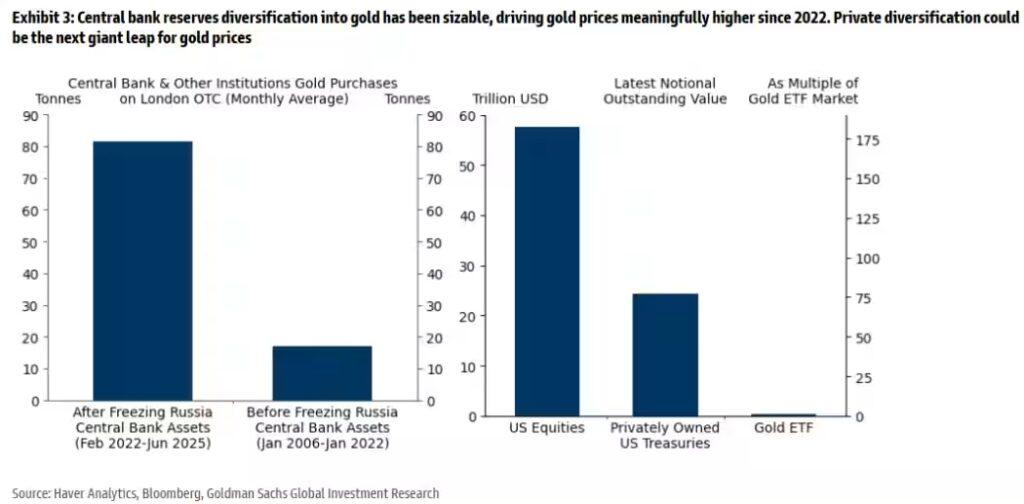
Banks Push Commodities as Fed Drama Stirs Inflation Risks The Federal Reserve’s independence is under pressure, and markets are bracing for the fallout. Trump’s pick for Fed governor, Stephen Miran, heads to a Senate hearing Thursday, while a judge may soon decide whether Governor Lisa Cook can keep her seat after Trump tried to oust her online. JPMorgan and Goldman Sachs say the political fight is already shaping asset flows. JPMorgan notes rising short bets on long-term Treasurys—signaling inflation fears—and a tilt toward value stocks. In commodities, investors are eyeing gains in copper and oil if the Fed eases too much, while gold has become the clearest hedge against political interference, with futures positioning spiking. Goldman warns that if Fed independence is eroded, investors could face higher inflation, rising yields, weaker equities, and even threats to the dollar’s reserve status. In that scenario, gold stands apart as a store of value that doesn’t rely on trust in institutions. The bank projects gold could surge past $4,000 by 2026, with upside toward $4,500—or even $5,000 if just 1% of private U.S. Treasury holdings shift into the metal. With gold futures already topping $3,600 this week, Goldman calls bullion its strongest bet in the commodities space.

broadcom
Market News

Broadcom Joins Nvidia at the Top

Broadcom may find it difficult to top its bold forecast of 60% AI revenue growth next year, but Melius Research sees any post-earnings pullback as a buying opportunity. Analysts describe the company as operating “in rarified air,” alongside Nvidia. The bar is high: Nvidia and Marvell both saw stock declines after earnings failed to meet Wall Street’s lofty AI expectations. Broadcom could face the same scrutiny, with guidance already pointing to $30 billion in AI revenue next year. Still, analysts led by Ben Reitzes believe the company is “firing on all cylinders.” For the July quarter, Wall Street expects $15.8 billion in revenue and adjusted earnings of $1.66 a share, with $9.1 billion from semiconductors. Google and Meta are already boosting spend on Broadcom’s custom AI chips, while Apple, Arm, ByteDance, Elon Musk’s ventures, and even OpenAI are seen as future customers. Beyond silicon, Broadcom benefits from VMware’s subscription business, Tomahawk 6 networking chips, and its strong position in hyperscaler data centers, where demand for AI accelerators and networking gear continues to grow. Though trading at 37x forward earnings, Melius calls Broadcom a “must-own” AI stock thanks to its fabless model, diverse customer base, and leadership in both high-performance and cost-efficient AI workloads. The firm raised its two-year price target to $335 from $305 and reiterated a buy rating.

DayTradeToWin Review

Sonic Trading: Quick Wins Without Overtrading

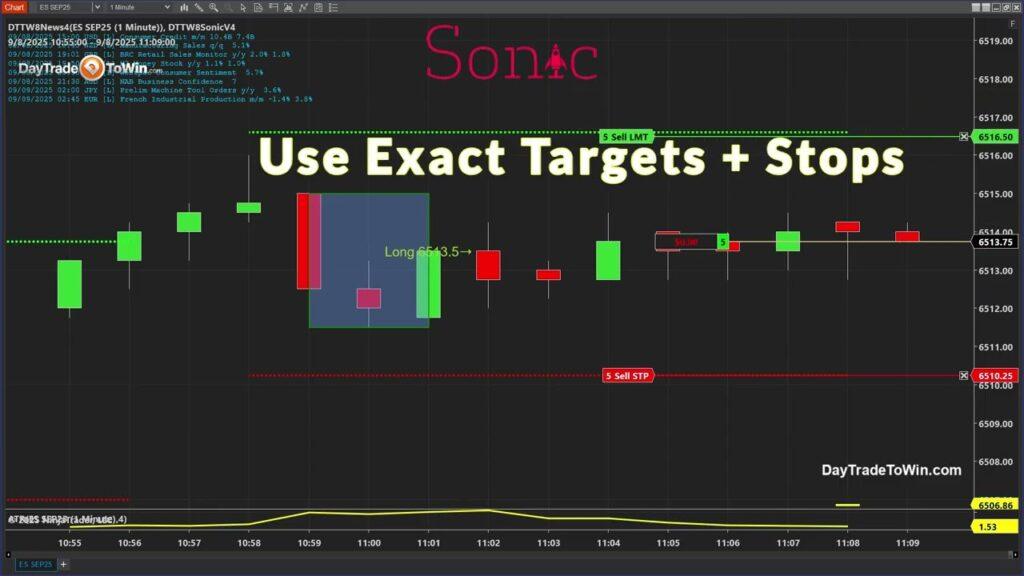
After a three-day break, the markets opened with energy — and the Sonic Trading System was ready to spot opportunities in the E-mini S&P 500 futures. Here’s how to approach these trades with confidence and discipline. Start with Market Strength When trading resumes, the first question to ask: How strong is the market? Tools like the Average True Range (ATR) measure speed and volatility, helping you decide whether conditions are worth trading. ⚠️ Remember: Trading always carries risk. Never trade with money you can’t afford to lose. Finding the Right Entry At the open, the Sonic system produced several short signals — all winners. But the real test came with a chance to go long. Instead of rushing in, we waited for a retracement to secure a better price and stronger risk-to-reward ratio. This small adjustment turned a risky setup into a balanced trade. The lesson: don’t accept lopsided trades where the downside far outweighs the upside. The Power of Risk Management With Sonic, the goal is to trade smart, not nonstop. Typically, four to five solid trades are enough in a session. Avoid setups where the target is tiny and the stop is massive — patience for the right entry pays off. 💡 Tip: The longer you sit in a trade, the more exposed you are. Stay quick, decisive, and disciplined. Results in Real Time In this session, whether you entered at 6414.25 or waited for a retracement, the Sonic system delivered another winning trade. Success comes down to evaluating your target, stop, and risk-to-reward balance before entering. Common Pitfalls to Avoid Stick to these rules, and you’ll protect your capital while staying consistent. Ready to Take the Next Step? Get started at daytradetowin.com with a free member account, access to trial software (including the Sonic system), and step-by-step mentorship. 👉 Learn proven price action strategies, ditch conventional indicators, and trade with tools designed for real-world results.

gold
Market News

Why Gold Shines When Stocks and Bonds Struggle

Gold may not generate income or fuel industry, but that’s exactly why it belongs in a portfolio. According to DE Shaw, an allocation of up to 9% makes sense — because gold doesn’t zig when stocks and bonds zag. As September opens with financial turbulence, gold is setting records while bond yields rise in the U.S., U.K., and France. DE Shaw labels gold an “NPSOV” — a non-productive store of value — like bitcoin, diamonds, fine wine, or art. That status makes valuation tricky: gold’s worth is based less on output and more on collective belief. Still, history offers a guide. Since 1975, gold has typically represented between 1.8% and 7.3% of developed market liquid wealth, generally rising in step with global wealth, which itself has grown faster than GDP. At the same time, annual gold supply has expanded about 1.6%, though central bank stockpiling can offset that. DE Shaw projects modest returns — about 0.5% above inflation-adjusted risk-free rates, with volatility near 15%. But the real case for gold isn’t return; it’s diversification. Over long periods, gold’s correlations with stocks, bonds, and inflation are loose, meaning it can smooth out volatility when traditional assets move together. Here’s the key: With today’s correlations hovering near zero, gold’s role sits squarely between those ranges — offering insurance against the next bout of market stress.

Scroll to Top