meta
Market News

Meta Shows AI Bets Are Paying Off

Meta Hikes AI Spending—but Strong Ad Growth Keeps Investors Onboard Meta Platforms Inc., the parent of Facebook, raised its capital expenditure forecast for the year, signaling an aggressive push into artificial intelligence. But thanks to strong quarterly results, investors appear unfazed. The company now expects to spend $64 billion to $72 billion on capex in 2024, up from its prior range of $60 billion to $65 billion. That’s a sharp increase from the $39 billion it spent last year. The spending surge reflects Meta’s efforts to ramp up AI infrastructure and stay competitive in a crowded tech landscape. Investor concerns about runaway AI spending were top of mind heading into earnings season—especially amid fears of slower ad growth due to economic pressures and tariffs. But Meta’s solid performance helped offset those worries. The stock climbed 5.4% in after-hours trading Wednesday. Meta reported first-quarter earnings per share of $6.43, beating Wall Street’s estimate of $5.23 and rising from $4.71 a year earlier. Advertising revenue hit $41.39 billion, ahead of expectations and reflecting stronger-than-anticipated growth. “Ad growth in the quarter was much better than anticipated, especially on a constant-currency basis,” said Gil Luria, head of technology research at D.A. Davidson. He noted that the stronger revenue gives Meta more flexibility to raise its investment levels. By contrast, Alphabet Inc. kept its capex guidance flat at $75 billion last week, highlighting a more cautious approach. Meta defended its ramped-up spending, saying it’s necessary to meet internal demand for compute power and build out advanced AI systems. Management believes these tools will directly improve its advertising business by enhancing targeting and boosting conversion rates. Although the company flagged some softness in Asia-based ad spending tied to tariff concerns, it said overall trends for Q2 are healthy. Meta guided for revenue of $42.5 billion to $45.5 billion, with the midpoint above analyst estimates. To further bolster ad revenue, Meta is expanding placements into new products like Threads and WhatsApp, while continuing to use AI to help advertisers improve performance.

sonic
DayTradeToWin Review

5 Trades. 1 System. Real Results with Sonic

It’s Wednesday, and I’ve decided to take on a challenge today: executing five consecutive trades using the Sonic System. This is going to be a real test of how the system performs in real-time conditions. No filters, no pre-selection — just five back-to-back trades. We’re going to see the winners, the losers, and everything in between. Let’s dive into the action! A Quick Disclaimer: Remember, trading is inherently risky. Never trade with funds you can’t afford to lose. In this video, I’ll be going through each trade step by step, showing you how the Sonic System works in real trading conditions. Keep in mind that this is an educational example, and your results may vary. Why the Sonic System? The Sonic System is a powerful tool for traders who want to take advantage of price action. Whether you’re using NinjaTrader or TradingView, it’s designed to help you make smart trading decisions by focusing on trends and key price levels. For the trades I’m making today, I’m going to follow the system’s signals exactly as they come. Now, let’s get into the trades. Trade 1: First Entry, First Win! The market’s showing a strong downtrend, and my first trade signal comes in at 5476. I’m going short. The entry is clear, and my target and stop are set. I follow the system’s guidelines, and within minutes, I’m up $625. Winner! Key takeaway: The Sonic System’s signals don’t always guarantee a win, but it gives you a clear framework to make decisions. Trade 2: The First Loss For the second trade, I’m shorting at 5472. I set my target and stop, but this trade doesn’t go in my favor. The market moves against me, and I get stopped out. Loss: $312. At this point, it’s a 50/50 split — one win and one loss. But as part of the plan, I’m sticking with it. Trading isn’t just about individual outcomes; it’s about consistent application of a system. Important lesson: Don’t move your stop loss in the heat of the moment. Stick to your plan. Trade 3: Back on Track The market’s bouncing, and a new short signal comes in at 5480. I take the trade, and thankfully, it works out. Winner: $250. Now I’m up $250 after three trades: two winners, one loser. Why keep going? Some traders might consider stopping here, but I’m committed to completing the five trades. Trading is about understanding your system’s behavior over a series of trades, not just one-off results. Trade 4: The Risk-to-Reward Dilemma For trade four, the system gives me a short signal below the yellow filter line. The risk-to-reward ratio isn’t the best, but I trust the system. The market dips, and I hit my target. Winner: $1,062. Now I’m up $1,062 after four trades — three winners, one loser. Even though I’m up significantly, I’m not stopping here. If you stop too soon, you miss out on seeing what the system can do over multiple trades. Trade 5: The Final Test Last trade of the day. The market’s moving slightly against me at 5471, but I jump in anyway. I’m following the system, and sure enough, I hit my target. Winner: $1,937. This brings the total to four winners and one loser, for a win rate of 80% on five trades. It’s 10:01 AM, and I’ve completed my goal of five consecutive trades. Mission accomplished. Key Takeaways from the Day: Want to Learn More? If you’re interested in the Sonic Trading System and want to take your trading to the next level, visit DayTradeToWin.com. We offer discounts, promotions, and training programs designed to help you succeed in today’s volatile market. Remember, trading is a journey. Stick to the system, manage your risk, and always focus on learning and improving. See you in the next video, and happy trading!

markets
Market News

Why Are Markets Rising Amid Recession Fears?

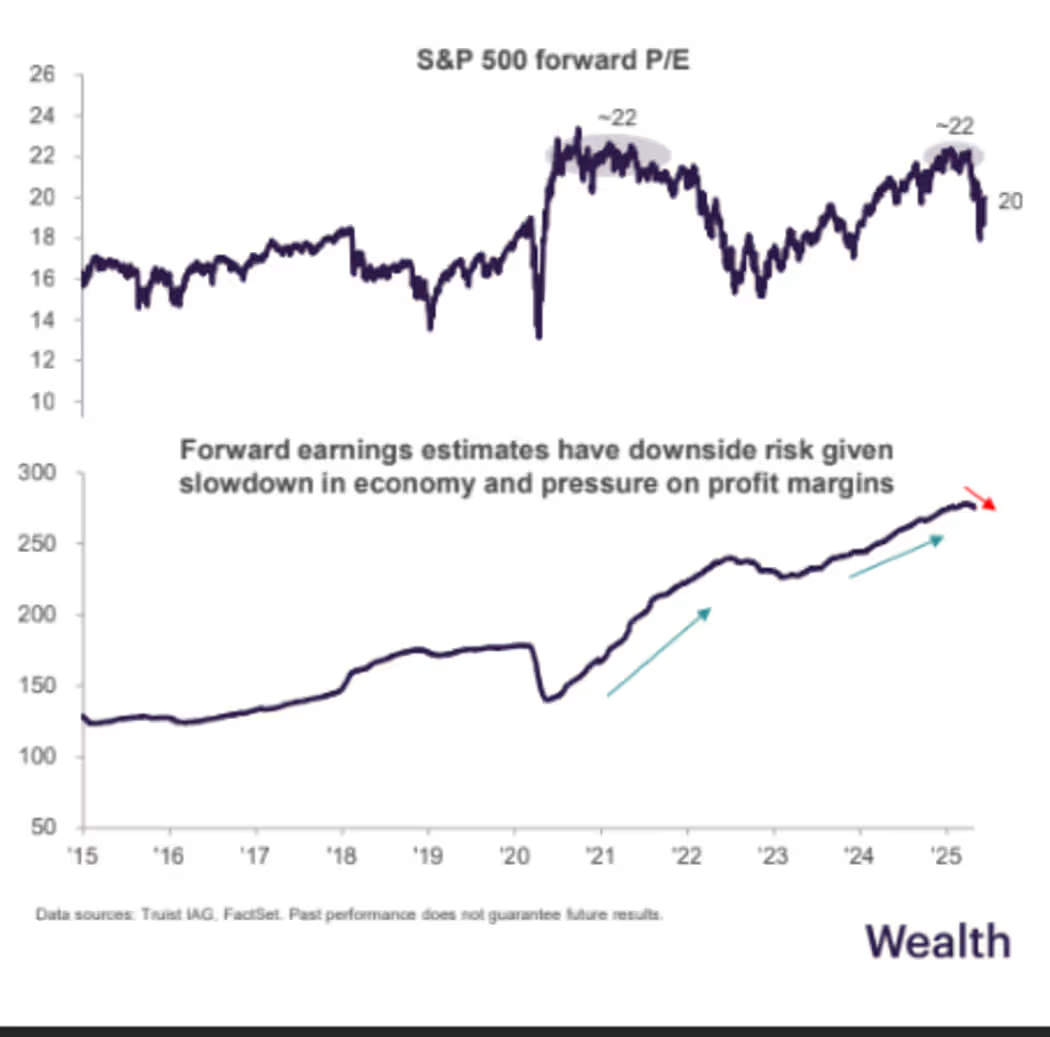
Markets Rebound Despite Recession Fears as Trump Pushes Trade and Tax Reforms Treasury Secretary Scott Bessent said Tuesday that President Donald Trump is making meaningful progress on trade deals and a new tax bill — developments that have offered some relief to investors as April’s volatility winds down. Optimism around potential pro-growth policies has helped the S&P 500 log its longest streak of gains since November, despite lingering concerns. However, Trump’s tariffs announced on April 2, and partially paused on April 8, rattled global markets and deepened anxiety among U.S. businesses and households. The moves triggered stock market turbulence and raised fears of a potential recession. Luke Tilley, chief economist at Wilmington Trust, said his team shifted to a “recession as baseline” outlook on April 9. He noted that even if the new tariffs are rolled back, overall import duties remain elevated compared to historical norms. Wilmington now puts the odds of a recession at 60% within the next year, expecting it to be short and shallow. So why the rally in stocks? Investors appear to be looking past short-term volatility, betting that the worst may already be priced in. Tilley pointed out that in past recessions, the S&P 500 has fallen around 20% on average — roughly in line with recent losses — and typically recovers within 11 months. As of April 8, the index was down 18.9% from its February 19 high, and 21.3% on an intraday basis when including April 7. Still, the market’s ability to bounce back quickly has given some investors confidence. Yet challenges remain. The S&P 500 is down 7.3% over Trump’s first 100 days in office — the worst showing since Nixon’s second term. Meanwhile, Bessent has warned that markets need to “detox” from pandemic-era stimulus after years of outsized gains. Adding to the uncertainty is the drop in the S&P 500’s price-to-earnings ratio — from 22x at the end of last year to below 20x — driven by doubts over Trump’s policies and competition from China’s AI advancements. “It’s hard to justify a return to 22x valuations amid slowing earnings, weaker economic data, and rising uncertainty,” said Keith Lerner of Truist Advisory Services. Still, markets found footing Tuesday. The Dow rose 300 points (0.8%), while the S&P 500 and Nasdaq both gained 0.6%, according to FactSet.

trade
DayTradeToWin Review

Trade Management Strategies That Work

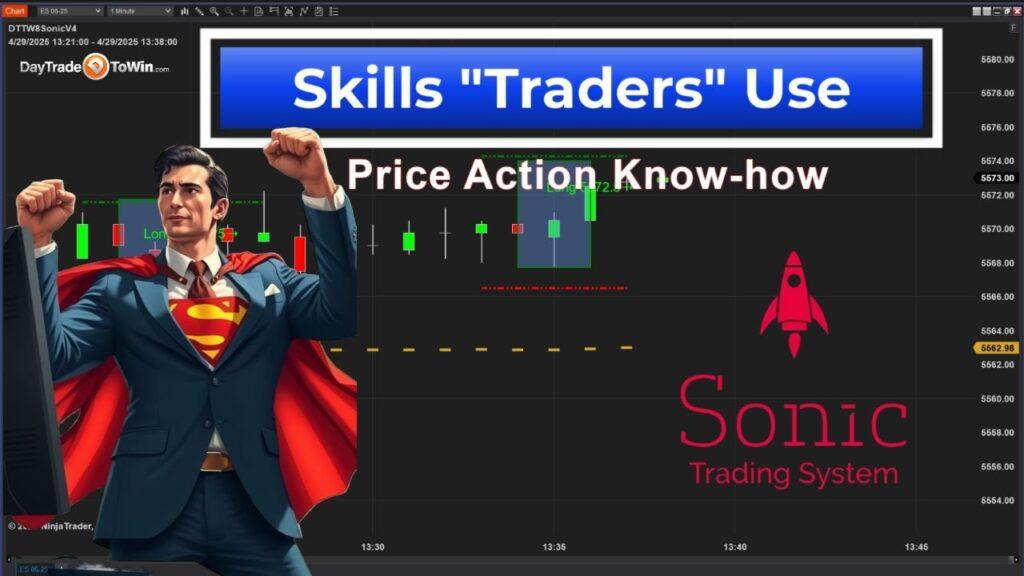
It’s Tuesday, and today we’re zeroing in on a critical skill: managing trade using price action with the Sonic System. 📌 Trade Example: E-Mini S&P Long Setup This morning, the Sonic System signaled a long entry on the E-Mini S&P. I entered the trade with one contract, aiming for the target price of 5574.25. 👉 Important Reminder: Trading is risky. Never use funds you can’t afford to lose. If you’re new, start with demo trading or micro contracts before moving up. ⚠️ The Fill That Almost Didn’t Happen Here’s what happened:The market touched my target, but my limit order wasn’t filled. This is where experience matters. Pro Tip: If price hits your target but doesn’t fill your order, and it returns to that level again—close your trade. Markets often retest highs or lows, especially early in the session. Don’t wait for the market to reverse—take the small win instead of risking a loss. In my case, the order eventually filled, but this is a key lesson in staying proactive. 💡 Why Sonic? The Sonic Indicator is designed for NinjaTrader and TradingView, built to help traders focus on price action over lagging indicators. It gives you structure, clarity, and most importantly—a plan. ✅ Ready to Level Up? Stay smart, stay focused, and let the price action lead the way.See you in class!

consumer
Market News

Is Consumer Fear Trump’s Economic Weak Link?

Consumer Confidence Takes Historic Nosedive in Trump’s Early Months Amid Tariff Fears President Donald Trump’s return to the White House has been marked by a steep and sudden decline in consumer confidence—falling faster than at any time since the 1990 recession. Daniella Knight, a mother of three from Annapolis, Maryland, says she’s already feeling the pressure. “I’m terrified,” she said, worried that Trump’s tariffs will drive up everyday prices. “Politicians won’t feel it if the price of milk or electronics goes up—but families like mine will.” Despite campaigning on promises to revive the economy and ease financial stress, Trump’s early economic moves—especially sweeping tariffs—have rattled markets and fueled anxiety. Polls show that many Americans feel worse off than they did when Trump took office just months ago. Consumer sentiment has dropped sharply, with Americans increasingly pessimistic about their finances, job prospects, and the broader economy. Many are cutting back on spending, skipping large purchases, and tightening household budgets—moves that are already being felt by businesses. “Sentiment across consumers, investors, and businesses is down, and that matters,” said Mark Zandi, chief economist at Moody’s Analytics. “That kind of uncertainty will weaken the economy.” According to University of Michigan’s long-running consumer sentiment survey, expectations have dropped around 30 points since January—the steepest early-term drop for a president in more than three decades. “This isn’t a normal post-election fluctuation,” said Joanne Hsu, the survey’s director. “It’s a major decline.” Tariffs are a recurring concern among respondents, even though they aren’t directly mentioned in survey questions. While some tariffs have been paused, others—such as a 10% baseline tariff on many imports—remain in place, adding to consumer uncertainty. Gallup recently found a record 53% of Americans say their financial situation is worsening—surpassing the peak pessimism of the early pandemic. And Fed data shows fewer people expect financial improvement, with more anticipating decline. The political divide is stark: Republicans, buoyed by Trump’s return, now report far more confidence than during the Biden years. But even among Trump voters, worry is growing. Support for tariffs among Republicans has dipped slightly, while opposition has risen. Still, the White House remains optimistic. “President Trump’s policies created historic economic growth during his first term, and we’re doing it again,” said spokesman Kush Desai. But signs of strain are mounting. Retailers and homebuyers are pulling back. Redfin reports one in four Americans are canceling major purchases due to tariff-related uncertainty. Airlines and major brands like Chipotle and Procter & Gamble are lowering expectations as consumer spending slows. Mortgage delinquencies are on the rise, especially among first-time and lower-income buyers. Job security fears are also increasing: nearly a third of workers say they’re worried about layoffs, according to recent surveys. “People make decisions based on what they think is coming,” said Hsu. “If they don’t feel confident, they stop spending—and that drives the economy.” For Knight, the outlook is clear: “I’m already trying to find ways to cut back, but with kids, that’s not easy. Prices are rising, and it feels like there’s no safety net.”

sonic
DayTradeToWin Review

One Trade, One Win, Weekend Ready ✅

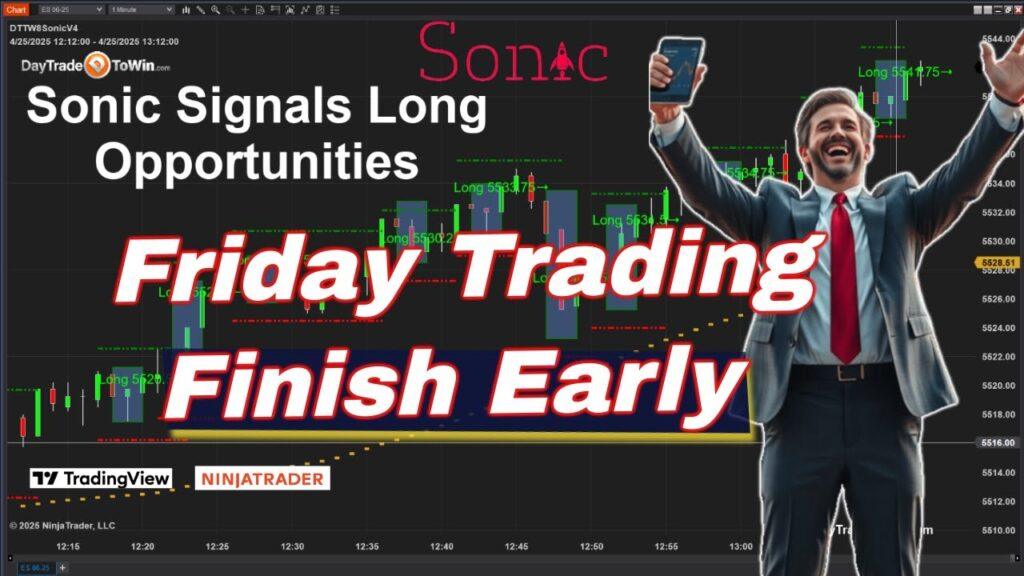
It’s Friday — and around here, that means one thing: finish early and head into the weekend on a high note. Fridays are also our live mentorship class days at Day Trade to Win, so it’s a full day of learning and opportunity if you’re part of our community. We don’t like to overtrade on Fridays. Instead, we look for a quality setup, take the opportunity, and call it a day. Today, I turned on the Sonic System to see if we could catch one more move before the weekend. Right away, multiple long signals popped up — a great sign! Catching the Setup Moments after turning on Sonic, a long opportunity appeared on the E-mini S&P. No hesitation — I liked the risk-to-reward and jumped in. Entry: 5541.25 (E-mini S&P) Remember, you can use the Sonic System across many markets — micros, Nasdaq, oil, stocks, even Bitcoin. Sonic is built around pure price action, making it highly adaptable. I’m using NinjaTrader for execution, but the Sonic System is also available for TradingView users. Every Sonic purchase includes live training, ensuring you’re fully supported every step of the way. Important Trade Lessons After years of trading, here’s a tip: Today’s trade went right into profit — exactly what we want to see. I wasn’t trailing a stop because Sonic provides clear entries, exits, and stops. The risk-to-reward ratio was about 1:1, which is ideal for quick Friday trading. After a few minutes, the target was hit. Just like that — the week ended with a clean winner. Learn the Right Way to Trade If you’re serious about trading and ready to move beyond confusing indicators and messy charts, it’s time to focus on price action. When you join us at Day Trade to Win, you get:✅ Access to our live trading room✅ Friday one-on-one mentorship sessions✅ Lifetime access through Accelerated Mentorship (including all software like Sonic) Ready to get started?Sign up for a free member account at daytradetowin.com. You’ll get trial access to the ABC software and a first step toward trading the right way. Until next time — happy trading and enjoy your weekend!

Scroll to Top