dot-com
Market News

Dot-Com Crash 25 Years Later: Echoes Today?

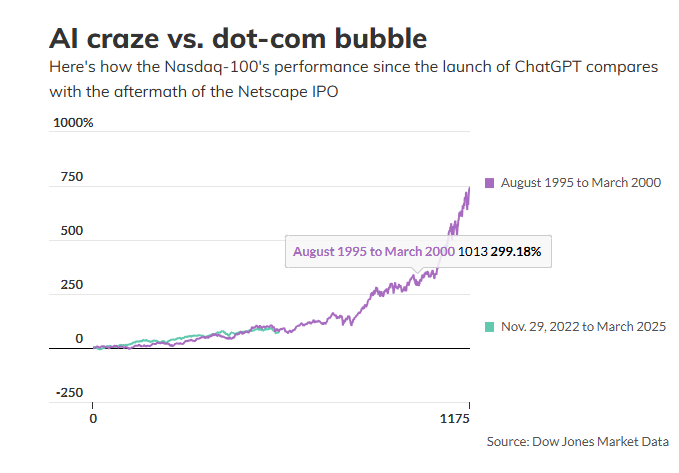
AI Boom Echoes Dot-Com Bubble: Investor Warns of Risks This week marks 25 years since the dot-com bubble peaked, a period of tech-fueled euphoria that ended in a massive market crash. The Nasdaq-100 took over 15 years to recover its dot-com highs. Now, an investor who predicted that crash is raising concerns about today’s AI market. Familiar Warning Signs In hindsight, the signs of the dot-com crash were apparent. Former Federal Reserve Chairman Alan Greenspan’s 1996 warning about “irrational exuberance” went unheeded as investors focused on technological potential over financial fundamentals. The S&P 500 hit its peak on March 24, 2000, at 1,527.46. The Nasdaq-100 followed on March 27 at 4,704.73. The Nasdaq Composite had already reached its high on March 10, while the Dow Jones Industrial Average peaked earlier in January. The Aftermath When the bubble burst, the ensuing bear market wiped out trillions in market value. The Nasdaq-100 plummeted over 80%, while the terrorist attacks of September 11, 2001, and corporate scandals like Enron further eroded confidence. Euphoria and Reckoning During the dot-com era, stock speculation was widespread. Sam Stovall, Chief Investment Strategist at CFRA, recalls the sentiment: “Everyone believed it was a new era where valuations didn’t matter. The only concern was how much money you had in the market.” The Federal Reserve’s interest rate hikes in 1999 and a subsequent mild recession in 2001 exacerbated the downturn. Companies that relied on hype over profitability faced steep losses as revenue projections fell short. A Long Road to Recovery While the S&P 500 regained its highs by May 2007, the Nasdaq-100 and Nasdaq Composite required over 15 years to recover. Startups like Webvan, Pets.com, and Boo.com became infamous for their failures. Even established companies like Cisco Systems, which briefly became the world’s most valuable company, have yet to reach their dot-com-era valuations. Telecom companies like WorldCom collapsed under the weight of fraud and poor business models. Parallels in the AI Craze James Stack, president of InvesTech Research, predicted the dot-com crash. Now, he warns of similarities with the AI market. Since the launch of ChatGPT in 2022, the Nasdaq-100’s gains have mirrored its meteoric rise during the dot-com boom. Despite some moderation in valuations, Stack remains cautious, holding nearly 50% of his clients’ portfolios in cash. “The most concerning similarity is the overconfidence in the market’s resilience. That’s when investors are most vulnerable,” he warned. While AI may deliver long-term value, Stack’s insights serve as a reminder that market bubbles often burst when confidence is at its highest.


sonic
DayTradeToWin Review

Simplify Trading with Price Action Strategies

Trading in the financial markets can be both rewarding and challenging. With the right tools and strategies, traders can make informed decisions to maximize their returns. The Sonic System and RoadMap from DayTradeToWin are designed to provide clear trading signals and market insights. This guide will walk you through how to apply these systems effectively in live trading. Understanding the Sonic System and Road Map Using both systems together provides a solid foundation for traders to make data-driven decisions. Key Trading Techniques 1. Executing Long Trades with the Sonic System When the Sonic System signals a long trade, look for a better entry price using limit orders. The RoadMap’s resistance zones, such as Zone D, serve as effective targets. Steps to Execute a Long Trade: 2. Managing Trade Exits Effectively Proper exit management is crucial. Moving your target using a limit order helps minimize slippage and secure profits. If the market stalls, consider exiting early to protect your gains. Exit Strategies to Consider: Adapting to Market Conditions 3. Trading Reversals with Confidence The RoadMap identifies support zones that often lead to market reversals. When a support zone aligns with a Sonic System signal, traders can confidently enter a long position. Reversal Trade Checklist: 4. Adjusting to Market Volatility Markets move at different speeds. The Average True Range (ATR) measures volatility and helps adjust targets and stops accordingly. Larger ATR values suggest wider targets and stops, while smaller values require tighter parameters. Why Choose DayTradeToWin? DayTradeToWin offers a holistic approach to trading education. By combining real-time demonstrations, comprehensive mentorship, and proprietary trading software, traders gain practical experience in applying their strategies. Benefits of DayTradeToWin: Start Your Trading Journey Are you ready to level up your trading? Visit DayTradeToWin.com to create a free member account. Gain access to trials and educational resources, and start learning how to trade using price action strategies. Join the DayTradeToWin community today and take control of your financial future!

futures
Market News

Stock Futures Signal Optimism on Wall Street

U.S. stock futures moved higher Sunday night, building on last week’s rebound when the S&P 500 broke a four-week losing streak. As of 11 p.m. Eastern, futures for the Dow Jones Industrial Average (YM00 +0.75%) were up about 220 points, or 0.5%. S&P 500 futures (ES00 +0.97%) gained 0.6%, while Nasdaq-100 futures (NQ00 +1.19%) advanced 0.8%. In commodities, crude oil prices (CL.1 +0.34%) edged down, gold (GC00 +0.22%) remained mostly flat, and bitcoin (BTCUSD +2.54%) briefly surpassed $86,000 for the first time since Thursday. The S&P 500 (SPX +0.08%) rose 0.5% last week, and the Nasdaq Composite (COMP +0.52%) inched up 0.2%, ending their losing streaks. The Dow Jones Industrial Average (DJIA +0.08%) climbed 1.2%, notching its first weekly gain in three weeks. The Federal Reserve kept interest rates steady on Wednesday and reiterated its expectation of two rate cuts later this year. Former President Donald Trump, however, renewed calls for immediate cuts to counteract the impact of his tariffs. Despite the market’s upward momentum, uncertainty remains. Key economic data is expected this week, and Trump’s reciprocal tariffs are set to be announced next week. Investors remain wary of how these tariffs could influence inflation and economic growth. On Sunday, The Wall Street Journal reported that the White House may narrow the tariffs to target specific countries and industries, avoiding broader measures.

nvidia
Market News

After Nvidia, Blogger Sounds Alarm on AI Giant

Jeffrey Emanuel, the former crypto executive and blogger who made waves earlier this year with his warning about Nvidia vulnerability to Chinese AI startup DeepSeek, is now cautioning investors about CoreWeave’s upcoming IPO. Emanuel’s analysis on DeepSeek led to a $600 billion drop in Nvidia market value in a single day, garnering attention from Wall Street to Silicon Valley. Now, he is sounding the alarm on CoreWeave Inc., a New Jersey-based cloud services provider planning to go public. While CoreWeave’s revenue surged 747% in 2024 by running AI data centers, Emanuel warns the company’s business model is fragile. Unlike competitors that own infrastructure, CoreWeave leases its data centers, creating financial risk if AI spending slows. “CoreWeave could face a severe cash crunch if revenue growth stalls and lease obligations remain high,” Emanuel said, comparing it to WeWork’s collapse after unsustainable expansion. CoreWeave plans to offer shares at $47 to $55, seeking to raise $2.5 billion with a market cap of around $25 billion. While lower than previous expectations, Emanuel believes the valuation remains inflated, arguing it should be closer to $3 billion. Not all analysts share his view. Renaissance Capital’s Matthew Kennedy sees CoreWeave’s IPO as a major opportunity for investors wanting exposure to the AI infrastructure boom. However, Emanuel raised concerns over CoreWeave’s dependence on Microsoft, which accounts for 62% of its revenue. Microsoft’s plans to invest $80 billion in its own AI data centers could reduce its reliance on CoreWeave. “CoreWeave’s growth could suffer if Microsoft expands its infrastructure or AI demand falters,” warned D.A. Davidson analyst Alexander Pratt. Additionally, Emanuel questioned CoreWeave’s claims of proprietary AI management software, stating that comparable open-source solutions are available. He also expressed skepticism over CoreWeave’s recent $11.9 billion contract with OpenAI, citing a lack of transparency on financial terms. In 2024, CoreWeave’s revenue reached $1.9 billion, up from $229 million in 2023, but its losses also widened to $863 million. The company’s prospectus outlines significant risks, including its reliance on a few major customers and the need to stay competitive in a rapidly evolving market. While Emanuel holds no financial position in CoreWeave, he hopes his warnings will help retail investors avoid overvalued stocks. “This IPO is a clear attempt to capitalize on AI hype,” he concluded. “Investors should approach with caution.”

fed
Market News

Fed Warns: Tariffs Slow U.S. Economy

Fed Holds Off on Changes, Maintains Outlook for Two Rate Cuts in 2025 — For Now The Federal Reserve kept interest rates steady on Wednesday and reaffirmed its forecast for two rate cuts in 2025, despite growing economic uncertainty fueled by President Donald Trump’s new tariffs. “Uncertainty today is unusually elevated,” Fed Chair Jerome Powell said at his press conference. “We need to see how things actually play out.” While the Fed’s official projection still shows two cuts next year, Powell emphasized that policymakers are in no rush to move until they have a clearer picture of how the economy responds. He noted the economy remains stable enough to allow for patience. “We are well-positioned to wait for greater clarity,” he said. Markets welcomed the Fed’s cautious approach, with the Dow Jones Industrial Average climbing 0.92% and the S&P 500 up 1.08%. Still, signs of division within the Fed are emerging. Eight officials now expect only one or zero cuts this year — double the number from December — hinting at a more hawkish tone. Matthew Luzzetti, chief U.S. economist at Deutsche Bank, said markets had been bracing for exactly that shift due to persistent inflation concerns. But others pointed out Powell’s calm demeanor. “He seemed very relaxed about inflation,” said Padhraic Garvey, ING’s head of research for the Americas. At the same time, the Fed lowered its 2025 GDP growth forecast from 2.1% to 1.7% and predicted inflation would rise to 2.7% by year-end — well above its 2% target. Powell attributed part of the rise to tariffs but suggested it might be temporary, with inflation expected to ease to 2.2% in 2026. The Fed’s mixed messaging left some economists puzzled. “Uncertainty is high, inflation is climbing, officials are split on rate moves, but they still forecast two cuts. That seems wildly unlikely,” economist Robert Frick commented on social media. Luzzetti noted that any cuts this year would likely be reactionary — what he called “bad-news cuts” — in response to slowing growth. In a separate move, the Fed announced it will slow its balance sheet runoff, allowing just $5 billion in Treasurys to mature without replacement each month, down from $25 billion, while continuing to let $35 billion in mortgage-backed securities roll off. In a rare dissent, Fed Governor Christopher Waller voted against the decision, preferring no change to the runoff pace. The economy has clearly cooled since the start of the year, with uncertainty around trade and immigration policies adding pressure. Meanwhile, inflation remains stubbornly above target, complicating the Fed’s ability to respond proactively. With the White House set to announce new tariffs on April 2, economists warn the Fed could soon face even more challenging conditions. “I think by the time Powell holds his next press conference in May, the data will look quite a bit uglier,” said Scott Anderson, chief U.S. economist at BMO Capital Markets.

nvidia
Market News

Nvidia Falls Flat Post-GTC — What Disappointed Investors?

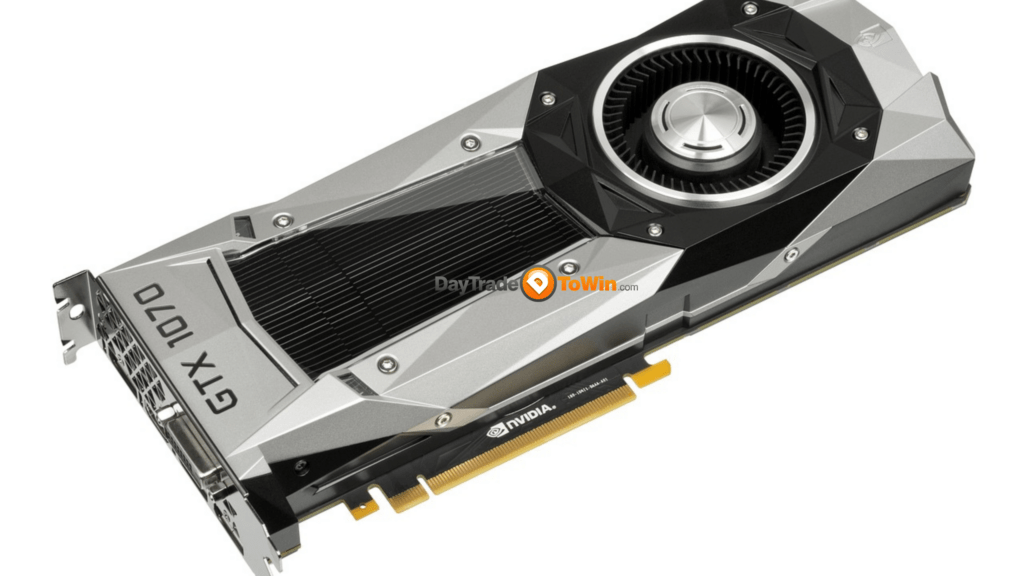
Nvidia’s Keynote Delivered Energy — but Not the Surprise Investors Wanted Jensen Huang took the stage with trademark enthusiasm, speaking for nearly two hours — reportedly without a teleprompter — about Nvidia’s bold future. But for investors hoping for a game-changing announcement, the presentation fell short. Nvidia shares (NVDA) closed down 3.4% on the day, deepening losses that had already begun before Huang’s keynote. While Nvidia’s roadmap is undeniably impressive — highlighting advances in AI, robotics, autonomous driving, and quantum computing — much of what Huang presented felt familiar. “The things Huang said had already been said,” observed Maribel Lopez, founder of Lopez Research. Investors had been hoping for an unexpected catalyst: a surprise revenue stream or a groundbreaking product reveal. Instead, Huang pointed to areas that are still in development and years from delivering meaningful financial returns. Quantum computing remains a long-term prospect, and while robotics is growing, it won’t scale as quickly as Nvidia’s core chip business, according to Lopez. Jefferies analyst Blayne Curtis also expressed mild disappointment, saying he had hoped for “more proof points” demonstrating how Nvidia could expand its total addressable market and drive greater cost advantages. Still, he acknowledged Nvidia’s unmatched strength across hardware, software, and vertical markets. Huang did reveal Nvidia’s product cadence moving forward: a new platform every 12 to 18 months. Next up is Vera Rubin, arriving in late 2026 with 3.3x the performance of today’s Grace Blackwell system and 144 GPUs. Vera Rubin Ultra will follow in late 2027, delivering a massive 14.4x performance increase with 576 GPUs. The company also teased its next-generation platform, “Feynman,” expected in 2028. Curtis noted that Vera Rubin appears to be an incremental upgrade, with Rubin Ultra marking the more significant leap. Even so, Nvidia’s ability to innovate rapidly continues to give it an edge. “Even when they stumble, they recover fast,” Lopez said, pointing to the company’s unwavering ability to stick to its ambitious product cycle. Huang ended by reminding the audience that Nvidia’s technology isn’t an impulse buy. “This isn’t like buying a laptop,” he said. Enterprises need time to plan budgets, infrastructure, and power demands — part of a much larger vision that remains firmly in place, even if short-term surprises are in short supply.

Scroll to Top