market
Market News

Market Reversal Ahead? Watch This Key Level! 📊📈

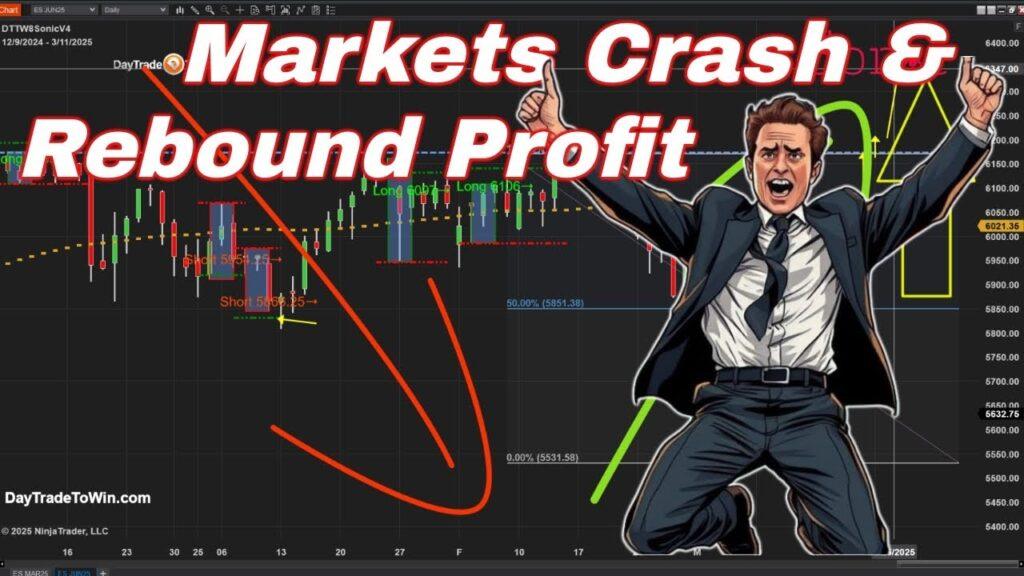
March has been a challenging month, with markets continuing to push lower. It may seem like the downturn is relentless, but there’s a silver lining—this volatility presents both shorting opportunities and potential for a market reversal. Capitalizing on the Downtrend The Sonic System by DayTradeToWin provides clear signals to help traders navigate these conditions. Whether you’re using NinjaTrader or TradingView, the system identifies high-probability trade setups, helping you take advantage of market movement. Take, for example, March 11th—we saw the shift, offering opportunities to go long. As a day trader, focusing on short-term swings is crucial since the market fluctuates constantly. Understanding Market Volatility For those trading the E-mini S&P, Nasdaq, or other indices, it’s important to be aware of volatility. The market’s current momentum may suggest further downside, but a potential reversal is on the horizon. Knowing when and where this shift occurs can provide significant profit opportunities. Signs of a Market Reversal By analyzing a daily chart of the June E-mini S&P contract, we can pinpoint potential support zones. Markets tend to revisit previous highs, and history suggests that a breakout above key resistance levels could lead to a sustained rally. A 50% retracement level gives us a critical price point—5,850. If the market closes above this level, it may signal a shift in sentiment, leading to a bullish move toward 6,200. Preparing for the Market Turnaround Once we see a confirmed reversal above 5,850: Final Thoughts If you’re currently shorting, there’s still room for profit, but keep a close eye on the 5,850 level. Once the market clears this hurdle, we’ll likely see a sustained bullish move. Want to stay ahead? Join the Accelerated Mentorship Program at DayTradeToWin.com to learn price action strategies and avoid reliance on conventional indicators. Trade smart, and as always—Good Trading!

nasdaq
Market News

Nasdaq Worst Day of 2025: Bear Market Ahead?

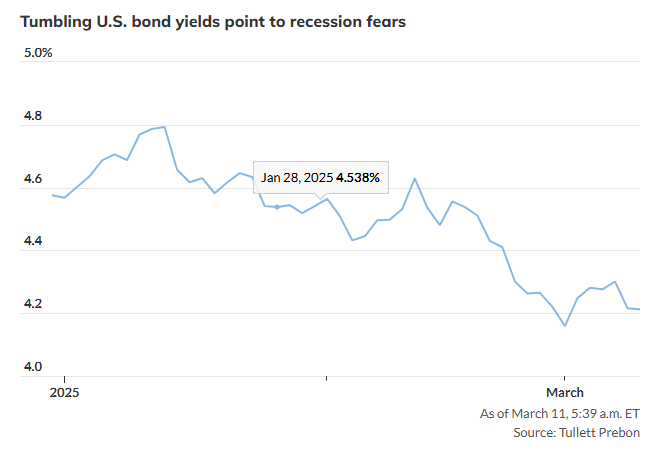
Dow Drops Nearly 900 Points as S&P 500 Nears Correction U.S. stock markets endured their worst session of 2025 on Monday, as investor fears of a potential recession intensified. The Trump administration’s attempts to reassure markets fell flat, raising the prospect of further selloffs and a possible bear market for the Nasdaq Composite Index. The Nasdaq Composite suffered the steepest losses, plunging 727.90 points, or 4%, to close at 17,468.32—its lowest level since September 11, 2024. This marked its biggest percentage drop since September 13, 2022. Having already entered correction territory last week with a 10% decline from its peak, the index is now down 13.4% from its record close of 20,173.89 on December 16. The Dow Jones Industrial Average tumbled 890.01 points, or 2.1%, to settle at 41,911.71, after dipping as much as 1,189 points intraday. The S&P 500 also saw a sharp decline, falling 155.64 points, or 2.7%, to close at 5,614.56, putting it 8.6% below its record close of 6,144.15 from February 19. Market analysts anticipate further downside. “This selloff may not be over,” warned Peter Cardillo, chief market economist at Spartan Capital Securities. He pointed out that with the Nasdaq in correction mode and the S&P 500 teetering on the edge, continued selling pressure is likely. “Is a bear market next? The risk for the Nasdaq is growing,” he added. President Donald Trump attempted to calm markets over the weekend, downplaying the effects of his administration’s tariff policies in a Fox News interview. However, he acknowledged that a recession in 2025 was a possibility. White House economic adviser Kevin Hassett sought to reassure investors in a CNBC interview on Monday, but market reaction suggested that confidence remained shaky. “The market is sending a strong message,” Cardillo stated, highlighting that bond markets were signaling recession fears. Treasury yields, which move inversely to bond prices, continued to decline, reflecting expectations that the Federal Reserve may need to cut interest rates to stabilize the economy. Tom Essaye, founder of Sevens Report Research, attributed the selloff to mounting uncertainty over tariffs, the looming debt ceiling fight, and discussions on extending Trump-era tax cuts. He warned that hesitation from businesses and consumers amid this uncertainty could slow economic growth and weaken corporate earnings. While fear is driving market sentiment, Essaye emphasized that “the data itself hasn’t turned negative yet.” Corporate earnings remain solid, and analysts have not yet made sweeping downward revisions to estimates. However, with the S&P 500 still trading at over 21 times expected earnings, the index remains vulnerable to further declines. The 10-year Treasury yield, now at 4.212%, has dropped from its recent 4.8% peak as inflation concerns give way to economic slowdown fears. Although Fed Chair Jerome Powell recently described the economy as “in good shape,” escalating trade tensions have darkened the outlook. This has fueled speculation that the Federal Reserve may reconsider its cautious stance on rate cuts in 2025. “The market has shifted from optimism to anxiety in a matter of weeks,” noted Gennadiy Goldberg, head of U.S. rates strategy at TD Securities USA. Investors now face a range of uncertainties—not only regarding Trump’s trade policies and economic approach but also the threat of a government shutdown if Congress fails to pass a budget deal by Friday. “The bond market’s main concern is slowing economic growth, compounded by trade and fiscal uncertainty,” Goldberg told MarketWatch. As volatility grips Wall Street, all eyes are on upcoming economic data and Federal Reserve decisions, as investors brace for what could be an extended period of market turbulence.

doordash
Market News

DoorDash Stock Jumps on S&P 500 Inclusion

DoorDash is among four companies set to join the S&P 500, while AppLovin and Coinbase were not selected. The committee responsible for choosing S&P 500 components exercises discretion in its selections, and this time, it appears to have prioritized stability over volatility. S&P Dow Jones Indices announced Friday that four companies will be added to the index later this month. DoorDash Inc. (DASH) is the largest of the new entrants, joining TKO Group Holdings Inc. (TKO), Williams-Sonoma Inc. (WSM), and Expand Energy Corp. (EXE). The S&P 500 consists of some of the largest U.S. companies by market capitalization, but inclusion is based on more than size alone. Companies must meet criteria related to profitability, public float, and other factors. Additionally, the selection committee considers aspects like sector diversification and stock volatility. While DoorDash met the eligibility requirements, it was not the largest company considered. AppLovin Corp. (APP) and Interactive Brokers Group Inc. (IBKR) both have larger market caps but were not chosen. Notably, the committee did not introduce any new technology companies to the S&P 500 in this round. Though DoorDash operates in the tech-driven food-delivery space, it is classified as a consumer-discretionary company. It may have been viewed as a more stable option than AppLovin, which recently came under scrutiny following two short-seller reports. AppLovin’s stock surged more than 700% in 2024 but has declined early in 2025. By contrast, DoorDash shares rose 70% last year and have continued climbing. The company recently qualified for S&P 500 inclusion after meeting profitability requirements. Coinbase Global Inc. (COIN), though smaller than DoorDash, was another widely discussed candidate that was ultimately left out. As a cryptocurrency exchange, Coinbase operates in an industry subject to a rapidly evolving regulatory landscape. Its stock has surged over 500% since the end of 2022, but its volatility may have factored into the committee’s decision. Historically, stocks that experience rapid gains ahead of S&P 500 inclusion often face volatility. Super Micro Computer Inc. (SMCI), added in March 2024, has seen its stock price decline by more than half since its inclusion, weighed down by financial control concerns and increasing competition in the server market. The company’s stock remains one of the most volatile in the index. Bernstein analysts have noted that while new entrants tend to outperform the S&P 500 in the year leading up to their addition, their relative returns tend to diminish shortly after the announcement. Stocks typically see an immediate boost after being named as future S&P 500 constituents, as index-tracking funds must purchase shares of the new entrants. This was evident in Friday’s extended trading session, where DoorDash shares climbed 6%, TKO gained 2.4%, Williams-Sonoma rose 1.6%, and Expand Energy advanced 2.3%. Conversely, stocks of companies that were not selected saw declines. AppLovin dropped 4.3%, Interactive Brokers fell 2.6%, and Coinbase slipped 2.1% in after-hours trading. The four new S&P 500 entrants will replace BorgWarner Inc. (BWA), Teleflex Inc. (TFX), Celanese Corp. (CE), and FMC Corp. (FMC) before trading begins on March 24.

jpmorgan
Market News

JPMorgan: Market Gains Could Take Longer

The bulls are starting to sweat. JPMorgan bullish stance has always been measured, and now cracks are beginning to show. After parting ways with Marko Kolanovic due to his unfulfilled bearish forecasts, the bank’s new team, led by Dubravko Lakos-Bujas, set a conservative S&P 500 year-end target of 6,500 — a forecast that sits in the middle of Wall Street projections. Achieving that target would require a 13% surge from current levels, following Thursday’s 1.8% drop that left the index at 5,738.52. “We are sticking with our 6,500 target for year-end but acknowledge significant uncertainty, with the possibility that this level may not be reached until 2026,” the strategists noted. They anticipate the index will trade between 5,200 and 6,000 in the near term before rallying later in the year. Despite recent turbulence, JPMorgan sees minimal recession risk. The strategists believe markets are recalibrating to policy-driven growth concerns, with falling interest rates, oil prices, and a weaker U.S. dollar offering support for risk assets. Lower borrowing costs could unleash pent-up demand in sectors like housing, retail, and autos. The 10-year Treasury yield has dropped nearly 30 basis points this year, oil prices are down 7%, and the U.S. dollar index has slid 4% in 2025. Markets are pricing in nearly three Federal Reserve rate cuts this year, with the potential for additional cuts if economic conditions deteriorate. Policy easing would align with the Treasury secretary’s objective to lower rates, stimulate growth without stoking inflation, and narrow the budget deficit. Additionally, a potential Russia-Ukraine peace deal and softer commodity prices could further tame inflation. Corporate earnings and the labor market remain resilient, bolstering the outlook. Credit markets continue to show strength — a rare signal in the late stages of a business cycle. Capital spending initiatives in the U.S., defense spending in Europe, economic easing in China, and pro-growth reforms in Japan could further boost earnings. Meanwhile, the AI boom is accelerating, especially in the U.S. and China, with productivity gains likely to provide an underappreciated lift to earnings. JPMorgan recommends a barbell strategy: defensive stocks like utilities and consumer staples on one side, and rate-sensitive sectors like regional banks and real estate on the other. The bank downgraded large-cap banks to neutral from overweight and upgraded consumer discretionary stocks to neutral from short. Outside the U.S., Chinese tech and internet stocks present significant upside potential.

market
Market News

Good News for Investors Amid Market Turmoil

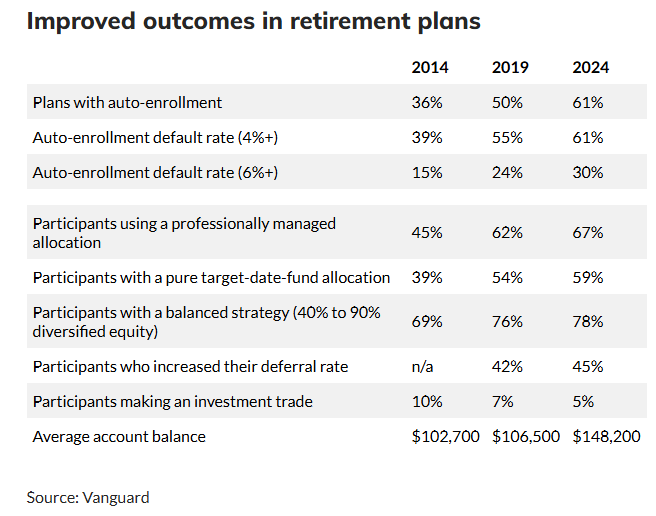
With market volatility making headlines, discussing retirement optimism might feel out of place. Put Aside Your 401(k) Statement—These Retirement Trends Paint a Brighter Picture However, David Stinnett, Vanguard’s head of strategic retirement consulting, remains hopeful. Despite inflation worries, federal job losses, and slow GDP growth, Stinnett points to positive shifts among retirement savers. “You can have years of double-digit negative returns, high inflation, and unemployment — all of which we’ve seen recently — yet people are steadily improving their investing habits, participation rates, and savings contributions,” Stinnett said. “This week’s market fluctuations don’t worry me in the context of long-term savings.” A Steady Climb Financial advisers often urge clients to stay the course during market downturns, and Vanguard’s early look at the 2024 “How America Saves” report backs up that advice. The report, which examines five million participants in Vanguard’s retirement plans, shows how American workers are building retirement savings consistently — and how the system is evolving to address key vulnerabilities. Auto-enrollment has been a game-changer. Ten years ago, just 36% of retirement plans had automatic enrollment. Today, that number has jumped to 61%, helping more lower-income workers start saving. Default contribution rates are also rising, with more companies enrolling workers at 4% and a growing number starting at 6%. Additionally, 45% of participants increased their savings rates in 2024. Overcoming Roadblocks Despite these gains, many workers face setbacks. Job changes often reset contribution rates to lower default levels, slowing savings progress. “We need a smarter 401(k) system that ensures savings continue rather than restart,” Stinnett said. Positive Balance Growth Average account balances climbed 10% in 2024 to $148,200, while median balances rose 8% to $38,176. However, hardship withdrawals also increased. Only 5% of participants took such withdrawals, which Stinnett attributed to regulatory changes and greater participation by lower-income workers. While the trend warrants attention, Stinnett does not see it threatening overall retirement readiness. A Brighter Future Despite short-term economic uncertainty, Stinnett remains optimistic. “Our voluntary retirement system differs from the global norm, and employers, policymakers, and record keepers are continuously adopting best practices. These improvements are gradual but steady — in both good and bad years. That’s a message worth sharing.” By focusing on consistent contributions and long-term strategies, American workers are proving that even in turbulent times, retirement goals can stay on track.

sonic
Market News

Sonic Signals Deliver Wins – March 5th

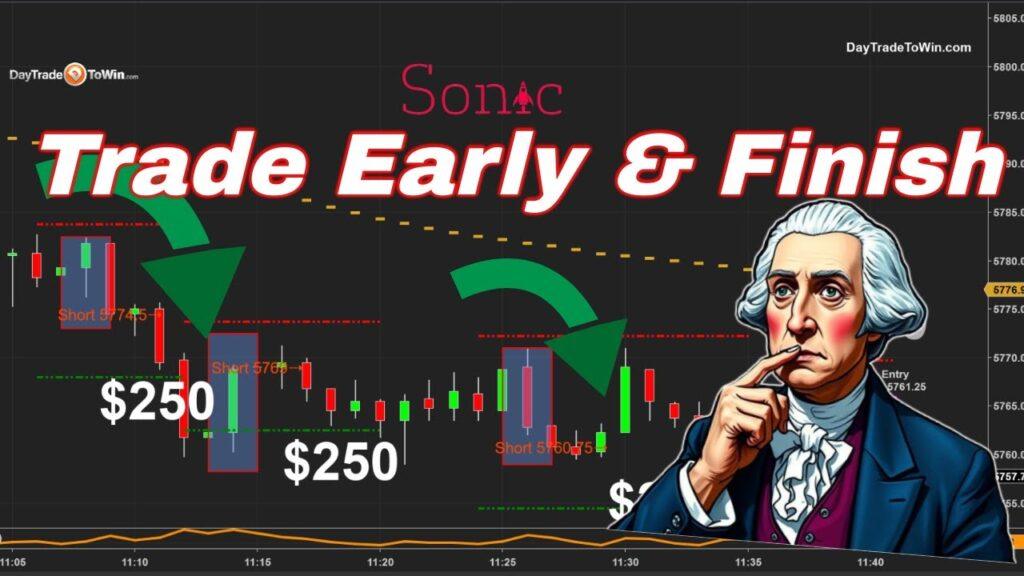
Welcome to our Wednesday, March 5th market recap! Today, we’re highlighting how the Sonic Trading System consistently identifies high-probability opportunities, especially during trending markets. Market Insights The market has been trending lower, offering multiple short opportunities. However, volatility remains high, making it essential to follow a proven system. Always remember — trading involves risk. Never trade with money you cannot afford to lose. Sonic Signals in Action During today’s session, the Sonic Trading System generated three consecutive short signals, indicating a strong bearish trend. When multiple signals align, it confirms momentum in the same direction — a powerful advantage for traders. A standout short signal was at 5764, offering a specific entry price. Although patience is key for better entries, the combination of multiple signals and market volatility made this trade highly favorable. Profit Potential Breakdown Trading the E-mini S&P today yielded $200–$300 per contract on each trade. Using the Average True Range (ATR), we adjusted targets based on market speed, typically aiming for 3–5 points. This dynamic approach ensures that targets align with current conditions rather than fixed values. Key Takeaways Join Our Trading Community We had a fantastic day in the trading room! Ready to elevate your trading skills? Sign up for a free member account at daytradetowin.com and gain access to live price action classes Monday through Friday. Join the Accelerated Mentorship Program and get instant access to proprietary software like the Sonic Trading System and ABC software. Whether you’re a beginner or experienced trader, we’ll help you navigate the markets the right way. Let’s trade smarter together!

Scroll to Top