U.S. Stocks
Market News

New Highs for U.S. Stocks—Boom or Bubble?

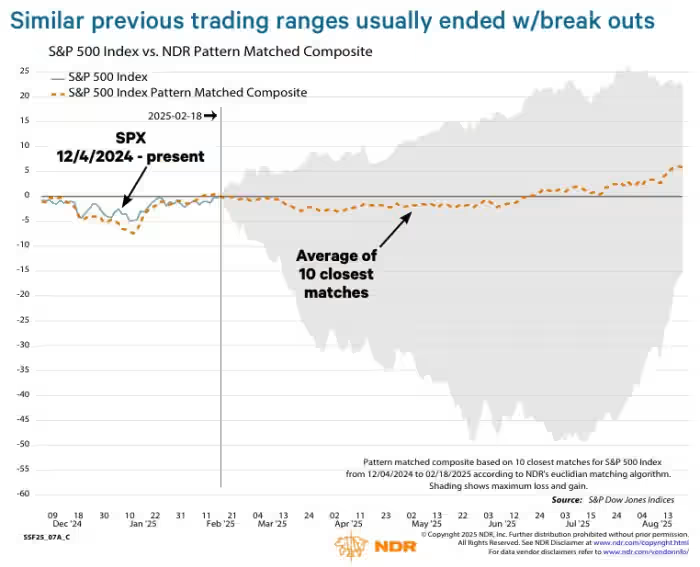
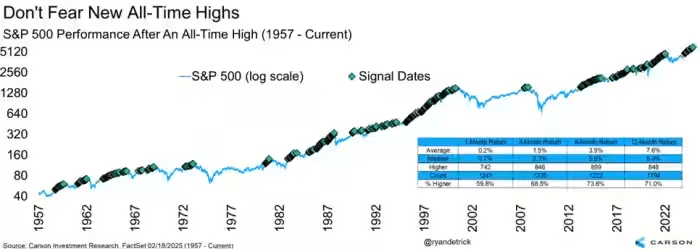
Investors Should Embrace Stocks Record Highs While Staying Vigilant For the first time in nearly four weeks, the S&P 500 reached a new closing high on Tuesday. Investors who have remained on the sidelines may now be wondering: Is it too late to enter the market? After two years of strong gains, it’s natural to question whether to invest now or wait for a potential pullback. As the saying goes, “trees don’t grow to the sky”—markets don’t rise indefinitely without pauses or corrections. New market highs can shape investor sentiment, but history shows they are not unusual. Ryan Detrick, chief market strategist at Carson Group, notes that since 1957, the S&P 500 has reached a new record high roughly every three weeks on average. This doesn’t mean stocks are immune to downturns. While bear markets occur, they have historically been infrequent. Investors who remain on the sidelines often miss out on significant long-term gains. “Should you buy at all-time highs? That’s a frequent question,” Detrick shared on X. “My take: Don’t fear new highs. The S&P 500 has risen a year later 71% of the time after reaching a record, with a median return of 8.3%—essentially normal returns.” Of course, exceptions exist. The S&P 500 hit a record of 4,796.56 on January 3, 2022, before declining 25% in a bear market. It took over two years to surpass that peak. However, such downturns are the exception, not the rule. Historically, stocks trend upward over time, particularly following the recovery from the 2008 financial crisis. Key Risks to Consider Despite market resilience, investors should remain mindful of emerging risks. Several challenges have surfaced at a time when U.S. large-cap valuations are historically high. Additionally, seasonal trends indicate that the first quarter of a new presidential term is often one of the weakest in the four-year cycle, according to Detrick. Potential concerns include: Thus far, investors have largely brushed off these risks, but sentiment can shift quickly. Market Breadth and Leadership While the “Magnificent Seven” megacap tech stocks have struggled in early 2025, other stocks have gained ground, broadening the market rally. This diversification reduces the market’s vulnerability to single-stock declines, such as Nvidia Corp.’s sharp 17% drop in late January, which caused the S&P 500 to fall nearly 1.5%, despite gains in most other index components. The S&P 500’s rise has slowed in 2025, but broader participation suggests a more stable rally. Year to date, the index is up 4.2% as of midday Wednesday. The Invesco S&P 500 Equal Weight ETF (RSP), which better reflects the performance of the average S&P 500 stock, has gained 4%, according to FactSet. Looking Back and Moving Forward Exactly five years ago, on February 19, 2020, the S&P 500 hit a record before the COVID-19 pandemic disrupted global markets. Since then, the index has climbed more than 80%, according to FactSet data. By late summer 2020, it had fully recovered from the pandemic-induced selloff. As of Wednesday’s trading session, the S&P 500 was down 6 points, or 0.1%, at 6,122. The Nasdaq Composite declined 53 points, or 0.3%, to 19,990, while the Dow Jones Industrial Average dropped 144 points, or 0.3%, to 44,413. While new highs may seem concerning, history suggests they are a natural part of market cycles. Investors who take a measured approach and maintain a long-term perspective are often rewarded over time.

Goldman
Market News

Goldman: AI Could Add $200B to China—But Wait

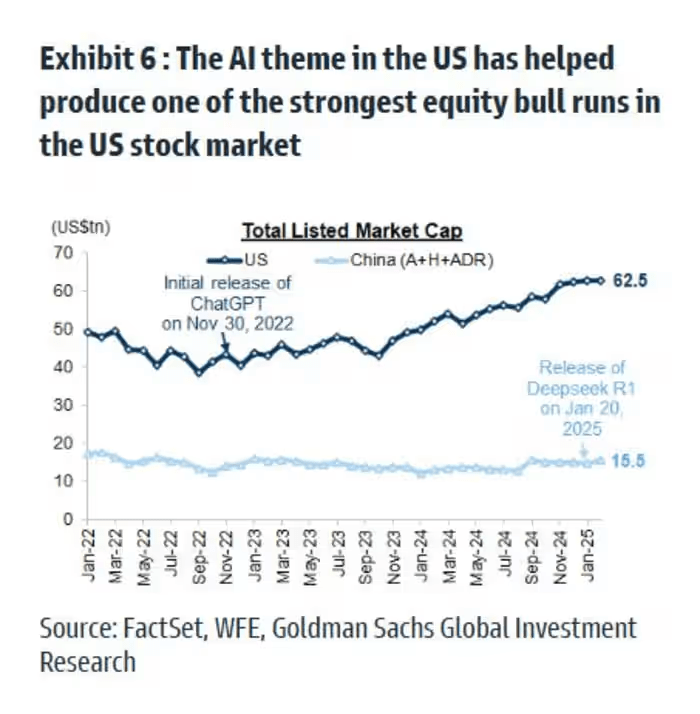
Fiscal Stimulus: The Key to Sustaining China’s Market Rebound Chinese stocks are regaining momentum, fueled by a transformative artificial intelligence (AI) breakthrough that could draw up to $200 billion in investor inflows this year. Goldman Sachs strategists, led by Kinger Lau, have raised their target for China’s CSI 300 index from 4,600 to 4,700, signaling a potential 19% price return. Goldman estimates that widespread AI adoption could enhance Chinese earnings per share by 2.5% annually over the next decade. This technological shift, coupled with renewed investor confidence, could elevate the fair value of Chinese equities by 15-20%, triggering substantial capital inflows. Despite this optimism, analysts stress that AI alone cannot sustain long-term growth. Strong fiscal stimulus is essential to address macroeconomic challenges and drive sustainable equity gains. Specifically, China must implement policies to counter tariff-related headwinds, stimulate domestic demand, curb deflationary pressures, and correct economic imbalances—all crucial for bolstering corporate earnings and extending market gains. The CSI 300 rose 14% last year after three years of losses, compared to a 23% gain in the S&P 500. Meanwhile, the Hang Seng Tech Index, home to many of China’s leading AI and tech firms, has surged 23% year-to-date, with an ETF tracking the index up 19% in 2024—the first annual gain in four years. Goldman Sachs identifies strong potential for later-cycle AI beneficiaries, favoring companies in data, cloud computing, software, and applications as AI monetization and practical use cases expand. Their analysis reveals a valuation gap between U.S. and Chinese AI stocks, drawing comparisons between major firms like Apple and Tencent. Since ChatGPT’s launch in late 2022, U.S. stocks have surged 50%, adding $13 trillion in market capitalization. Over the past year, U.S. and global investors have funneled $660 billion into U.S. equities, fueling double-digit gains in the S&P 500 and Nasdaq Composite and generating over $10 trillion in market value. Optimism surrounding DeepSeek is now driving significant inflows into Chinese stocks. If Chinese firms can grow their market cap by $3 trillion in the next year, AI-related investments could contribute up to $200 billion in global net buying, potentially reversing the underweight positioning of Chinese equities among asset managers. However, Goldman Sachs warns of risks to China’s AI-driven growth, including regulatory uncertainties, data privacy concerns, national security considerations, disinflationary pressures, and potential Western tech export restrictions. While these risks are currently overshadowed by AI enthusiasm, they remain crucial factors for investors to monitor moving forward.

UBS & Goldman Sachs
Market News

UBS & Goldman Sachs Boost Gold Targets—What It Means

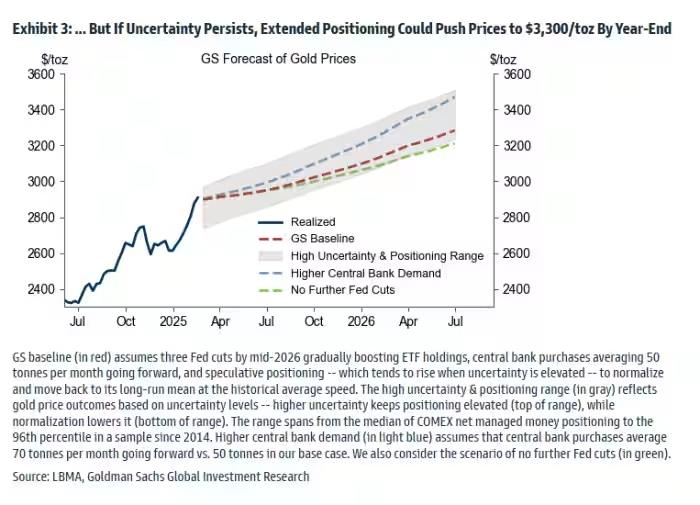
UBS and Goldman Sachs Raise Gold Price Forecasts, Citing Investor Sentiment and Central Bank Demand Strategists at UBS and Goldman Sachs have revised their gold price targets upward, pointing to strong investor sentiment and rising central bank demand as key drivers of the metal’s ongoing rally. UBS strategist Joni Teves acknowledged the difficulty of chasing a strong market but argued that it would be premature to call an end to gold’s bull run simply because prices have repeatedly hit record highs. She raised her year-end forecast to $2,900 from $2,800 and increased her 2026 target to $2,900 from $2,850. Similarly, Goldman Sachs analysts, led by Lina Thomas, boosted their year-end target to $3,100 from $2,890. Gold futures (GC00 +0.82%) climbed 1% on Tuesday, reaching $2,923.80 per ounce, continuing a year in which the metal has outperformed U.S. stocks, bonds, the Swiss franc, and the Japanese yen. What’s Driving the Rally? Teves sees gold potentially reaching $3,200 later this year, attributing the rise to strong investor sentiment in the face of macroeconomic uncertainty. She also noted that low positioning in the market leaves ample room for further accumulation. Additionally, official purchases and tightening liquidity—especially in London—could amplify price movements. Over the long term, UBS expects gold to stabilize around $2,500, reflecting elevated production costs and capital expenditures. Teves also pointed to broader concerns such as fiat currency debasement, the worsening U.S. fiscal deficit, and geopolitical risks, all of which could keep gold attractive as a hedge. While UBS left its silver forecast unchanged at $35.40 per ounce by year-end, Teves suggested that silver could outperform gold if weaker economic growth prompts a more dovish Federal Reserve. Goldman Sachs echoed UBS’s bullish outlook but emphasized rising central bank demand as a key factor. The bank estimates this structural demand could push gold prices up by 9% by year-end. If policy uncertainty remains high, Goldman sees the potential for gold to surge as high as $3,300.

presidents day
Market News

Presidents Day: What’s Open & Closed?

What’s Open and Closed on Presidents Day? Here’s What You Need to Know Presidents Day, observed on the third Monday of February, honors all U.S. presidents but originally celebrated George Washington’s birthday. Officially recognized as Washington’s Birthday on federal and stock market calendars, this year’s holiday falls on February 17. As a federal holiday, many businesses, government offices, and financial markets will be closed. Here’s a breakdown of what’s open and what’s not. Are the Stock and Bond Markets Open? No. The New York Stock Exchange (NYSE), Nasdaq, and bond markets will be closed on Monday. Trading resumes on Tuesday, February 18. Stocks were heading into the holiday weekend with strong momentum. The S&P 500 was just shy of its record close from January 23, while the Dow Jones Industrial Average had gained 5.1% year-to-date, and the Nasdaq Composite was up 3.3% through Thursday’s close. Will There Be Mail Delivery? Are Banks Open? Most banks follow the Federal Reserve’s holiday schedule and will be closed. However, ATMs, mobile banking, and online services will remain available. Check with your local branch for specific hours. Are Government Offices Open? Nonessential federal and state government offices will be closed for the holiday. Are Schools Open? Most schools will be closed, though some districts may use the day as a makeup day for weather-related closures. Check with your local school district for details. Are Stores Open? Yes. Many retailers not only remain open but also offer Presidents Day sales, with discounts on everything from electronics to home goods. Whether you’re planning a shopping trip or just need to know what’s open, now you’re prepared for the holiday schedule.

scalping
Market News

Optimize Scalping with ATR Targets

Hello, Traders! Happy Friday! Today, we’re exploring live trades and the importance of dynamically adjusting targets using the Sonic System for scalping. Whether you’re seeking rapid entries and exits or larger profit targets, refining your approach can significantly impact your success. Optimizing Your Scalping Strategy A key takeaway from today’s session is adjusting profit targets based on the ATR (Average True Range). By default, our take-profit target is set at 75% of the ATR, allowing us to capitalize on momentum while managing risk effectively. Live Trade Recap: February 13th We identified multiple long signals throughout the session. Once an audible alert signaled an entry, we followed the system’s guidance on stops and targets: For traders who prefer frequent trades, this method maximizes opportunities while keeping risk under control. However, excessive trading should be avoided—10 quality trades a day are more than sufficient for solid results. Managing Stops & Targets Effectively A balanced 50/50 risk-reward ratio is crucial. We ensure that our target isn’t disproportionately small compared to our stop. If the market moves sideways without hitting either, we exit manually—scalping isn’t about holding on for hours! Live Trade: February 14th – Expanding Targets Today’s market open provided an opportunity to increase profit targets while keeping stops constant. Volatility at market open can be high, so caution is advised. Instead of using a 75% ATR target, we adjusted to 3.5x the ATR for a larger profit window. Trade Breakdown: By securing a better entry price, we reduced risk while maintaining flexibility in managing trades based on live market conditions. Key Takeaways for Scalpers For more trading insights, visit DayTradeToWin.com, get your free member account, and subscribe to the Day Trade To Win YouTube channel for live examples and strategies. See you at the next class!

market
Market News

Market Climb, Investors Downplay Trump’s Tariffs

Market Rally Doesn’t Shield Investors from Tariff Risks Wall Street appears unfazed by the looming threat of a global trade war. The S&P 500 closed just shy of a record high on Thursday after President Donald Trump instructed his administration to explore reciprocal tariffs on several U.S. trading partners. Despite concerns about escalating trade tensions, markets surged, reflecting investor sentiment that the economic impact of tariffs may be less severe than initially feared. “The bark is worse than the bite,” said George Young, partner and portfolio manager at Villere & Co., which oversees $1.8 billion in assets. Investors were relieved that Trump’s order didn’t impose immediate tariffs, easing fears of swift economic disruption. Similar tariff-related announcements in the past have also been met with less severe consequences than initially expected. On Wednesday, the S&P 500 climbed 1% to close at 6,115.07, just 0.1% below its record high of 6,118.71 set on Jan. 23. The Dow Jones Industrial Average gained 342.87 points (0.8%), while the Nasdaq Composite surged 1.5%. Earlier this week, Trump imposed a 25% tariff on steel and aluminum imports, following previous levies on goods from Canada, Mexico, and China. However, tariffs on Canada and Mexico were temporarily paused after both countries pledged to tighten border security and combat drug trafficking. Despite the market’s optimism, investors remain cautious. “This is the new normal,” Young told MarketWatch. “The market isn’t ignoring the risks—it’s digesting them one step at a time, waiting to see what actually unfolds.” The tariff debate is far from over. White House officials suggest that reciprocal tariffs could take effect within weeks or months. While the administration has backed away from a universal 10%-20% tariff, a country-by-country approach could result in even higher average tariffs and rising consumer prices, warned Paul Ashworth, chief North America economist at Capital Economics. Tariffs are just one of several economic uncertainties tied to Trump’s policies, noted Matt Eagan, portfolio manager at Loomis, Sayles & Co., which manages $389 billion in assets. “Tax cuts may boost spending but worsen the deficit. Immigration policies could tighten labor markets but drive up wages. Tariffs could slow demand while increasing costs,” Eagan explained. “Investors must look beyond the headlines. Trump’s policies may seem more bark than bite, but complacency is risky.” That complacency could lead to a dangerous cycle, warned Christopher Smart, managing partner at Arbroath Group, a firm specializing in geopolitical risk analysis. “If markets don’t react negatively, Trump may feel encouraged to push even further,” Smart noted. “Tariffs are coming—it’s just a matter of how high they’ll go. Given the market’s calm response so far, the president may be emboldened to test the limits.”

Scroll to Top