market
Market News

Market Rally vs. Fed Meeting: Is a Drop Inevitable?

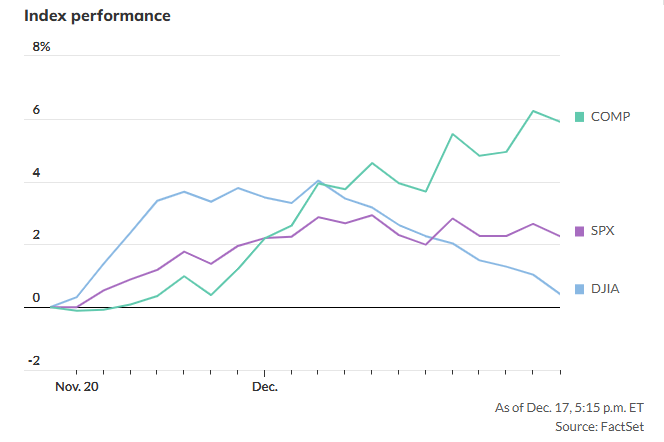
Wall Street’s festive cheer appears muted as the stock market rally takes a breather ahead of the Federal Reserve’s final policy meeting of 2024. Hopes for a December surge driven by tech stocks have dimmed, raising concerns about market fragility. The S&P 500 Value Index (SPYV) extended its record losing streak, while the Dow Jones Industrial Average (DJIA) posted its seventh consecutive daily loss on Friday—the longest stretch since February 2020. “I would love to see a meaningful pullback in equities,” said Talley Leger, chief market strategist at the Wealth Consulting Group. While Leger expects the typical year-end boost from holiday spending, he predicts some market turbulence could emerge in 2025. The S&P 500 (SPX) closed flat on Friday but remains poised to achieve back-to-back annual gains exceeding 20% for 2023 and 2024, defying earlier fears of a recession. However, this bull market has avoided pullbacks of at least 15% since October 2022, a rarity according to Dow Jones Market Data. David Laut, chief investment officer at Abound Financial, compared today’s market euphoria to the iconic “Titanic” scene where arms are outstretched at the bow. Despite strong investor sentiment, Laut sees growing risks, including inflation, disappointing earnings, and geopolitical tensions. “Why not take some money off the table?” he suggested, highlighting a shift toward mid- and small-cap stocks, emerging markets, and cash reserves. Laut also recommends a 5% allocation to gold and cryptocurrencies as part of a diversified strategy. The ‘Magnificent Seven’ FactorOne major concern is the outsized influence of megacap technology stocks, known as the “Magnificent Seven.” For every dollar invested in the SPDR S&P 500 ETF Trust (SPY), 31 cents are allocated to these stocks. Laut advocates for a more balanced approach heading into 2025, focusing on undervalued opportunities beyond large-cap tech. Parallels to the 1990s The Fed is expected to announce a 25-basis-point rate cut on Wednesday, but Chair Jerome Powell’s cautious tone suggests a slower pace of easing in 2025. Talley Leger draws comparisons to the mid-1990s, a period marked by robust economic growth and the early stages of the tech boom. “This feels a lot like the run-up to tech mania 1.0,” said Leger, emphasizing the importance of navigating inflation risks. Higher bond yields add complexity to the outlook. The 10-year Treasury yield climbed significantly last week, reflecting concerns that inflation may not cool as quickly as anticipated. George Cipolloni, portfolio manager at Penn Mutual Asset Management, warned, “The market wants easing, but yields remain a challenge. Lower yields would help, but getting there won’t be easy.” What’s Next? The Fed’s rate decision on Wednesday will be the centerpiece of a busy week that includes November’s PCE inflation data on Friday. Other key economic reports, including updates on manufacturing, retail sales, and housing starts, will provide further insights. Despite recent setbacks, 2024 has been a strong year for equities. The Dow is up 16.3%, the S&P 500 has gained 27%, and the Nasdaq has surged 32.7%, according to FactSet. As investors look to 2025, the focus shifts to navigating market uncertainty while capitalizing on new opportunities.

stock
Market News

20-Year Stock Anomaly: Key Investor Takeaways

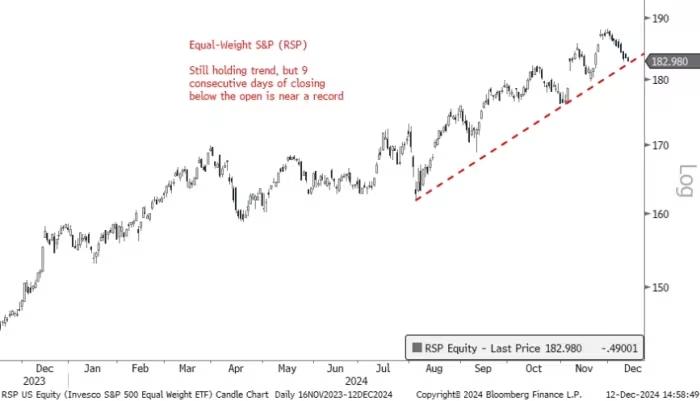
S&P 500 Sees Nine Straight Sessions of Weak Breadth, a Rare Market Phenomenon The U.S. stock market is experiencing a rare stretch of “bad breadth,” where more stocks are declining than advancing, even as the S&P 500 continues to climb. For nine consecutive sessions, the number of falling stocks in the index has surpassed those rising—a pattern not seen in over two decades, according to BTIG technical strategist Jonathan Krinsky. Market breadth, a key measure of market health, has deteriorated sharply since early December. This anomaly, last observed during the period around September 11, 2001, contrasts with the S&P 500’s modest 0.4% gain so far this month, driven by strong performances from megacap technology stocks, including the so-called “Magnificent Seven.” However, this narrow leadership is raising concerns about the sustainability of the rally. Broader market measures highlight the underlying weakness. The Invesco S&P 500 Equal Weight ETF (RSP), which assigns equal importance to all stocks in the index, has declined 2.5% in December. On Thursday, it marked its ninth consecutive loss, the longest streak since December 2018, when markets were reeling from a significant selloff. Historically, such weak breadth has been associated with markets trading well below record highs. Jason Goepfert, senior research analyst at SentimenTrader, notes that similar instances over the past 70 years typically occurred with the S&P 500 12% below its peak. Yet, as of Thursday, the index was just 0.6% off its record close of 6,090.27, making this situation unprecedented. This poor breadth is impacting various market segments. Value stocks, tracked by the S&P 500 Value Index (SPYV), have fallen for nine straight sessions, their worst losing streak since 2000. Momentum-driven growth stocks, such as Palantir Technologies Inc. and AppLovin Corp., have also struggled to recover, further reflecting the uneven market environment. Analysts, including Krinsky, caution that this trend could lead to heightened volatility in early 2024, as investors lock in gains from the current rally. Despite this, the S&P 500 remains on track to deliver a total return exceeding 25% in 2024, which would mark back-to-back years of such strong performance for the first time since the late 1990s. On Thursday, U.S. stocks closed lower across the board. The S&P 500 fell 0.5% to 6,051.25, the Nasdaq Composite lost 0.7% to finish at 19,902, and the Dow Jones Industrial Average declined 0.5% to close at 43,914.12. Investors are now watching closely to see if broader participation can return to the market or if this narrow rally will give way to further weakness.

nasdaq
Market News

Nasdaq Hits 20,000: Risk or Reward?

Profit-Taking or Staying the Course: What’s Next for Stock Investors? The Nasdaq Composite hit a historic milestone on Wednesday, closing above 20,000 for the first time. This surge was powered by a rally in tech giants like Alphabet Inc. (GOOGL, GOOG) and Meta Platforms Inc. (META), which reached record highs, pushing the Nasdaq up 1.77%. Richard Steinberg, chief market strategist at The Colony Group, cautioned that the recent gains might come at a cost to future returns, comparing the rally to “borrowing from Peter to pay Paul.” Historically, U.S. stocks perform well in December, especially during the “Santa Claus rally” period starting December 24. However, with the Nasdaq already up 4.3% this month, investors appear eager to act sooner, according to FactSet data. Steinberg warns that a year-end tech rally could reduce momentum in early 2025. Elevated 10-year Treasury yields, a stronger dollar tied to Trump’s “America First” policies, and potential fiscal concerns could challenge growth stocks in the new year. He suggests that investors consider rebalancing portfolios to avoid excessive exposure to equities. The Case for Staying the Course While some advocate for caution, others believe in sticking with strategies that have proven successful. Keith Lerner, co-chief investment officer at Truist Advisory Services, emphasized the enduring strength of the AI theme, which continues to drive the bull market. Despite political uncertainties, Lerner sees strong earnings expectations for technology stocks, which he argues are far from overvalued. Callie Cox, chief market strategist at Ritholtz Wealth Management, views the Nasdaq’s 20,000 milestone as a psychological boost, reflecting tech’s resilience despite high interest rates. However, she warned against overemphasizing round-number markers, noting they often oversimplify complex market dynamics. Looking Ahead As 2025 approaches, investors face a pivotal choice: lock in profits or remain invested in the strategies that have propelled markets to new highs. While challenges like elevated interest rates and fiscal uncertainties persist, the tech sector’s strong earnings potential and growth themes could sustain its appeal into the new year.

inflation
Market News

Inflation vs. Fed: Traders Brace for Impact

November CPI Could Upend December Rate Cut Expectations Traders in fed-funds futures currently place an 85% chance on the Federal Reserve cutting rates by 25 basis points at its December policy meeting. This level of confidence aligns with historical norms during the Fed’s “blackout” period, when officials refrain from public comments on monetary policy ahead of a meeting. As of Tuesday, market expectations for a December rate cut remain steady, supported by data from the CME FedWatch Tool. This optimism has fueled a strong stock market rally, with the S&P 500 and Nasdaq Composite reaching record highs last week and the Dow Jones Industrial Average crossing the 45,000 milestone for the first time. Inflation Data Looms as a Potential Game-Changer This week’s release of the November consumer price index (CPI) on Wednesday and producer price index (PPI) on Thursday could still shift market sentiment. Economists surveyed by The Wall Street Journal expect CPI to rise by 0.3% month-over-month for both headline and core readings. Year-over-year, headline inflation is forecasted to tick up to 2.7% from 2.6% in October, with core inflation steady at 3.3%. A sharper-than-expected increase in CPI—such as a 0.4% monthly gain—could raise questions about the Fed’s plans, said Jay Hatfield, CEO of Infrastructure Capital Advisors. However, most analysts see little likelihood of such an outcome, given policymakers’ confidence that inflation is on track toward the 2% target. Fed’s Gradual Approach and Market Sentiment Minutes from the Fed’s November meeting highlighted officials’ preference for a more measured pace of rate cuts, with Chair Jerome Powell emphasizing the importance of avoiding undue haste. Although a December rate cut appears likely, the Fed may strike a “hawkish” tone, signaling slower rate reductions in the future. Recent economic data has bolstered expectations for a December easing. November’s stronger-than-expected jobs report reinforced this view, and remarks from Fed officials, including Powell and Governor Christopher Waller, have not challenged the market’s outlook. Waller, in particular, indicated he supports a rate cut unless inflation data surprises significantly. The Role of the Dot Plot The December meeting will also include an updated Summary of Economic Projections, known as the dot plot, which outlines individual Fed officials’ rate forecasts. A projection showing only modest rate cuts in 2024 could help balance the more hawkish voices within the central bank, according to Hatfield. Key Takeaways With inflation data as the final major input before the December meeting, the market is poised for a rate cut. However, any significant surprise in the CPI could disrupt these expectations, underscoring the Fed’s delicate balancing act as it navigates its monetary policy path.

bond
Market News

Navigating Bond Vigilantism: Pimco’s Take

Pimco, one of the world’s largest bond managers with $2 trillion in assets under management, is recalibrating its investment strategy amid concerns over the U.S. fiscal outlook. The firm has been reducing its exposure to longer-duration U.S. Treasurys, citing factors that could drive yields higher, such as inflation, economic growth, and increased government borrowing to fund the deficit. Pimco Shifts Focus: Favoring U.S. Equities and European Debt “We have been reducing allocations to longer-dated bonds, which we find relatively less attractive,” explained Marc Seidner, Chief Investment Officer for nontraditional strategies, and Pramol Dhawan, a portfolio manager at Pimco. The managers emphasized that while no coordinated “bond vigilante” movement exists, investors demanding higher yields for greater risks could serve as a check on government borrowing. Pimco encourages “vigilance before vigilantism” in managing bond portfolios. Pimco’s Strategy in Action In response to these concerns, Pimco has shifted its focus to shorter- and intermediate-duration bonds, favoring high-quality debt from both corporate and sovereign issuers. The firm is also diversifying its exposure to include bonds from countries with stronger fiscal positions, such as the U.K. and Australia. Pimco highlighted the unique benefits of U.S. equities, supported by a deficit-driven economic model that has fueled productivity and technological innovation. This dynamic, they argue, continues to make U.S. stocks an attractive investment. “We believe it makes sense to maintain equity exposure in the U.S. while preferring debt exposure in Europe,” wrote Seidner and Dhawan. Market Context On Monday, 1-month Treasury bill yields held steady at 4.43%, while 10-year Treasury yields hovered around 4.2%, according to FactSet. Despite some volatility, 10-year yields remain significantly above their lows for the year. Meanwhile, U.S. stocks have delivered robust performance in 2023. The Dow Jones Industrial Average is up 18% year-to-date, the S&P 500 has gained 27%, and the Nasdaq Composite has surged 31.4%. By balancing U.S. equity exposure with a preference for European debt, Pimco demonstrates a nuanced approach to navigating a complex global economic landscape.

market
Market News

Lower Earnings Forecasts: Market Risks Ahead?

The stock market is at record highs, but declining profit projections for S&P 500 companies suggest a potential pullback is on the horizon. Wall Street analysts have lowered their 2025 earnings per share (EPS) estimates by 0.5% over the past six months, dropping from $276 in June to $273, according to FactSet. Sales estimates also fell by 0.3% during the same period. The sharper decline in EPS versus sales indicates pressure on profit margins, as fixed costs limit companies’ ability to cut expenses in response to revenue drops. This trend extends across the S&P 500, excluding the “Magnificent Seven” tech giants—Nvidia, Microsoft, Amazon, Meta, Alphabet, Apple, and Tesla. These seven companies have largely resisted the downturn due to early gains from rising artificial intelligence investment. For the rest of the index, 2025 EPS estimates have fallen 5.5% this year, according to Citi. The energy and materials sectors have seen the largest cuts, with EPS forecasts down 18% and 6%, respectively. Oil prices have declined as global economic growth slows and production outside OPEC increases. Materials producers, including chemical and steel makers, are similarly affected by weaker demand tied to slowing economic activity. The consumer discretionary sector has also faced a 2.4% drop in earnings estimates, reflecting diminished consumer spending and broader economic challenges. While downward revisions are typical—historically averaging 6% for the next year’s estimates—this trend is more concerning against the backdrop of a softening economy. Signs of a slowdown include a weaker labor market, easing consumer spending, and persistently high interest rates. Although the Federal Reserve recently lowered rates, they remain far above the near-zero levels seen in 2021, continuing to weigh on growth. Even if earnings projections stabilize, current forecasts signal trouble for the stock market. Analysts note a strong correlation between earnings revisions and S&P 500 performance. With upward and downward revisions now evenly balanced, compared to a previous trend favoring upward adjustments, valuations appear stretched. At 22.5 times forward earnings, the S&P 500 is trading at its most expensive level in three years. A correction—a decline of 10% or more—seems increasingly likely. Morgan Stanley estimates that the S&P 500 could fall to around 5,300, a 16% drop from its current level of 6,095. However, the depth of any decline would depend on a specific catalyst, such as disappointing earnings from a major company, unexpected Federal Reserve policy changes, or economic setbacks. That said, market pullbacks rarely happen without warning. Investors should remain cautious, particularly with economic growth slowing and stock prices increasingly disconnected from earnings fundamentals. As Morgan Stanley’s chief U.S. equity strategist Mike Wilson points out, “There is room for modest valuation compression from current levels.” In summary, while the market remains elevated, the risk of a meaningful decline is growing. Prepare for potential volatility and don’t be caught off guard by a pullback.

Scroll to Top