sonic
Market News

12 Trades in 2 Hours: Sonic System in Action

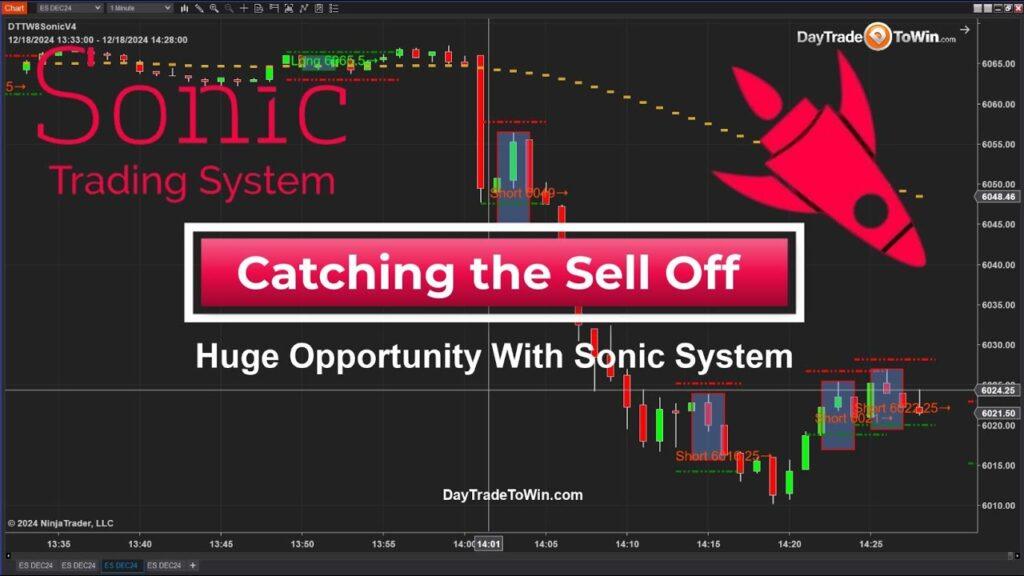
Today, the market is experiencing a significant sell-off. Let’s dive into the current situation and explore how the Sonic Trading System can help you make the most of these opportunities. Market Overview This afternoon, the market has been dropping sharply, presenting numerous opportunities for traders. Let’s take a closer look at the events that led to this sell-off and how the Sonic system has been performing. Key News Event At approximately 1:00 to 2:00 PM, a major news event triggered a significant bearish candle. This large move signals impactful market news, which you can easily track using the News Indicator. If you’re not using the News Indicator yet, sign up for a free member account to get access. This tool highlights upcoming news events directly on your chart, helping you stay informed and prepared for sudden market moves. Opportunities with the Sonic System The Sonic Trading System has been exceptionally effective in today’s environment, identifying multiple short opportunities: Closing the Trading Day As we approach 3:45 PM, it’s a good time to start wrapping up your trades. The end of the trading day often brings reduced activity and less favorable conditions for new positions. Whether you’ve been using the Sonic system, the Atlas Line, or another strategy, now is the time to assess your results and prepare for tomorrow. Why the Sonic Trading System? The Sonic system stands out for its ability to deliver consistent results, even in challenging market conditions. Here’s why traders trust it: For those looking to enhance their trading skills, consider enrolling in our Accelerated Mentorship Program. Gain instant access to all our proprietary software and learn proven strategies directly from experts. Take Action Now Ready to elevate your trading? Visit DayTradeToWin.com to: Start trading smarter today. See you in class!

stocks
Market News

Stock, Bonds, and Volatility: Fed Meeting Impact

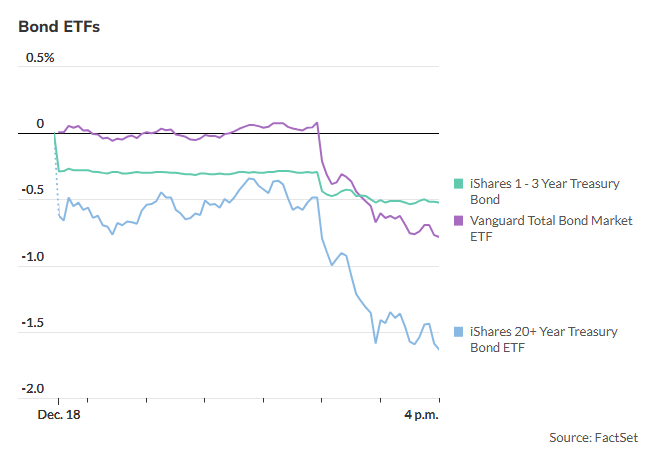
Stock Market Jitters: Fed Signals Slower Rate Cuts, Spiking Volatility Financial markets faced a wave of turbulence on Wednesday after the Federal Reserve released economic projections signaling a slower pace of interest rate cuts in 2025 and persistent inflation concerns. The announcement triggered a sharp sell-off in stocks and bonds, while the Cboe Volatility Index (VIX), often referred to as the stock market’s “fear gauge,” skyrocketed by 74% to 27.6, according to FactSet data. Steep Declines in Stocks and BondsThe Dow Jones Industrial Average fell 2.6%, the S&P 500 dropped 2.9%, and the Nasdaq Composite tumbled 3.6%, marking one of the most significant single-day losses this year. In the bond market, Treasury yields spiked, sending prices lower, with longer-term bonds experiencing sharper declines due to their higher sensitivity to interest rate changes. The iShares 20+ Year Treasury Bond ETF (TLT) fell more than 1%, deepening its year-to-date losses to 6.1%, while broader bond ETFs like the Vanguard Total Bond Market ETF (BND) and iShares Core U.S. Aggregate Bond ETF (AGG) each dropped 0.8%. Fed Projects Persistent Inflation and Modest Rate CutsThe Federal Reserve cut its benchmark interest rate by 0.25% to a target range of 4.25% to 4.5%. However, its Summary of Economic Projections painted a cautious picture, with policymakers now expecting only two quarter-point rate cuts in 2025, down from four projected in September. Inflation remains a key concern, with the Fed estimating it will end 2025 at 2.5%, above its earlier forecast of 2.1% and well above the 2% target. Fed Chair Jerome Powell acknowledged the complexity of assessing inflation risks, particularly in light of potential policy changes under the incoming administration. “We don’t know what will be tariffed, from what countries, for how long,” Powell said, emphasizing the uncertainty surrounding the potential impact of new trade policies on inflation and the broader economy. Investor Sentiment Turns CautiousThe market reaction underscores growing concerns about prolonged inflation, rising interest rates, and geopolitical risks. Investors are also preparing for heightened volatility as potential tariff policies and their economic ramifications come into focus. “The main takeaway from today’s Fed meeting is that inflation risks are back, and the Fed is clearly concerned,” said Charlie Ripley, senior investment strategist at Allianz Investment Management. He noted that the Fed’s ability to maintain its current pace of rate cuts may be limited by inflationary pressures and the economic outlook. Preston Caldwell, chief U.S. economist at Morningstar, added, “The Fed is setting the stage for the possibility of few—or even no—additional rate cuts in 2025 and 2026.” Broader ImplicationsThe Fed’s projections sent the yield on the 10-year Treasury note climbing to 4.493%, its highest level since May, while the U.S. dollar also strengthened. Longer-duration bonds bore the brunt of the sell-off, reflecting heightened sensitivity to interest rate changes. As the markets digest the Fed’s hawkish tone, the focus now shifts to upcoming economic data and policy developments. Persistent inflation and a cautious Federal Reserve could continue to weigh on investor sentiment and drive further market volatility.

sonic
DayTradeToWin Review

Sonic Trading System: Real-Time Performance

Are you ready to elevate your trading strategies and achieve consistent results? In this blog post, we explore the Sonic Trading System, a powerful approach that simplifies decision-making for traders at all experience levels. Whether you’re a beginner or a seasoned professional, this guide will provide an in-depth look at the system’s features, benefits, and its role in navigating the 2024 market landscape. Why Choose the Sonic Trading System? The Sonic Trading System is built around price action, allowing traders to focus on market behavior without the distractions of conventional indicators like MACDs, crossovers, or momentum tools. Here’s why it stands out: Core Features of the Sonic System 1. ATR-Based Targets The system uses the Average True Range (ATR) to dynamically set profit targets and stop-loss levels, accommodating both slow and volatile market conditions: 2. Trend Filtering The 65-period filter ensures you’re trading in sync with the market’s dominant trend: This approach helps you avoid unnecessary risks and stay aligned with the market’s momentum. 3. Flexible Stop-Loss Configurations Stop-loss levels are strategically placed below or above shaded boxes for optimal risk management. Adjustments, such as setting stops five ticks below the box, provide additional flexibility based on your preferences. Best Practices for Sonic Trading Platform Compatibility The Sonic Trading System integrates seamlessly with NinjaTrader and TradingView: Looking Ahead: 2024 Market Forecast The upcoming year promises exciting opportunities and challenges for traders. Here’s what to expect: Get Started with the Sonic Trading System Ready to transform your trading experience? Visit daytradetowin.com to learn more about the Sonic Trading System and explore our special offers. Use promo code CYBER20 for 20% off any program. Sign up for a free member account to access trials, including the ABC software, and begin your journey to successful trading today. Learn price action-based strategies and avoid reliance on conventional indicators. Conclusion The Sonic Trading System is a comprehensive tool designed to empower traders in any market condition. Its focus on price action, trend alignment, and customizable features ensures it adapts to your needs. With proper risk management and the insights provided, you’re set to make 2024 a breakthrough year for your trading endeavors. Start now and take control of your trading success!

Dow
Market News

Is the Dow Slide a Warning Sign?

Factors Behind the Dow Slump The Dow Jones Industrial Average has fallen for nine consecutive days, marking its longest losing streak since 1978. This downturn has caught many investors off guard, particularly after the strong postelection rally that drove stocks to record highs. While the S&P 500 and Nasdaq Composite remain near their peak levels, the Dow has struggled. On Tuesday, it closed below its 50-day moving average for the first time since the November election, raising concerns about its underlying momentum. What’s Driving the Decline? Weak Market Breadth The Dow’s challenges reflect a broader trend across the market. Since early December, previously strong sectors have faltered, and investors have shifted back to Big Tech and semiconductor stocks like Broadcom Inc. In contrast, value-focused sectors such as small caps and financials have underperformed. Financials in the S&P 500 have dropped 4.4% this month, with utilities and energy performing even worse. While tech leaders have supported the S&P 500 and Nasdaq Composite, the Dow’s narrower composition has made it more vulnerable to sector-specific weakness. Market breadth has also been a concern. For 12 consecutive trading days, more S&P 500 stocks have declined than advanced, setting a record since at least 1999. Only 40.6% of S&P 500 stocks are currently trading above their 50-day moving averages, the lowest level since May. Individual Stock Pressures Much of the Dow’s recent losses can be attributed to one company: UnitedHealth Group Inc. Since the losing streak began, UnitedHealth has contributed 750 points to the Dow’s 1,564-point decline, accounting for nearly half of the drop. The company has faced pressure from congressional scrutiny over its pharmacy benefit manager business and negative headlines related to the death of a top executive. Other laggards dragging down the index include Sherwin-Williams Co., Caterpillar Inc., and Goldman Sachs Group Inc. Rising Treasury Yields Another factor weighing on the market is rising Treasury yields. The 10-year Treasury yield has climbed 20 basis points this month to 4.397%, fueled by concerns that the Federal Reserve may pause its interest rate cuts and that inflation could remain elevated. Higher yields have particularly impacted the equal-weighted S&P 500, which has significantly underperformed its market-cap-weighted counterpart this month. Outlook for Investors Despite the Dow’s recent struggles, there are reasons for optimism. The U.S. economy is on track to grow at over 3% in the third quarter, and corporate earnings forecasts for next year remain robust. According to Mona Mahajan, a senior investment strategist at Edward Jones, lagging sectors like small caps and value stocks may rebound due to their attractive valuations. However, a broader market recovery may depend on interest rates stabilizing and inflation remaining under control. As the Federal Reserve prepares to announce its next rate decision and economic projections, investors will be watching closely for signals about future policy moves and market direction.

market risks
Market News

2025 Market Outlook: Key Investor Worries

Deutsche Bank Research: Shifting Market Risks for 2025 Investor concerns about market stability have shifted significantly heading into 2025, with a potential global trade war now viewed as the top risk, according to Deutsche Bank Research. This marks a departure from last year when a U.S. economic “hard landing” was the most cited concern. “The leading global risks are a potential trade war, a sharp decline in the U.S. tech sector, and renewed inflationary pressures,” said Jim Reid, Deutsche Bank’s global head of macro and thematic research, in a Monday note. The report highlights how investor sentiment has evolved over the past year. Trade War Concerns and Inflation Risks While the U.S. economy expanded in 2024 despite fears of a recession, investor focus has turned to the implications of new tariffs under President-elect Donald Trump’s trade policies. A rise in tariffs could exacerbate inflation, which remains a lingering concern despite the Federal Reserve’s shift toward looser monetary policy in September. Deutsche Bank’s research also shows that investors remain wary of potential surprises from central banks, including unexpected rate hikes to combat inflation. Bond market volatility has heightened these concerns, with the 10-year Treasury yield climbing to 4.397% on Monday, its elevated levels raising the specter of destabilizing effects on equity markets. Tech Stocks and AI Momentum at Risk A sharp drop in tech stock valuations ranks as the second-largest market risk heading into 2025. Tech stocks have led the market rally in 2024, driven by enthusiasm for artificial intelligence. For instance, Nvidia’s stock has soared over 166%, and the Nasdaq Composite has gained 34.4% year-to-date. Additionally, the Roundhill Magnificent Seven ETF, which includes major tech firms, is up 73.2% for the year, per FactSet data. However, investors are concerned that waning AI-driven enthusiasm could trigger a correction in the tech sector, which has an outsized influence on broader market performance. Outlook for 2025 Despite these risks, Deutsche Bank’s survey reveals cautious optimism for 2025. Investors project a 5.2% gain for the S&P 500 and a 6.8% increase for the Magnificent Seven stocks. Still, the specter of geopolitical tensions, inflationary pressures, and central bank policy uncertainty could weigh heavily on markets. As the Federal Reserve prepares to announce its latest interest rate decision on Wednesday, market participants are closely watching for signals about the trajectory of monetary policy. With 2024 delivering strong equity gains—the S&P 500 is up 27.3% year-to-date—investors remain vigilant about emerging risks that could shape the market landscape in the year ahead.

sonic trading
DayTradeToWin Review

LIVE Sonic Trading Success: 8 Winning Signals in a Row!

Hello Traders! Welcome to today’s trading session, where we’ll break down a sequence of back-to-back signals and dive into strategies, signals, and trade management techniques designed to refine your trading skills with Sonic Trading System. Recognizing the Signals As the market opens, we immediately observe momentum. By 9:55 AM, three consecutive signals set the stage for our first trade. This session focuses on short signals, drawing on past successes while keeping the broader market perspective in mind. Pro Tip: Always stay aware of high-impact news events. Trading during these periods can bring unnecessary volatility. To help you avoid these risks, our free news indicator—available with a member account—keeps you informed about potential disruptions. Executing Trades: Timing is Everything Trading after the market opens gives you a clearer view of trends. Here’s a breakdown of a typical trade: If a trade takes longer than expected, it’s important to consider exiting with a small profit, break-even, or minor loss. Managing trades effectively helps minimize risks and protects your capital. The Sonic System Advantage The Sonic trading system gives you reliable entry and exit points. For example: Guidance: Always aim to enter at a more favorable price to improve your risk-reward ratio. This particular trade offers plenty of time to enter and exit successfully, demonstrating the strength of the Sonic system. Managing Trades Effectively When trading the E-mini S&P 500, discipline and precision are key. Here’s how we manage our trades: Filtering for Success Our built-in filter ensures you’re trading with the right market trend. Short signals below the yellow dashed line suggest selling opportunities, while those above it indicate buying signals. This extra layer of protection keeps you in sync with market movements. Scaling Your Strategy If you’re new to trading, it’s wise to start small. Micro contracts offer a low-risk way to practice and build your confidence. For example: As you gain experience, you can scale up to multiple contracts, increasing your profit potential. Conclusion: Trade Smarter, Not Harder Today’s session highlighted essential trading principles: Are you ready to elevate your trading? Sign up for a free member account at daytradetowin.com. You’ll gain access to our proprietary Sonic system, ABC software, and exclusive mentorship. Start mastering price action, and stop relying on conventional indicators. Happy Trading, and I’ll see you in the next session!

Scroll to Top