recovery
Market News

History’s 4-Step Path to Market Recovery

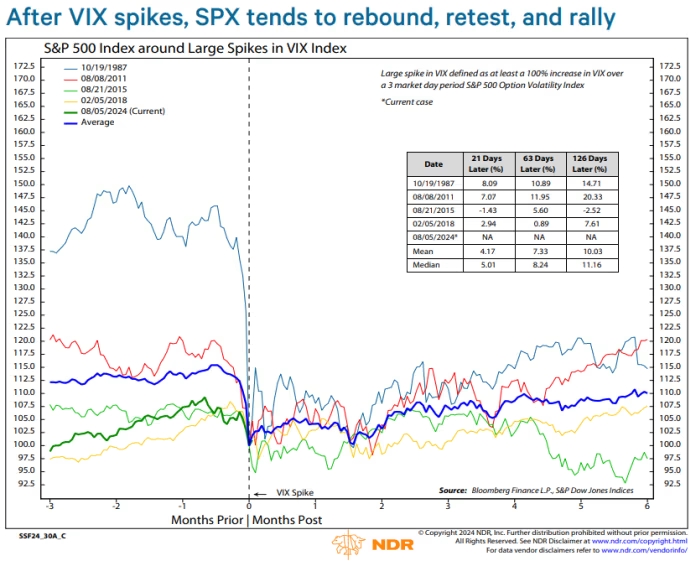
Monday’s Shock Could Haunt Markets for Weeks, NDR Analysts Say After the S&P 500’s sharpest drop in nearly two years on Monday, a rebound on Tuesday followed by a shaky Wednesday has left investors questioning the next steps. According to Ed Clissold, chief U.S. strategist, and Thanh Nguyen, senior quantitative analyst at Ned Davis Research, a retest of Monday’s lows is probable, but the market could regain strength in the coming weeks if a recession is avoided. “The effects of Monday’s shock could linger for several weeks. However, current fundamentals don’t support a major bear market,” they wrote in a note on Wednesday. The analysts pointed to a dramatic rise in the Cboe Volatility Index (VIX), often called Wall Street’s “fear gauge,” which more than doubled in just three days—a rare event that has occurred only four times before. Historically, such spikes in volatility have led to initial market drops, followed by rebounds and subsequent retests of the lows. Monday’s 3% decline left the market oversold, setting the stage for a four-step recovery process: oversold, rally, retest, and breadth thrusts. While the market began to bounce back on Tuesday, gains were shaky by Wednesday afternoon. Clissold and Nguyen stressed that the retest phase could be critical, with the key to recovery being that fewer stocks hit new lows than during the initial selloff. Despite the volatility, they believe that as long as underlying fundamentals remain solid, the stock market is likely to resume its uptrend after navigating this four-step recovery process.

Wall Street
Market News

Market Recovery or Bear Trap? Insights from a Wall Street Expert

U.S. stocks rebounded on Tuesday after fears of a weakening economy triggered a global selloff, leading to Wall Street’s worst day since 2022. Despite the rebound, Barry Bannister, chief equity strategist at Stifel, warns it is too early to jump back into the U.S. stock market. He maintains his prediction that the S&P 500 (SPX) will drop to 5,000 by October, a 12% decline from its July peak, due to a significantly slowing economy and persistent inflation. “Our view remains a correction to 5,000 on the S&P 500 by October,” Bannister and his team wrote in a Monday note. “While we foresee a low-double-digit correction, there is also a risk of a bear market if the slowdown turns into a recession, which would be a surprise to investors and the Federal Reserve.” A market correction typically occurs when a stock index falls at least 10% from a recent high. This can worsen into a bear market, marked by a drop of 20% or more. The S&P 500 last entered correction territory on October 27, 2023, and the recent selloff has brought it close to another correction. It is currently down 7.5% from its high of 5,667 set on July 16, according to Dow Jones Market Data. Earlier this year, Bannister predicted a summer selloff and has repeatedly forecasted a market correction by October. His stance makes him one of Wall Street’s few remaining bears, as many other strategists have raised their year-end targets for the S&P 500, expecting multiple interest-rate cuts by the Fed. Bannister and his team advise investors to remain defensive, favoring “defensive-value” sectors such as healthcare, consumer staples, and utilities. These sectors typically perform well if inflation remains high and GDP growth slows sharply, offering a hedge against a potential recession. On Tuesday, the S&P 500 and Nasdaq Composite (COMP) each rebounded over 1%, while the Dow Jones Industrial Average (DJIA) advanced 0.8%, according to FactSet data.

JPMorgan
Market News

Unveiling the Classic Signs of a Stock-Market Bottom: JPMorgan’s Expert Tips

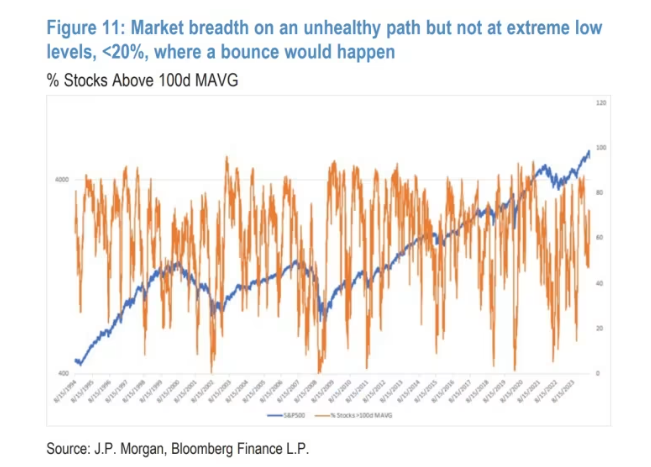
U.S. stock index futures are up early Tuesday following a significant decline on Monday that caused the S&P 500 to drop by 3%, marking its worst single-day performance in nearly two years. Over the past three sessions, the S&P 500 lost 6%, the Nasdaq Composite fell 8%, and the Russell 2000 plummeted 10%. These declines are driven by fears of a U.S. recession and the Bank of Japan’s interest rate hike, which impacted the yen carry trade. The pressing question now is whether the worst is over for the market. Thomas Salopek, head of cross-asset strategy at JPMorgan, believes the answer is no. He explains that the necessary conditions for a market bottom are not yet present. Salopek identifies the pullback as “legitimate,” supported by widening credit spreads, a steepening Treasury yield curve, and the outperformance of utilities over the broader market. Factors like economic slowdowns or disinflation, which negatively affect other sectors, benefit utilities and defensive sectors that thrive on lower interest rates. “The growth outperformance of the second quarter suggested an economic slowdown while the third-quarter defensive leadership suggests growth risk,” says Salopek. Salopek also questions the optimistic view of labor market data, which suggests that the rise in the unemployment rate is due to increased labor supply. “If that were the case, we would expect unemployment to stabilize, not continue to rise as it has,” he notes, adding that Hurricane Beryl affected the latest figures. With the next jobs report a month away, investors need to focus on technical and risk-based signals, which are not indicating a market bottom, according to Salopek. For instance, stocks rarely bottom when the VIX (the market’s fear gauge) is at its highs, although the VIX has dropped sharply in early Tuesday trading. Additionally, the 20-day moving average’s slope does not provide reassurance, and crossing above it is “a minimum starting point.” He also notes that the put/call ratio typically peaks at market lows. The percentage of Nasdaq stocks above their 100-day moving average is 34%, but Salopek would prefer this to drop to 20% before considering it closely. Similarly, the percentage of stocks at four-week lows is far from the 60% seen in previous corrections. He also monitors the American Association of Individual Investors sentiment survey, which sent a strong signal in fall 2022 when sentiment was worse than during the COVID crisis. “Historically, a confluence of these bottoming signals during market corrections helps pinpoint the best time to re-enter,” Salopek says. For now, he recommends staying underweight in stocks and waiting for conditions to worsen enough to signal capitulation.

blueprint
DayTradeToWin Review

Mastering Volatile Markets: A Trader’s Guide

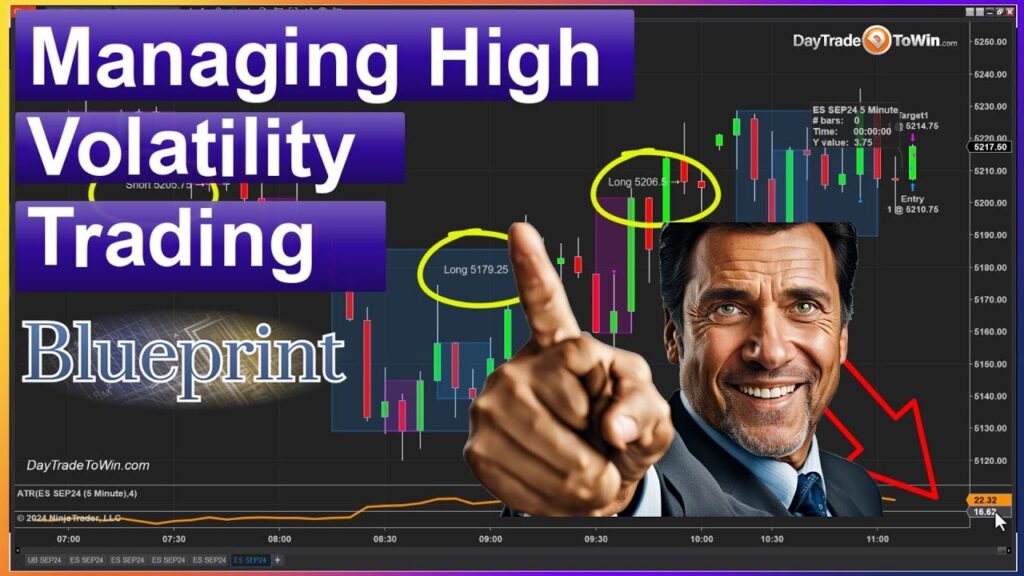
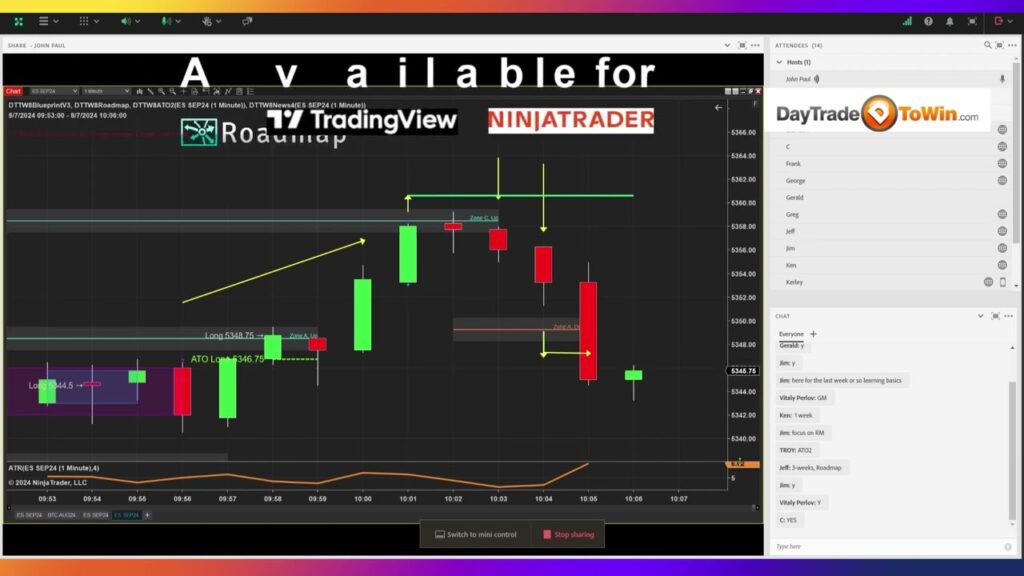
Today is an exciting day filled with market volatility. In this post, I’ll guide you through effective strategies for trading under these conditions and introduce some powerful tools that can help enhance your trading experience. Remember, trading is inherently risky, so always trade with funds you can afford to lose. Navigating Volatile Market Conditions Volatility in the market presents both opportunities and risks. It’s crucial to adapt your strategies accordingly. One tool that can be incredibly useful in such situations is the software from Day Trade to Win, available for Ninja Trader and TradingView. This software can help you secure funding through our all-access program, which includes a comprehensive suite of trading tools. The Power of The Blueprint Software The Blueprint software, part of the Day Trade to Win package, helps you make informed trading decisions by providing signals based on market movements. It identifies optimal entry and exit points, signaling you to buy or sell when the market moves outside of predefined shaded areas. A key indicator used in this software is the Average True Range (ATR). In today’s volatile market, the ATR for the E-mini S&P is about 4.2 points. Typically, we aim to keep the ATR under 5 or 6 points to manage risk effectively. Higher volatility necessitates adjustments in our trading approach. Adjusting Your Trading Strategy In a highly volatile market, adjusting the timeframe of your charts can be highly effective. Instead of using longer timeframes like 5-minute or 1-minute charts, consider switching to 20 or 30-second charts. This change helps manage risk by providing more frequent updates and allowing for quicker decision-making. For example, with an ATR of around 4 points, setting a target of 4 points on a trade aligns with current market conditions. Shorter timeframes like 20 or 30-second charts offer more manageable signals and lower risk compared to longer timeframes where each candle might represent a larger point movement, increasing the risk. Practical Example Let’s consider a practical example. On a 5-minute chart, the signals might be accurate, but each candle representing 22 points introduces substantial risk. By switching to a 30-second chart, you can still capture valuable signals but with reduced risk, making it easier to manage your trades in a volatile environment. When the market slows down, increase the timeframe of your charts to 5, 10, or 15 minutes. This adjustment helps maintain consistent profit targets while accommodating the slower market pace. Final Thoughts on Trading Strategies Adapting to market conditions is crucial for successful trading. The Blueprint software, included in our all-inclusive program, provides the tools and signals necessary to navigate volatile markets effectively. Our all-inclusive program offers a lifetime license, complete with audible alerts and comprehensive software support. If you have any questions or want to learn more, visit daytradetowin.com and sign up for a free member account. Stay informed and prepared for the next trading opportunity! Stay Connected Subscribe to our YouTube channel for daily updates and new videos that provide insights and strategies for successful trading. Don’t miss out on valuable content designed to help you navigate the ever-changing market landscape. Happy Trading!

stocks
Market News

Wall Street Woes: Stocks and Crypto Fall Sharply

Dow, S&P 500, and Nasdaq-100 Futures Plunge Sunday Night U.S. stock-market futures fell late Sunday following a turbulent week on Wall Street, during which the Nasdaq entered correction territory. As of 11 p.m. Eastern, Dow Jones Industrial Average futures dropped over 250 points, or 0.7%. S&P 500 futures decreased by 1.4%, and Nasdaq-100 futures fell 2.4%. All showed slight improvements from their session lows late Sunday. Crude oil futures rose slightly amid concerns over escalating hostilities in the Middle East. Cryptocurrencies also fell, with Bitcoin dropping 8% to below $55,000 after reaching over $65,000 on Friday. Ether dropped more than 15%. Japan’s Nikkei 225 plunged 5%, continuing the previous week’s trend, as global markets reacted to recent U.S. economic data and Wall Street’s losses. U.S. stocks fell on Friday after a weaker-than-expected jobs report raised concerns about economic growth. This followed Fed signals on Wednesday indicating potential interest rate cuts in September. However, investors worry these cuts might come too late to prevent a recession. Last week, all three major indexes experienced significant losses. The S&P 500 had its worst week since April, falling 2.1%. The Dow also dropped 2.1%, and the Nasdaq saw a 3.4% decline, ending 10% below its July 10 record close, placing it in correction territory. Stephen Innes, managing partner at SPI Asset Management, noted, “Market participants scrambled for hedges amidst growing panic over interest rates and a looming recession. The spike in volatility underscores how jittery markets have become.” He added, “The real question is whether the typical market reflex to sell volatility or buy the dip can overcome the anxiety from this sudden recession scare.” Investors might brace for further declines in tech stocks on Monday after Warren Buffett’s Berkshire Hathaway revealed it reduced its Apple stake by nearly 50% last quarter. Tech stocks have struggled recently, highlighted by Intel, whose stock plunged 26% on Friday following disappointing earnings.

dow
Market News

500-Point Dow Decline: Rethinking Economic News and Stocks

Strategist: Dow Selloff Reflects ‘Buy the Rumor, Sell the Fact’ on Fed Rate-Cut Signal Thursday’s selloff, which saw the Dow Jones Industrial Average on track for its largest one-day drop since May, was partly attributed to a series of weaker-than-expected economic data. The relationship between economic news and the stock market seems to be shifting. Traditionally, bad economic news was seen as good for stocks because it reinforced the case for Federal Reserve interest rate cuts. However, Thursday’s reaction indicates a change, with disappointing data now negatively impacting stocks. What’s behind this shift? Despite a generally strong labor market, signs of weakness are emerging. Several consumer-focused companies report increasing stress among lower-income consumers. Federal Reserve Chair Jerome Powell hinted on Wednesday that a rate cut might come in September if economic data supports it. However, some analysts believe the Fed has waited too long to ease. Neil Dutta, head of economics at Renaissance Macro Research, commented, “The Fed’s delay, combined with today’s rising jobless claims, low unit labor costs, and slowing global manufacturing, suggests we are at a point where bad economic news is bad for markets.” Thursday’s economic data painted a gloomy picture. First-time jobless claims reached their highest level in nearly a year, possibly due to seasonal auto-plant closures. The stock selloff intensified after the Institute for Supply Management’s July manufacturing index fell for the fourth consecutive month to 46.8%, signaling a contracting manufacturing sector. Ian Lyngen, rates strategist at BMO Capital Markets, remarked, “Bad news is bad again. Claims increased, ISM disappointed, unit labor costs underperformed, and stocks sold off. The macro narrative is shifting, and the data hasn’t reached a deeply worrying point yet.” Treasury yields fell in response, with the 10-year note dropping below 4% for the first time since February. Yields move inversely to price. The Dow ended the day with a loss of around 495 points, or 1.2%, after dropping as much as 744 points. Initially, cyclical stocks led the decline, followed by tech stocks. The tech-heavy Nasdaq Composite slumped 2.3%, the S&P 500 fell 1.4%, and the small-cap Russell 2000 dropped 2.3%. Not everyone sees this as a growth scare. Kent Engelke, chief economic strategist at Capitol Securities Management, noted that the market’s downturn appeared to be a “buy on the rumor, sell on the fact” response to Powell’s hint at a future rate cut. Additionally, tech stocks remain highly priced, and disappointing results from companies like Amazon and Apple could lead to further declines.

Scroll to Top