
Bears Are Eyeing This Stock-Market Predictor — But It’s Rarely Right
The “Fed model” isn’t about to derail the stock market, despite its recent shift into negative territory.
This well-known market-timing tool compares the stock market’s earnings yield (the inverse of the P/E ratio) with the 10-year Treasury yield. According to proponents, equities are favorable when the earnings yield exceeds the Treasury yield and risky when the reverse is true.
Right now, the S&P 500’s earnings yield, based on trailing 12-month earnings, is 3.90%, while the 10-year Treasury yield is higher at 4.46%. That negative spread is reminiscent of the 2008-09 financial crisis, a parallel that’s causing unease among bearish investors.
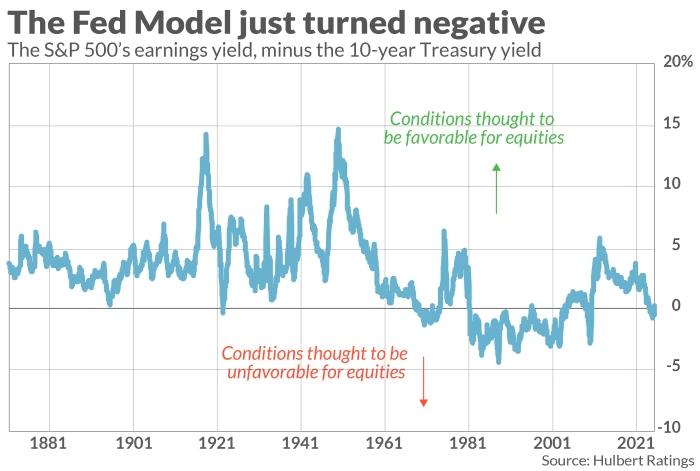
But history shows the Fed model’s track record as a predictor is weak at best.
The Fed Model’s Flawed Record
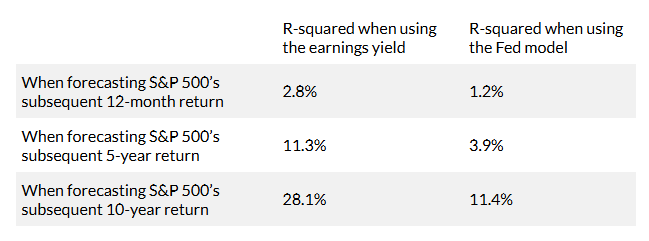
Using data from Yale economist Robert Shiller, I analyzed the Fed model’s performance back to 1871. Specifically, I compared how well it and the simpler earnings yield predicted the inflation-adjusted total returns of the stock market over one-, five-, and ten-year periods.
The earnings yield consistently outperformed the Fed model. When the Treasury yield was incorporated, the model became less reliable, not more.
Why the Fed Model Falls Short
The main issue is the Fed model’s comparison of two incompatible metrics: the stock market’s earnings yield, which is real (adjusted for inflation), and the 10-year Treasury yield, which is nominal (not adjusted for inflation). This mismatch undermines its conclusions.
Cliff Asness, founder of AQR Capital Management, addressed this flaw in his influential paper, “Fight the Fed Model,” published two decades ago. He wrote:
“The Fed model has the appearance but not the reality of common sense… [its appeal stems from] a confusion of real and nominal (money illusion).”
A Misleading Signal
None of this means the stock market is risk-free. There are other legitimate reasons to question its valuation or future performance. But the Fed model’s current bearish signal isn’t one of them. Its history of unreliability makes it a poor tool for predicting market trends — and an even weaker foundation for bearish bets.

John Paul is the founder of DayTradeToWin, a trading education and software company established in 2008, supporting traders worldwide. His expertise focuses on price action-based futures trading strategies and structured market analysis.
DayTradeToWin delivers trading education, indicators, and software tools designed to help traders apply disciplined, rule-based decision-making across global futures markets.
He is the creator of multiple trading methodologies, including the Sonic System, Atlas Line, and Trade Scalper, which help traders identify structured opportunities in markets such as the E-mini S&P 500 (ES), Nasdaq (NQ), crude oil (CL), and gold (GC).
Official website: https://daytradetowin.com