
daytrading

markets
Market News

Markets Hit Record Highs — But Can the Rally Last?

High-Stakes Wednesday: Markets Await ‘Magnificent Seven’ Earnings, Fed Decision, and Powell’s Words Wednesday is shaping up to be one of the most important days of the year for investors — a rare triple event that could define the market’s next move. The Federal Reserve’s interest rate decision, Chair Jerome Powell’s press conference, and earnings reports from the “Magnificent Seven” tech giants will all hit within hours of each other. Stocks have already powered to new record highs this week, with the S&P 500 nearing the 6,900 mark ahead of the Fed’s expected rate cut. But the spotlight now turns to Microsoft, Alphabet, Apple, and Meta, which are set to report their quarterly results. Investors are watching closely for confirmation that these tech titans can keep translating the AI boom into profits — and sustain their lofty valuations. “The markets have had a huge run,” said Richard Steinberg, global market strategist at Focus Partner Wealth. “At these levels, investors need to be very careful about what they own and what they expect.” His firm has been trimming positions and holding cash in case earnings disappoint. All three major indexes — the Dow, S&P 500, and Nasdaq — closed at record highs Tuesday for a third straight day. But as the 10-year Treasury yield steadies around 4%, traders are watching how rate expectations could impact high-growth tech names. So far, third-quarter earnings have reinforced the bull market narrative, led by the Magnificent Seven. Yet the rally has also widened the wealth gap — with higher-income households benefiting from stock and home price gains, while lower-income families continue to battle inflation. “The wealth effect has been a major driver of this year’s economic resilience,” said Matthew Miskin of Manulife John Hancock Investments. The top 10 S&P 500 companies now make up more than 40% of the index, roughly double their share three decades ago — underscoring both strength and risk. While record highs might seem to lessen the urgency for further rate cuts, investors are bracing for Powell’s tone. Macquarie’s Thierry Wizman noted that the Fed still remembers 1998, when aggressive rate cuts helped inflate the dot-com bubble — a scenario the central bank will likely want to avoid repeating. Markets largely expect a 25-basis-point cut, but focus is shifting to the Fed’s balance sheet. It has already shrunk from $9 trillion to about $6.6 trillion, reducing liquidity in the system. If Powell hints at slowing that runoff — or reinvesting bond proceeds — it could help absorb excess Treasury supply and steady yields. Even with inflation still hovering around 3%, the S&P 500 has climbed more than 17% this year, and the tech sector is up over 30%, according to FactSet. If all three major indexes extend their winning streak Wednesday, it would mark the longest stretch of record closes since 2021 — fitting for a market walking a fine line between euphoria and caution. John PaulJohn Paul is the founder of DayTradeToWin, a trading education and software company established in 2008, supporting traders worldwide. His expertise focuses on price action-based futures trading strategies and structured market analysis. DayTradeToWin delivers trading education, indicators, and software tools designed to help traders apply disciplined, rule-based decision-making across global futures markets. He is the creator of multiple trading methodologies, including the Sonic System, Atlas Line, and Trade Scalper, which help traders identify structured opportunities in markets such as the E-mini S&P 500 (ES), Nasdaq (NQ), crude oil (CL), and gold (GC). Official website: https://daytradetowin.com daytradetowin.com

blackstone
Market News

Blackstone CEO Warns of Power Crunch

Blackstone Schwarzman Sounds Alarm: “The U.S. Has a Power Problem” Blackstone CEO Stephen Schwarzman warned that the United States is facing a looming energy crisis. Despite attracting 80% to 85% of global investment flows, the country’s electric grid has barely expanded in 20 years, he said. “With data centers multiplying everywhere, we’re looking at power demand growth of at least 4% to 5% a year,” Schwarzman noted. “But with only a 15% reserve margin, the math doesn’t work — something bad will happen fast.” He said the scale of the challenge is massive. “At Blackstone, we’re the largest developer and owner of data centers globally. We can see this coming — and there’s just not enough capital to meet the demand unless investors are offered very high returns.” Meanwhile, Qualcomm CEO Cristiano Amon unveiled two new chips designed for the AI-driven data center boom, sending QCOM shares up more than 11% on Monday. Amon described AI as a new layer of software that will reshape every device — from phones and PCs to cars and industrial systems. “Companies that truly connect with consumers and understand human intentions will lead the next wave,” he said, highlighting opportunities in agentic AI experiences for enterprises. AI’s growing influence also dominated a broader market discussion. BlackRock CEO Larry Fink said global investors are flocking back to the U.S. dollar, reversing earlier moves into Europe. “There’s still deep faith in the U.S.,” Fink said. “AI investment is driving growth we’re not seeing elsewhere. Most investors are overweight the U.S. — and that’s the right call for at least the next 18 months.” Fink added that the buzz around AI is overshadowing another major shift — the digitization and tokenization of financial assets. “We’re not talking enough about how fast every asset class — ETFs, bonds, everything — will move into digital wallets. It’s coming faster than most realize, and many countries are unprepared,” he warned. Rounding out the discussion, Goldman Sachs CEO David Solomon reaffirmed his belief in America’s leadership in innovation and capital markets, while offering a sharp take on alternative assets. “Cryptocurrencies and gold are assets of fear,” Solomon said. “People buy them when they’re worried — about inflation, about stability, about security. They’re a hedge against optimism.” John PaulJohn Paul is the founder of DayTradeToWin, a trading education and software company established in 2008, supporting traders worldwide. His expertise focuses on price action-based futures trading strategies and structured market analysis. DayTradeToWin delivers trading education, indicators, and software tools designed to help traders apply disciplined, rule-based decision-making across global futures markets. He is the creator of multiple trading methodologies, including the Sonic System, Atlas Line, and Trade Scalper, which help traders identify structured opportunities in markets such as the E-mini S&P 500 (ES), Nasdaq (NQ), crude oil (CL), and gold (GC). Official website: https://daytradetowin.com daytradetowin.com
evercore isi
Market News

Evercore ISI: The Comeback Play You Might Be Missing

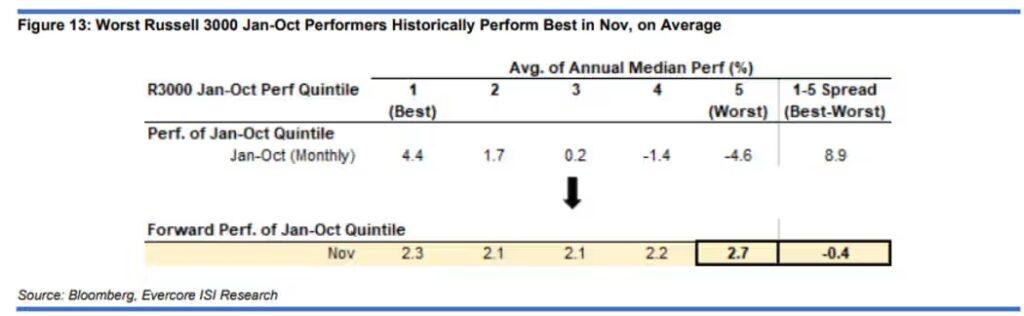
Evercore ISI: Tax-Loss Trades Could Spark a November Comeback Investors kicked off the week in high spirits, buoyed by optimism over a potential U.S.–China trade deal, strong upcoming tech earnings, a healthy U.S. economy, and expectations that the Federal Reserve will trim interest rates this week. Together, these factors are helping the S&P 500 edge toward its 35th record high of 2025. Still, Evercore ISI strategist Julian Emanuel points out that not all stocks are sharing in the rally. While the Russell 3000 has gained roughly 15% this year—matching the S&P 500’s performance—48% of its components remain down year-to-date. Historically, only about 35% of stocks would typically be negative at these index levels. Evercore’s data shows that despite the Russell 3000’s 41% rebound since its April 7 trough, only 27% of its constituents have climbed more than 10% from that low. Meanwhile, 16% are still below it. This reinforces the idea that “it’s a market of stocks, not just a stock market,” Evercore notes. That uneven performance sets the stage for the mutual fund tax-loss season, which wraps up on October 31. Tax-loss harvesting—selling losing positions to offset capital gains—often weighs on underperformers in the short term. But according to Evercore, it can also create opportunity. Looking back to 1990, the firm found that the worst-performing quintile of Russell 3000 stocks from January through October tends to outperform in November, rebounding an average of 2.7% once selling pressure eases. In short, some of today’s laggards could soon turn into November winners. Evercore screened the Russell 3000 for what it calls “Tax-Loss Tacticians”—stocks that have struggled relative to the market but remain fundamentally attractive. Among the top 20 by market value are: UnitedHealth (UNH), Accenture (ACN), Adobe (ADBE), Comcast (CMCSA), UPS (UPS), ONEOK (OKE), Target (TGT), Kraft Heinz (KHC), Kenvue (KVUE), General Mills (GIS), Constellation Brands (STZ), Lululemon Athletica (LULU), Gartner (IT), GoDaddy (GDDY), Centene (CNC), International Flavors & Fragrances (IFF), Dow (DOW), LyondellBasell (LYB), Deckers Outdoor (DECK), and DocuSign (DOCU). For traders eyeing opportunity, Evercore’s message is clear: October’s pain could set the stage for November’s gain. John PaulJohn Paul is the founder of DayTradeToWin, a trading education and software company established in 2008, supporting traders worldwide. His expertise focuses on price action-based futures trading strategies and structured market analysis. DayTradeToWin delivers trading education, indicators, and software tools designed to help traders apply disciplined, rule-based decision-making across global futures markets. He is the creator of multiple trading methodologies, including the Sonic System, Atlas Line, and Trade Scalper, which help traders identify structured opportunities in markets such as the E-mini S&P 500 (ES), Nasdaq (NQ), crude oil (CL), and gold (GC). Official website: https://daytradetowin.com daytradetowin.com
stocks
Uncategorized

Why Global Stocks Are Leaving the U.S. Behind

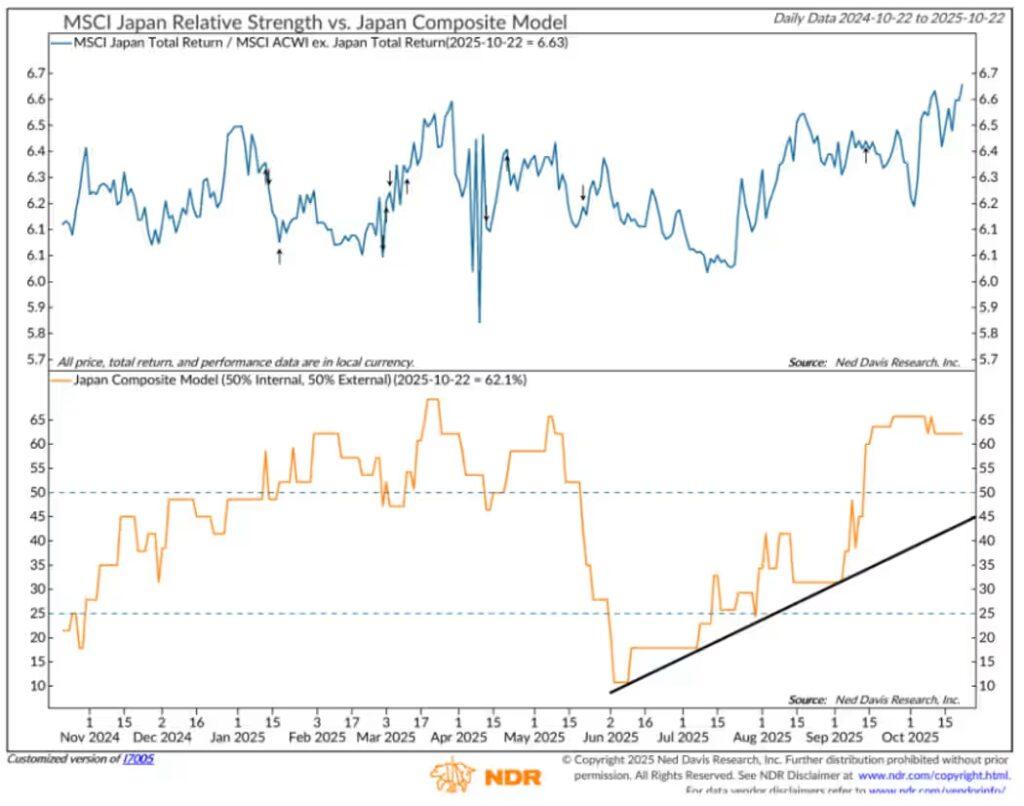
Ned Davis Research: Shift Toward Japan and Emerging Markets, Away from U.S. Stocks The U.S. market may be hitting record highs, but one top strategist says it’s time to look elsewhere. Despite a steady run for the S&P 500 — up 14.6% this year — and the Nasdaq Composite gaining 18.8%, Ned Davis Research (NDR) believes investors should start reducing U.S. exposure and reallocating to Japan and emerging markets (EM). In a recent note, Tim Hayes, NDR’s global chief strategist, warned that signs of fading relative strength in U.S. equities suggest a period of underperformance ahead, while Japan and EM are showing strong momentum, attractive valuations, and positive capital flows. U.S. Strength Starting to Fade U.S. stocks make up nearly two-thirds of the MSCI All-Country World Index (ACWI), but despite their global influence, they’ve underperformed both year-to-date and over the past several weeks. In comparison, the MSCI Emerging Markets Index has surged 25% in 2025, and the MSCI Japan Index is up 4% in the last 21 days — both ahead of U.S. benchmarks. This divergence has triggered an NDR sell signal for U.S. stocks as the 20-day relative strength reading hits its weakest level since April. Meanwhile, both EM and Japan have generated buy signals, suggesting stronger price momentum ahead. Attractive Valuations and Currency Tailwinds Hayes points out that emerging markets are far cheaper than the U.S., which remains the most expensive regional market based on NDR’s global valuation metrics. EMs have also benefited from rising currencies and steady inflows into exchange-traded funds, signaling renewed investor confidence. Japan, on the other hand, is being propelled by a weaker yen that supports exporters and boosts earnings. Investor sentiment has strengthened further amid optimism that the new government will deliver on its pro-growth policies. NDR’s internal data shows that 86% of Japan’s market indicators are bullish, the highest in over a year. Portfolio Rebalancing Ahead Given the shifting dynamics, NDR has downgraded U.S. equities to underweight, while upgrading Japan to overweight and increasing exposure to emerging markets. “The duration of these trends can’t be predicted,” Hayes concludes, “but our models clearly favor continued U.S. underperformance — and leadership from Japan and EM.” Investors seeking exposure to these regions can consider: John PaulJohn Paul is the founder of DayTradeToWin, a trading education and software company established in 2008, supporting traders worldwide. His expertise focuses on price action-based futures trading strategies and structured market analysis. DayTradeToWin delivers trading education, indicators, and software tools designed to help traders apply disciplined, rule-based decision-making across global futures markets. He is the creator of multiple trading methodologies, including the Sonic System, Atlas Line, and Trade Scalper, which help traders identify structured opportunities in markets such as the E-mini S&P 500 (ES), Nasdaq (NQ), crude oil (CL), and gold (GC). Official website: https://daytradetowin.com daytradetowin.com
gold
Market News

JPMorgan Sees Gold Doubling by 2028

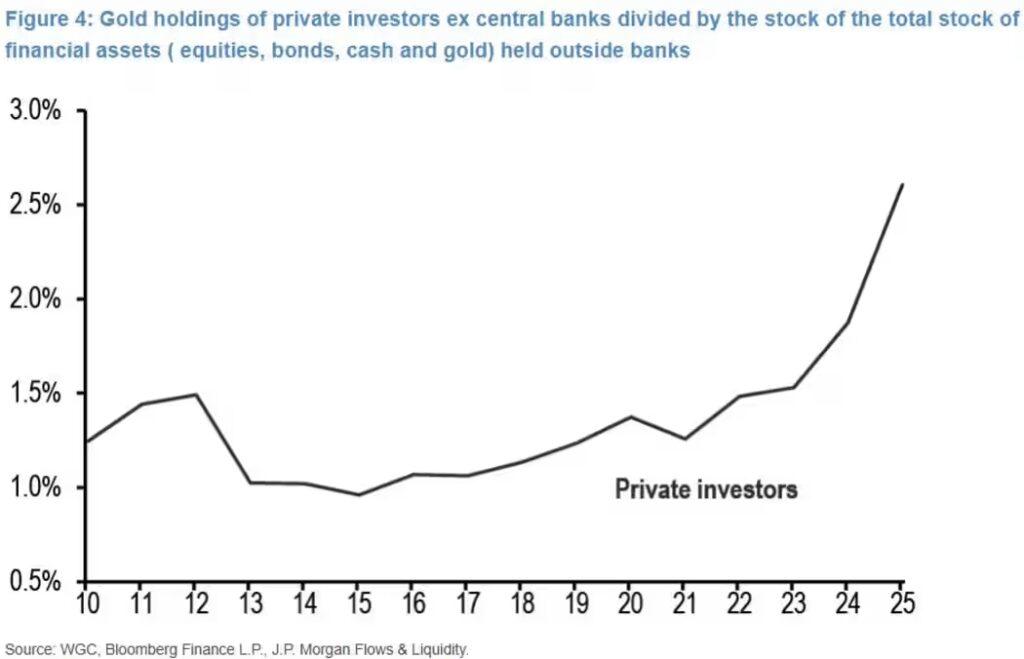
Goldman Sachs Doubles Down on Its Bullish Gold Outlook For those exhausted by the nonstop AI market debate, gold’s dramatic fall this week has offered a welcome change of topic. After its steepest one-day drop in more than ten years on Tuesday, the focus has turned to whether the metal can recover. Goldman Sachs believes it can. The bank is sticking with its end-2026 gold target of $4,900 per ounce, expecting further upside driven by central bank and institutional investor demand. “The pace of ETF inflows and client feedback suggests that long-term investors — including sovereign-wealth funds, central banks, pension funds, and asset managers — are preparing to raise their gold exposure as a strategic portfolio diversifier,” Goldman analysts Lina Thomas and Daan Struyven said in a note. That view aligns with JPMorgan’s latest forecast, where strategists led by Nikolaos Panigirtzoglou predict gold prices could more than double over the next three years as investors increasingly use the metal to hedge equity risk. According to JPMorgan, the recent selloff wasn’t sparked by retail investors leaving the market but by trend-following commodity trading advisers taking profits on gold futures — which have already risen 56% this year. The strategists argue that much of today’s gold demand isn’t about fears of a weakening dollar — the traditional “debasement trade” — but rather a shift toward protecting portfolios against rising stock prices. Unlike in past years, investors are now buying both equities and gold while avoiding long-term bonds, a sign that gold is reclaiming its place as a preferred hedge. By JPMorgan’s estimates, nonbank investors now hold about 2.6% of their portfolios in gold, equivalent to roughly $6.6 trillion in holdings. But if investors continue swapping bonds for gold as a hedge, that share could rise sharply. The strategists note that during last year’s market volatility — following tariff-related announcements from President Donald Trump — long-dated bonds failed to protect investors, prompting a rethink of traditional hedging strategies. If just 2% of bond allocations shift to gold, the total allocation could climb to 4.6%, implying a near doubling in gold prices. Factoring in rising equity values and expanding global financial assets, JPMorgan estimates gold prices may need to increase by 110% by 2028 to reach that level. In essence, both Goldman Sachs and JPMorgan see gold as entering a new golden age — not a relic of the past, but a modern hedge for an equity-driven era, with powerful tailwinds from central banks, institutions, and retail investors alike. John PaulJohn Paul is the founder of DayTradeToWin, a trading education and software company established in 2008, supporting traders worldwide. His expertise focuses on price action-based futures trading strategies and structured market analysis. DayTradeToWin delivers trading education, indicators, and software tools designed to help traders apply disciplined, rule-based decision-making across global futures markets. He is the creator of multiple trading methodologies, including the Sonic System, Atlas Line, and Trade Scalper, which help traders identify structured opportunities in markets such as the E-mini S&P 500 (ES), Nasdaq (NQ), crude oil (CL), and gold (GC). Official website: https://daytradetowin.com daytradetowin.com

fund
Market News

Einhorn’s Fund Says AI Math Doesn’t Add Up

David Einhorn’s Greenlight Fund: “We Can’t Make Sense of the AI Math” Just how massive can AI spending get? Meta Platforms’ latest move — a record-breaking $27 billion private-credit deal to fund a new Louisiana data center — might have pushed even Wall Street’s limits. But it’s not just everyday investors who are struggling to make sense of the numbers. In our Call of the Day, billionaire David Einhorn and his $2 billion hedge fund Greenlight Capital say they’re “refusing to join the AI frenzy,” calling the current enthusiasm mathematically unsound. Einhorn, who correctly called Lehman Brothers’ downfall before the 2008 crash, said a month ago that AI-related spending is “so extreme that it’s really, really hard to understand.” In its latest quarterly letter, Greenlight doubled down: “When it comes to AI, doing the math is essential. The numbers simply have to make sense — and right now, they don’t.” The firm cited McKinsey’s projection of $6.7 trillion in global data center investment by 2030 — a figure it believes will require “extraordinary leverage” to finance. By Greenlight’s calculation, the industry would need to generate $2 trillion in annual revenue by 2030 just to earn a reasonable return. “Something’s got to give,” the letter warns, likening today’s hype to the dot-com bubble, when nobody knew “who would be the last buyer or the last short seller.” It’s been a tough road for Greenlight this year — the fund reported a 3.6% loss in Q3, bringing its 2025 gains to just 0.4%, compared to the S&P 500’s 14.8% rise. Still, Einhorn says there are no regrets: “While others are doing better right now, many are taking risks that we find hard to justify.” Instead of chasing AI, Greenlight is leaning into biotech and utilities. The fund highlighted Coya Therapeutics (COYA) — where it’s the largest shareholder — as a potential standout, citing optimism around the company’s clinical trials for an ALS (Lou Gehrig’s disease) treatment. “When AI startups with little more than a PowerPoint are getting multi-billion valuations, we’d rather invest in Coya — a $100 million company with real potential.” Greenlight also disclosed a medium-sized stake in Pacific Gas & Electric (PCG), expecting state-backed recovery after devastating wildfires. Its gold exposure through Green Brick Partners (GRBK) helped cushion the quarter’s losses, though gains were partly offset by a housing hedge. The fund closed out its Teck Resources (TECK) position with a solid profit but criticized the miner’s coal spinoff and merger with Anglo American (AAL). Einhorn’s bottom line: “This is still the most expensive market we’ve ever seen. Our best move is to stay cautious and disciplined.” John PaulJohn Paul is the founder of DayTradeToWin, a trading education and software company established in 2008, supporting traders worldwide. His expertise focuses on price action-based futures trading strategies and structured market analysis. DayTradeToWin delivers trading education, indicators, and software tools designed to help traders apply disciplined, rule-based decision-making across global futures markets. He is the creator of multiple trading methodologies, including the Sonic System, Atlas Line, and Trade Scalper, which help traders identify structured opportunities in markets such as the E-mini S&P 500 (ES), Nasdaq (NQ), crude oil (CL), and gold (GC). Official website: https://daytradetowin.com daytradetowin.com

Scroll to Top