
daytrading

dollar
Market News

Dollar, Bonds, and the Elusive Market Rally

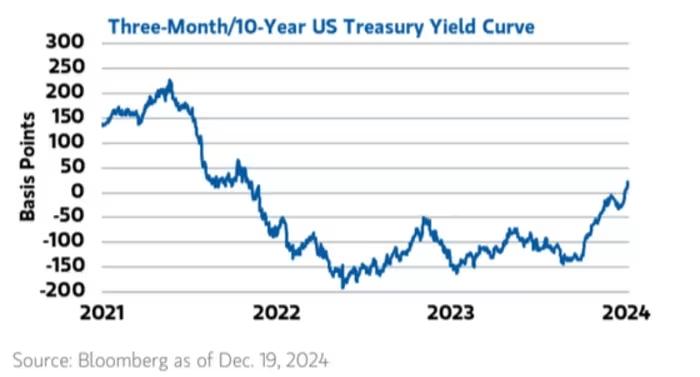
Treasury Yields and Dollar Levels Present Challenges for Stock Market Recovery Stocks started the holiday-shortened week on a positive note Monday, but the continued rise in Treasury yields and the U.S. dollar could act as hurdles to sustained equity gains, a prominent market analyst warned. Both the bond market and the dollar extended their upward trends, reaching levels that could pressure stock-market performance. This follows last Wednesday’s surge, when the Federal Reserve indicated it would implement fewer interest-rate cuts in 2025 than previously expected. The 10-year Treasury yield climbed to 4.594%, marking its highest close since late May, based on Dow Jones Market Data. Meanwhile, the ICE U.S. Dollar Index (DXY), which measures the dollar against six major currencies, rose 0.4% to 108.09, nearing Friday’s high of 108.54—its strongest level since November 2022. After a brief pullback last Friday driven by a positive inflation report, both yields and the dollar resumed their climb Monday. Rising yields, which move inversely to bond prices, and a stronger dollar often create headwinds for equities by pressuring corporate valuations and weighing on export-driven profits. Tom Essaye, founder of Sevens Report Research, described the current levels of the 10-year yield and the dollar as “mild” headwinds but cautioned that their impact could grow if they continue to rise. Despite these pressures, stocks managed to post gains Monday, albeit in thin preholiday trading. The Dow Jones Industrial Average added nearly 100 points, or 0.2%, while the S&P 500 advanced 0.8%, led by strength in semiconductor stocks. The Nasdaq Composite outperformed with a 1% increase. Even with Monday’s gains, major indexes remain down for the month following losses last week. However, the S&P 500 continues to show impressive year-to-date performance, with gains exceeding 25%. In the bond market, last week saw the yield curve return to its typical upward slope, ending an extended period of inversion. Inverted yield curves, where short-term yields exceed long-term yields, are often seen as recession indicators. Analysts noted, however, that the end of an inversion has historically been a more immediate precursor to economic downturns. Lisa Shalett, CIO at Morgan Stanley Wealth Management, suggested the yield curve’s normalization signals a shift from disinflationary growth to a reflationary environment. This transition could pose challenges for high-growth stocks, as higher long-term yields reduce the present value of future earnings. Higher yields and a strong dollar remain obstacles to higher stock valuations, Essaye noted. “Calm currency and bond markets are what stocks need to continue to rally, and we got the opposite last week,” he said. He added that clearer signals from the Federal Reserve or supportive economic data could help stabilize markets and pave the way for further stock market gains. John PaulJohn Paul is the founder of DayTradeToWin, a trading education and software company established in 2008, supporting traders worldwide. His expertise focuses on price action-based futures trading strategies and structured market analysis. DayTradeToWin delivers trading education, indicators, and software tools designed to help traders apply disciplined, rule-based decision-making across global futures markets. He is the creator of multiple trading methodologies, including the Sonic System, Atlas Line, and Trade Scalper, which help traders identify structured opportunities in markets such as the E-mini S&P 500 (ES), Nasdaq (NQ), crude oil (CL), and gold (GC). Official website: https://daytradetowin.com daytradetowin.com

Dow
Market News

Will the Dow Join the Santa Claus Rally?

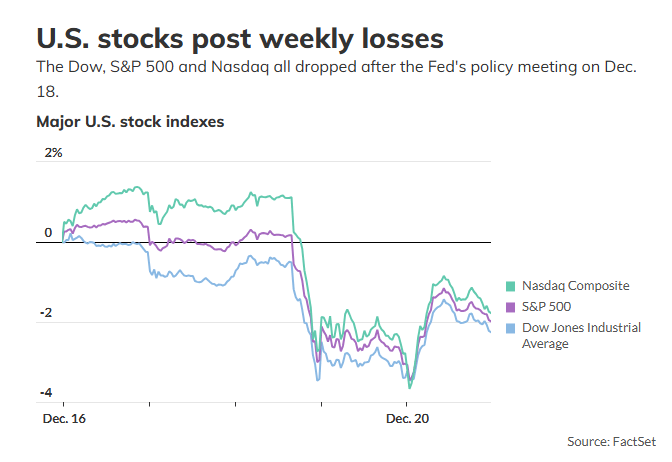
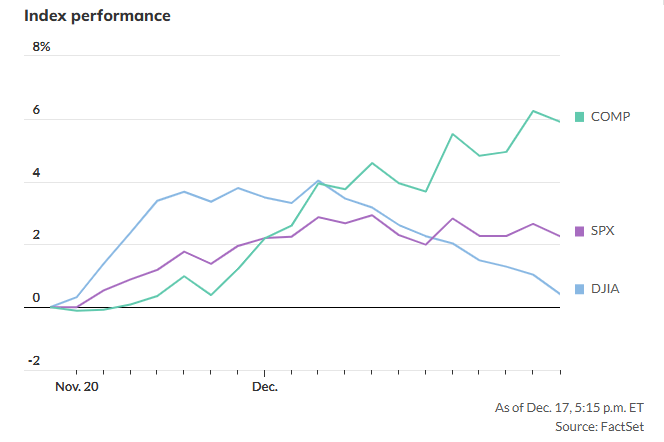
U.S. Stocks Close the Week with Losses Despite Friday Rally U.S. stocks ended the week in negative territory, weighed down by concerns over Federal Reserve policy, inflation, and narrowing market breadth. While Friday’s rally offered a brief respite, it wasn’t enough to erase losses for the week. December Slump Undermines Holiday Optimism The U.S. stock market stumbled in December after a robust November rally. Mark Hackett, chief market strategist at Nationwide, described an “almost light-switch moment” earlier this month that led to a “breakdown in breadth.” “I don’t feel comfortable that the traditional Santa Claus rally is going to come,” Hackett said, noting that the November surge might have borrowed gains typically seen in late December. The Dow Jones Industrial Average (DJIA) dropped 4.6% this month, erasing most of its quarterly gains. The S&P 500 (SPX) recorded consecutive weekly losses, while the Nasdaq Composite (COMP) ended its streak of four straight weekly gains, per Dow Jones Market Data. Fed Signals and Inflation Concerns Investor sentiment soured after the Federal Reserve suggested it may scale back interest rate cuts in 2025. Coupled with persistent inflation concerns and a concentration of gains in a few large-cap stocks, this dampened optimism surrounding the broader market. Holiday Trading Period Holds Uncertainty Historically, the “Santa Claus rally” period—spanning the final five trading days of December and the first two of January—has delivered average gains of 1.29% for the S&P 500 since 1950. However, last year bucked this trend with a 0.9% decline, and this year’s market conditions suggest a repeat could be possible. Softer Inflation Data Sparks Friday Rebound November inflation data, which came in slightly below expectations, brought relief to investors on Friday. The Dow rose 1.2%, marking its largest single-day gain since November, while the S&P 500 and Nasdaq climbed 1.1% and 1%, respectively. Despite this rally, all three major indexes finished the week lower, with the Dow down 2.3%, the S&P 500 off 2%, and the Nasdaq slipping 1.8%. Tech Sector Under Pressure Big Tech stocks, which have driven much of 2024’s rally, delivered mixed results this week. The Roundhill Magnificent Seven ETF (MAGS), which tracks key tech giants like Apple, Microsoft, Alphabet, Amazon, Nvidia, Tesla, and Meta, lost more than 1% for the week, ending its streak of four weekly gains. Policy and Economic Risks Loom Market uncertainties extend beyond inflation, with concerns over potential changes to trade and immigration policies in 2025. Analysts worry that aggressive measures, such as new tariffs or mass deportations, could fuel inflation and slow economic growth. A Strong Year Faces a Quiet Finish Even with December’s struggles, 2024 has been a strong year for equities. The Nasdaq is up 30.4% year-to-date, the S&P 500 has gained 24.3%, and the Dow has risen 13.7%. However, the S&P 500 remains 2.6% below its December 6 record high. “There’s a lot of optimism already priced into stocks,” said Anthony Saglimbene, chief market strategist at Ameriprise Financial. “We’ve had a really strong year, but I don’t think we’ll see a significant rally from now until year-end.” John PaulJohn Paul is the founder of DayTradeToWin, a trading education and software company established in 2008, supporting traders worldwide. His expertise focuses on price action-based futures trading strategies and structured market analysis. DayTradeToWin delivers trading education, indicators, and software tools designed to help traders apply disciplined, rule-based decision-making across global futures markets. He is the creator of multiple trading methodologies, including the Sonic System, Atlas Line, and Trade Scalper, which help traders identify structured opportunities in markets such as the E-mini S&P 500 (ES), Nasdaq (NQ), crude oil (CL), and gold (GC). Official website: https://daytradetowin.com daytradetowin.com
sonic
DayTradeToWin Review

Fast Profits: Mastering Double System Trading

Hello, traders! Today is Thursday, December 19th, and I’m excited to share insights on a powerful trading approach that combines the Trade Scalper and Sonic System. Using these systems together provides increased confidence and better results by leveraging their unique strengths. The Power of Combining Systems Integrating the Trade Scalper with the Sonic System offers a comprehensive trading strategy: Together, these tools help traders make well-informed decisions with enhanced accuracy. Real-World Example: A Profitable Trade Here’s a recent trade that illustrates the synergy of these systems: While not every trade is a winner, disciplined execution and strategic filtering ensure consistent, favorable results over time. Sonic System Highlights The Sonic System stands out with these features: Leveraging Combined Signals Pairing the Sonic System with the Trade Scalper creates: For example, overlapping short signals from both systems within minutes highlight high-probability opportunities. Trading Tips for Success Start Your Trading Journey Today Ready to elevate your trading? Visit daytradetowin.com and create a free member account. You’ll gain access to: Trading doesn’t have to be complicated. By using the right tools and strategies, you can simplify your process and achieve consistent success. Let’s get started today! John PaulJohn Paul is the founder of DayTradeToWin, a trading education and software company established in 2008, supporting traders worldwide. His expertise focuses on price action-based futures trading strategies and structured market analysis. DayTradeToWin delivers trading education, indicators, and software tools designed to help traders apply disciplined, rule-based decision-making across global futures markets. He is the creator of multiple trading methodologies, including the Sonic System, Atlas Line, and Trade Scalper, which help traders identify structured opportunities in markets such as the E-mini S&P 500 (ES), Nasdaq (NQ), crude oil (CL), and gold (GC). Official website: https://daytradetowin.com daytradetowin.com
stocks
Market News

Stock, Bonds, and Volatility: Fed Meeting Impact

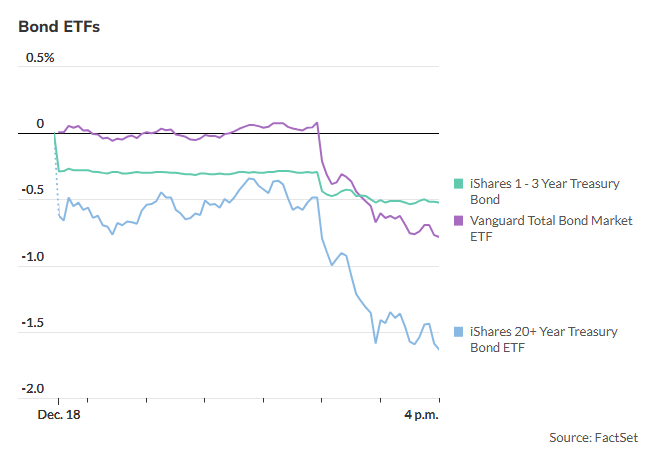
Stock Market Jitters: Fed Signals Slower Rate Cuts, Spiking Volatility Financial markets faced a wave of turbulence on Wednesday after the Federal Reserve released economic projections signaling a slower pace of interest rate cuts in 2025 and persistent inflation concerns. The announcement triggered a sharp sell-off in stocks and bonds, while the Cboe Volatility Index (VIX), often referred to as the stock market’s “fear gauge,” skyrocketed by 74% to 27.6, according to FactSet data. Steep Declines in Stocks and BondsThe Dow Jones Industrial Average fell 2.6%, the S&P 500 dropped 2.9%, and the Nasdaq Composite tumbled 3.6%, marking one of the most significant single-day losses this year. In the bond market, Treasury yields spiked, sending prices lower, with longer-term bonds experiencing sharper declines due to their higher sensitivity to interest rate changes. The iShares 20+ Year Treasury Bond ETF (TLT) fell more than 1%, deepening its year-to-date losses to 6.1%, while broader bond ETFs like the Vanguard Total Bond Market ETF (BND) and iShares Core U.S. Aggregate Bond ETF (AGG) each dropped 0.8%. Fed Projects Persistent Inflation and Modest Rate CutsThe Federal Reserve cut its benchmark interest rate by 0.25% to a target range of 4.25% to 4.5%. However, its Summary of Economic Projections painted a cautious picture, with policymakers now expecting only two quarter-point rate cuts in 2025, down from four projected in September. Inflation remains a key concern, with the Fed estimating it will end 2025 at 2.5%, above its earlier forecast of 2.1% and well above the 2% target. Fed Chair Jerome Powell acknowledged the complexity of assessing inflation risks, particularly in light of potential policy changes under the incoming administration. “We don’t know what will be tariffed, from what countries, for how long,” Powell said, emphasizing the uncertainty surrounding the potential impact of new trade policies on inflation and the broader economy. Investor Sentiment Turns CautiousThe market reaction underscores growing concerns about prolonged inflation, rising interest rates, and geopolitical risks. Investors are also preparing for heightened volatility as potential tariff policies and their economic ramifications come into focus. “The main takeaway from today’s Fed meeting is that inflation risks are back, and the Fed is clearly concerned,” said Charlie Ripley, senior investment strategist at Allianz Investment Management. He noted that the Fed’s ability to maintain its current pace of rate cuts may be limited by inflationary pressures and the economic outlook. Preston Caldwell, chief U.S. economist at Morningstar, added, “The Fed is setting the stage for the possibility of few—or even no—additional rate cuts in 2025 and 2026.” Broader ImplicationsThe Fed’s projections sent the yield on the 10-year Treasury note climbing to 4.493%, its highest level since May, while the U.S. dollar also strengthened. Longer-duration bonds bore the brunt of the sell-off, reflecting heightened sensitivity to interest rate changes. As the markets digest the Fed’s hawkish tone, the focus now shifts to upcoming economic data and policy developments. Persistent inflation and a cautious Federal Reserve could continue to weigh on investor sentiment and drive further market volatility. John PaulJohn Paul is the founder of DayTradeToWin, a trading education and software company established in 2008, supporting traders worldwide. His expertise focuses on price action-based futures trading strategies and structured market analysis. DayTradeToWin delivers trading education, indicators, and software tools designed to help traders apply disciplined, rule-based decision-making across global futures markets. He is the creator of multiple trading methodologies, including the Sonic System, Atlas Line, and Trade Scalper, which help traders identify structured opportunities in markets such as the E-mini S&P 500 (ES), Nasdaq (NQ), crude oil (CL), and gold (GC). Official website: https://daytradetowin.com daytradetowin.com
Dow
Market News

Is the Dow Slide a Warning Sign?

Factors Behind the Dow Slump The Dow Jones Industrial Average has fallen for nine consecutive days, marking its longest losing streak since 1978. This downturn has caught many investors off guard, particularly after the strong postelection rally that drove stocks to record highs. While the S&P 500 and Nasdaq Composite remain near their peak levels, the Dow has struggled. On Tuesday, it closed below its 50-day moving average for the first time since the November election, raising concerns about its underlying momentum. What’s Driving the Decline? Weak Market Breadth The Dow’s challenges reflect a broader trend across the market. Since early December, previously strong sectors have faltered, and investors have shifted back to Big Tech and semiconductor stocks like Broadcom Inc. In contrast, value-focused sectors such as small caps and financials have underperformed. Financials in the S&P 500 have dropped 4.4% this month, with utilities and energy performing even worse. While tech leaders have supported the S&P 500 and Nasdaq Composite, the Dow’s narrower composition has made it more vulnerable to sector-specific weakness. Market breadth has also been a concern. For 12 consecutive trading days, more S&P 500 stocks have declined than advanced, setting a record since at least 1999. Only 40.6% of S&P 500 stocks are currently trading above their 50-day moving averages, the lowest level since May. Individual Stock Pressures Much of the Dow’s recent losses can be attributed to one company: UnitedHealth Group Inc. Since the losing streak began, UnitedHealth has contributed 750 points to the Dow’s 1,564-point decline, accounting for nearly half of the drop. The company has faced pressure from congressional scrutiny over its pharmacy benefit manager business and negative headlines related to the death of a top executive. Other laggards dragging down the index include Sherwin-Williams Co., Caterpillar Inc., and Goldman Sachs Group Inc. Rising Treasury Yields Another factor weighing on the market is rising Treasury yields. The 10-year Treasury yield has climbed 20 basis points this month to 4.397%, fueled by concerns that the Federal Reserve may pause its interest rate cuts and that inflation could remain elevated. Higher yields have particularly impacted the equal-weighted S&P 500, which has significantly underperformed its market-cap-weighted counterpart this month. Outlook for Investors Despite the Dow’s recent struggles, there are reasons for optimism. The U.S. economy is on track to grow at over 3% in the third quarter, and corporate earnings forecasts for next year remain robust. According to Mona Mahajan, a senior investment strategist at Edward Jones, lagging sectors like small caps and value stocks may rebound due to their attractive valuations. However, a broader market recovery may depend on interest rates stabilizing and inflation remaining under control. As the Federal Reserve prepares to announce its next rate decision and economic projections, investors will be watching closely for signals about future policy moves and market direction. John PaulJohn Paul is the founder of DayTradeToWin, a trading education and software company established in 2008, supporting traders worldwide. His expertise focuses on price action-based futures trading strategies and structured market analysis. DayTradeToWin delivers trading education, indicators, and software tools designed to help traders apply disciplined, rule-based decision-making across global futures markets. He is the creator of multiple trading methodologies, including the Sonic System, Atlas Line, and Trade Scalper, which help traders identify structured opportunities in markets such as the E-mini S&P 500 (ES), Nasdaq (NQ), crude oil (CL), and gold (GC). Official website: https://daytradetowin.com daytradetowin.com

market risks
Market News

2025 Market Outlook: Key Investor Worries

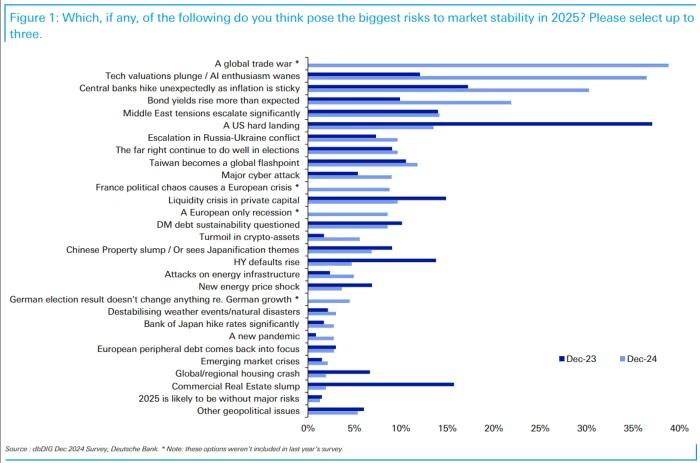
Deutsche Bank Research: Shifting Market Risks for 2025 Investor concerns about market stability have shifted significantly heading into 2025, with a potential global trade war now viewed as the top risk, according to Deutsche Bank Research. This marks a departure from last year when a U.S. economic “hard landing” was the most cited concern. “The leading global risks are a potential trade war, a sharp decline in the U.S. tech sector, and renewed inflationary pressures,” said Jim Reid, Deutsche Bank’s global head of macro and thematic research, in a Monday note. The report highlights how investor sentiment has evolved over the past year. Trade War Concerns and Inflation Risks While the U.S. economy expanded in 2024 despite fears of a recession, investor focus has turned to the implications of new tariffs under President-elect Donald Trump’s trade policies. A rise in tariffs could exacerbate inflation, which remains a lingering concern despite the Federal Reserve’s shift toward looser monetary policy in September. Deutsche Bank’s research also shows that investors remain wary of potential surprises from central banks, including unexpected rate hikes to combat inflation. Bond market volatility has heightened these concerns, with the 10-year Treasury yield climbing to 4.397% on Monday, its elevated levels raising the specter of destabilizing effects on equity markets. Tech Stocks and AI Momentum at Risk A sharp drop in tech stock valuations ranks as the second-largest market risk heading into 2025. Tech stocks have led the market rally in 2024, driven by enthusiasm for artificial intelligence. For instance, Nvidia’s stock has soared over 166%, and the Nasdaq Composite has gained 34.4% year-to-date. Additionally, the Roundhill Magnificent Seven ETF, which includes major tech firms, is up 73.2% for the year, per FactSet data. However, investors are concerned that waning AI-driven enthusiasm could trigger a correction in the tech sector, which has an outsized influence on broader market performance. Outlook for 2025 Despite these risks, Deutsche Bank’s survey reveals cautious optimism for 2025. Investors project a 5.2% gain for the S&P 500 and a 6.8% increase for the Magnificent Seven stocks. Still, the specter of geopolitical tensions, inflationary pressures, and central bank policy uncertainty could weigh heavily on markets. As the Federal Reserve prepares to announce its latest interest rate decision on Wednesday, market participants are closely watching for signals about the trajectory of monetary policy. With 2024 delivering strong equity gains—the S&P 500 is up 27.3% year-to-date—investors remain vigilant about emerging risks that could shape the market landscape in the year ahead. John PaulJohn Paul is the founder of DayTradeToWin, a trading education and software company established in 2008, supporting traders worldwide. His expertise focuses on price action-based futures trading strategies and structured market analysis. DayTradeToWin delivers trading education, indicators, and software tools designed to help traders apply disciplined, rule-based decision-making across global futures markets. He is the creator of multiple trading methodologies, including the Sonic System, Atlas Line, and Trade Scalper, which help traders identify structured opportunities in markets such as the E-mini S&P 500 (ES), Nasdaq (NQ), crude oil (CL), and gold (GC). Official website: https://daytradetowin.com daytradetowin.com

Scroll to Top