
daytrading

inflation
Market News

Inflation, Rates, and Deficits: Druckenmiller’s Take

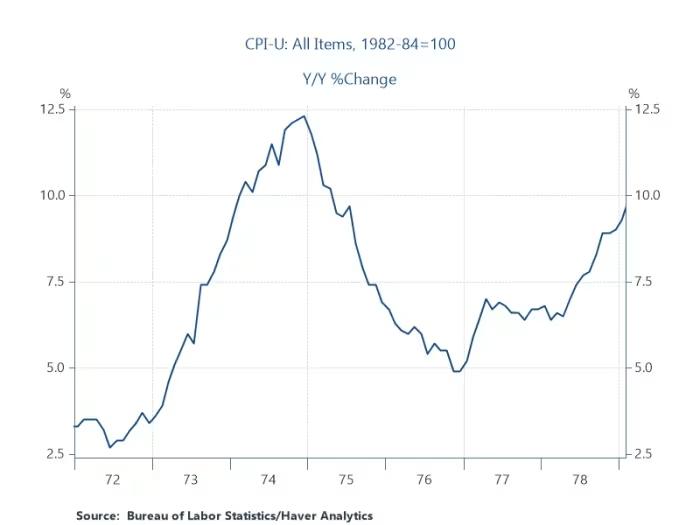
The Fed’s latest interest-rate decision comes on the heels of a historic post-election stock market rally. Reflecting on recent market trends, Druckenmiller, a former top advisor to George Soros and now head of the Duquesne Family Office, shared that while he accurately predicted a decline in inflation, his concerns about an economic downturn were off the mark. Legendary investor Stanley Druckenmiller has projected that if the U.S. faces a major budget deficit issue, it could surface in late 2025 or early 2026. Now, he’s more concerned about inflation’s potential resurgence than about economic weakness. Druckenmiller observed that inflation in the 1970s dropped temporarily before surging again, and with U.S. inflation having peaked in June 2022 before easing, he believes the Fed might be declaring victory too early. With tight credit spreads, record-high gold prices, and a robust stock market, he worries that recent rate cuts could risk another spike in inflation. Commenting on fiscal policy, Druckenmiller warned of an eventual “reckoning” over the growing budget deficit. While the U.S. has avoided a crisis due to the dollar’s status as the global reserve currency, he pointed out that recent policies are even more aggressive than those that triggered bond market volatility in the U.K. For now, refinancing has prevented serious debt issues, but he suggests that as debt rolls over, a fiscal crisis could emerge in the next couple of years if left unaddressed. John PaulJohn Paul is the founder of DayTradeToWin, a trading education and software company established in 2008, supporting traders worldwide. His expertise focuses on price action-based futures trading strategies and structured market analysis. DayTradeToWin delivers trading education, indicators, and software tools designed to help traders apply disciplined, rule-based decision-making across global futures markets. He is the creator of multiple trading methodologies, including the Sonic System, Atlas Line, and Trade Scalper, which help traders identify structured opportunities in markets such as the E-mini S&P 500 (ES), Nasdaq (NQ), crude oil (CL), and gold (GC). Official website: https://daytradetowin.com daytradetowin.com
S&P 500
Market News

Why the S&P 500 Trades at Higher Valuations

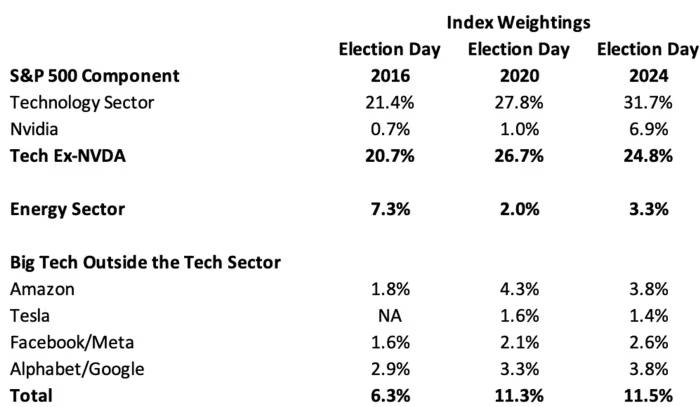
Nicholas Colas, co-founder of DataTrek Research, notes that substantial changes within the S&P 500 over the last four to eight years have led to its high valuation compared to 2016. On Election Day 2024, the S&P 500 rose by 1.2%, boosted by gains in Big Tech stocks like Nvidia, Meta, and Tesla, as voters cast their ballots for the next U.S. president. Colas explained that the S&P 500’s price-to-earnings (P/E) ratio has increased significantly since 2016, though it is now closer to 2020 levels. This rise has been driven by shifts in fiscal and monetary policy and a greater weighting of technology stocks in the index. For example, Nvidia’s weighting in the S&P 500 has surged from 0.7% in 2016 to 6.9%, reflecting its position as a leader in AI. The tech sector now represents 31.7% of the index, up from 21.4% eight years ago. Dominic Rizzo, portfolio manager for the T. Rowe Price Technology ETF, emphasized the critical role that technology and related sectors play in the S&P 500, with Big Tech names like Apple, Microsoft, Amazon, and Meta now accounting for 43.2% of the index, up from 27.7% in 2016. For investors, this high concentration of tech stocks makes valuation a key consideration. DataTrek’s analysis shows that, despite high interest rates, tech valuations remain strong. Colas noted that while many expected tech sector valuations to decline in a rising-rate environment, they have instead expanded more than any other sector, with Nvidia trading at 40 times forward earnings, underscoring the ongoing demand for tech-driven growth. John PaulJohn Paul is the founder of DayTradeToWin, a trading education and software company established in 2008, supporting traders worldwide. His expertise focuses on price action-based futures trading strategies and structured market analysis. DayTradeToWin delivers trading education, indicators, and software tools designed to help traders apply disciplined, rule-based decision-making across global futures markets. He is the creator of multiple trading methodologies, including the Sonic System, Atlas Line, and Trade Scalper, which help traders identify structured opportunities in markets such as the E-mini S&P 500 (ES), Nasdaq (NQ), crude oil (CL), and gold (GC). Official website: https://daytradetowin.com daytradetowin.com

24-Hour Trading
Market News

Why 24-Hour Trading is the Future of Investing

For global investors, 24-hour trading offers a significant advantage — particularly when market-moving events happen outside regular trading hours. In the U.S., stock markets operate on a schedule that suits East Coast traders, opening at 9:30 a.m. and closing at 4 p.m. But for those in different time zones, trading can be less convenient. West Coast traders need an early start, while international investors in Asia, for example, face a more challenging overlap with U.S. hours. To meet the growing demands of investors worldwide, financial institutions have been pushing for expanded trading hours, with some now offering nearly 24-hour access. Advances in technology, combined with the globalization of financial markets, have made it easier to accommodate around-the-clock trading. This concept isn’t new; futures markets in the U.S. have traded almost continuously from Sunday evening to Friday afternoon for years, and commodity markets also offer extensive weekday hours. Cryptocurrencies, meanwhile, have proven the viability of 24/7 trading. Yet, the U.S. stock exchanges still operate within limited hours set back in 1985, offering only some premarket and after-hours trading. This gap is now closing. The New York Stock Exchange recently extended trading on its Arca Exchange, which now operates from 1:30 a.m. to 11:30 p.m. Eastern Time, allowing nearly 22 hours of trading per day. Major brokerages, like Charles Schwab, are also expanding access. Schwab now offers clients the ability to trade all stocks in the S&P 500 and Nasdaq 100 indices, plus hundreds of ETFs, 24 hours a day. Driving this shift is Blue Ocean Technologies, whose alternative trading system (ATS) runs from 8 p.m. to 4 a.m. Eastern, supporting trading during hours that align with the Asian market. Blue Ocean works with over 50 brokerages, including Robinhood and Webull, to serve a growing number of investors looking to trade U.S. stocks in their local daylight hours. The need for resilient, 24-hour trading systems has become more critical as volume surges during major after-hours events. For example, when a surprise move in the yen caused volatility in Asian markets, Blue Ocean’s ATS experienced an intense surge in trades. Recognizing the importance of handling such spikes, Blue Ocean partnered with MEMX exchange to upgrade its system’s capacity, ensuring stability during high-volume events. Investors are increasingly expecting reliable access to the market at all hours, especially in response to impactful events like geopolitical developments or election results. For brokerages, any outage during after-hours trading could damage their reputation, as clients expect the same reliability during extended hours as they do within regular market hours. In today’s interconnected markets, where events in one part of the world affect investors everywhere, the demand for accessible 24-hour trading is only set to rise, making it a valuable tool for investors across the globe. John PaulJohn Paul is the founder of DayTradeToWin, a trading education and software company established in 2008, supporting traders worldwide. His expertise focuses on price action-based futures trading strategies and structured market analysis. DayTradeToWin delivers trading education, indicators, and software tools designed to help traders apply disciplined, rule-based decision-making across global futures markets. He is the creator of multiple trading methodologies, including the Sonic System, Atlas Line, and Trade Scalper, which help traders identify structured opportunities in markets such as the E-mini S&P 500 (ES), Nasdaq (NQ), crude oil (CL), and gold (GC). Official website: https://daytradetowin.com daytradetowin.com
Dow
Market News

What’s Driving October’s Market Drop?

The Dow and S&P 500 ended October with their first monthly declines since April, while Halloween brought more market scares than treats. A wave of tech-sector selling on Thursday pulled down the S&P 500, and the Nasdaq Composite posted its steepest one-day drop since early September. Analysts pointed to various factors behind the slide, including cautious guidance from Big Tech and potential pre-election anxiety. Thomas Martin, senior portfolio manager at Globalt Investments, noted that investors seem to be zeroing in on earnings reports from the “Magnificent Seven” tech giants, even though he felt most of their results were solid. The Nasdaq Composite dropped 2.8%, its sharpest one-day percentage drop since Sept. 3, while tech sectors led the S&P 500 down 1.9%. Meanwhile, the Dow Jones Industrial Average, more weighted toward cyclical sectors, lost 0.9%. The month marked the first declines since April for the S&P 500 and Dow and the first since July for the Nasdaq. The Invesco QQQ Trust, which tracks the Nasdaq-100, dropped 2.5%. Microsoft and Meta Platforms fell 6.1% and 4.4%, respectively, following strong earnings reports that were overshadowed by conservative revenue outlooks and continuing high costs linked to artificial intelligence. Louis Navellier, founder of Navellier & Associates, explained that tech companies with high price-to-earnings ratios must beat expectations and provide robust guidance, a situation he describes as “priced for perfection.” Navellier also pointed to rising uncertainty around the upcoming election, as reflected in a jump in the Cboe Volatility Index, which rose above its historical average. Despite Thursday’s losses, Microsoft remains up more than 8% this year, Meta has gained over 60%, and Nvidia is up nearly 170%. Still, rising Treasury yields—now around 4.3% on the 10-year note, up from 3.6% in mid-September—have intensified pressure on high-valuation tech stocks, as higher yields reduce the present value of future earnings. Jonathan Krinsky, chief market technician at BTIG, noted that the S&P 500 has broken its uptrend from the August lows. He previously warned of market vulnerability in mid-October, and now suggests that the next key support level could be around 5,500-5,650. John PaulJohn Paul is the founder of DayTradeToWin, a trading education and software company established in 2008, supporting traders worldwide. His expertise focuses on price action-based futures trading strategies and structured market analysis. DayTradeToWin delivers trading education, indicators, and software tools designed to help traders apply disciplined, rule-based decision-making across global futures markets. He is the creator of multiple trading methodologies, including the Sonic System, Atlas Line, and Trade Scalper, which help traders identify structured opportunities in markets such as the E-mini S&P 500 (ES), Nasdaq (NQ), crude oil (CL), and gold (GC). Official website: https://daytradetowin.com daytradetowin.com
market
Market News

2023’s Market Surge: Is More Growth Ahead?

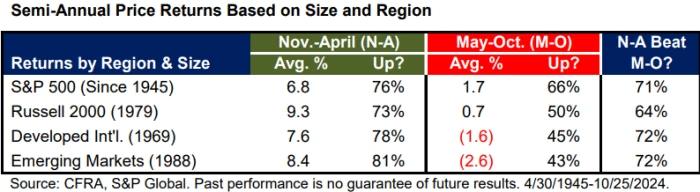
The U.S. stock market is gearing up for its historically strongest six-month period, November through April, following impressive gains over the summer months. Traditionally, investors adhere to the “sell in May and go away” adage, but this year’s performance defied that trend. Yet with rising Treasury yields and the looming presidential election, many wonder if the market rally has enough fuel to keep running. Historically, the November-April period is the best six-month stretch for stocks. Since 1945, the S&P 500 has averaged nearly a 7% return in this window compared to only 2% from May to October, according to Sam Stovall, CFRA Research’s chief investment strategist. This year, however, has been an outlier. Since April 30, the S&P 500 has surged more than 16%, setting up for the biggest May-October gain since 2009, on top of the previous November-April’s 20% gain. This two-part rally has raised questions about whether the market is due for a slowdown, yet history suggests the momentum could continue. Stovall notes that previous strong gains from May to October have often led to even stronger performance in the following November-April period. In fact, in the 12 instances since 1945 when the S&P 500 rose over 10% from May to October, it went on to climb an average of 13% in the subsequent November-April period. Additionally, in cases where double-digit gains occurred in both periods, stocks stayed on an upward trend in four out of five subsequent periods, with an average gain of 11%. Beyond the large-cap S&P 500, the November-April stretch has also been strong for smaller stocks and international markets, including the Russell 2000, MSCI EAFE, and MSCI Emerging Markets indices. However, election-related concerns and economic pressures are adding uncertainty. Recently, rising Treasury yields have triggered market volatility, with the yield on the 10-year note trading above 4.3%, a level that has challenged stocks in recent months. “With stocks up 23% year-to-date, many are questioning the remaining upside,” commented José Torres, senior economist at Interactive Brokers. Although this year has seen impressive growth, he pointed out that it trails some recent years like 2021, 2019, and 2013, each of which saw returns ranging from 24% to 30% in the first 10 months. Torres added that for stocks to keep their upward momentum, factors like favorable election outcomes, calmer interest rates, and strong AI-driven earnings could play a role. Sam Stovall is still optimistic, emphasizing that the market has historically risen through periods of uncertainty, driven by potential interest rate cuts and solid tech earnings. U.S. stocks closed mostly higher on Tuesday, with the Nasdaq up 0.8% for its 28th record close of the year. Meanwhile, the S&P 500 edged up 0.2%, while the Dow Jones slipped 0.4%. John PaulJohn Paul is the founder of DayTradeToWin, a trading education and software company established in 2008, supporting traders worldwide. His expertise focuses on price action-based futures trading strategies and structured market analysis. DayTradeToWin delivers trading education, indicators, and software tools designed to help traders apply disciplined, rule-based decision-making across global futures markets. He is the creator of multiple trading methodologies, including the Sonic System, Atlas Line, and Trade Scalper, which help traders identify structured opportunities in markets such as the E-mini S&P 500 (ES), Nasdaq (NQ), crude oil (CL), and gold (GC). Official website: https://daytradetowin.com daytradetowin.com

stocks
Market News

Is a Market Nightmare Looming for U.S. Stocks?

The S&P 500’s recent dip hasn’t dampened investor enthusiasm for tech stocks, which remain crucial to market performance. This week’s earnings reports from major players—Alphabet on Tuesday, Microsoft and Meta on Wednesday, and Apple and Amazon on Thursday—will be watched closely, with Nvidia reporting later in November. High-Stakes Week Ahead for Markets with Election Jitters, Big Tech Earnings, and Key Economic Data The U.S. stock market’s recent record-breaking rally could be tested this week as investors brace for a series of high-impact events. The focus will be on Big Tech earnings, fluctuating U.S. Treasury yields, October’s jobs report, and a tense lead-up to the presidential election. Dec Mullarkey, head of investment strategy at SLC Management, highlighted the tension in bond markets: “The 10-year yield has surged over the past month,” reflecting worries that the election outcome may drive further volatility. Mullarkey noted that election anxiety is also driving up demand for safe-haven assets like gold, particularly with polls pointing to a close race. Big Tech Earnings Take Center Stage “These earnings will be pivotal,” said Eric Beiley, executive managing director at Steward Partners. “Stocks are trading at high valuations, so it’s critical that these companies show strong results.” The reliance on large-cap tech contrasts with weakness in small-cap stocks, as seen in the Russell 2000’s 3% drop last week. “Big Tech could be a trick or a treat,” observed Keith Lerner, co-chief investment officer at Truist Advisory Services, especially with Apple and Amazon’s results landing on Halloween, a day that often brings volatility due to month-end rebalancing. October Jobs Report in the Spotlight Friday’s jobs report will also command attention as the Federal Reserve seeks signs of a balanced labor market—neither too hot nor too cold. However, Boeing worker strikes and recent hurricanes may distort October’s numbers. September’s unexpectedly strong jobs data quelled fears of an economic slowdown, yet persistently high wages could complicate the Fed’s path to rate cuts. “The jobs report could be the day’s main focus,” said Lerner. “But afterward, all eyes will likely return to the election.” Election Uncertainty Fuels Debt Market Turmoil The upcoming election is adding pressure to U.S. debt markets, with Treasury yields on the rise. Yields on 10-year Treasury notes reached 4.23% on Friday, driven partly by uncertainty over how either presidential candidate would handle the U.S. deficit and debt levels. Some investors, including billionaire Paul Tudor Jones, have raised concerns over potential policies like tariffs and dollar penalties, should former President Trump return to the White House. Mullarkey pointed out that central bank gold purchases are pushing prices higher as investors seek protection from potential post-election volatility. As this critical week unfolds, markets may see increased volatility as investors navigate a challenging mix of earnings, economic data, and political uncertainty. John PaulJohn Paul is the founder of DayTradeToWin, a trading education and software company established in 2008, supporting traders worldwide. His expertise focuses on price action-based futures trading strategies and structured market analysis. DayTradeToWin delivers trading education, indicators, and software tools designed to help traders apply disciplined, rule-based decision-making across global futures markets. He is the creator of multiple trading methodologies, including the Sonic System, Atlas Line, and Trade Scalper, which help traders identify structured opportunities in markets such as the E-mini S&P 500 (ES), Nasdaq (NQ), crude oil (CL), and gold (GC). Official website: https://daytradetowin.com daytradetowin.com

Scroll to Top