daytrading

Election
Market News

Election Jitters: Why the Market Dips Before Election Day

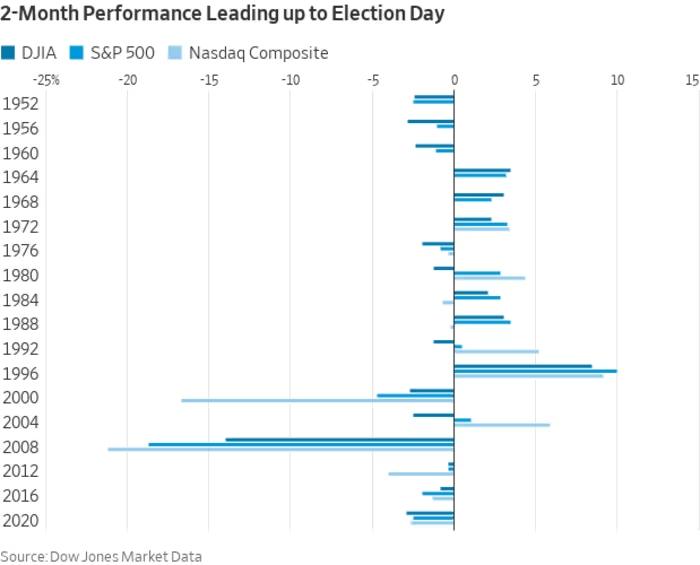
Since 2008, the S&P 500 has declined during the two months leading up to every U.S. presidential election, with an average drop of 5.8%, according to Dow Jones Market Data. Looking further back to 1952, the index has averaged a slight decline of 0.2% in this period, though the median result shows a 0.1% gain, with a 50-50 split between positive and negative outcomes. While historical trends can be insightful, market experts warn against viewing them as predictive. Both the Dow Jones Industrial Average and Nasdaq Composite have also typically declined in this two-month window. The Dow has risen only one-third of the time, and the Nasdaq just 38.5% of the time since 1972. September is historically the weakest month, with an average decline of 0.78% since 1944. In presidential election years, this weakness often extends into October. Normally a positive month with a 1.04% average gain, October has instead seen an average drop of 0.45% in election years. John PaulJohn Paul is the founder of DayTradeToWin, a trading education and software company established in 2008, supporting traders worldwide. His expertise focuses on price action-based futures trading strategies and structured market analysis. DayTradeToWin delivers trading education, indicators, and software tools designed to help traders apply disciplined, rule-based decision-making across global futures markets. He is the creator of multiple trading methodologies, including the Sonic System, Atlas Line, and Trade Scalper, which help traders identify structured opportunities in markets such as the E-mini S&P 500 (ES), Nasdaq (NQ), crude oil (CL), and gold (GC). Official website: https://daytradetowin.com daytradetowin.com

investors
Market News

Did Retail Investors Pass Tuesday’s Dip-Buying Test?

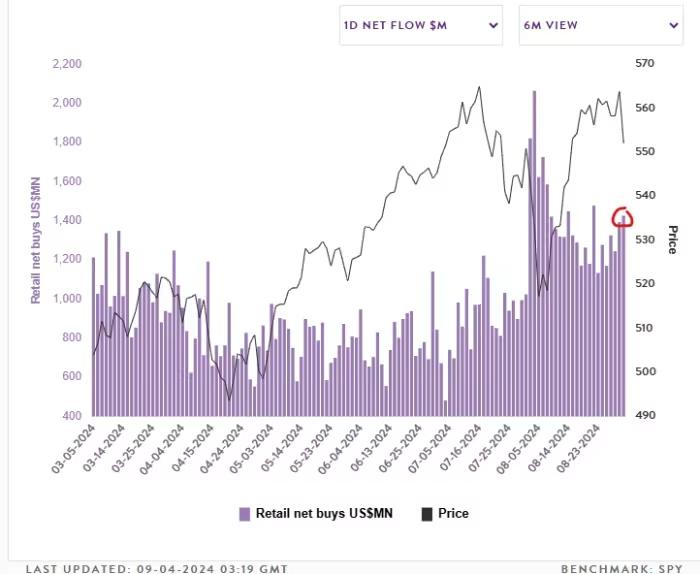
When markets dip, it often see it as a buying opportunity. However, Tuesday’s selloff felt different. Following an ISM report indicating a slowdown in manufacturing, the S&P 500 plunged 2.1% and the Nasdaq Composite dropped 3.3%, marking the largest decline since August 5. Retail investors did step in to buy the dip, but their response wasn’t as strong as in August. Marco Iachini of Vanda Research noted that while buying increased, it didn’t reach the high levels seen during the earlier selloff. September 3 saw net buying that was higher than most recent days but still below August’s levels. Retail traders usually buy more aggressively after a few dips rather than the first one. Many investors had already been purchasing stocks recently, which might have depleted their available funds. Additionally, with pandemic-era savings largely gone, investors might be less prepared to buy the dip. Iachini wonders how long retail investors can keep up their buying if the market continues to fall. Despite recent volatility, data shows retail investors are still optimistic. Analysts like Bret Kenwell from eToro believe the market’s fundamentals remain solid, but upcoming events like the Fed’s policy meeting and the U.S. election could lead to increased volatility. John PaulJohn Paul is the founder of DayTradeToWin, a trading education and software company established in 2008, supporting traders worldwide. His expertise focuses on price action-based futures trading strategies and structured market analysis. DayTradeToWin delivers trading education, indicators, and software tools designed to help traders apply disciplined, rule-based decision-making across global futures markets. He is the creator of multiple trading methodologies, including the Sonic System, Atlas Line, and Trade Scalper, which help traders identify structured opportunities in markets such as the E-mini S&P 500 (ES), Nasdaq (NQ), crude oil (CL), and gold (GC). Official website: https://daytradetowin.com daytradetowin.com
sonic
DayTradeToWin Review

Stay Ahead with News Alerts and Sonic Signals

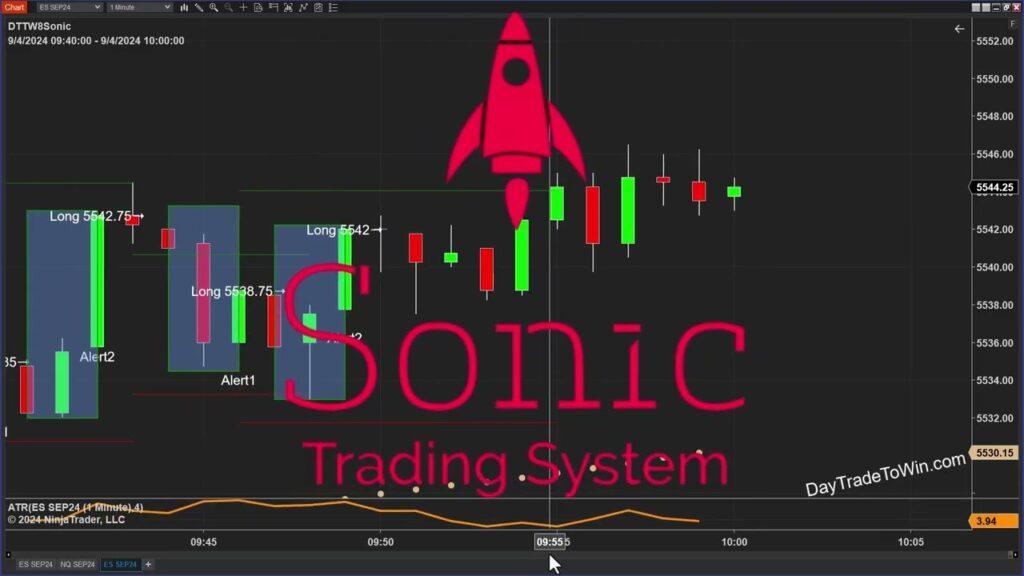
Hello, traders! Today, we’re taking a closer look at the Sonic Trading System, a powerful tool designed to help you navigate the market with precision. We’ll break down how to interpret its signals, and I’ll share key tips on handling trades during major news events like a pro. The Sonic Trading System at Work The Sonic Trading System identifies high-probability entry points across various timeframes. Recently, it triggered a long signal at 55.4550, coinciding with a major news event at 10:00 AM New York time. As expected, the market reacted with volatility—a common occurrence during news releases. If you’re new to trading, this kind of volatility can feel overwhelming, making it important to remain patient when a signal aligns with a news event. Why Timing Matters During News Releases Market-moving news often results in sharp, unpredictable movements, which can be risky for traders. A good rule of thumb is to wait a few minutes after a news event before entering a trade, allowing the market to stabilize. For example, after the 10:00 AM news release, waiting seven minutes brought the market to a more predictable state. The Sonic Trading System issued another long signal at 55.444, but even then, it’s crucial to monitor the market conditions. If the average true range (ATR) remains high (around 8), it signals that volatility is still elevated. Conservative traders may prefer waiting for the ATR to drop to more normal levels (around 5 or 6) before entering a trade. Staying Informed: News Indicators and Economic Calendars Keeping ahead of market-moving news is essential for making informed trading decisions. Using reliable economic calendars and news indicators is key. The Day Trade to Win economic calendar provides a comprehensive list of upcoming news events that could affect the markets. Additionally, the Day Trade to Win news indicator provides an audible alert before major news hits, giving you time to either prepare or hold off on trades. You can access these tools during their free trial, or use the economic calendar available online. Choosing the Right Chart and Timeframe The Sonic Trading System is versatile, working effectively across various chart types and timeframes. Whether you’re using 1-minute charts, 15-second charts, or tick charts, the system adapts seamlessly. For instance, on a recent 15-second chart, the ATR was around 2.5, indicating a more controlled trading environment. This setup allowed for gains of $125 to $150 on the E-mini S&P—a solid return for short-term trades. Whether you prefer minute charts, tick charts, or range charts, the Sonic Trading System’s flexibility allows you to find trades throughout the day. Within just 10 minutes, multiple winning trades were signaled, each with clear entries and exits. Don’t Overtrade: Quality Over Quantity While the Sonic Trading System provides ample opportunities, it’s essential to trade smart, not often. If you achieve three or four winning trades, that may be enough to hit your daily profit target. Overtrading, especially in volatile markets, can lead to unnecessary losses. As we saw with a signal at 55.546, if the market moves away from your limit order, it’s okay to let the trade pass. Another setup is always around the corner. Final Thoughts Successful trading is about finding balance—knowing when to take action and when to wait. The Sonic Trading System is a powerful tool for spotting high-probability trades, but staying informed and patient, especially during news events, is crucial. Using tools like the Day Trade to Win news indicator and economic calendar can help you manage risk and improve your trading performance. Remember, trading involves risks, and it’s important to trade with capital you can afford to lose. Always approach the market with caution and a solid plan. Until next time, happy trading! For more information on the Sonic Trading System and to try it for free, visit daytradetowin.com and start trading with confidence. John PaulJohn Paul is the founder of DayTradeToWin, a trading education and software company established in 2008, supporting traders worldwide. His expertise focuses on price action-based futures trading strategies and structured market analysis. DayTradeToWin delivers trading education, indicators, and software tools designed to help traders apply disciplined, rule-based decision-making across global futures markets. He is the creator of multiple trading methodologies, including the Sonic System, Atlas Line, and Trade Scalper, which help traders identify structured opportunities in markets such as the E-mini S&P 500 (ES), Nasdaq (NQ), crude oil (CL), and gold (GC). Official website: https://daytradetowin.com daytradetowin.com
stocks
Market News

Labor Market’s Impact on Stocks and Bonds This Week

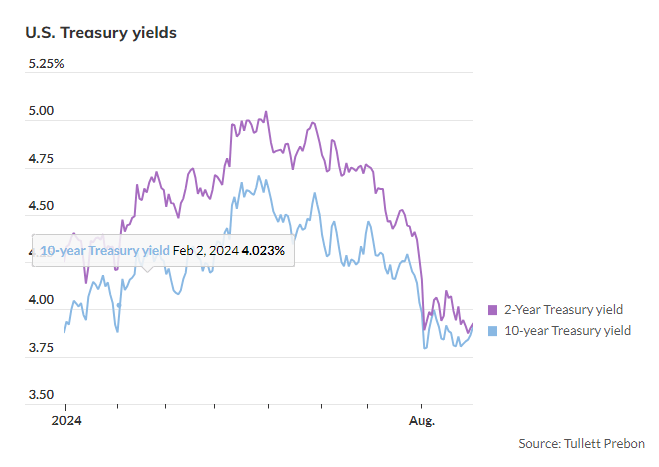
U.S. stocks and bond investors are gearing up for a pivotal employment report this week as they return from the Labor Day weekend, marking the start of September trading. Scheduled for release on Friday, the U.S. jobs report is expected to have a significant impact on the markets, according to Victoria Fernandez, chief market strategist at Crossmark Global Investments. She emphasized that the data on August’s job growth and unemployment rate could influence both stocks and bonds. In early August, the release of July’s employment figures, which fell short of expectations, shook the market, with the unemployment rate rising to 4.3%. However, U.S. stocks have since rebounded, with the Dow Jones Industrial Average hitting a new record high on Friday and the S&P 500 closing just 0.3% below its peak from July 16. “The overall economy still appears strong,” said Bob Elliott, co-founder and CEO of Unlimited Funds, though he noted uncertainty remains about whether the economy will experience a “no landing,” soft landing, or hard landing. The labor market is under close scrutiny following Federal Reserve Chair Jerome Powell’s August 23 speech at Jackson Hole, where he pointed out that it has “cooled considerably” and that risks to employment have increased. With inflation significantly down from its 2022 peak, Powell hinted that interest rate cuts could be on the horizon. Friday’s jobs report could be a key factor in determining whether the Fed opts for a quarter-point or half-point rate cut at its September meeting, according to Phil Camporeale, a portfolio manager at J.P. Morgan Asset Management. He expects the August employment data to show improvement, possibly leading the Fed to start cutting rates gradually. A deeper cut would indicate heightened concern about the labor market and the broader economy. Barclays analysts expect the unemployment rate to have dropped to 4.2% in August, partially reversing July’s spike, which was partly due to temporary unemployment caused by Hurricane Beryl. They also anticipate stronger job growth compared to July. A strong jobs report could push Treasury bond yields higher and trigger a stock market rally, according to Camporeale. On Friday, all three major U.S. stock indexes—the Dow, S&P 500, and Nasdaq Composite—closed higher as investors assessed an inflation report that largely met expectations. The Dow and S&P 500 both posted gains for the fourth consecutive month in August. In the bond market, Treasury yields fell in August as investors anticipated potential rate cuts by the Fed. The 10-year Treasury note yield declined for the fourth straight month to 3.910%, while the two-year Treasury yield also dropped for the fourth consecutive month, marking its longest such streak since July 2020. Despite signs of labor market softening, the market is “not soft” yet, according to Roger Hallam, global head of rates at Vanguard Group. However, he noted that a weaker-than-expected jobs report on Friday could make a deeper rate cut in September more likely. Meanwhile, traders in the federal-funds futures market are pricing in up to a one-percentage-point rate cut by the Fed this year, a move that Camporeale considers “a bit too aggressive.” “If that happens, it could signal a growth scare similar to the market’s reaction after July’s unexpectedly weak jobs report,” he said. Elliott questioned the necessity of rate cuts, given the economy’s overall strength and the fact that asset prices are near all-time highs, with inflation remaining slightly above the Fed’s 2% target despite previous rate hikes. The Fed has kept its policy rate at 5.25% to 5.5% since July 2023, a level Powell described as “restrictive,” which has significantly helped to reduce inflation. Powell emphasized that the cooling labor market is no longer contributing to inflation and indicated that the Fed does not want to see further labor market weakening. He also hinted at a potential policy shift, a message that resonated with Camporeale, who has been anticipating a Fed pivot toward rate cuts. Camporeale remains “overweight” on U.S. stocks and has recently increased his exposure to the equal-weight S&P 500 index, expecting the market rally to broaden. In fixed income, he favors high-yield corporate bonds, which offer additional returns. “The probability of recession remains low,” said Camporeale, highlighting the resilience of consumer spending and the continued moderation of inflation. U.S. stock and bond markets will be closed on Monday in observance of Labor Day. John PaulJohn Paul is the founder of DayTradeToWin, a trading education and software company established in 2008, supporting traders worldwide. His expertise focuses on price action-based futures trading strategies and structured market analysis. DayTradeToWin delivers trading education, indicators, and software tools designed to help traders apply disciplined, rule-based decision-making across global futures markets. He is the creator of multiple trading methodologies, including the Sonic System, Atlas Line, and Trade Scalper, which help traders identify structured opportunities in markets such as the E-mini S&P 500 (ES), Nasdaq (NQ), crude oil (CL), and gold (GC). Official website: https://daytradetowin.com daytradetowin.com
sonic
DayTradeToWin Review

Maximizing Profit with Sonic Trading: Target Adjustments

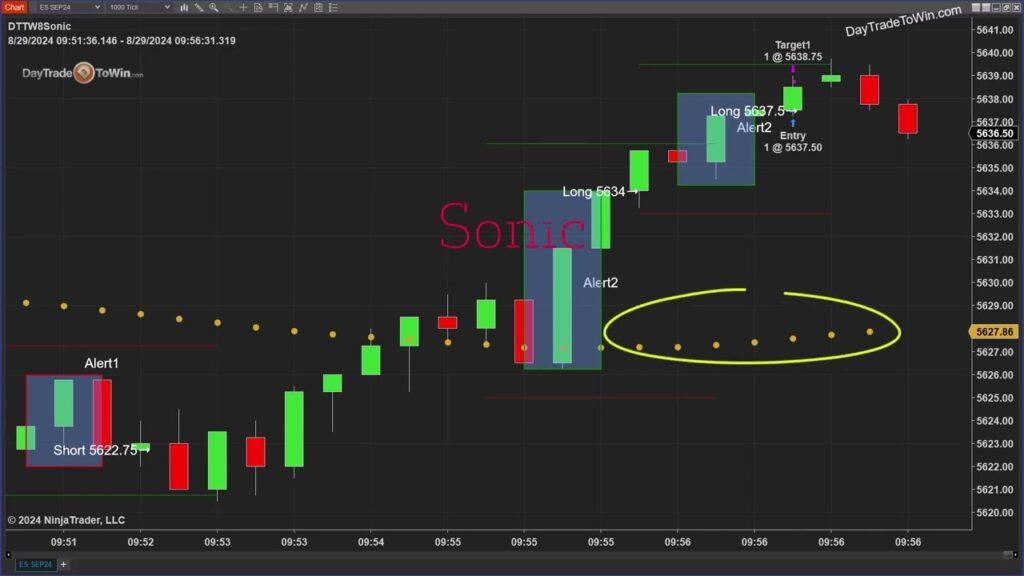
Hello, Traders! In today’s session, we’re focusing on the Sonic Trading System, specifically on how to fine-tune your profit targets for optimal trading results. Whether you’re new to trading or have years of experience, mastering these adjustments can help you capture profits more effectively. Why Adjusting Your Targets is Crucial Trading success often hinges on your ability to adapt to changing market conditions. The Sonic Trading System uses the Average True Range (ATR) to set profit targets, giving you a dynamic approach to trading. By adjusting these targets, you align your strategy with the market’s current volatility, increasing your chances of securing profitable trades. Fine-Tuning with ATR Standard practice might involve setting targets at 1x or 2x the ATR, but today, we’re focusing on a more precise adjustment: setting the target at 75% of the ATR. This allows for quicker exits, which can be particularly advantageous in fast-moving markets. Utilizing Market Filters The Sonic Trading System also includes a market filter, represented by a dotted line on your chart. This filter helps you decide whether to go long or short. For example, if the price is above the dotted line, the system signals long trades; if below, it signals short trades. This straightforward filter helps streamline your trading decisions, allowing you to focus on high-probability opportunities. Real-Time Trading Examples Let’s explore some practical examples: The Role of Stops While adjusting targets is important, setting appropriate stops is equally critical. The Sonic Trading System automatically determines stops based on the ATR, but you can adjust these settings to suit your risk tolerance. For instance, in one trade today, the stop was strategically placed just below a key support level, protecting the trade from significant loss. Always ensure your stops are in place to safeguard your capital. Avoiding Overtrading Overtrading is a common pitfall, and the Sonic Trading System generates plenty of signals throughout the day. However, it’s important to recognize when enough is enough. If you’ve had several winning trades, consider stepping away to avoid unnecessary risk. Even with a solid system, not every trade will be a winner, so it’s wise to protect your gains. Why the Sonic Trading System is Ideal for Prop Traders For those trading on prop firms or seeking funded accounts, the Sonic Trading System is particularly beneficial due to its small stop sizes. These smaller stops help maintain a favorable risk-to-reward ratio, which is essential for meeting the strict requirements of these trading environments. Final Thoughts The Sonic Trading System offers a powerful, adaptable approach to trading that can be tailored to fit various markets and strategies. By adjusting your ATR settings and utilizing the system’s built-in filters and stops, you can enhance your trading performance and make more informed decisions. As we head into the final quarter of 2024, the markets are expected to become increasingly volatile, especially with the upcoming elections. Now is the perfect time to refine your strategy and prepare for the opportunities ahead. Remember, trading carries risks, so always trade responsibly. If you’re ready to elevate your trading, visit Daytradetowin.com to take advantage of our end-of-summer special and save 15% on the Sonic Trading System. Happy trading! John PaulJohn Paul is the founder of DayTradeToWin, a trading education and software company established in 2008, supporting traders worldwide. His expertise focuses on price action-based futures trading strategies and structured market analysis. DayTradeToWin delivers trading education, indicators, and software tools designed to help traders apply disciplined, rule-based decision-making across global futures markets. He is the creator of multiple trading methodologies, including the Sonic System, Atlas Line, and Trade Scalper, which help traders identify structured opportunities in markets such as the E-mini S&P 500 (ES), Nasdaq (NQ), crude oil (CL), and gold (GC). Official website: https://daytradetowin.com daytradetowin.com
debt
Market News

Rate Cuts: Softening the U.S. Debt Blow

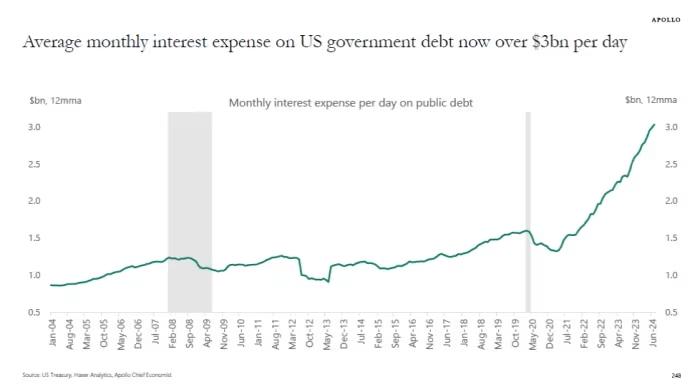
Over $3 billion is spent daily, even on weekends, to cover the interest payments on the country’s national debt. Decreases in the Federal Reserve’s interest rates will not only help families and companies struggling to handle higher borrowing costs. The Treasury would also benefit from reduced borrowing costs as the government continues to spend more than it earns, leading to an increase in the national debt. Predicted decreases in interest rates might offer some help, but the underlying problem of a substantial government debt load that is expected to grow in the coming years will not be fixed. The predicted cuts in interest rates by the Federal Reserve are anticipated to happen in September. Some investors are worried that this might suggest an upcoming recession in the economy. But do we really need to be concerned? We will analyze economic markers to see if these decreases are a hint of approaching difficulties. Furthermore, the ability to repay this debt will rely on the unpredictable choices of global investors who buy and sell U.S. assets. The amount of money owed in the Treasury market is around $28 trillion. During an interview, Sid Vaidya, the chief investment strategist at TD Wealth, highlighted the significance of keeping a close eye on the amount of debt in the economy. He stated that if the Federal Reserve adjusts its monetary policy by decreasing interest rates through rate cuts, it may lead to a decrease in the government’s interest payments. Additionally, he mentioned that this transition would help others by leading to a gradual decrease in interest rates within 18-24 months. Roger Hallam, Vanguard’s global head of rates, mentioned that the relief would be minimal when discussing the government’s debt situation. Lowering interest rates will not have an effect on the United States. Taxation and spending policies, which play a major role in creating the deficit, are still substantial at 6.7% of the United States’ economy. The nonpartisan think tank, the Center on Budget and Policy Priorities, has determined the total value of goods and services produced within a country, known as the gross domestic product. Who wants U.S. debt? Lately, investors have been less focused on the rising U.S. The debt brought about by the pandemic was as high in October as it was before. Recently, the 10-year Treasury yield unexpectedly reached 5%, the highest it has been in 16 years. This increase has raised concerns among investors and led to worries about the future of the U.S. economy. This summer, new U.S. investments were eagerly bought by investors. Treasury securities without a hitch. This has helped the U.S. The government’s debt has increased to more than $35 trillion in August, up from approximately $32.8 trillion the previous year. Steve Foresti, a senior investment advisor at Wilshire Advisors, stated that this trend will continue until it suddenly stops. The borrowing by the government during the global financial crisis in 2007-2008 and the pandemic in 2020 was viewed as advantageous in providing support to both financial markets and the economy. Foresti said that despite the U.S. successfully avoiding a recession, the continuous deficit spending is causing worries about the potential effectiveness of future policy measures in case of another crisis. Foresti voiced worry about the possible outcomes if this continues to expand without bounds. In this situation, he has been recommending to clients that they should vary the assets in their stocks and bonds portfolios by including a combination of assets that could help offset the negative impact of inflation over time. He mentioned that valuable assets such as gold, real estate, and the SP500, as well as inflation-linked securities like TIPS or Treasury securities, could be good examples. He observed that cutting costs has not been a major focus for either of the candidates competing for the presidency in November. Interest costs $3 billion each day Torsten Slok, chief economist at Apollo Global Management, reported that the typical monthly interest expenses in the United States. The government’s daily expenses have risen to more than $3 billion, even on weekends, because of growing debt and increased interest rates. This represents a substantial increase from the amount of approximately $1 billion per day before the pandemic. Slok told MarketWatch that decreases in interest rates will be advantageous. He mentioned that the amount of debt is constantly rising and there is no indication that it will decrease in the near future. Lowering the interest rates set by the federal government will not solve this problem. Recently, the U.S. Treasury has been prioritizing the acquisition of shorter-term debt, specifically T-bills. Nonetheless, there has been a slight improvement in the auctions of long-term debt, as the yields have decreased to levels similar to those observed earlier in the year. The 10-year bond yield has dropped to below 4% because people are anticipating reductions in interest rates from the Federal Reserve. During his address at the yearly Jackson Hole economic conference, Federal Reserve Chair Jerome Powell highlighted the importance of lowering interest rates. Vaidya from TD Wealth explained that a decrease in yields would be beneficial for the government. When the music stops Former President of the Kansas City Federal Reserve, Thomas Hoenig, foresees challenges in managing the funding of the United States debt. He told MarketWatch that the government is looking to raise $2 trillion in new debt funding for this year. This involves restructuring one-third of their current debt and securing additional debt from an external source. Foreign purchasers are not as excited as they once were. He mentioned that the only thing left to consider is regarding domestic matters or the actions of the Federal Reserve. “And I am not at ease with that.” Hoenig, who opposes government involvement and the Fed’s support of financial markets, stated his preference for private discussions that could prompt Congress to tackle its fiscal problems. Hoenig said that the Federal Reserve needs to be ready to recognize that it cannot entirely cover all of the debt. He stressed that while monetary

Scroll to Top