

daytrading

stock market
Market News

What Biden’s Departure Could Mean for Stock Market Stability

With President Joe Biden’s re-election campaign appearing to hang by a thread after last week’s debate debacle, investors understandably may wonder whether a change at the top of the Democratic ticket would move the stock market. To understand this, it’s useful to examine how the market has reacted to swings in the race between Biden and his Republican challenger, former President Donald Trump. “The market has been consistently trending in the same direction as President Trump’s odds of victory in November,” said Adam Turnquist, chief technical strategist at LPL Financial, in a phone interview. Turnquist first noted a change in this relationship in March, when the market and Trump’s prospects began to move in tandem. However, Turnquist cautioned that this doesn’t mean market participants are necessarily endorsing Trump’s policies. “I don’t think you can make the case that the market is moving higher because Trump’s odds are moving higher,” Turnquist said. “But we know the market doesn’t like uncertainty.” As Trump’s chances of winning have seemed more assured, the market has taken comfort in that certainty. Turnquist noted that earlier in 2024, when Biden was favored to win, the market had also shown a positive correlation with the president’s re-election chances. In essence, the market seems to react positively to the prospects of a decisive victory by either candidate. Uncertainty around the Democratic ticket, meanwhile, could further boost certainty around a Trump victory or even a Republican congressional sweep. Speculation about Biden’s candidacy has intensified since the June 27 debate, where his performance was widely criticized. Democratic politicians have expressed concerns about Biden’s condition and viability. White House Press Secretary Karine Jean-Pierre stated Wednesday that Biden was “absolutely not” withdrawing from the race. Vice President Kamala Harris on Wednesday moved ahead of Biden in some betting markets regarding who will be the Democratic presidential nominee. Meanwhile, Trump’s odds of victory were pegged at 59% on PredictIt as of Wednesday, while Biden’s fell to around 16%. Post-debate polls have shown some shift towards Trump, though the race remains close. A Suffolk University/USA Today poll published Tuesday showed Trump ahead of Biden by 3 percentage points in a six-candidate field, after previously finding the candidates tied a month ago. Turnquist shared a chart showing the rolling three-month correlation between Trump’s prospects, based on PredictIt’s prediction market, and the S&P 500, now standing at 0.31. While not particularly high (a correlation of 1.0 would mean they move in lockstep, while -1.0 would mean they move perfectly in opposite directions), the correlation is stronger than other factors. For instance, the correlation between moves in the 10-year Treasury yield and the S&P 500 index is roughly zero, indicating little current influence on each other. Jeff deGraaf, founder of Renaissance Macro Research, recently noted that the negative correlation between Biden’s standing in the polls, based on the RealClearPolitics polling average, and the S&P 500’s performance, while not statistically significant, explains stock-market performance this year better than other factors like oil prices, Treasury yields, Federal Reserve policy, corporate bond spreads, purchasing managers’ index readings, inflation data, and gross domestic product. Some investors and strategists argue that prospects of a Trump victory — which could bring a full extension of his 2017 tax-cut package and further deregulation — have been market positives. In a Monday note, equity strategists at Morgan Stanley led by Mike Wilson said that after last week’s debate, clients were showing interest in small-capitalization and cyclical stocks that benefited following Trump’s 2016 election victory. However, they warned investors to note important differences between now and then. “First, we think the data indicates that the cycle is more mature today, which supports a quality and large-cap bias,” they wrote. “Further, the market welcomed a reflationary/pro-fiscal playbook in 2016 as the economy was recovering from the manufacturing/commodity downturn of 2015, and inflation was broadly not a headwind for consumers.” While neither Biden nor Trump are expected to significantly rein in fiscal deficits, prospects for a broader extension of tax cuts and other measures were cited as reasons for a sharp rise in Treasury yields following the debate. An important thing for investors to keep in mind is that election years tend to see increased volatility as November approaches, Turnquist said. Another key point to watch is how the stock market performs in the three months leading up to Election Day on Nov. 5. Over the last 100 years, the market’s performance during that period has predicted 20 of 24 election outcomes, Turnquist noted — with the incumbent tending to win when the market rose, and losing when it fell. John PaulJohn Paul is the founder of DayTradeToWin, a trading education and software company established in 2008, supporting traders worldwide. His expertise focuses on price action-based futures trading strategies and structured market analysis. DayTradeToWin delivers trading education, indicators, and software tools designed to help traders apply disciplined, rule-based decision-making across global futures markets. He is the creator of multiple trading methodologies, including the Sonic System, Atlas Line, and Trade Scalper, which help traders identify structured opportunities in markets such as the E-mini S&P 500 (ES), Nasdaq (NQ), crude oil (CL), and gold (GC). Official website: https://daytradetowin.com daytradetowin.com

JPMorgan
Market News

Legacy of JPMorgan’s Departing Bearish Strategist

Wall Street’s biggest bear, Chief Market Strategist Marko Kolanovic, is leaving JPMorgan Chase & Co. after 19 years. According to internal memos, Kolanovic is departing to pursue new opportunities, as first reported by Bloomberg News. Kolanovic’s exit comes after a challenging two-year period of market calls where he stayed bullish as stocks plummeted in 2022 and turned bearish just as the market began recovering in late 2023. Claudia Jury and Scott Hamilton, global co-heads of sales and research at JPMorgan, announced that Hussein Malik, previously co-head of global research with Kolanovic, will now lead the global research team solo. Dubravko Lakos-Bujas will take over as the new chief market strategist, overseeing the markets strategy group, while Steve Dulake and Nick Rosato will co-lead the newly unified credit and equity research team. Despite Kolanovic’s year-end S&P 500 target of 4,200 for 2024, which was the lowest among major Wall Street banks, many of his peers have raised their targets in response to the index’s rise. Kolanovic’s successor, Lakos-Bujas, has favored large-cap growth stocks but warned of the market’s increasing dependence on these megacap names. Kolanovic’s bearish outlook was based on concerns about a potential U.S. recession due to high interest rates and what he viewed as overly optimistic earnings expectations for U.S. stocks, particularly in the tech sector. He recommended defensive stocks and increasing exposure to commodities like gold. JPMorgan has not commented on whether Kolanovic’s bearish stance influenced his departure. His exit reduces the number of bearish voices among professional investors, though some like Peter Berezin of BCA Research and Barry Bannister of Stifel remain cautious about the market’s future. John PaulJohn Paul is the founder of DayTradeToWin, a trading education and software company established in 2008, supporting traders worldwide. His expertise focuses on price action-based futures trading strategies and structured market analysis. DayTradeToWin delivers trading education, indicators, and software tools designed to help traders apply disciplined, rule-based decision-making across global futures markets. He is the creator of multiple trading methodologies, including the Sonic System, Atlas Line, and Trade Scalper, which help traders identify structured opportunities in markets such as the E-mini S&P 500 (ES), Nasdaq (NQ), crude oil (CL), and gold (GC). Official website: https://daytradetowin.com daytradetowin.com
S&P 500
Market News

Will Earnings Season Stall the S&P 500 Pullback? LPL Insights

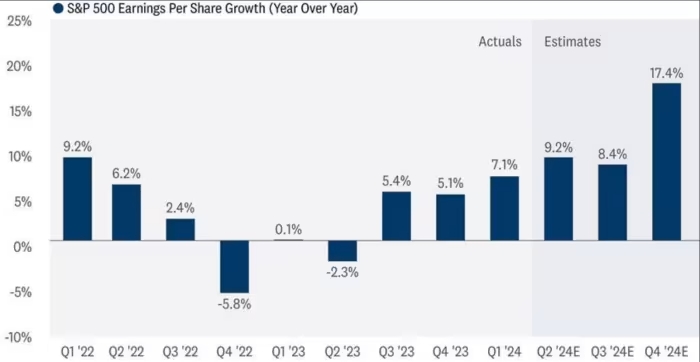
On Tuesday, the S&P 500 closed at a record high, boosted by anticipation of a strong upcoming earnings season. LPL Financial expects this season to be “solid,” but increasing growth estimates for the latter half of 2024 might be challenging. Jeff Buchbinder, chief equity strategist at LPL Financial, remarked that there likely won’t be any setbacks in the AI sector during the second quarter results. He suggested that positive earnings news could delay the long-expected pullback in the S&P 500. Buchbinder’s research notes that Big Tech will be a significant contributor to the S&P 500’s earnings growth for Q2, with other sectors like healthcare, financials, energy, and utilities also playing important roles. The earnings season will start with major Wall Street banks, including JPMorgan Chase, Citigroup, and Wells Fargo, reporting their results on July 12. Analysts expect a 9.2% year-over-year increase in S&P 500 earnings per share (EPS) growth for Q2, and Buchbinder forecasts this growth to reach double digits for the first time since Q4 2021. After a 14.5% rally in the first half of 2024, the S&P 500 is continuing its upward trend in July. Buchbinder stressed that earnings growth is key to sustaining or building on these gains. While he believes a pullback is overdue, he advised investors to be patient as the next six weeks of earnings may not present a buying opportunity. Buchbinder highlighted the “Super Six” — Alphabet, Amazon, Meta, Microsoft, Nvidia, and Apple — as key drivers of the S&P 500’s Q2 earnings growth. He expects the broadening of earnings growth to extend into 2025, with Big Tech remaining influential this year. He also pointed out the importance of company guidance during earnings season to gauge potential earnings growth for the latter half of 2024. Given the steady economy and continued AI investments, executives are unlikely to significantly lower their outlooks. On Tuesday, the Dow Jones Industrial Average rose by 0.4%, the S&P 500 by 0.6%, and the Nasdaq Composite by 0.8%. The S&P 500 closed at a record 5,509.01, according to Dow Jones Market Data. Buchbinder anticipates that a market dip might not occur until August, after earnings news has been fully reflected in stock prices. John PaulJohn Paul is the founder of DayTradeToWin, a trading education and software company established in 2008, supporting traders worldwide. His expertise focuses on price action-based futures trading strategies and structured market analysis. DayTradeToWin delivers trading education, indicators, and software tools designed to help traders apply disciplined, rule-based decision-making across global futures markets. He is the creator of multiple trading methodologies, including the Sonic System, Atlas Line, and Trade Scalper, which help traders identify structured opportunities in markets such as the E-mini S&P 500 (ES), Nasdaq (NQ), crude oil (CL), and gold (GC). Official website: https://daytradetowin.com daytradetowin.com

S&P 500
Market News

Warning: What Last Week’s Stock Fluctuations Mean

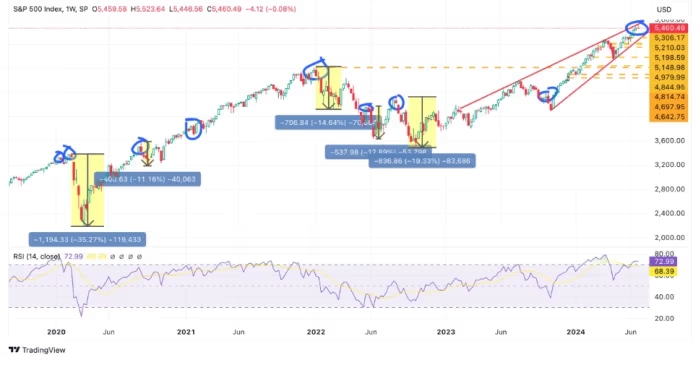
After a strong 14.5% rise in the first half of the year, S&P 500 futures indicate a challenging start for the second half of 2024, according to Michael Kramer, founder of Mott Capital Management. Kramer notes that the cautious start to July follows a concerning end to June, making stocks vulnerable to a pullback. Last Friday, the S&P 500 fell 0.4% after hitting a record intraday high, resulting in a bearish engulfing candle—a negative technical signal. A bearish engulfing candle occurs when a trading session’s range surpasses the previous session’s range but closes lower. This was the second such candle in a week, forming a “2b top reversal pattern.” This pattern suggests that an index or stock attempts a new high, fails to maintain it, and then closes below the previous high. Kramer highlights that last week’s high exceeded the previous week’s but ended lower over the five-session period. Since January 2020, this pattern has appeared only eight times, and in seven instances, the S&P 500 fell the following week. The only exception was in January 2021. For the ‘2b top’ pattern to be invalidated, the S&P 500 must close above 5,487.02 this week, according to Kramer. Other indicators also support Kramer’s caution. The CBOE 1-month implied correlation index, an options-based tool measuring market breadth, hit a record low of 5.59%, below the previous low of 6.78% in October 2017. Additionally, Kramer is wary of the VanEck Semiconductor ETF, which is holding at a 20-day moving average of around $255. A break below this level would signal a downward move. Kramer also notes that high-yield credit spreads, a measure of risk in corporate borrowing, are trending higher even as stock prices rise. Similar conditions in January 2020 and fall 2021 preceded significant market pullbacks. Addressing skepticism, Kramer acknowledges that some may find it hard to believe the S&P 500 could drop significantly. However, he argues that caution is warranted given the market’s rapid rise since October 2023, despite high overnight rates and Federal Reserve policies. “Being cautious isn’t about being bearish. It’s about assessing the odds and managing risk,” Kramer concludes. John PaulJohn Paul is the founder of DayTradeToWin, a trading education and software company established in 2008, supporting traders worldwide. His expertise focuses on price action-based futures trading strategies and structured market analysis. DayTradeToWin delivers trading education, indicators, and software tools designed to help traders apply disciplined, rule-based decision-making across global futures markets. He is the creator of multiple trading methodologies, including the Sonic System, Atlas Line, and Trade Scalper, which help traders identify structured opportunities in markets such as the E-mini S&P 500 (ES), Nasdaq (NQ), crude oil (CL), and gold (GC). Official website: https://daytradetowin.com daytradetowin.com

bond
Market News

Deficit Watch: Bond Markets and Trump vs. Biden

A strategist warns that a lack of budget restraint from either Biden or Trump could result in more frequent weak Treasury auctions. A significant takeaway from Thursday night’s debate between President Joe Biden and Republican challenger Donald Trump is that the U.S. is unlikely to see fiscal restraint regardless of who wins the November 5th election. Both candidates are likely to extend parts or all of the 2017 Trump tax cuts, which include provisions for households set to expire at the end of 2025. Biden plans to extend these for individuals making under $400,000, while Trump aims for a full extension. However, the ability of either candidate to implement these policies will depend on their control of Congress. The Congressional Budget Office estimates that extending the Trump tax cuts for the next decade would add about $4.6 trillion to the deficit, which currently stands at around $1.2 trillion with two-thirds of the fiscal year completed. On Friday, U.S. government debt sold off, pushing yields on 10-year notes and 30-year bonds to their highest closing levels in over two weeks. “There’s a slim chance of fiscal restraint as both candidates aim to renew parts of the Tax Cuts and Jobs Act,” said Will Compernolle, a macro strategist at FHN Financial in New York. “I’m unsure where the political will to narrow the deficit will come from,” he added, noting that even a divided government that causes gridlock tends to maintain the status quo, which is a widening deficit. A lack of fiscal restraint usually leads to more issuance of U.S. government debt, raising concerns about the $27 trillion Treasury market and the potential for waning investor appetite leading to broader disruptions. Compernolle suggests, “We might see more frequent weak auctions, indicating low demand for higher supply. However, this will likely happen incrementally rather than as major disruptions.” Treasury auctions are a primary method for traders and investors to express their views on the growing government debt. Parts of Wall Street have been unsettled by the possibility that investors’ appetite for this debt might be limited. For instance, a poorly received 30-year auction in November briefly sent the corresponding Treasury yield up significantly and marked a period where weak demand at debt sales negatively impacted stocks. Similar shaky auction results were observed last month. BMO Capital Markets strategists Ian Lyngen and Vail Hartman point out two main risks for the Treasury market. One is a resurgence of inflation, pushing interest-rate expectations into 2025. The other risk is a sweep by either party in the election, allowing greater deficit spending without fiscal checks. “A split control between the White House and Congress would limit further deficit growth, although it could bring the debt ceiling debate back into focus,” Lyngen and Hartman wrote in a note this week. Earlier this month, the Congressional Budget Office updated its projections, expecting the federal budget deficit to reach $1.9 trillion in fiscal 2024, or $2 trillion with certain adjustments, and federal debt held by the public to reach 122% of GDP by 2034. John PaulJohn Paul is the founder of DayTradeToWin, a trading education and software company established in 2008, supporting traders worldwide. His expertise focuses on price action-based futures trading strategies and structured market analysis. DayTradeToWin delivers trading education, indicators, and software tools designed to help traders apply disciplined, rule-based decision-making across global futures markets. He is the creator of multiple trading methodologies, including the Sonic System, Atlas Line, and Trade Scalper, which help traders identify structured opportunities in markets such as the E-mini S&P 500 (ES), Nasdaq (NQ), crude oil (CL), and gold (GC). Official website: https://daytradetowin.com daytradetowin.com

market
Market News

Debate Fallout: Markets Eye New Contender

Market Response Post-Debate Markets reacted swiftly to Thursday’s debate, anticipating a higher chance of former President Donald Trump defeating President Joe Biden. Stock-index futures and the U.S. dollar rose as Vice President Kamala Harris acknowledged Biden’s “slow start.” Scaramucci’s Shift in Perspective Anthony Scaramucci, managing partner of SkyBridge and former Trump spokesperson, now believes it would take something “seismic” for Trump not to win, reversing his previous expectation of a Biden re-election. Potential for a New Democratic Nominee New York Times columnist Ezra Klein suggested Democrats might consider a new nominee at the August convention, citing historical precedents like Lincoln and Roosevelt. Betting Market Movements On PredictIt, Trump’s contract rose from 53 to 61 cents, while Biden’s dropped from 48 to 31 cents. Other Democrats, such as California Gov. Gavin Newsom, saw gains. Despite this, Newsom affirmed his support for Biden. Possible Democratic Candidates Trending names included Pennsylvania Gov. Josh Shapiro, Michigan Gov. Gretchen Whitmer, former First Lady Michelle Obama, Commerce Sec. Gina Raimondo, Kentucky Gov. Andy Beshear, and Vice President Harris. Nate Silver’s Analysis Polling expert Nate Silver expressed a preference for Harris or Newsom over Biden, despite them not being his first choices. Intra-Party Challenges Grace Fan from TS Lombard highlighted the challenge of nominating Biden before Ohio’s August 7 certification deadline. Biden’s debate performance has intensified intra-party discussions. Goldman Sachs’ Market Forecasts Goldman Sachs outlined different market scenarios: a Republican sweep could lead to modest equity rallies, higher yields, and a stronger dollar, while a Democratic sweep might cause modest equity declines, higher yields, and a weaker dollar. Market movements will depend on shifts in the odds of a Democratic or Republican win and potential policy changes from any new candidate. John PaulJohn Paul is the founder of DayTradeToWin, a trading education and software company established in 2008, supporting traders worldwide. His expertise focuses on price action-based futures trading strategies and structured market analysis. DayTradeToWin delivers trading education, indicators, and software tools designed to help traders apply disciplined, rule-based decision-making across global futures markets. He is the creator of multiple trading methodologies, including the Sonic System, Atlas Line, and Trade Scalper, which help traders identify structured opportunities in markets such as the E-mini S&P 500 (ES), Nasdaq (NQ), crude oil (CL), and gold (GC). Official website: https://daytradetowin.com daytradetowin.com

Scroll to Top