
market news

Market News

What Drove Tuesday’s Market Decline? More Than Just Iran

The strike has raised concerns about supply chain disruptions and price increases for goods. Jose Torres, a senior economist at Interactive Brokers, highlighted that the uncertainty around the strike, along with strong warnings from union leaders, has further unsettled market. Port Strike Adds to Softer Start for October While Iran’s missile strike on Israel triggered a sharp selloff in U.S. stocks on Tuesday and caused oil prices to surge, it wasn’t the only factor rattling Wall Street. Analysts also pointed to the impact of a U.S. dockworkers’ strike, which has shut down major East Coast and Gulf ports, potentially affecting the economy by as much as $4 billion per day. Although the missile attack sent stocks plummeting early in the session, pushing investors toward safe-haven assets like U.S. Treasurys and gold, markets regained some ground later in the day. The Dow Jones Industrial Average ended down 173 points, or 0.4%, and the S&P 500 closed with a 0.9% loss. Oil prices, which spiked earlier, settled with gains of over 2%. The geopolitical risks in the Middle East, alongside the port strike, are expected to keep markets volatile. Despite this, some analysts believe these events could present buying opportunities. Ed Yardeni, president of Yardeni Research, noted that market selloffs driven by geopolitical concerns often create favorable entry points for investors. However, the risk of further escalation in the Middle East remains a key threat to the stock market’s momentum. John PaulJohn Paul is the founder of DayTradeToWin, a trading education and software company established in 2008, supporting traders worldwide. His expertise focuses on price action-based futures trading strategies and structured market analysis. DayTradeToWin delivers trading education, indicators, and software tools designed to help traders apply disciplined, rule-based decision-making across global futures markets. He is the creator of multiple trading methodologies, including the Sonic System, Atlas Line, and Trade Scalper, which help traders identify structured opportunities in markets such as the E-mini S&P 500 (ES), Nasdaq (NQ), crude oil (CL), and gold (GC). Official website: https://daytradetowin.com daytradetowin.com

gold
Market News

Gold Surges Ahead of Stocks and Bonds in Q3

The SPDR Gold Shares ETF saw a strong surge in the third quarter, fueled by growing investor optimism that the Federal Reserve could successfully achieve a “soft landing” for the U.S. economy. By the end of September, many investors appeared more confident that the Fed could lower inflation without triggering a recession. “There’s more confidence that we’re going to stick the soft landing,” said Michael Arone, chief investment strategist at State Street Global Advisors. However, Arone also noted that such outcomes are rare, and gold’s strong performance suggests that some investors are still hedging against economic risks. The SPDR Gold Shares ETF (GLD), which invests in physical gold, has soared 27.1% this year, including a 13% rise in the third quarter. This outpaced the S&P 500, which gained 5.5% during the same period and is up 20.8% for the year. September marked the start of the Fed’s interest-rate-cutting cycle, with the central bank opting for a larger-than-expected half-point reduction. This move sparked a rally in U.S. bonds, as the iShares Core U.S. Aggregate Bond ETF (AGG), which tracks investment-grade bonds, gained 5.3% in the third quarter. Meanwhile, riskier corporate bonds, like the iShares iBoxx $ High Yield Corporate Bond ETF (HYG), saw a 5.7% gain. Despite the optimism, Arone recommends maintaining a small allocation to gold as a hedge against potential risks. He suggests that long-term investors consider a 3% to 10% allocation, emphasizing that falling interest rates make gold an increasingly attractive asset. As the “opportunity cost” of holding gold declines, it remains a valuable safeguard, especially if the economic outlook shifts unexpectedly. John PaulJohn Paul is the founder of DayTradeToWin, a trading education and software company established in 2008, supporting traders worldwide. His expertise focuses on price action-based futures trading strategies and structured market analysis. DayTradeToWin delivers trading education, indicators, and software tools designed to help traders apply disciplined, rule-based decision-making across global futures markets. He is the creator of multiple trading methodologies, including the Sonic System, Atlas Line, and Trade Scalper, which help traders identify structured opportunities in markets such as the E-mini S&P 500 (ES), Nasdaq (NQ), crude oil (CL), and gold (GC). Official website: https://daytradetowin.com daytradetowin.com

market
Market News

World Market Cap Crosses $123 Trillion: What’s Next?

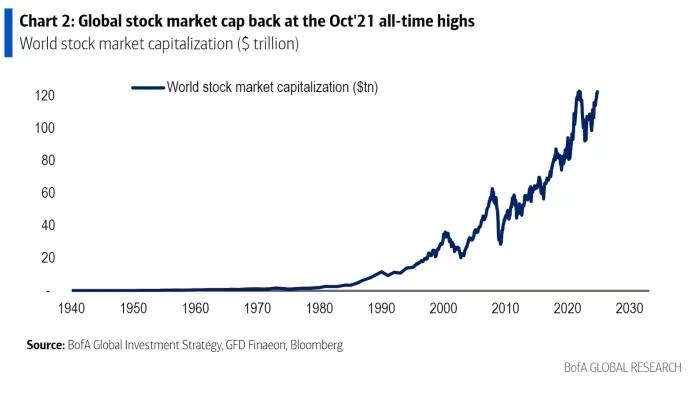
Strategists Suggest Industrial Metals, Materials, and International Stock market as Top Plays for China’s Rally Global stock market capitalization is on track to surpass its highest level in three years, driven by the Federal Reserve’s interest rate cuts and China’s latest economic stimulus efforts. Bank of America, citing data from GFD Finaeon, predicts global market cap will soon exceed the record $123 trillion reached in October 2021. The Vanguard Total World Stock ETF (VT), which tracks U.S. and global stocks, has already hit a new all-time high, overtaking its 2021 peak. According to Bank of America strategists led by Michael Hartnett, markets typically stabilize when policymakers intervene—exactly what’s happening now. China’s recent stimulus measures came on the heels of a half-point interest rate cut by the Fed, leading to a strong rally in Chinese assets. The Hang Seng Index jumped 13% this week, its best performance since 1998. With the Fed’s rate cuts and no recession on the horizon, risky assets are gaining momentum. Investors see the policy actions from the Fed and China as sufficient to reduce recession risks. Bank of America strategists advise that the best way to profit from China’s economic rally is by investing in industrial metals, materials, and international stocks, particularly as long as China’s 10-year yield stays above 2%. Currently, the yield stands at 2.17%. John PaulJohn Paul is the founder of DayTradeToWin, a trading education and software company established in 2008, supporting traders worldwide. His expertise focuses on price action-based futures trading strategies and structured market analysis. DayTradeToWin delivers trading education, indicators, and software tools designed to help traders apply disciplined, rule-based decision-making across global futures markets. He is the creator of multiple trading methodologies, including the Sonic System, Atlas Line, and Trade Scalper, which help traders identify structured opportunities in markets such as the E-mini S&P 500 (ES), Nasdaq (NQ), crude oil (CL), and gold (GC). Official website: https://daytradetowin.com daytradetowin.com

Economic Data
Market News

Why Investors Are Obsessed with Economic Data

Investors are increasingly jittery about economic data, even reports that once flew under the radar. As the Federal Reserve works to lower interest rates and guide the economy toward a soft landing, market reactions have become more pronounced. While crucial reports like monthly job numbers still draw attention, even routine data releases now have the power to move markets. Jack Janasiewicz, a portfolio manager at Natixis Investment Managers Solutions, attributes this to investors being “hyper-sensitive” to the constant stream of news, leading to swift and sometimes exaggerated market reactions. Bespoke Investment Group analyzed 25 years of data and found that Wall Street has seen greater volatility in the last four years, especially on days when economic data is released. Before the pandemic, the S&P 500 averaged a daily move of 0.81% on such days, but that figure has risen to 0.94% since March 2020. In their analysis of 34 economic indicators, Bespoke noted that previously overlooked data points have gained importance. Releases like the University of Michigan’s consumer confidence survey, ADP private payrolls, and durable-goods orders now frequently coincide with significant market moves—often 1% or more. Prior to the pandemic, such sharp reactions were rare. Jeffrey Roach, chief economist at LPL Financial, pointed to the Labor Department’s JOLTS report as a prime example of a dataset that has become a focal point during the recent economic tightening. Once ignored, it’s now closely watched, especially as the Fed monitors labor tightness through the openings-to-unemployed ratio. Market volatility has also surged around inflation data and Federal Reserve decision days. Before the pandemic, the average daily market move on Fed-decision days was 0.88%, but this has jumped to 1.17% since 2020. Janasiewicz suggests that rising market leverage and the use of short-term options trading could be fueling these swings. Despite ongoing recession fears, recent economic reports have kept markets buoyant, with the S&P 500 and Dow Jones rallying on the back of strong data. However, Janasiewicz warns that investors remain on edge, poised to exit quickly at any hint of economic weakness, driven by the fear of getting caught in a selloff. John PaulJohn Paul is the founder of DayTradeToWin, a trading education and software company established in 2008, supporting traders worldwide. His expertise focuses on price action-based futures trading strategies and structured market analysis. DayTradeToWin delivers trading education, indicators, and software tools designed to help traders apply disciplined, rule-based decision-making across global futures markets. He is the creator of multiple trading methodologies, including the Sonic System, Atlas Line, and Trade Scalper, which help traders identify structured opportunities in markets such as the E-mini S&P 500 (ES), Nasdaq (NQ), crude oil (CL), and gold (GC). Official website: https://daytradetowin.com daytradetowin.com
stocks
Market News

Stocks Set for a Dot-Com Bubble-Like Shift

This raises concerns about how much longer the rally can maintain its current momentum. The S&P 500 is nearing a rare milestone: a 20% or greater rise in two consecutive calendar years. As of Tuesday’s close, the index had crossed the 20% year-to-date mark, hitting its 41st record high of the year. Although the S&P 500 saw a slight pullback by the end of Wednesday, it remains near its peak. Following the Federal Reserve’s substantial interest rate cut, many investors are hopeful the index will push higher. It’s been a long time since the market experienced consecutive years of such strong performance. The last time was in 1998, during the dot-com boom, when the index posted four straight years of 20%-plus gains, starting in 1995. Before that, stocks hadn’t seen two consecutive years of such gains since 1955, before the S&P 500 was introduced. With the S&P 500 up 60% from its October 2022 low, according to FactSet data, investors are beginning to wonder how much further large-cap U.S. stocks can rise and whether this remarkable bull market may be nearing its peak. Some have suggested shifting away from large-cap stocks in favor of small- and mid-caps or looking for bargains abroad. Others argue that large-cap stocks still offer the best potential for returns, even as valuations have climbed to historically high levels. The comparison to the dot-com era is hard to ignore. While many experts are quick to point out the differences, it’s notable that technology stocks are once again leading the charge. Information technology and communication services now represent a significant share of the S&P 500’s market value, and valuations relative to sales are even higher than they were in 1999, according to FactSet. However, today’s companies are much more profitable than they were in the late 1990s. Recently, the S&P 500’s forward price-to-earnings ratio was 21.6, lower than the 24 times earnings seen in late 1999. Some analysts caution that high valuations could set the stage for below-average returns over the next decade. But others, like those at Yardeni Research, believe that strong earnings growth and improving productivity will continue to support the market, pushing it higher through at least 2030. While tech stocks may not dominate the market as much as they did earlier in this rally, other sectors—such as financials, industrials, and utilities—have begun to play a larger role. If these lagging sectors continue to gain momentum, the broader market could sustain its upward trajectory. Historically, following a 20% return, the S&P 500 has averaged a 9% gain the following year. While the pace may slow, history suggests that the rally could still continue. John PaulJohn Paul is the founder of DayTradeToWin, a trading education and software company established in 2008, supporting traders worldwide. His expertise focuses on price action-based futures trading strategies and structured market analysis. DayTradeToWin delivers trading education, indicators, and software tools designed to help traders apply disciplined, rule-based decision-making across global futures markets. He is the creator of multiple trading methodologies, including the Sonic System, Atlas Line, and Trade Scalper, which help traders identify structured opportunities in markets such as the E-mini S&P 500 (ES), Nasdaq (NQ), crude oil (CL), and gold (GC). Official website: https://daytradetowin.com daytradetowin.com

market
Market News

Reliable Market Signal Says It’s Time to Buy

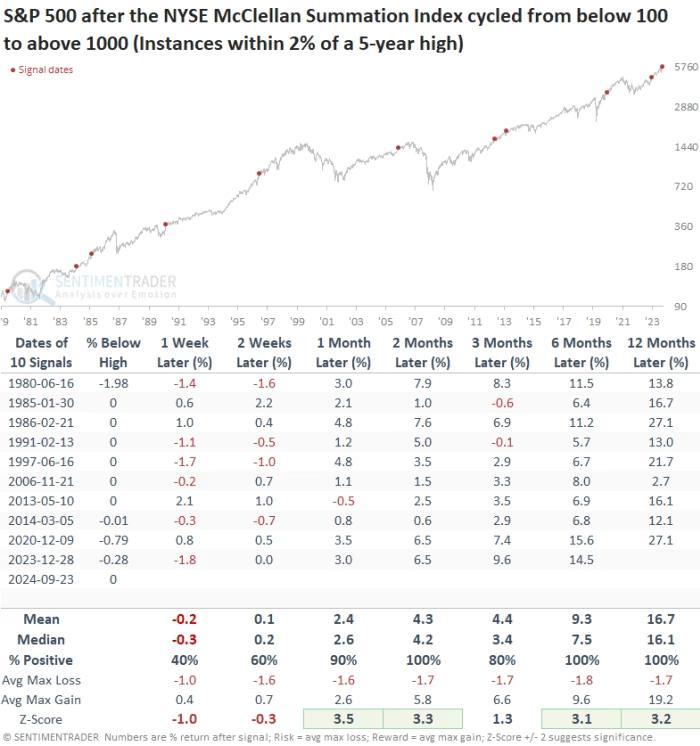
A closely-watched stock-market indicator is flashing a strong buy signal as more companies’ shares join the rally. The McClellan Summation Index, which tracks market breadth, has sharply increased, signaling more gains for the S&P 500 with near-perfect accuracy, according to Dean Christians, a senior research analyst at SentimenTrader. The McClellan Index measures how many stocks are participating in a markets move. When it’s rising, more stocks are rallying, signaling stronger market breadth. When it’s falling, market breadth is weakening, often indicating a broader market sell-off. Technical analysts use the index to monitor what’s happening beneath major indexes like the S&P 500. Historically, sharp improvements in the index have accurately predicted further stock market gains. When it surges from below 100 to over 1,000, stocks have gone on to rise over the next year with 96% accuracy. Even more impressive, that success rate jumps to 100% when the signal occurs while the S&P 500 is within 2% of a significant high. This signal was triggered on Monday. According to Christians, this means the projected gains are more significant than just the typical upward drift of the stock market over time. On Tuesday, the S&P 500 rose 14.36 points, or 0.3%, to close at 5,732.93, marking its 41st record close of 2024. The Dow Jones Industrial Average gained 83.57 points, or 0.2%, to 42,208.22, also hitting a record, while the Nasdaq Composite rose 100.25 points, or 0.6%, to 18,074.52, though it remains more than 3% below its July record. John PaulJohn Paul is the founder of DayTradeToWin, a trading education and software company established in 2008, supporting traders worldwide. His expertise focuses on price action-based futures trading strategies and structured market analysis. DayTradeToWin delivers trading education, indicators, and software tools designed to help traders apply disciplined, rule-based decision-making across global futures markets. He is the creator of multiple trading methodologies, including the Sonic System, Atlas Line, and Trade Scalper, which help traders identify structured opportunities in markets such as the E-mini S&P 500 (ES), Nasdaq (NQ), crude oil (CL), and gold (GC). Official website: https://daytradetowin.com daytradetowin.com

Scroll to Top