
market news

U.S. Stocks
Market News

Calm Before the Storm? What the Calm in U.S. Stocks Means for Your Portfolio

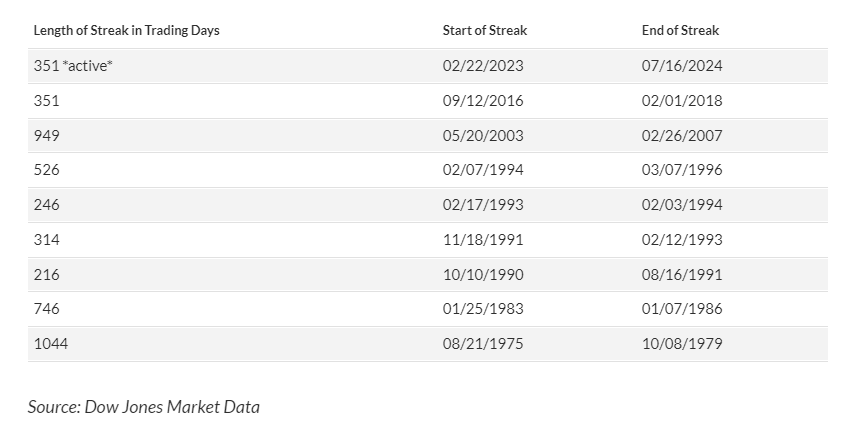
U.S. stocks are experiencing an unusually tranquil stretch poised to hit a new milestone on Wednesday as the rally expands beyond a few megacap names. If the S&P 500 avoids a significant selloff, it will mark 352 consecutive sessions without a 2% decline, the longest streak since February 2007. ETF and technical strategist Todd Sohn from Strategas explained to MarketWatch that while many investors brace for a pullback, historical data shows that periods of market calm can last much longer than expected. Over the past 50 years, there have been four instances where the S&P 500 went even longer without a 2% drop, with the longest being a 1,044-day stretch ending in October 1979. Sohn emphasized that excessive worrying about potential threats can lead to missed opportunities. Staying on the sidelines often results in greater losses than the selloffs themselves. “In and of itself, it isn’t really something to worry about,” he said, advising investors to remain focused on their long-term investment strategies. Despite recent risks, the rally has shown remarkable resilience. Paul Hickey, an analyst at Bespoke Investment Group, noted that even significant events, like a near-assassination of a leading U.S. presidential candidate and unexpected inflation data, haven’t derailed the market’s upward trajectory. The S&P 500 continues to reach new highs, even without contributions from key stocks like Nvidia. Hickey also pointed out the low volatility, with the Cboe Volatility Index (VIX) near its lowest levels since before the COVID-19 pandemic. A low VIX indicates a solid rally but also hints at potential investor complacency, especially as stocks enter their historically weakest three-month period from mid-July to mid-October. While the S&P 500 hasn’t seen a 2% drop in a single day recently, there have been pullbacks, including a 10% correction ending in late October and a 5% drop in April. As fall approaches, the market faces risks from U.S. politics, a cooling economy, and potentially disappointing corporate earnings. Wall Street experts, including those from Citigroup and Goldman Sachs, warn that the market might be due for a selloff due to rapid gains and high valuations. However, a recent rally in lagging market segments like the Russell 2000 is sparking optimism for a rotation toward value stocks and cyclical sectors, potentially driving the next phase of the rally. The key question is whether this rotation will negatively impact the megacap stocks responsible for most of this year’s gains. Mike Dickson, head of research and product development at Horizon Investments, believes the market can continue rising even if tech stagnates, but not if it collapses. Both the S&P 500 and Dow Jones Industrial Average reached record highs on Tuesday, with the Nasdaq Composite achieving its second-highest close in history. John PaulJohn Paul is the founder of DayTradeToWin, a trading education and software company established in 2008, supporting traders worldwide. His expertise focuses on price action-based futures trading strategies and structured market analysis. DayTradeToWin delivers trading education, indicators, and software tools designed to help traders apply disciplined, rule-based decision-making across global futures markets. He is the creator of multiple trading methodologies, including the Sonic System, Atlas Line, and Trade Scalper, which help traders identify structured opportunities in markets such as the E-mini S&P 500 (ES), Nasdaq (NQ), crude oil (CL), and gold (GC). Official website: https://daytradetowin.com daytradetowin.com
Small Caps
Market News

Small Caps: The Hottest Investment Now

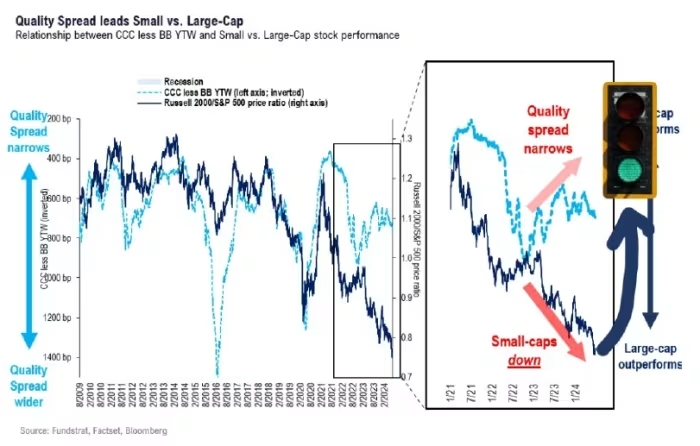
Futures indicate a positive start for equities, with the S&P 500 nearing a record high. Despite recent calm, analysts detect a significant shift in market sentiment. Greg Boutle of BNP Paribas notes that last Thursday’s softer-than-expected consumer price index report and the resulting dip in Treasury yields triggered a major rally in overlooked market segments. Small-cap stocks gained favor, while Big Tech faced heavy selling. Though this trend partially reversed on Friday, the key question is whether small caps will maintain their upward momentum. Tom Lee of Fundstrat is optimistic. He believes small caps, tracked by the iShares Russell 2000 ETF (IWM), present the “most compelling near-term investment case,” predicting a potential 50% gain in 2024. With small caps currently up only 6%, there is significant growth potential. Lee attributes this to the low June CPI, which he believes signals continued small-cap rallies. Lee’s optimism is based on five key factors: “We see the conditions for a strong rally in IWM. Mark Newton, head of technical strategy, believes a confirming ‘breakout’ of small caps could happen this week,” concludes Lee. John PaulJohn Paul is the founder of DayTradeToWin, a trading education and software company established in 2008, supporting traders worldwide. His expertise focuses on price action-based futures trading strategies and structured market analysis. DayTradeToWin delivers trading education, indicators, and software tools designed to help traders apply disciplined, rule-based decision-making across global futures markets. He is the creator of multiple trading methodologies, including the Sonic System, Atlas Line, and Trade Scalper, which help traders identify structured opportunities in markets such as the E-mini S&P 500 (ES), Nasdaq (NQ), crude oil (CL), and gold (GC). Official website: https://daytradetowin.com daytradetowin.com
market
Market News

Small Caps Shine Amid Market Rotation

Thursday was a rough day for hedge funds heavily invested in megacap tech stocks and shorting the rest of the market. A cooler-than-expected June consumer-price index (CPI) reading ignited a rotation into previously neglected sectors. “Hedge funds are blowing up today,” said Jay Hatfield, CEO of Infrastructure Capital Advisers, referring to strategies that involve long positions in large-cap tech stocks and short bets against small- and mid-cap stocks. While this strategy had been profitable during a rally led by a select group of tech giants in 2024, the tide turned abruptly. Small-cap stocks surged, with the Russell 2000 index up 3.6%, while the Nasdaq Composite fell 2%. This marked the biggest one-day outperformance for the Russell over the Nasdaq since records began in 1986, according to Dow Jones Market Data. The key question for investors is whether this rotation is temporary or the beginning of a broader rally, following a period of concentrated market leadership. Market analysts noted sharp rises in heavily shorted stocks, indicating the squeeze could persist for some time. On Thursday, the S&P 500 pulled back 0.9% after hitting a record intraday high, while the Dow Jones Industrial Average gained 0.1%. The consumer-price index fell 0.1% in June, slowing the year-over-year rate to 3%. The core rate, excluding energy and food costs, rose 0.1%, slowing to 3.3% from 3.4%. Economists warn that more data will be needed to ensure a September rate cut by the Federal Reserve, but fed-funds futures traders now see a better than 90% probability of at least a quarter-point reduction, according to the CME FedWatch Tool. The Magnificent Seven megacap tech stocks, which had led the rally since October 2022 due to AI enthusiasm, were each down at least 2% by midday Thursday. This resulted in a market cap drop of more than $500 billion, the largest single-day loss since September 13, 2022. Despite the decline in heavyweight tech stocks dragging down the S&P 500, around 80% of the index’s stocks were higher on the day. The equal-weighted S&P 500 outperformed its market-cap-weighted version by around 1.8 percentage points, marking the biggest relative gain since January 2021. Hatfield, also the portfolio manager of the InfraCap Small Cap Income ETF, sees potential for the rally to broaden as the market anticipates continued cooling inflation readings and eventual Fed rate cuts. He expects the overall market to extend its run, having recently raised his year-end target for the S&P 500 to 6,000. A September rate cut by the Fed could continue a trend of global central banks injecting liquidity into the banking system, historically boosting both stocks and bonds. Although the S&P 500’s pullback Thursday was exacerbated by the tech selloff, Sonu Varghese, global macroeconomic strategist at Carson Group, believes it won’t be a lasting drag on the index. He anticipates that large-cap value stocks could rally and support the index’s forward momentum, even if tech consolidates. John PaulJohn Paul is the founder of DayTradeToWin, a trading education and software company established in 2008, supporting traders worldwide. His expertise focuses on price action-based futures trading strategies and structured market analysis. DayTradeToWin delivers trading education, indicators, and software tools designed to help traders apply disciplined, rule-based decision-making across global futures markets. He is the creator of multiple trading methodologies, including the Sonic System, Atlas Line, and Trade Scalper, which help traders identify structured opportunities in markets such as the E-mini S&P 500 (ES), Nasdaq (NQ), crude oil (CL), and gold (GC). Official website: https://daytradetowin.com daytradetowin.com
Uncategorized

Act Fast: Short the Dollar, Says Goldman Sachs

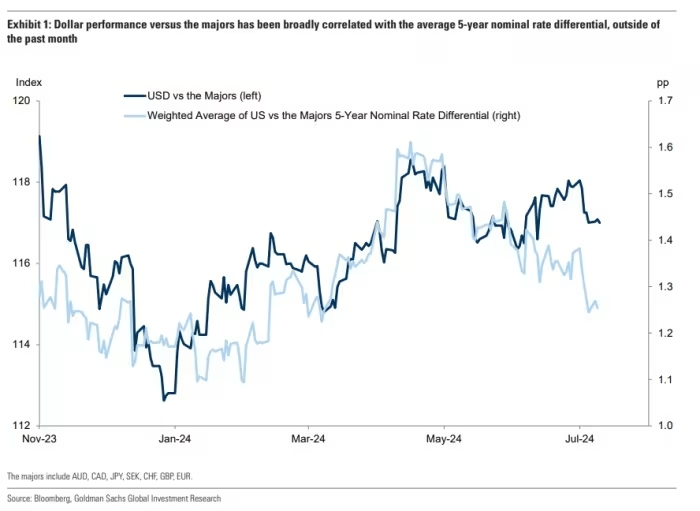
Happy CPI day to all who observe! Here’s a deeper look into today’s crucial report. If inflation aligns with economists’ expectations, there could be a brief opportunity to bet against the U.S. dollar, according to Karen Reichgott Fishman, senior currency strategist at Goldman Sachs. After reaching 2023 highs, the dollar has been declining and might weaken further. Fishman explains, “The tactical backdrop looks increasingly friendly for risk and negative for the dollar.” This year’s dollar fluctuations have primarily been driven by interest rate expectations, shown in a chart that plots the dollar against a weighted average of the rate differential in 5-year securities of major counterparts. Comparing the dollar’s performance against major rivals reveals this trend: it has risen sharply against the Japanese yen (USDJPY), where rate differentials have widened, and fallen against the British pound (GBPUSD), with minimal changes. Interest rates are not the only factor behind the dollar’s strength. Fishman notes that the second-largest contributor to the dollar’s gains has been the Mexican peso (USDMXN), influenced by a significant shift after Mexico’s landslide election. Fishman also points out that the correlation between stocks and bonds has been mostly positive this year, which often coincides with broad dollar swings. When stocks and bonds rise together, the dollar typically struggles. “This makes it all the more surprising to see the dollar simultaneously hit new highs and reinforces the scope for a tactical sell-off,” she adds. Currently, there appears to be a narrow window for further relief in U.S. yields and gains for U.S. equities, with few major obstacles expected until mega-cap tech earnings at the end of July. In such an environment, the dollar usually weakens against most currencies and becomes a good candidate for funding emerging-market carry trades. However, Fishman emphasizes that the dollar’s bullish trend is likely to resume in the second half. Ahead of the U.S. election, broader tariffs, especially against the Chinese yuan and other Asian currencies, pose an upside risk. This is in addition to the expected limited cross-border investment flows leading up to the election. John PaulJohn Paul is the founder of DayTradeToWin, a trading education and software company established in 2008, supporting traders worldwide. His expertise focuses on price action-based futures trading strategies and structured market analysis. DayTradeToWin delivers trading education, indicators, and software tools designed to help traders apply disciplined, rule-based decision-making across global futures markets. He is the creator of multiple trading methodologies, including the Sonic System, Atlas Line, and Trade Scalper, which help traders identify structured opportunities in markets such as the E-mini S&P 500 (ES), Nasdaq (NQ), crude oil (CL), and gold (GC). Official website: https://daytradetowin.com daytradetowin.com
Dow
Market News

Dow’s 2024 Struggles Against the S&P 500

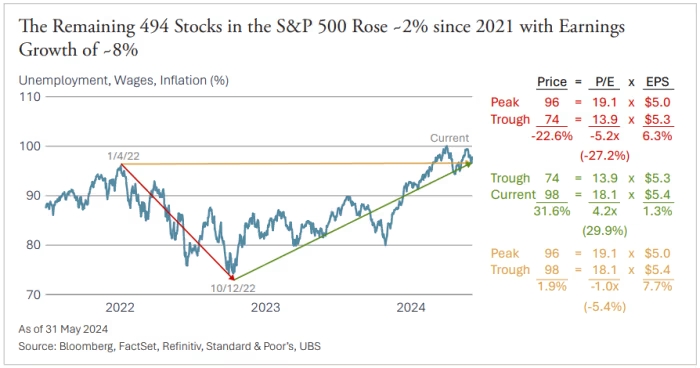
The Dow’s underperformance can be partly attributed to its structure as a price-weighted index, where higher-priced stocks like UnitedHealth Group have more influence than tech giants like Apple and Microsoft. This is unlike the S&P 500 and Nasdaq Composite, which are weighted by market capitalization. In 2024, the Dow Jones Industrial Average significantly lags behind other major indexes, with the S&P 500 outperforming it by 12.65 percentage points as of Tuesday. This gap is near historic levels, closely following last year’s 12.8 percentage-point difference. Megacap tech stocks have driven most of the gains for the S&P 500 and Nasdaq Composite this year, leaving the less tech-heavy Dow behind. From October 2022 to June 2024, the S&P 500 saw a 55% total return, with 60% of that from just 10 stocks, according to Ronald Temple of Lazard Asset Management. Despite predictions for a broader rally, the market remains tech-focused. The divergence extends beyond the Dow and S&P 500; the S&P 500’s equal-weight version is up only 3.9% in 2024, compared to 16.9% for the standard index. This performance gap mirrors the dot-com bubble peak in 2000, as noted by Bespoke Investment Group analysts. Skeptics argue that a shift away from megacap stocks could help lagging sectors catch up, potentially stabilizing or boosting the broader market. John PaulJohn Paul is the founder of DayTradeToWin, a trading education and software company established in 2008, supporting traders worldwide. His expertise focuses on price action-based futures trading strategies and structured market analysis. DayTradeToWin delivers trading education, indicators, and software tools designed to help traders apply disciplined, rule-based decision-making across global futures markets. He is the creator of multiple trading methodologies, including the Sonic System, Atlas Line, and Trade Scalper, which help traders identify structured opportunities in markets such as the E-mini S&P 500 (ES), Nasdaq (NQ), crude oil (CL), and gold (GC). Official website: https://daytradetowin.com daytradetowin.com

inflation
Market News

Inflation and Trump 2.0: Wall Street’s Mixed Signals

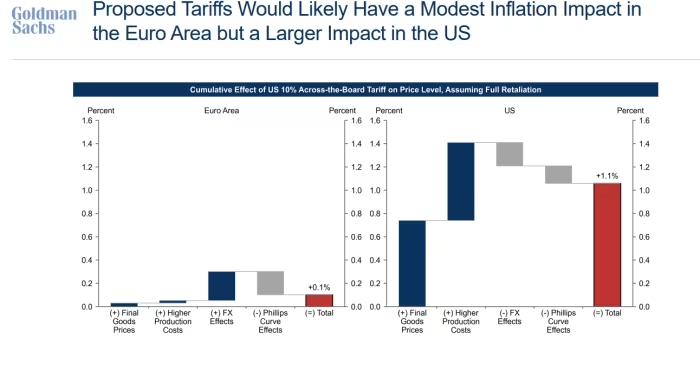
The upcoming election could fundamentally change the inflation outlook for the next three to four years, according to an inflation trader. While many investors and traders are optimistic about cooling U.S. inflation ahead of Thursday’s consumer-price index for June, Wall Street is concerned about the potential inflationary impacts of a second Trump presidency. Before the CPI report, there are conflicting views on the future of U.S. inflation, complicating the Federal Reserve’s analysis of the appropriate path for interest rates, which remain at 23-year highs of 5.25% to 5.5%. Major U.S. stock indexes closed mostly higher on Tuesday, sending the S&P 500 and Nasdaq Composite to record closes despite a selloff in U.S. government debt that pushed up 10- and 30-year Treasury yields for the first time in five sessions. One perspective is that inflation will likely continue easing as U.S. growth slows, allowing the Federal Reserve to cut interest rates as soon as September. Economists expect the annual headline CPI inflation rate to fall to 3.1% in June from 3.3% in May, with inflation traders predicting a drop to 2% by May 2025. Another perspective suggests that inflation could rise again if Trump is re-elected due to his trade and immigration proposals. Parts of the market have expressed concern about Trump 2.0, as seen in a two-day rise in Treasury yields on June 28 and July 1, despite four months remaining before Americans vote. “For good reasons, traders link Trump’s policy agenda with inflation,” said Thierry Wizman, a global FX and rates strategist at Macquarie. “They see policy rates being higher than otherwise under Trump 2.0.” Trump leads President Joe Biden in polls nearly two weeks after their June 27 debate, drawing attention to his proposals for 10% duties on all imports and minimum 60% tariffs on Chinese goods. Biden has also faced criticism for the U.S. inflation run-up that began in 2021, following his Covid-relief plan that added $1.9 trillion in federal spending. Goldman Sachs’ chief economist Jan Hatzius recently stated that Trump’s 10% tariff proposal could trigger reciprocal actions by other countries, potentially raising U.S. inflation by 1.1 percentage points and leading to five extra quarter-point rate hikes by the Fed. Additionally, Deutsche Bank strategist Steven Zeng highlighted the impact of Trump’s immigration policies on U.S. interest rates. He noted that increased immigration flows have acted as a positive supply shock, aiding the Fed in cutting rates, and that reversing these flows could lead to higher wage inflation and a more hawkish Fed stance. After Fed Chairman Jerome Powell’s congressional testimony on Tuesday, fed-funds futures traders priced in a 70% chance of a quarter-point rate cut by September. However, inflation trader Gang Hu of WinShore Capital Partners in New York doubts any rate cuts will occur in 2024. He emphasized that the outcome of the November 5 presidential election could drastically change everything, necessitating careful consideration by the Fed. “Right now, it’s all about Trump. That’s the major theme and the Fed cannot ignore the possible election results at all,” Hu said. “It’s about an election that can fundamentally change the inflation picture for the next three to four years, and parts of the market are already worrying about that picture.” The Fed’s role in controlling inflation means policymakers will likely consider Trump’s tariff proposals and immigration reforms, given their potential impact on the labor market and inflation. On Tuesday, Powell avoided discussing Trump’s tariff plans directly and instead highlighted the persistent nature of inflation after the 1970s and the current era’s supply and demand shocks from the post-Covid reopening of the U.S. economy. “The Fed is absolutely not going to go anywhere near Trump’s policies by talking about them,” said economist Derek Tang of Monetary Policy Analytics. He suggested that the Fed will use uncertain forecasts as a reason to avoid addressing Trump-related risks ahead of the November election. Tang predicted that the Fed might start easing rates by September or December but could reverse course if needed, potentially confusing investors. John PaulJohn Paul is the founder of DayTradeToWin, a trading education and software company established in 2008, supporting traders worldwide. His expertise focuses on price action-based futures trading strategies and structured market analysis. DayTradeToWin delivers trading education, indicators, and software tools designed to help traders apply disciplined, rule-based decision-making across global futures markets. He is the creator of multiple trading methodologies, including the Sonic System, Atlas Line, and Trade Scalper, which help traders identify structured opportunities in markets such as the E-mini S&P 500 (ES), Nasdaq (NQ), crude oil (CL), and gold (GC). Official website: https://daytradetowin.com daytradetowin.com

Scroll to Top