

stock market

Market News

S&P 500’s September Suffering: Inflation’s Toll on Markets

In September, the S&P 500 experienced its most substantial monthly decline since December of the previous year, with a 4.9% loss. On Friday, U.S. stock markets closed with most indices in the red as investors assessed the latest inflation data from the Federal Reserve. This marked the conclusion of a turbulent month for stocks. Here’s a snapshot of how key indices performed: For the week, the Dow registered a 1.3% decline, the S&P 500 dropped by 0.7%, while the Nasdaq Composite managed to eke out a 0.1% gain. All three indices reported both monthly and quarterly losses. Factors influencing the markets: The S&P 500 wrapped up Friday with a slight decline, marking its fourth consecutive week of losses. Initially, U.S. stocks posted gains at the opening bell following the release of the latest inflation data. Investor sentiment has been fluctuating between concerns about a potential U.S. economic recession and the possibility of a “soft landing” facilitated, at least in part, by Federal Reserve interest rate hikes aimed at combatting inflation. According to Brent Schutte, Chief Investment Officer at Northwestern Mutual Wealth Management Co., this uncertainty has left investors searching for answers. September saw the S&P 500’s worst monthly performance, with a 4.9% decline, according to FactSet data. Schutte characterized it as a “tough month for stocks.” Liz Ann Sonders, Chief Investment Strategist at Charles Schwab, noted that the declining breadth in the U.S. stock market might have attracted some “dip buyers” on Friday morning. She added that the inflation data from the Federal Reserve’s preferred gauge, released before the market opened, didn’t significantly impact stocks, as there were no major surprises in the data. The PCE (personal-consumption expenditures) index showed that core prices, excluding volatile food and energy categories, increased by 0.1% in August, a lower-than-expected rise. Additionally, the year-over-year inflation rate eased to 3.9%. However, rising energy prices contributed to a 0.4% increase in the headline PCE price index in August, marking its most significant increase in seven months. According to Carol Schleif, Chief Investment Officer at BMO Family Office, the core PCE still remains nearly double the Fed’s 2% target, prompting the Fed to consider the possibility of another interest rate hike. Callie Cox, U.S. Investment Strategist at eToro, highlighted the decline in services inflation, with prices rising by 4.9% from the previous year in August. This moderation in services inflation aligns with the Federal Reserve’s goals as they approach the end of rate hikes. Higher long-term yields have continued to exert pressure on stocks. On Friday, the yield on the 10-year Treasury note (BX:TMUBMUSD10Y) decreased by 2.4 basis points to 4.572%, although it remained near 16-year highs reached earlier in the week, according to Dow Jones Market Data. In other economic data released on Friday, the Bureau of Economic Analysis estimated that personal income increased by 0.4% in August, with consumer spending also up by 0.4%. There are signs of cooling consumer spending, particularly in the services sector, as per Northwestern Mutual’s Schutte. Investors also received updates from the Chicago Business Barometer, which registered at 44.1 in September, representing its first drop in three months. Meanwhile, the University of Michigan consumer-sentiment index showed sentiment improving slightly at the end of September, with the final reading rising to 68.1 from 67.7 earlier in the month. The University of Michigan data included a reading on inflation expectations, showing respondents expected inflation to decrease further to 3.2% in a year’s time. Some analysts attributed Friday’s fading stock-market gains to portfolio repositioning by funds as they prepared for the fourth quarter, which began the following Monday. The market has been characterized by a risk-off environment for much of September. Notable stocks in focus: John PaulJohn Paul is the founder of DayTradeToWin, a trading education and software company established in 2008, supporting traders worldwide. His expertise focuses on price action-based futures trading strategies and structured market analysis. DayTradeToWin delivers trading education, indicators, and software tools designed to help traders apply disciplined, rule-based decision-making across global futures markets. He is the creator of multiple trading methodologies, including the Sonic System, Atlas Line, and Trade Scalper, which help traders identify structured opportunities in markets such as the E-mini S&P 500 (ES), Nasdaq (NQ), crude oil (CL), and gold (GC). Official website: https://daytradetowin.com daytradetowin.com


Market News

? S&P 500 Alert: The Mother of All Trend Lines Unveiled

Following what appears to be the most challenging month for stocks this year, some investors are closely analyzing a chart that signals an impending showdown for the S&P 500 SPX. This chart was shared by a stock market commentator on X, known as Heisenberg, who goes by the handle @Mr_Derivatives: The S&P 500 has experienced a 5.1% decline so far this month, following a 1.7% drop in August, which ended a streak of five consecutive months of gains. Rising bond yields and the possibility of higher interest rates in the coming year have significantly impacted high-performing tech stocks, leaving investors feeling apprehensive. Other contributing factors to this decline include surging oil prices and concerns about potential slowing consumer spending, particularly as student loan payment moratoriums conclude. October is historically known as the most volatile month of the year. Michael Kramer, the founder of Mott Capital Management, emphasized that the chart represents a “major trendline stemming from the October lows.” He pointed out that the Nasdaq Composite has already broken a significant uptrend, which is a bearish sign, coupled with the presence of a head-and-shoulders and diamond reversal pattern. The head-and-shoulders pattern often signals a shift from a bullish to a bearish market, while the diamond reversal pattern suggests a trend reversal following an extended period (learn more here). Kramer’s chart illustrates how these patterns have affected the Nasdaq Composite, which has fallen by 6.7% in September, making it the worst month of 2023: Kramer expressed skepticism about the next significant move for the S&P 500 off that trendline, stating, “If that breaks, we could see a sharp drop back to 4,100.” He also highlighted the climbing 30-year Treasury yield (BX:TMUBMUSD30Y) as a critical factor. “If 4.8% breaks, there is no resistance until 5.4%,” potentially leading to more significant stock declines, including the Nasdaq-100 index (NDX) dropping to around 13,300 from its current 14,580. See his chart for reference: Regarding the 10-year Treasury yield (BX:TMUBMUSD10Y), Kramer noted key resistance at 4.69%, with no significant resistance until it reaches 5.25%. He attributed the onset of market stress to changes in the Bank of Japan’s negative interest rate policy in July, allowing the 10-year JGB (BX:TMBMKJP-10Y) to rise to 1%. “This whole thing started after the July BOJ meeting,” he observed. Kramer also pointed out international developments, referring to it as a “global reset.” The U.K. 10-year gilt yield (BX:TMBMKGB-10Y) surged from a low of 3.08% to 4.5%. He added, “Additionally, I think the market is saying the Fed policy is not restrictive enough.” However, there might be a silver lining in the “mother of all trend lines” chart for the S&P 500, according to Adam Kobeissi from The Kobeissi Letter. He cautioned against assuming that if the trendline breaks, the entire market will collapse. Instead, he sees a different scenario. “If that trendline holds, we should prepare for the next significant upward move,” Kobeissi suggested. Nevertheless, he acknowledged that the near-term trend has been leaning downward, with the S&P 500 establishing lower lows and lower highs. In his analysis, the 4,200 level is crucial support for the index, as it aligns with the high from February 2023. Kobeissi believes that the technical indicators are showing signs of being oversold and anticipates “some sort of a bounce in the 4200-4250 range, which may have already started yesterday, leading into 4335. A rejection of that level would form a lower high and open the door for new lows, while breaking above that level opens the path to 4400. John PaulJohn Paul is the founder of DayTradeToWin, a trading education and software company established in 2008, supporting traders worldwide. His expertise focuses on price action-based futures trading strategies and structured market analysis. DayTradeToWin delivers trading education, indicators, and software tools designed to help traders apply disciplined, rule-based decision-making across global futures markets. He is the creator of multiple trading methodologies, including the Sonic System, Atlas Line, and Trade Scalper, which help traders identify structured opportunities in markets such as the E-mini S&P 500 (ES), Nasdaq (NQ), crude oil (CL), and gold (GC). Official website: https://daytradetowin.com daytradetowin.com

Market News

US Futures Take a Breather as Oil Rally Pauses

Thursday saw Wall Street stocks struggling to gain ground, as they grappled with the prevailing market pessimism despite a pause in the oil rally. Investors were eagerly awaiting an update on the state of the US economic growth. Futures linked to the S&P 500 (^GSPC) and the Dow Jones Industrial Average (^DJI) faced challenges in making significant gains, hovering near the flatline. Meanwhile, futures tied to the tech-heavy Nasdaq 100 (^NDX) remained relatively unchanged. The Federal Reserve’s announcement that interest rates would remain elevated for an extended period had unsettled the markets. Nevertheless, stocks appeared to be stabilizing after enduring several days of sharp declines. In the realm of bonds, the rapid rise of the 10-year Treasury yield (^TNX) was showing signs of slowing down, although it still lingered around 4.63%, a level not seen in over 15 years. Both the stock and bond markets felt pressure due to the surge in oil prices, which had reached fresh 2023 highs on Wednesday and had surged by over 35% since the end of June. This surge was expected to drive up fuel costs, presenting a challenge to the Fed’s attempts to curb inflation, and subsequently affecting the likelihood of a rate reduction. On Thursday, oil prices retraced their steps, with West Texas Intermediate futures (CL=F) sliding to $93.50 per barrel after earlier reaching $95. Brent crude futures (BZ=F) were down by 0.5% at $96.09, having come close to $97. The central question remained whether the Fed could successfully orchestrate a “soft landing” for the economy, a subject of significant debate. Investors kept a close watch on updates regarding second-quarter GDP and jobless claims, scheduled for release later on Thursday. Additionally, the week’s data highlight was the forthcoming report on PCE inflation, the preferred gauge of the Fed, set to be released on Friday. However, some believed that it wouldn’t be persistent price increases but rather insatiable consumer spending and an overheated economy that would prompt central bankers to take action. In terms of individual stocks, Micron (MU) witnessed a nearly 5% decline during premarket trading following the chipmaker’s announcement of a wider-than-expected first-quarter loss. John PaulJohn Paul is the founder of DayTradeToWin, a trading education and software company established in 2008, supporting traders worldwide. His expertise focuses on price action-based futures trading strategies and structured market analysis. DayTradeToWin delivers trading education, indicators, and software tools designed to help traders apply disciplined, rule-based decision-making across global futures markets. He is the creator of multiple trading methodologies, including the Sonic System, Atlas Line, and Trade Scalper, which help traders identify structured opportunities in markets such as the E-mini S&P 500 (ES), Nasdaq (NQ), crude oil (CL), and gold (GC). Official website: https://daytradetowin.com daytradetowin.com
Market News

The Road to Recovery: 3 Indicators to Gauge Stock-Market Pain’s Departure

Many investors are eagerly seeking signs of the stock market downtrend nearing its end, despite the S&P 500 only witnessing a 5.5% decrease since reaching its highest point in late July. Considering this, Victor Cossel from Seaport Research Partners has presented a few technical charts that could offer some understanding about when a possible reversal may happen. Nonetheless, the crucial idea is that, at present, there is an anticipation of encountering further challenges unless the ongoing rise in Treasury yields and the U.S. dollar ceases. At first, it is important for the proportion of Nasdaq 100 companies that are currently trading below their 200-day average to match the number of S&P 500 and Russell 2000 members that are also trading below their 200 DMAs. Analysts utilize moving averages to evaluate the speed and trajectory of a specific financial asset. Through analyzing these trends in the constituents of an index, analysts can ascertain the degree to which the performance of said index is dependent on a chosen few stocks. This trend has been especially prevalent in the U.S. stock markets over the year, largely attributable to the emergence of the renowned “Magnificent Seven.” The term “Magnificent Seven” is used to describe a group of prominent technology stocks that have seen substantial growth as a result of the increasing popularity of artificial intelligence. This group encompasses companies like Nvidia Corp., Microsoft Corp., Apple Inc., Meta Platforms Inc., Tesla Inc., Amazon.com Inc., and Alphabet Inc.’s Class A and Class C shares. According to the latest information from Cossell, which was current until the close of trading on Monday, 61% of Nasdaq 100 NDX members were above their 200-day moving averages. In comparison, the percentages were 45% for the S&P 500 SPX and 35% for the Russell 2000 IWM. However, these percentages may have altered slightly due to a notable drop in U.S. stock prices on Tuesday. If there is more pressure to sell, traders will closely monitor whether the S&P 500 can continue to stay at 4,200 points, a level that has served as a solid base for the large-cap index for a long time. If the stock market goes down to a level lower than 4,200, it may suggest negative outcomes for the future. Traders would perceive this decrease as a sign that the downwards trend is becoming more powerful. However, the excessive excitement and speculation in the market, which potentially impacted the Federal Reserve’s decision to signal consistent increases in interest rates, are slowly decreasing. One example of this can be seen when the information-technology section of the S&P 500 experienced a correction on Tuesday. It closed at 2,869.6, a decrease of 1.8% in value. This drop caused the index to decline by 10.5% from its highest point in the past year, which was 3,207.29. When a stock or index falls by 10% or more from its recent peak, it is categorized as being in correction territory. The interest rate plans revealed by the central bank after its September policy meeting have been widely cited as the main reason behind the recent changes in Treasury yields and the value of the dollar. The stock market may encounter difficulties if bond yields adjusted for inflation, known as real rates, continue to rise. This was illustrated by Cossel in a chart depicting the S&P 500’s valuation based on the future price-to-earnings ratio, which reveals a significant disparity compared to the current trading of 10-year real rates. In this particular situation, Cossel used the actual rate of interest, known as the 10-year nominal Treasury yield BX:TMUBMUSD10Y. However, this rate has been adjusted by considering the difference between the 10-year Treasury yield and the expected inflation rate, also known as the 10-year breakeven spread. Cossel indicated in the message that if rates do not go down, there is a chance that the S&P 500 could face some vulnerability while remaining at its present levels. The U.S. stock market faced notable declines on Tuesday, as the Dow Jones Industrial Average saw its biggest drop in a single day since March. Additionally, Treasury yields rose and the ICE U.S. Dollar Index reached its highest point in 10 months, indicating a stronger value for the U.S. dollar. Specifically, the ICE U.S. Dollar Index increased by 0.2% to 106.18, as mentioned. The Dow Jones Industrial Average fell by 338 points, indicating a 1.1% decrease to its present value of 33,618.88. In a similar vein, the S&P 500 index dropped by 63.91 points, or 1.5%, reaching 4,273.53. Likewise, the Nasdaq Composite index experienced a decrease of 207.71 points, reflecting a 1.6% decline, resulting in a new level of 13,063.61. John PaulJohn Paul is the founder of DayTradeToWin, a trading education and software company established in 2008, supporting traders worldwide. His expertise focuses on price action-based futures trading strategies and structured market analysis. DayTradeToWin delivers trading education, indicators, and software tools designed to help traders apply disciplined, rule-based decision-making across global futures markets. He is the creator of multiple trading methodologies, including the Sonic System, Atlas Line, and Trade Scalper, which help traders identify structured opportunities in markets such as the E-mini S&P 500 (ES), Nasdaq (NQ), crude oil (CL), and gold (GC). Official website: https://daytradetowin.com daytradetowin.com

DayTradeToWin Review

Mastering Day Trading with the ABC Method: Perfect for Novice Traders

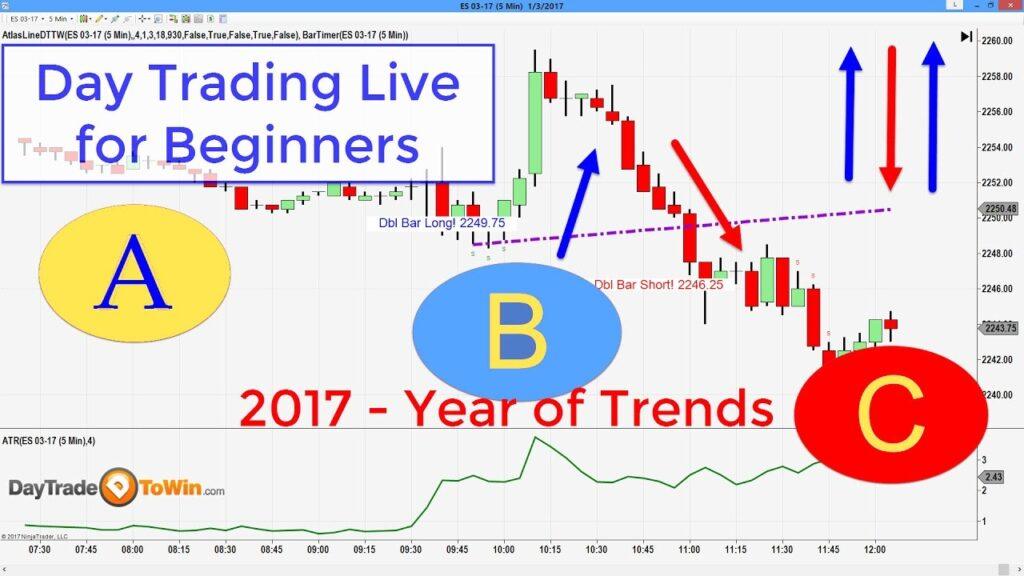
Are you eager to immerse yourself in the thrilling realm of day trading but find the plethora of strategies and indicators overwhelming? Fret not, as this blog post will introduce you to the ABC Method—an uncomplicated yet powerful approach to day trading that’s particularly well-suited for newcomers. Demystifying Day Trading Before we embark on unraveling the intricacies of the ABC Method, let’s take a moment to comprehend what day trading entails. Day trading involves the buying and selling of financial instruments within the same trading day with the aim of profiting from short-term price fluctuations. It’s a proactive trading style that necessitates swift decision-making and is not for the faint-hearted. Why Choose Price Action? Price action trading is a strategy that exclusively relies on the price movement of an asset, devoid of the complexities introduced by intricate indicators. This approach is founded on the belief that all pertinent information is already reflected in the price, rendering it an uncomplicated strategy for traders. Now, let’s delve into the ABC Method: A – Assessing the Market The inaugural step in the ABC Method involves market analysis. Here’s what you should be on the lookout for: B – Constructing a Trading Blueprint After you’ve conducted a thorough market analysis, it’s time to formulate a trading plan. Your plan should encompass: C – Executing the Trade With your meticulously devised trading plan in hand, it’s time to put it into action. Observe these guiding principles: Review and Continuous Learning Following the completion of a trade, it is imperative to conduct a thorough post-mortem: In Conclusion The ABC Method simplifies the complexities of day trading, rendering it accessible to neophyte traders. By focusing on price action and adhering to a structured approach, you can elevate your prospects for success in the dynamic domain of day trading. It is vital to remember that trading carries inherent risks, and it is paramount to practice prudent risk management and perpetually augment your trading expertise on your journey. So, are you ready to commence your day trading odyssey with the ABC Method? Give it a whirl, and may your trades be prosperous! John PaulJohn Paul is the founder of DayTradeToWin, a trading education and software company established in 2008, supporting traders worldwide. His expertise focuses on price action-based futures trading strategies and structured market analysis. DayTradeToWin delivers trading education, indicators, and software tools designed to help traders apply disciplined, rule-based decision-making across global futures markets. He is the creator of multiple trading methodologies, including the Sonic System, Atlas Line, and Trade Scalper, which help traders identify structured opportunities in markets such as the E-mini S&P 500 (ES), Nasdaq (NQ), crude oil (CL), and gold (GC). Official website: https://daytradetowin.com daytradetowin.com

Market News

Market Meltdown? A Closer Look at September’s Stock Market

Wall Street Witnesses Earnings Forecast Downturn as S&P 500 Declines by 4% in September As apprehension grows among stock market investors due to the surge in Treasury yields and its impact on equities, the downward revisions in S&P 500 earnings forecasts are further fueling concerns. Nicholas Colas, co-founder of DataTrek Research, observed that after several weeks of Wall Street analysts either increasing or maintaining their 2023 and 2024 S&P 500 earnings estimates, there was a reversal in this trend last week. This shift may have played a less recognized role in the recent market selloff. In the past week, Wall Street reduced its third-quarter earnings estimate for the S&P 500 to $55.74 per share, representing a 0.6% decrease from the prior week. This effectively erased all the positive revisions made over the past seven weeks. For the fourth quarter, analysts lowered their forecast by 0.4% to $57.85 per share, essentially returning Wall Street’s estimate to where it stood at the beginning of June, as noted by Colas. The changes in earnings forecasts signify a shift from the earlier optimism stemming from the upward trajectory in estimates, according to DataTrek. Colas pointed out that many trading algorithms give significant weight to revisions in earnings forecasts. “While minor adjustments to earnings estimates typically go unnoticed, trends in this data can sometimes carry substantial implications,” he explained. “We anticipate further downward revisions in the upcoming week as analysts finalize their Q3 estimates.” On Monday, the S&P 500 managed to eke out a modest gain but still recorded a 3.8% loss for September, marking the third consecutive weekly decline. Most sectors within the S&P 500 incurred losses this month, with only the energy and utilities sectors showing positive performance. Utilities saw a 1% gain, while energy stocks rose by 2.5%, partly due to increased oil prices in September. The recent decline in the S&P 500 is attributed, in part, to the surge in bond yields, which have exerted pressure on equity valuations following the Federal Reserve’s late-September policy meeting. The yield on the 10-year Treasury note reached its highest level since 2007 after the Fed indicated its intention to raise interest rates and maintain them at elevated levels for longer than initially anticipated. Higher bond yields result in increased borrowing costs, which can weigh on companies and their earnings. With regard to corporate earnings expectations for the upcoming year, DataTrek highlighted a trend of downward revisions. Wall Street analysts reduced their 2024 earnings estimate for the S&P 500 by 0.3% last week, bringing it to $247.90 per share, marking the first reduction in nine weeks. For the first half of the next year, analysts revised their earnings estimate for the S&P 500 to $57.93 per share for the first quarter and $60.90 per share for the second quarter, according to DataTrek. Despite the climb in Treasury bond yields, U.S. stocks managed to close higher on Monday, with the Dow Jones Industrial Average edging up 0.1%, the S&P 500 rising by 0.4%, and the Nasdaq Composite advancing by 0.5%, according to FactSet data. John PaulJohn Paul is the founder of DayTradeToWin, a trading education and software company established in 2008, supporting traders worldwide. His expertise focuses on price action-based futures trading strategies and structured market analysis. DayTradeToWin delivers trading education, indicators, and software tools designed to help traders apply disciplined, rule-based decision-making across global futures markets. He is the creator of multiple trading methodologies, including the Sonic System, Atlas Line, and Trade Scalper, which help traders identify structured opportunities in markets such as the E-mini S&P 500 (ES), Nasdaq (NQ), crude oil (CL), and gold (GC). Official website: https://daytradetowin.com daytradetowin.com

Scroll to Top