

stock market

Fireworks
Market News

Is the U.S. Stock Market Operational on the 4th of July?

The New York Stock Exchange and Nasdaq, the two biggest stock-trading venues in the U.S., have declared that they will be closed on Tuesday in recognition of the Fourth of July holiday. Furthermore, Monday’s trading, which marks the start of the second half of 2023, will end three hours early at 1 p.m. Eastern Time, giving equity traders a brief respite. Sifma, the Securities Industry, and Financial Markets Association, advises bond traders to acknowledge the Fourth of July with an early closure in the fixed-income trading sector, recommending trading to end at 2 p.m. Eastern Time on Monday. Friday saw U.S. stocks wrap up the first half of 2023 at 14-month highs. According to Dow Jones Market Data, the S&P 500 SPX touched its highest close since April 20, 2022, going up by 53.94 points, or 1.2%, to 4,450.38. Meanwhile, the Nasdaq Composite COMP celebrated June by registering its most significant first-half gain since 1983. The Dow Jones Industrial Average DJIA also ended on a high note on Friday, finishing the first half at 34,407.60, its highest closing point since June 15, with an increase of 285.18 points, or 0.8%. Treasury yields saw minimal changes on Friday. However, the day prior saw the 2-year and 10-year Treasury yields reach their highest closing levels in more than three months, according to FactSet data. It’s noteworthy that bond yields inversely reflect prices. The yield on the 2-year Treasury note TMUBMUSD02Y finished almost unchanged on Friday at 4.877% compared to 4.876% on Thursday. The yield on the 10-year Treasury note TMUBMUSD10Y, on the other hand, fell by 3.5 basis points to conclude Friday at 3.818%, compared with 3.853% on Thursday afternoon. As Tuesday marks the 247th year of ratifying the Declaration of Independence, Charles Passy from MarketWatch has put together a guide of what will be open and closed. John PaulJohn Paul is the founder of DayTradeToWin, a trading education and software company established in 2008, supporting traders worldwide. His expertise focuses on price action-based futures trading strategies and structured market analysis. DayTradeToWin delivers trading education, indicators, and software tools designed to help traders apply disciplined, rule-based decision-making across global futures markets. He is the creator of multiple trading methodologies, including the Sonic System, Atlas Line, and Trade Scalper, which help traders identify structured opportunities in markets such as the E-mini S&P 500 (ES), Nasdaq (NQ), crude oil (CL), and gold (GC). Official website: https://daytradetowin.com daytradetowin.com


stock money
Market News

Decoding the Paradox: Big Tech’s Defiance to Traditional Market Theories

Delving into a volatile market—both high-risk and high-quality stocks have experienced surges this year. This typically isn’t the norm, but there’s a logical explanation backing it. Usually, when investors choose high-volatility stocks, thereby increasing their prices, they commonly sell their high-quality stocks. The objective is to benefit from increased earnings as the economy stages a comeback—a scenario favoring volatile stocks. Contrarily, to shield their portfolios from economic strife, investors generally invest in high-quality stocks, sometimes by selling off the more economically sensitive and volatile ones. High-quality stocks usually exhibit a mix of steady earnings and sturdy cash reserves. However, this year’s market dynamics don’t seem to follow this trend. Take, for instance, the Invesco S&P 500 High Beta ETF (ticker: SPHB)—a fund that handpicks the 100 most volatile stocks within the S&P 500—it has enjoyed almost a 20% increase this year. Remarkably, the Invesco S&P 500 Quality ETF (SPHQ)—which selects companies based on various parameters such as high return on equity—is nearly 13% up. The simultaneous gains of both funds is intriguing. To make sense of this irregularity, let’s start with the high-volatility aspect. Stocks that are susceptible to economic fluctuations are climbing, stemming from the market’s confidence in an impending uplift in demand for goods and services. The underlying premise is the Federal Reserve is nearing its cycle of increasing interest rates, intended to suppress inflation by curbing demand. Spearheading these economically sensitive stocks, Generac (GNRC), Royal Caribbean Group (RCL), Norwegian Cruise Line (NCLH), and Caesars Entertainment (CZR) have all witnessed marked increases this year. Additional stocks, including those from Big Tech, are contributing to these gains. Nvidia (NVDA), the fund’s most significant holding, almost tripled its value, indicating a rising market appetite for future profits. The unexpected parity performance of high-quality stocks compared to high-volatility ones can be attributed to the influence of Big Tech in the quality category. As a persistently high-growth sector, Big Tech benefits from stable rates. Victor Cossel, Macro Strategist at Seaport Global Securities, explains, “When you unwind recession, and you unwind inflation, that’s why you can have beta and quality working simultaneously.” Prominent Big Tech companies like Apple (AAPL), Microsoft (MSFT,) and Alphabet (GOOGL) have recorded significant growth this year. Collectively, these stocks account for nearly 30% of the quality fund. If this fund were equal-weighted, it would record gains under 9% for the year, which is less than half the gains of high-volatility stocks, according to Dow Jones Market Data. Tech stocks are categorized as high-quality because, despite having their own volatile triggers, they have redeeming features, such as, Apple’s vast cash reserves and Microsoft’s impressive return on equity in 2022, which significantly trumps the S&P 500’s average. In essence, there are times when high-volatility and high-quality stocks rally simultaneously, thereby challenging conventional market theory. John PaulJohn Paul is the founder of DayTradeToWin, a trading education and software company established in 2008, supporting traders worldwide. His expertise focuses on price action-based futures trading strategies and structured market analysis. DayTradeToWin delivers trading education, indicators, and software tools designed to help traders apply disciplined, rule-based decision-making across global futures markets. He is the creator of multiple trading methodologies, including the Sonic System, Atlas Line, and Trade Scalper, which help traders identify structured opportunities in markets such as the E-mini S&P 500 (ES), Nasdaq (NQ), crude oil (CL), and gold (GC). Official website: https://daytradetowin.com daytradetowin.com

stock market
Market News

Years of Subpar Stock Market Returns Ahead, Warns Fed Economist: Two Key Tailwinds Fade ??

US stock investors may need to prepare for potential disappointments, as recent warnings from a Federal Reserve researcher suggest. Corporate tax reductions and interest-rate cuts have been driving stock returns for a prolonged period, according to Federal Reserve economist Michael Smolyansky. Smolyansky foresees a rather challenging future for stocks, characterized by slowing earnings growth and dissipating tailwinds. US stock investors have enjoyed strong tailwinds for years, but their fortunes may soon change, according to a Federal Reserve researcher. Smolyansky recently published a research paper titled “End of an Era: The Coming Long-run Slowdown in Corporate Profit Growth and Stock Returns.” In the paper, he concludes that the S&P 500’s real return of 5.5% (excluding dividends) from 1989 to 2019 was mainly due to declines in interest rates and corporate tax, a trend unlikely to continue in future years. Stock prices generally rise when corporate profits grow, or P/E multiples expand. Smolyansky’s research found that more than 40% of the real corporate profit growth between 1989 and 2019 can be attributed to reductions in corporate tax and interest rates. Additionally, the lowered interest rates led to decreased risk-free rates (the guaranteed return from assets such as US Treasuries), accounting for the P/E multiples expansion during this period. Smolyansky states, “Investors, therefore, got lucky. I argue that this streak of good luck is likely over.” Even before the 2020 COVID-19 pandemic, interest rates were historically low, leaving little room for further reductions, particularly given the reemerging inflation risks. Simultaneously, the effective corporate tax rate for S&P 500 non-financial firms declined from 34% in 1989 to 15% by 2019. Further cuts seem unlikely given the current near-record levels of the US debt-to-GDP ratio and the Biden administration’s implementation of a 15% minimum tax rate last year. Smolyansky contends that if corporate tax and interest rates remain around their 2019 lows in the future, corporate profits will grow only at the same pace as EBIT. He cites a lag in EBIT growth compared to US GDP growth between 1962 and 2019, suggesting that it is unlikely to exceed a growth rate of 2% annually in the long term. Limitless expansion of P/E multiples also appears improbable. “This scenario carries serious implications for stock returns,” says the economist. “If actual earnings growth fails to surpass 2% per annum in the long run, then the stock prospects are grim.” “Expect future stock returns and corporate profit growth to be significantly lower,” he warns, describing the continuous boost to earnings growth from tax reductions and interest rate cuts as “a trend that has now reached its limit.” Smolyansky cautions that his pessimistic outlook could be seen as conservative. If the stock market hasn’t already priced in slower earnings growth, P/E multiples could rapidly contract once it does. Moreover, the reduction in interest and corporate tax rates may have artificially stimulated EBIT growth in recent decades, paving the way for an even greater slowdown than anticipated. “The risks associated with this forecast, if anything, lean towards the downside,” he concludes. John PaulJohn Paul is the founder of DayTradeToWin, a trading education and software company established in 2008, supporting traders worldwide. His expertise focuses on price action-based futures trading strategies and structured market analysis. DayTradeToWin delivers trading education, indicators, and software tools designed to help traders apply disciplined, rule-based decision-making across global futures markets. He is the creator of multiple trading methodologies, including the Sonic System, Atlas Line, and Trade Scalper, which help traders identify structured opportunities in markets such as the E-mini S&P 500 (ES), Nasdaq (NQ), crude oil (CL), and gold (GC). Official website: https://daytradetowin.com daytradetowin.com
Bear market
Market News

Stock Market Rallies Onward: Hold the Celebration for the Bear’s Demise Just Yet

During premarket trading on Thursday, Apple shares saw modest gains, edging closer to a valuation of $3 trillion. Some analysts, such as Wedbush’s Dan Ives, anticipate the company could reach a $4 trillion valuation by 2025. The exact implications of such a massive valuation on market weight remain unclear. With Apple holding a 7.6% weighting in the S&P 500, the adage goes, “as goes Apple, so goes the market” (not forgetting Microsoft and its 6.8% share). According to Irene Tunkel, chief strategist at BCA Research, this momentum has contributed to the overall positive trajectory of the stock market. Other contributing factors include the Federal Reserve’s winding down of rate increases, no recession currently underway, an earnings recession nearing its end, and a substantial amount of idle cash. Nevertheless, Tunkel warns against premature celebration, pointing to several red flags. One such concern is the anticipated decline in consumer spending on services, which has been essential in supporting the economy thus far. Additionally, consumers’ excess savings are waning and are projected to decrease even more once student loan repayments resume. Following the debt ceiling agreement, fiscal stimulus is expected to decrease. Coupled with a cautious banking sector limiting lending, this could expose a weakening job market. Regarding market valuations, Tunkel notes the current high valuations and incorporation of optimistic projections make the market seem expensive. She challenges the notion that only top-performing stocks are overvalued. Regarding technical factors, Tunkel observes the market is in overbought territory. The AAII investor sentiment survey shows the highest level of optimism since 2021, and the CBOE VIX is below 14. Tunkel believes these factors may signal a potential mean reversion. Tunkel ultimately concludes, “While the rally can persist longer, driven by all the positive aspects, eventually a black swan event will emerge, triggering a rapid acceleration of developments – due to the overvalued index, multiples will contract dramatically, leading to a major market downturn.” John PaulJohn Paul is the founder of DayTradeToWin, a trading education and software company established in 2008, supporting traders worldwide. His expertise focuses on price action-based futures trading strategies and structured market analysis. DayTradeToWin delivers trading education, indicators, and software tools designed to help traders apply disciplined, rule-based decision-making across global futures markets. He is the creator of multiple trading methodologies, including the Sonic System, Atlas Line, and Trade Scalper, which help traders identify structured opportunities in markets such as the E-mini S&P 500 (ES), Nasdaq (NQ), crude oil (CL), and gold (GC). Official website: https://daytradetowin.com daytradetowin.com

stock market
Market News

Today’s Stock News: Futures Decline as Semiconductor Curbs and Powell’s Remarks Take Center Stage

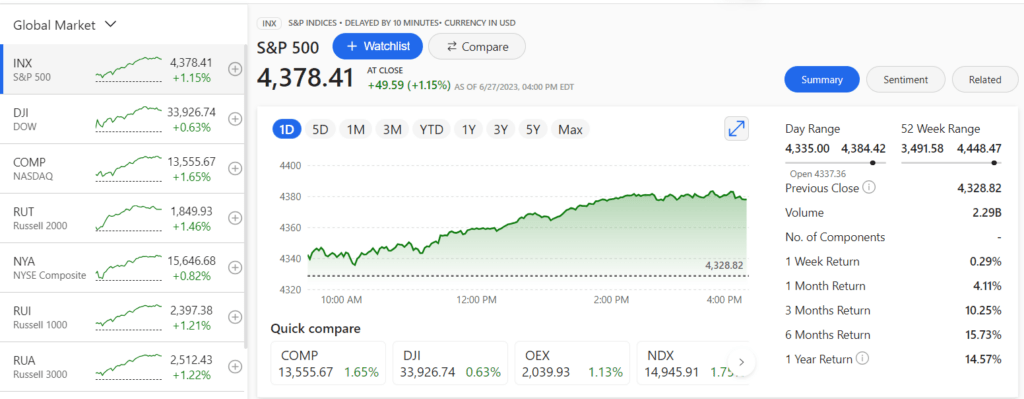
On Wednesday, stocks demonstrated potential volatility, particularly within the tech sector. This uncertainty stemmed from apprehensions about further trade restrictions on AI chips, as well as the expected statements from Federal Reserve Chair Jerome Powell. Futures linked to the Nasdaq Composite (^IXIC) experienced a significant decrease, plunging 0.45%. S&P 500 (^GSPC) Futures declined by 0.19%, while Dow Jones Industrial Average (^DJI) futures remained relatively stable. Nvidia took the lead in tech losses following The Wall Street Journal’s report concerning the Commerce Department’s potential implementation of stricter limitations on AI chip exports to China. In contrast, robust economic data fueled a stock rally on Tuesday. This recovery from previous downtrends has maintained the major benchmarks’ course for an exceptionally strong performance as we near the mid-year mark of 2023. The stock market will closely observe remarks made by Federal Reserve Chair Jerome Powell at an ECB event later today. Market watchers anticipate possible indications of the central bank’s next steps following the presentation of data that bolsters the case for further rate hikes. Given the undeniable resilience of the US economy, investors will attentively watch Powell’s involvement in an ECB forum on Wednesday morning, seeking insights into the Federal Reserve’s upcoming actions. John PaulJohn Paul is the founder of DayTradeToWin, a trading education and software company established in 2008, supporting traders worldwide. His expertise focuses on price action-based futures trading strategies and structured market analysis. DayTradeToWin delivers trading education, indicators, and software tools designed to help traders apply disciplined, rule-based decision-making across global futures markets. He is the creator of multiple trading methodologies, including the Sonic System, Atlas Line, and Trade Scalper, which help traders identify structured opportunities in markets such as the E-mini S&P 500 (ES), Nasdaq (NQ), crude oil (CL), and gold (GC). Official website: https://daytradetowin.com daytradetowin.com

Roller Coaster
Uncategorized

Navigating the Market Maze ?: Harnessing Options Strategies to Embrace Uncertainty ?️

As the quarter nears its end, the stock market appears to be losing steam amid speculations that investors are coming to terms with the potential delay of a Fed rate hike in 2023. Both the S&P 500 and Nasdaq Composite have experienced five losing sessions in the last six. In the past three months, the S&P index surpassed the critical resistance level of 4,200 in June, setting the stage for a battle between bulls and bears and creating uncertainty for investors. A team at Evercore ISI, led by Julian Emanuel, observed this development. Nonetheless, they urge investors to “embrace the uncertainty” and offer insights on managing the potential direction of stocks this summer. According to Emanuel and his team, the breakout above 4,200 led to an influx of funds into stocks and a significant covering of record S&P 500 short futures positions. They highlighted that all these “new longs” would be “underwater” at 4,200, providing the following chart as evidence: Conversely, the pullback at 4,450 highlights the common and volatile nature of momentum market corrections, as observed in 2021 and 1999. Strategists suggest that a return to 4,450 could rekindle the “chase” similar to the 127% rise in the Nasdaq 100 after the 14.1% decline in 1999. In essence, the stock market may see another clash between bears and bulls this summer. For investors hesitant to take sides, Evercore proposes employing a strangle options strategy. This approach involves holding calls and put options with different strike prices but the same expiration dates and underlying assets. To recap, calls are options contracts that give the holder the right (but not the obligation) to buy the underlying security at a predetermined price by a specific deadline, while puts John PaulJohn Paul is the founder of DayTradeToWin, a trading education and software company established in 2008, supporting traders worldwide. His expertise focuses on price action-based futures trading strategies and structured market analysis. DayTradeToWin delivers trading education, indicators, and software tools designed to help traders apply disciplined, rule-based decision-making across global futures markets. He is the creator of multiple trading methodologies, including the Sonic System, Atlas Line, and Trade Scalper, which help traders identify structured opportunities in markets such as the E-mini S&P 500 (ES), Nasdaq (NQ), crude oil (CL), and gold (GC). Official website: https://daytradetowin.com daytradetowin.com

Scroll to Top