
stock news

markets
Market News

Markets Turn Skeptical as Layoffs Trigger Stock Declines

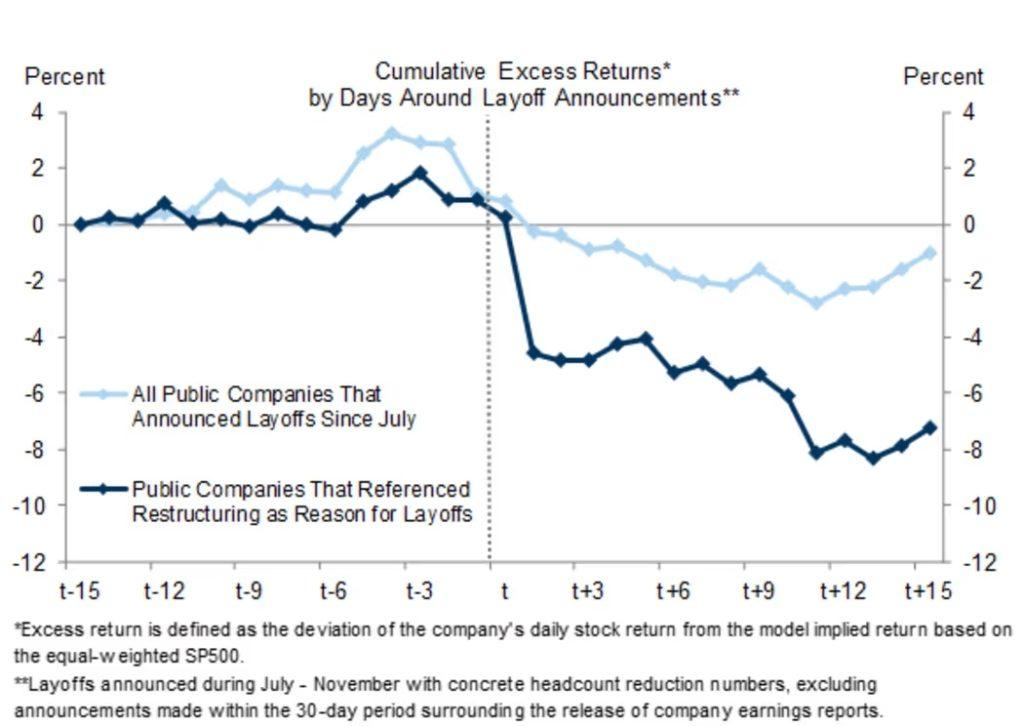
Markets No Longer Cheer Layoffs, Goldman Sachs Warns Announcing job cuts used to be a quick way for companies to boost their share prices, particularly when layoffs were framed as efficiency or cost-saving measures. That reaction has faded. Goldman Sachs says companies now underperform the broader market by around 2% after revealing layoffs. Investors appear increasingly unconvinced by management’s explanations. Even when job cuts are presented as part of harmless restructuring or productivity initiatives, equity markets are punishing stocks rather than rewarding them. Goldman Sachs analyst Elsie Peng says the shift reflects growing investor skepticism. In a research note published Monday, Peng analyzed stock performance following layoff announcements and found that markets may view claimed productivity gains as a cover for deeper problems, such as rising interest expenses or weakening profitability. According to Peng, labor market weakness in 2025 has been marked more by sluggish hiring than by traditional layoff indicators. Initial jobless claims and official layoff rates remain low, yet third-quarter earnings commentary suggested more job cuts could be coming. Many companies have blamed these reductions on automation and the use of AI to lower labor costs. Goldman’s findings show that the market reaction worsens when layoffs are explicitly tied to restructuring. While stocks announcing job cuts generally lag the market by about 2%, companies that directly cite restructuring have suffered much steeper declines, with average excess returns of negative 7%. The analysis also shows that firms announcing layoffs have experienced faster growth in capital spending, debt, and interest expenses, alongside weaker profit growth than industry peers this year. That pattern suggests layoffs may be driven by more concerning financial pressures than companies publicly admit. Despite this, Peng notes that Goldman’s equity and credit analysts see limited risk to the broader economy from layoffs so far. Corporate balance sheets remain broadly strong, and profit margins are still elevated. The S&P 500 ended slightly lower on Monday and is just over 1% below its record high after gaining 16% this year. U.S. stock index futures also edged lower ahead of key jobs data. John PaulJohn Paul is the founder of DayTradeToWin, a trading education and software company established in 2008, supporting traders worldwide. His expertise focuses on price action-based futures trading strategies and structured market analysis. DayTradeToWin delivers trading education, indicators, and software tools designed to help traders apply disciplined, rule-based decision-making across global futures markets. He is the creator of multiple trading methodologies, including the Sonic System, Atlas Line, and Trade Scalper, which help traders identify structured opportunities in markets such as the E-mini S&P 500 (ES), Nasdaq (NQ), crude oil (CL), and gold (GC). Official website: https://daytradetowin.com daytradetowin.com


AI
Market News

Citi Sees AI Adoption Driving S&P 500 Gains in 2026

Citi expects a shift in market leadership from AI “enablers” to AI “adopters” as investors head into what could be a more volatile 2026. With the bull market entering its fourth year, volatility is likely to increase, making it harder to separate winners from losers in the AI race. Even so, Citi strategists remain constructive, citing an accommodative Federal Reserve, earnings growth above consensus, and a stronger fiscal boost from the OBBBA. Together, these factors support a year-end S&P 500 target of 7,700. That forecast is above the MarketWatch consensus of 7,500, which already implies roughly 10% upside from Friday’s close. Citi projects total market returns of around 13% in 2026 but expects leadership to rotate away from companies that build AI infrastructure toward firms that successfully adopt AI to boost productivity. The firm also anticipates broader participation across the index. Starting from elevated valuations, U.S. equities will face growing pressure to deliver strong fundamentals to justify prices. Citi’s base-case target of 7,700—outlined by Scott Chronert, Drew Pettit, and Patrick Galvin in the firm’s 2026 U.S. equity outlook—assumes S&P 500 earnings of $320 per share and a valuation multiple of 24 times earnings. While that represents only modest compression from current levels, Citi warns that greater dispersion in returns, especially among AI-related stocks, will make stock selection more difficult. Wall Street consensus earnings estimates for 2026 are closer to $310 per share, though Citi points to the ongoing resilience of corporate earnings. AI remains a powerful tailwind, but Citi sees investor focus gradually shifting away from hyperscalers, whose outlook remains debated, toward companies that can effectively integrate AI into their business models. The firm also expects more idiosyncratic performance among AI enablers, which now make up roughly 40% of the S&P 500, adding complexity to portfolio construction. To benefit from broader market leadership, Citi recommends positioning for positive earnings revision momentum in value, cyclical, and small-cap stocks. Growth stocks, including mega-cap technology names, will need continued earnings beats and guidance upgrades to support valuations. Citi’s outlook also assumes the Fed will cut rates twice in early 2026—earlier than markets currently expect—as higher unemployment emerges as a side effect of AI-driven productivity gains. The firm forecasts the U.S. 10-year Treasury yield will fall to 3.75% by the end of 2026, from about 4.18% today. In a bull-case scenario, stronger-than-expected earnings growth could push the S&P 500 to 8,300. In a downside scenario marked by weaker fundamentals and multiple compression, Citi sees the index falling to 5,700. John PaulJohn Paul is the founder of DayTradeToWin, a trading education and software company established in 2008, supporting traders worldwide. His expertise focuses on price action-based futures trading strategies and structured market analysis. DayTradeToWin delivers trading education, indicators, and software tools designed to help traders apply disciplined, rule-based decision-making across global futures markets. He is the creator of multiple trading methodologies, including the Sonic System, Atlas Line, and Trade Scalper, which help traders identify structured opportunities in markets such as the E-mini S&P 500 (ES), Nasdaq (NQ), crude oil (CL), and gold (GC). Official website: https://daytradetowin.com daytradetowin.com
AI
Market News

Why Space Could Be the Next Big AI Boom

The next major investing edge in AI may come from identifying where capital for orbital computing flows first, according to Matthew Tuttle, CEO and CIO of Tuttle Capital. Just months ago, anything tied to OpenAI could send tech stocks soaring. Today, the mood has cooled. Investors are more skeptical, and the AI sector now faces the classic “front-cover curse” after Time named several AI leaders as Persons of the Year—including Nvidia’s Jensen Huang, who also just received Financial Times Person of the Year honors. AI’s narrative may need a fresh spark. That spark could be space. The Wall Street Journal reports that Jeff Bezos and Elon Musk are exploring orbital data centers designed to support Earth’s growing AI workloads. In a recent blog post, Tuttle breaks down how investors can position for this next frontier. The biggest constraint for AI’s expansion, he argues, isn’t chips—it’s power. “AI and data centers are set to drive a major surge in electricity demand this decade, which is why ‘grid tech’ has become a real market theme,” he writes. Space, however, has a distinct energy advantage. Orbital data centers can harness uninterrupted solar power. “That’s where ‘compute in orbit’ becomes a serious idea,” Tuttle says. “AI has extremely high revenue per kilowatt, and solar in space is always on—unlike Earth-based constraints.” Scaling orbital computing and delivering that power back to Earth remains the main challenge. The real opportunity, Tuttle says, is recognizing where capex flows first—into edge inference and space infrastructure—while full-scale gigawatt beamed power remains a long-term, sci-fi vision. He lays out a three-phase investable roadmap: Phase 1: Happening Now — On-Orbit InferenceExisting satellites used for weather, communications, Earth observation, maritime tracking, and missile warning. “If satellites classify, compress, and decide onboard, they downlink answers—not terabytes,” he writes. “That cuts bandwidth, speeds up action, and reduces the need for ground stations. That’s today’s ‘sky-brains.’” Phase 2: Purpose-Built AI SatellitesSatellites designed with compute modules. “You’re not just processing your own sensor stream—you’re renting compute,” Tuttle notes. Challenges include radiation tolerance, launch cadence, and networking. This works for niche workloads where latency or sovereignty matters more than cost. Phase 3: Space-Based Solar PowerBeaming solar power from space to Earth. This requires massive lightweight structures, conversion systems, beam-safety protocols, and grid integration—making it the hardest engineering challenge. For the first two phases, Tuttle highlights potential winners in space infrastructure: Redwire, Rocket Lab, L3Harris Technologies, RTX, Northrop Grumman, and Lockheed Martin. “These companies benefit from any version of orbital compute or space power,” he says, “because they supply spacecraft platforms, integration, communications, and space-qualified components.” Radiation-tolerant processors will also be crucial. Tuttle points to Microchip Technology as a direct play on space-grade silicon. But near term, most AI workloads will stay Earth-based. The real spending boom, he says, is still in the power grid—transformers, cooling systems, and distribution. His picks for that theme include Eaton, Hubbell, Quanta Services, and Vertiv. Asked whether any ETF captures this orbital-AI opportunity, Tuttle joked: “Not until I launch it.” John PaulJohn Paul is the founder of DayTradeToWin, a trading education and software company established in 2008, supporting traders worldwide. His expertise focuses on price action-based futures trading strategies and structured market analysis. DayTradeToWin delivers trading education, indicators, and software tools designed to help traders apply disciplined, rule-based decision-making across global futures markets. He is the creator of multiple trading methodologies, including the Sonic System, Atlas Line, and Trade Scalper, which help traders identify structured opportunities in markets such as the E-mini S&P 500 (ES), Nasdaq (NQ), crude oil (CL), and gold (GC). Official website: https://daytradetowin.com daytradetowin.com
tax refunds
Market News

Tax Refunds Forecast: A Major Tailwind for the Economy

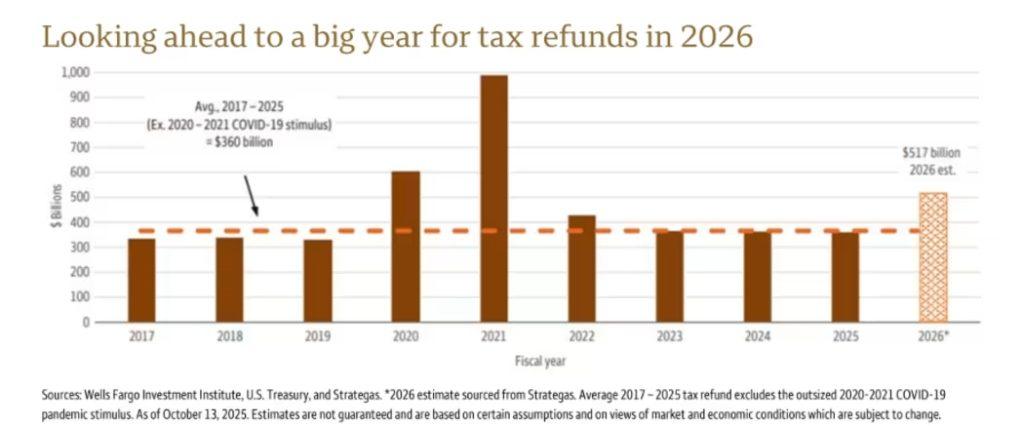
Tax-rebate checks are expected to start arriving in the second quarter, but most of the relief from Trump’s One Big Beautiful Bill Act is directed toward businesses. Stocks could see another leg higher next year as taxpayers begin receiving refunds tied to President Donald Trump’s major tax-and-spending package signed this summer. White House National Economic Council Director Kevin Hassett said Monday that typical workers, now exempt from taxes on tips or overtime, could receive an extra $1,600 to $2,000 next year. “A lot of that will come as tax refunds at the beginning of the year,” he told CNBC. Hassett is also viewed as a top contender to replace Fed Chair Jerome Powell in May. Analysts at the Wells Fargo Investment Institute expect about $517 billion in tax refunds next year — a surge they believe will help “reignite broad consumer spending” and support both the economy and markets. If accurate, it would be one of the largest refund years since 2017, excluding the pandemic-stimulus years. “We expect the nearly 44% year-over-year increase to meaningfully boost consumer spending and help the U.S. economy gather renewed momentum in 2026,” wrote Jennifer Timmerman, an investment-strategy analyst at Wells Fargo. Wells Fargo forecasts the S&P 500 ending 2025 in the 7,400–7,600 range, while the 10-year Treasury yield is expected to stay between 4% and 5%. On Wednesday, the 10-year yield was at 4.15% and the S&P 500 closed just below record highs at 6,886 — poised for a 17.1% annual gain. Will stocks stumble early next year? Meghan Shue, chief investment strategist at Wilmington Trust, expects the current rally to continue through December but is more cautious about the first quarter. After a strong 2025 — especially for AI-related stocks — she anticipates more volatility, selling, and profit-taking as investors rebalance. She also notes tariff uncertainty. Many businesses may be holding off on passing higher import costs to consumers during the critical holiday season. “There could be more supply-chain pressure and more tariff price increases to come in the first quarter,” she said. The outlook brightens in the second quarter as clarity around tariffs and tax relief improves. For consumers, that’s when tax refunds arrive. For businesses — the biggest winners under the new tax law — the payoff will depend more on capital-expenditure incentives than timing. John PaulJohn Paul is the founder of DayTradeToWin, a trading education and software company established in 2008, supporting traders worldwide. His expertise focuses on price action-based futures trading strategies and structured market analysis. DayTradeToWin delivers trading education, indicators, and software tools designed to help traders apply disciplined, rule-based decision-making across global futures markets. He is the creator of multiple trading methodologies, including the Sonic System, Atlas Line, and Trade Scalper, which help traders identify structured opportunities in markets such as the E-mini S&P 500 (ES), Nasdaq (NQ), crude oil (CL), and gold (GC). Official website: https://daytradetowin.com daytradetowin.com

CTA
Market News

UBS Warns CTA Positioning Could Intensify Market Drop

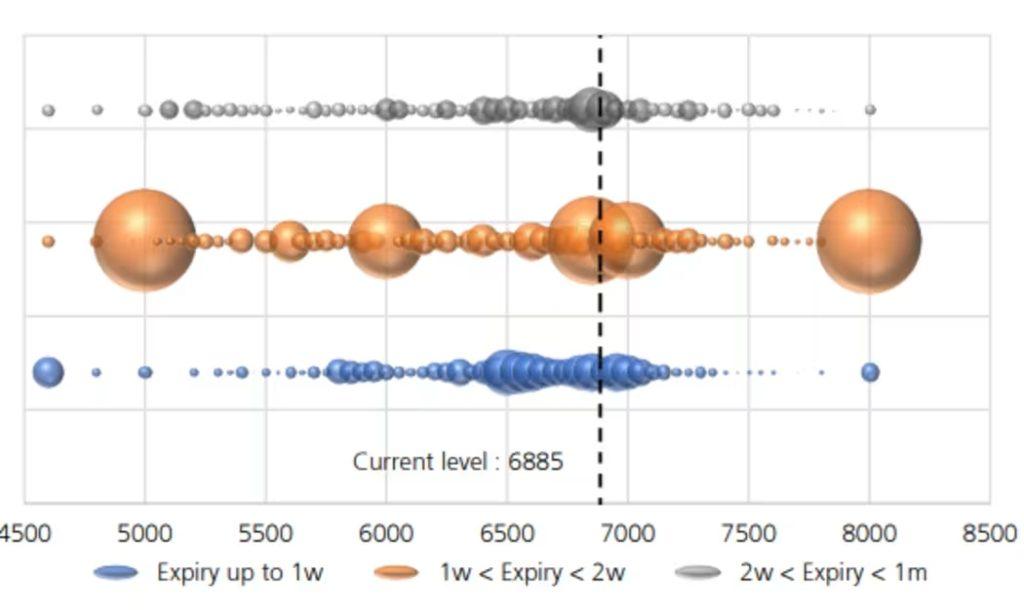
UBS warns that CTA positioning could sharply amplify any market downturn. With a major U.S. options expiration approaching on Dec. 19, markets are heading into a dense cluster of risk events — the Fed decision on Wednesday, nonfarm payrolls on Dec. 16, and the CPI report on Dec. 18. UBS analysts say that given current positioning and the size of outstanding options, even a small pullback could morph into a much steeper decline. Their analysis shows that a drop in the S&P 500 to around 6,500 — about 5% below current levels — could trigger a critical downside inflection point. UBS’s proprietary model, built to track macro hedge fund behavior around expiration, highlights major sensitivity near 6,850. If the index weakens toward 6,500, commodity trading advisors (CTAs), who follow momentum-driven, algorithmic strategies, would be forced to sell into the decline, accelerating the move lower. The Dec. 19 expiration carries unusually heavy risk, with large open interest at the 5,000, 6,000, 6,850, and 8,000 S&P 500 strikes. Because CTAs rely on systematic trend-following and delta hedging intensifies into expiry, their positioning can significantly exaggerate market swings. December’s expiry is even more consequential because it caps both the quarter and the year. UBS finds CTAs have recently added risk but remain skewed toward selling. A slide toward 6,500 would likely force them to unload increasing amounts of futures to manage directional exposure. In Europe, CTAs are very long Eurostoxx 50 near 5,700, and a move toward 5,600 could trigger heavier selling. UBS also highlights other areas of sensitivity: CTAs are near max short the Japanese yen ahead of the Dec. 19 BOJ meeting, heavily long the Chinese yuan, and holding notable long positions in U.S. 10-year Treasurys that could come under pressure if yields rebound toward 4.25%. John PaulJohn Paul is the founder of DayTradeToWin, a trading education and software company established in 2008, supporting traders worldwide. His expertise focuses on price action-based futures trading strategies and structured market analysis. DayTradeToWin delivers trading education, indicators, and software tools designed to help traders apply disciplined, rule-based decision-making across global futures markets. He is the creator of multiple trading methodologies, including the Sonic System, Atlas Line, and Trade Scalper, which help traders identify structured opportunities in markets such as the E-mini S&P 500 (ES), Nasdaq (NQ), crude oil (CL), and gold (GC). Official website: https://daytradetowin.com daytradetowin.com

mortgage
Market News

Mortgage Rates Rise: What Homeowners Can Do Now

How Homeowners and Buyers Can Still Beat High Mortgage Rates With Two Smart Moves Mortgage rates are rising sharply even though the Federal Reserve is widely expected to cut rates this week — a break from the usual pattern. Typically, when markets anticipate Fed cuts, the 10-year Treasury yield falls, pulling 30-year mortgage rates down with it. This time, the opposite happened. On Monday, the average 30-year mortgage rate jumped nine basis points to 6.36%, its highest level in two weeks, according to Mortgage News Daily. The 10-year Treasury also climbed to 4.17%, signaling that markets aren’t reacting the way they normally do ahead of a rate cut. Jeffrey Ruben, president of WSFS Home Lending, said the 10-year and 30-year yields “are not behaving as they traditionally would,” pointing to two main reasons: Fed Cuts Aren’t Pushing Mortgage Rates Lower The spike in mortgage rates works against the Trump administration’s goal of reducing borrowing costs to revive the housing market. High prices and elevated mortgage rates continue to sideline buyers, while homeowners are still waiting for the right moment to refinance and ease monthly expenses. Despite multiple Fed cuts in 2025, the 30-year fixed mortgage rate hasn’t dipped below 6% all year. Its lowest point was 6.13% in September and October — and it hasn’t been under 6% since February 2023. Two Practical Mortgage Moves You Can Make Right Now Even in this tough rate environment, homeowners and buyers still have options to lower monthly housing costs: 1. Consider an Adjustable-Rate Mortgage (ARM) ARMs offer much lower initial rates compared to 30-year fixed loans. As of Nov. 28, the average 30-year fixed rate was 6.32%, while the five-year ARM averaged just 5.4%, according to the Mortgage Bankers Association. While ARMs carry some risk, they can help buyers secure a lower entry rate. If mortgage rates fall in the next few years, borrowers can refinance into a lower, fixed-rate mortgage later on. 2. Ask Your Lender for a Rate Modification Homeowners can also request a rate adjustment from their lender. A rate modification lowers your existing mortgage rate without refinancing — meaning your loan terms stay the same and your credit isn’t affected. Lenders often agree because it keeps the loan with them rather than losing the borrower to another lender. John PaulJohn Paul is the founder of DayTradeToWin, a trading education and software company established in 2008, supporting traders worldwide. His expertise focuses on price action-based futures trading strategies and structured market analysis. DayTradeToWin delivers trading education, indicators, and software tools designed to help traders apply disciplined, rule-based decision-making across global futures markets. He is the creator of multiple trading methodologies, including the Sonic System, Atlas Line, and Trade Scalper, which help traders identify structured opportunities in markets such as the E-mini S&P 500 (ES), Nasdaq (NQ), crude oil (CL), and gold (GC). Official website: https://daytradetowin.com daytradetowin.com

Scroll to Top