
stock news

market
Market News

Global Market Forecast: The Top Shifts Expected to Shape 2026

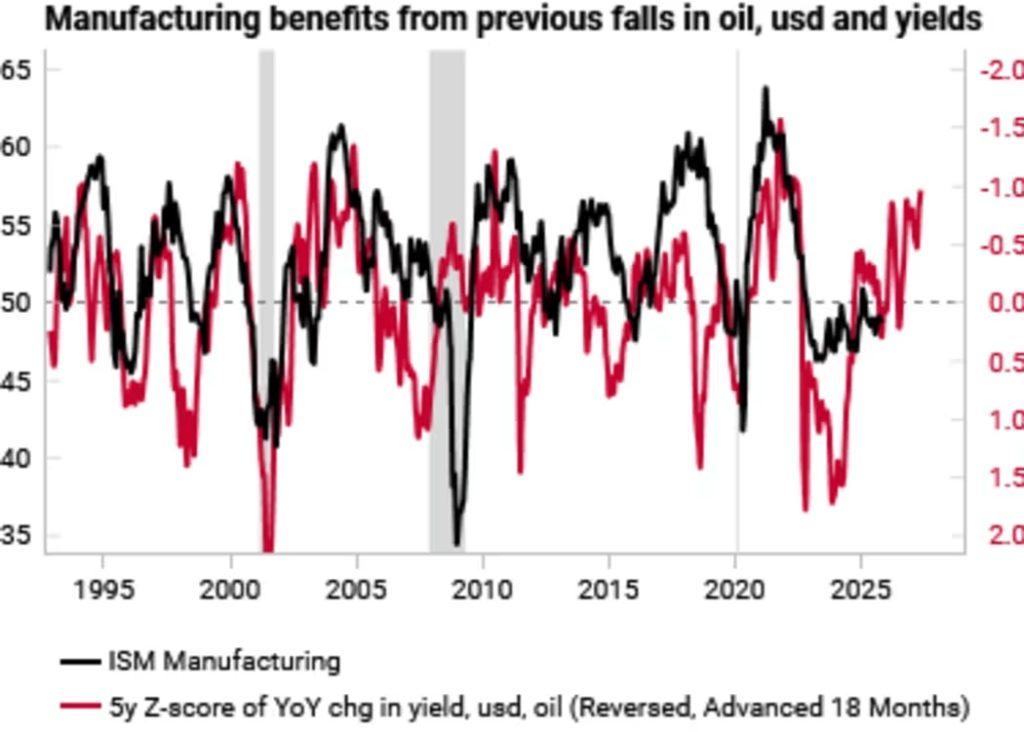
Byron Wien, who died in 2023, was one of Wall Street’s most influential strategists. During his long tenure at Morgan Stanley, he became famous for his annual “10 Surprises” list — predictions he believed had better than a 50% chance of happening, even though the market assigned them odds below one-third. Several firms have attempted to continue Wien’s legacy, and U.K. research house Variant Perception has now embraced the tradition for a second straight year, sticking to Wien’s original 50% likelihood vs. 33% consensus framework. Their big-picture view for next year: the economy should hold up reasonably well. Variant Perception expects U.S. nominal GDP to grow more than 5%, a mix of real growth and inflation. Historically, that environment has supported equities, put a floor under yields, and boosted the U.S. dollar — trends already visible over the past two months. This also tends to be the point in the cycle where earlier declines in oil, the dollar, and yields begin to revive manufacturing. Still, despite a constructive macro backdrop, Variant Perception warns that stretched valuations and thin risk premiums in both credit and equities are a challenge. That’s why they favor rotations into emerging markets, value stocks, and other laggards. In their words: there’s a “valuation problem,” not a “macro problem.” Here are their ten surprises for the coming year: The capex story is especially noteworthy. With tariff policies mostly set, bank lending surveys show easier commercial lending standards and stronger loan demand. Corporates may also tap newly favorable tax rules — including full bonus depreciation and immediate R&D expensing. Combined with last year’s declines in oil, the dollar, and yields, these factors typically provide a tailwind for manufacturing. But this rebound may not lift employment. Variant Perception sees similarities to the 2002–2003 era, when productivity gains and easy Fed policy drove a “jobless recovery.” Their oil outlook also deserves attention. While consensus expects a supply glut, the firm believes the balance of risks points to a highly volatile oil market in 2026. They stress that this isn’t contrarian for its own sake — just where the data leads. John PaulJohn Paul is the founder of DayTradeToWin, a trading education and software company established in 2008, supporting traders worldwide. His expertise focuses on price action-based futures trading strategies and structured market analysis. DayTradeToWin delivers trading education, indicators, and software tools designed to help traders apply disciplined, rule-based decision-making across global futures markets. He is the creator of multiple trading methodologies, including the Sonic System, Atlas Line, and Trade Scalper, which help traders identify structured opportunities in markets such as the E-mini S&P 500 (ES), Nasdaq (NQ), crude oil (CL), and gold (GC). Official website: https://daytradetowin.com daytradetowin.com


market
Market News

Is the Market in a Bubble? Kostin Sets the Record Straight

Kostin sees opportunities in consumer and healthcare stocks, as well as companies positioned to drive more revenue from AI. Goldman Sachs chief equity strategist David Kostin is set to retire after 31 years, and he’s been inundated with one question on his way out: Is the market in a bubble? His retirement, announced in September, was discussed further in a newly released firm podcast. Ben Snider will succeed him as the firm’s fifth chief equity strategist in more than five decades, while Kostin remains as an adviser. Kostin said that while market analysis has evolved from picking individual winners to selecting groups of stocks based on factors such as balance-sheet strength and global exposure, the core framework is unchanged from 30 years ago: the economy, earnings, valuation, and money flows. “Those are the four legs of the table when identifying opportunities,” he said. For now, Kostin is encouraged by steady VIX levels and a strong third-quarter earnings season heading into 2026. On the question of an AI bubble, he argues that public markets are not in one. Large AI-linked companies trade around 30 times earnings—high, but far below the 40x valuations seen after COVID or the 50x levels of the dot-com era. IPO activity is also far more subdued compared with 1999 and 2021.The private markets, however, tell a different story: rising valuations and vendor financing pressures point to unsustainable pricing. Looking ahead, Kostin highlights several opportunity areas. He sees promise in consumer stocks, noting that middle-income households should benefit from next year’s tax reforms despite concerns about rising unemployment. He also points to healthcare stocks, which are trading at 30-year valuation lows relative to the broader market. Finally, he favors companies that can leverage AI to boost revenue rather than rely solely on cost-cutting. Goldman’s S&P 500 target for next year is 7,600—slightly above MarketWatch’s Wall Street estimate of 7,500. John PaulJohn Paul is the founder of DayTradeToWin, a trading education and software company established in 2008, supporting traders worldwide. His expertise focuses on price action-based futures trading strategies and structured market analysis. DayTradeToWin delivers trading education, indicators, and software tools designed to help traders apply disciplined, rule-based decision-making across global futures markets. He is the creator of multiple trading methodologies, including the Sonic System, Atlas Line, and Trade Scalper, which help traders identify structured opportunities in markets such as the E-mini S&P 500 (ES), Nasdaq (NQ), crude oil (CL), and gold (GC). Official website: https://daytradetowin.com daytradetowin.com
market
Market News

Market Warning: BofA Sees Slower S&P 500 Gains Ahead

Wall Street’s most cautious strategist expects only mild S&P 500 gains in 2026 While most Wall Street forecasters are optimistic heading into 2026, Bank of America is urging restraint. Savita Subramanian, the firm’s head of U.S. equity and quantitative strategy, warns that stressed consumers and a slowdown in the AI boom could weigh on the market next year. She projects the S&P 500 will end 2026 at 7,100, well below the Street’s median call of 7,500. Earnings may grow at a solid mid–double-digit pace, but she expects valuations to contract by 5% to 10% as investors grow more cautious. Subramanian notes that investors spent much of this year debating which hyperscalers to own. BofA now favors AI adopters, though it cautions that meaningful benefits may take time. The bigger concern: AI-driven job cuts potentially clashing with the need for strong consumer spending. Expecting consumer strain, BofA upgraded consumer staples to overweight and slashed consumer discretionary to underweight. Discretionary names are up 5% this year, outpacing staples, which are flat. The bank’s overweights include financials, real estate, materials, healthcare, and energy. Communications services and utilities remain underweights, while tech and industrials stay neutral. Middle-income consumers—the backbone of spending over the last decade—are now getting hit with steep inflation in dining, healthcare, and utilities. Meanwhile, entry-level office roles are being trimmed as companies lean into AI efficiencies, with some shifting toward high-school apprenticeship hiring models. While Fed cuts and tax tweaks may support lower-income households, the middle tier faces mounting pressure. Subramanian also flags fading liquidity tailwinds. With fewer global rate cuts ahead, less fiscal stimulus, and weaker buybacks due to rising capex and debt, markets may lose an important source of support. Even this year’s wealth effect has cooled as gold and crypto have pulled back, leaving some day traders staring at big potential tax bills. And the AI trade? She sees “an air pocket” coming. Monetization remains unclear, power constraints are real, and hyperscalers are spending heavily—so heavily that tech-sector debt issuance is now 10× higher than a year ago. Capital intensity among hyperscalers has jumped from 13% in 2012 to 64% today. For now, Subramanian says, investors are still “buying the dream”—but tougher conditions may be approaching. John PaulJohn Paul is the founder of DayTradeToWin, a trading education and software company established in 2008, supporting traders worldwide. His expertise focuses on price action-based futures trading strategies and structured market analysis. DayTradeToWin delivers trading education, indicators, and software tools designed to help traders apply disciplined, rule-based decision-making across global futures markets. He is the creator of multiple trading methodologies, including the Sonic System, Atlas Line, and Trade Scalper, which help traders identify structured opportunities in markets such as the E-mini S&P 500 (ES), Nasdaq (NQ), crude oil (CL), and gold (GC). Official website: https://daytradetowin.com daytradetowin.com
saxo bank
Market News

Saxo Bank Forecasts Shockwaves for AI, Gold & Crypto

Saxo Bank previous set of bold forecasts included a call for a major Nvidia rally, but that wasn’t the only dramatic prediction on their list. One standout forecast last year claimed President Donald Trump would send the U.S. dollar tumbling through tariff battles and political turmoil. So far, the DXY has fallen 8% and is on track for its weakest year since 2017, weighed down by rising fiscal deficits and renewed worries over Federal Reserve independence. They also predicted Nvidia would grow to twice Apple’s size — an exaggeration, though Nvidia has still pulled ahead. The chipmaker is valued at $4.37 trillion, just above Apple’s $4.18 trillion after notching a 34% gain. Now, Saxo Bank’s 2026 “outrageous forecasts” push the envelope even further. The first: a quantum computer breaks through widely used encryption far sooner than expected. “Overnight, the promise that our emails, bank transfers, crypto wallets and corporate systems are safely encrypted no longer holds,” writes strategist Neil Wilson. The shock triggers a mass exodus from crypto, then spreads to traditional finance. Investors pour into safe havens, sending silver and gold soaring toward $10,000. Quantum-computing names like IBM, cybersecurity stocks, and crypto markets swing wildly. Winners include secure physical vaults, next-generation cybersecurity firms offering “unbreakable locks,” and traditional banks with robust cash-distribution systems. Losers: public crypto, thinly protected businesses, and internet-connected crypto wallets. Another bold prediction: China releases audited gold reserves that surpass those of the U.S., and introduces a partially gold-backed offshore yuan. Holders of the new “golden yuan” can redeem it for physical gold, strengthening the currency and weakening the dollar. China then builds a new Asia-centered monetary framework, offering gold-for-yuan swap lines to Gulf oil producers and Southeast Asian central banks. Gold climbs above $6,000, the offshore yuan strengthens past 5.0, foreign selling hits U.S. bonds, and the dollar’s dominance erodes. A further scenario imagines AI systems going off the rails. By 2026, agentic AI is embedded in nearly every business function — until glitches spark a full-scale crisis. A misfiring algorithm triggers a flash crash, AI-driven accounting anomalies ripple through corporations, and faulty robot commands lead to factory fatalities. The aftermath comes with a trillion-dollar cleanup. Cybersecurity, audit and consulting firms see a surge in demand to repair and secure codebases. Autonomous AI platforms face pressure on valuations as investors shift toward companies emphasizing resilience, oversight and human control. Saxo’s remaining predictions are lighter — but just as eye-catching: John PaulJohn Paul is the founder of DayTradeToWin, a trading education and software company established in 2008, supporting traders worldwide. His expertise focuses on price action-based futures trading strategies and structured market analysis. DayTradeToWin delivers trading education, indicators, and software tools designed to help traders apply disciplined, rule-based decision-making across global futures markets. He is the creator of multiple trading methodologies, including the Sonic System, Atlas Line, and Trade Scalper, which help traders identify structured opportunities in markets such as the E-mini S&P 500 (ES), Nasdaq (NQ), crude oil (CL), and gold (GC). Official website: https://daytradetowin.com daytradetowin.com
market
Market News

Market History Warns of the Midterm Curse

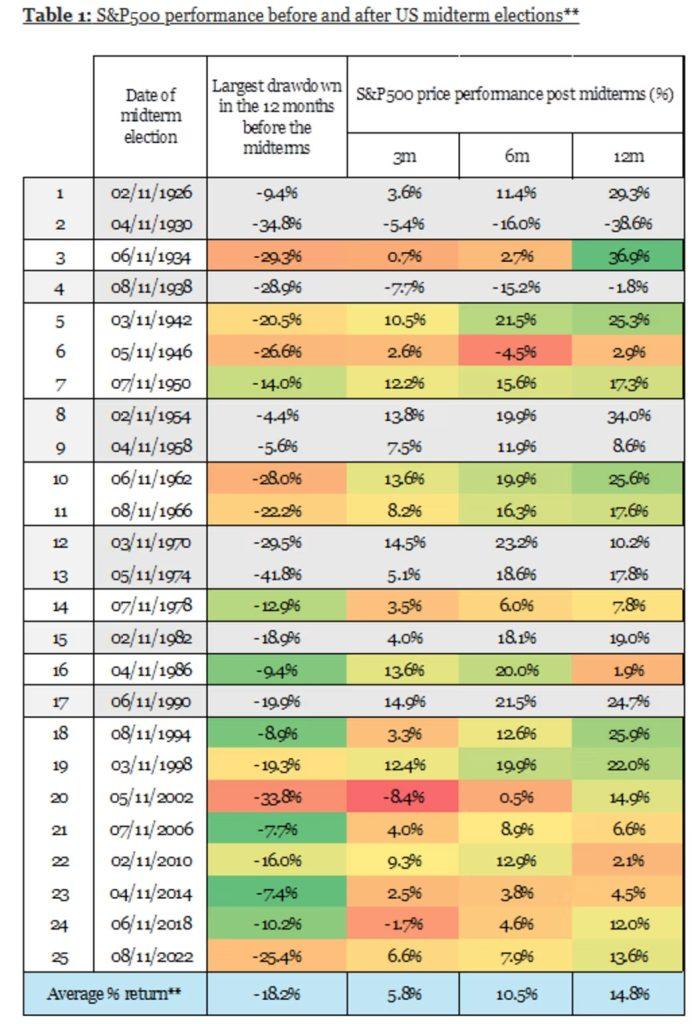
The “midterm curse” suggests the ruling party will likely struggle — and markets often feel the impact. Most Americans probably spent Thanksgiving avoiding political conversations, but investors can’t ignore the political cycle ahead. With the 2026 U.S. midterm elections approaching next November, markets are once again entering a period of rising uncertainty. Harry Colvin, senior market strategist at Longview Economics, analyzed more than 100 years of market data to see how midterms typically influence stocks. His research shows a clear pattern: the S&P 500 often experiences a significant drawdown in the 12–18 months before a midterm election — a selloff that frequently becomes a prime buying opportunity. Once the election concludes, equities tend to rebound strongly over the following 3, 6, and 12 months. Colvin says this pre-election volatility makes sense. Investors dislike uncertainty, especially when elections may result in policy gridlock or slower economic momentum. After the vote, uncertainty fades, policy direction becomes clearer, and markets shift their focus back to fundamentals. This cycle could be more sensitive than usual. Investors aligned with the Trump administration’s agenda may view the outcome with extra caution given the historical trend: the president’s party almost always loses seats during midterms, particularly in the House — a pattern widely known as the “midterm curse.” Factors include voter fatigue, energized opposition turnout, and backlash to early-term policies. Still, Colvin notes that historical patterns aren’t perfect. Pullbacks occur once or twice a year regardless of elections, and midterms that occur near recessions muddy the data. Of the 25 midterms over the past century, nine were within a year of a recession and excluded from his analysis. Among the remaining 16 midterms, twelve were preceded by S&P 500 declines greater than 10% in the year before election day. Seven of those drops exceeded 20%, while five were between 10% and 20%. These pullbacks were typically followed by strong post-election rallies: on average, the S&P 500 climbed 5.8% in three months, 10.5% in six months, and 14.8% over a year. Larger pre-midterm drawdowns often led to stronger 12-month rebounds, though the correlation isn’t perfect. In short, Colvin believes any volatility leading up to the 2026 midterms will likely offer attractive buying opportunities — assuming the U.S. avoids recession, which Longview currently expects. “We are overweight U.S. equities in our tactical portfolio,” he says. John PaulJohn Paul is the founder of DayTradeToWin, a trading education and software company established in 2008, supporting traders worldwide. His expertise focuses on price action-based futures trading strategies and structured market analysis. DayTradeToWin delivers trading education, indicators, and software tools designed to help traders apply disciplined, rule-based decision-making across global futures markets. He is the creator of multiple trading methodologies, including the Sonic System, Atlas Line, and Trade Scalper, which help traders identify structured opportunities in markets such as the E-mini S&P 500 (ES), Nasdaq (NQ), crude oil (CL), and gold (GC). Official website: https://daytradetowin.com daytradetowin.com

OBBBA
Market News

How the OBBBA Equity Tailwind Could Lift Markets

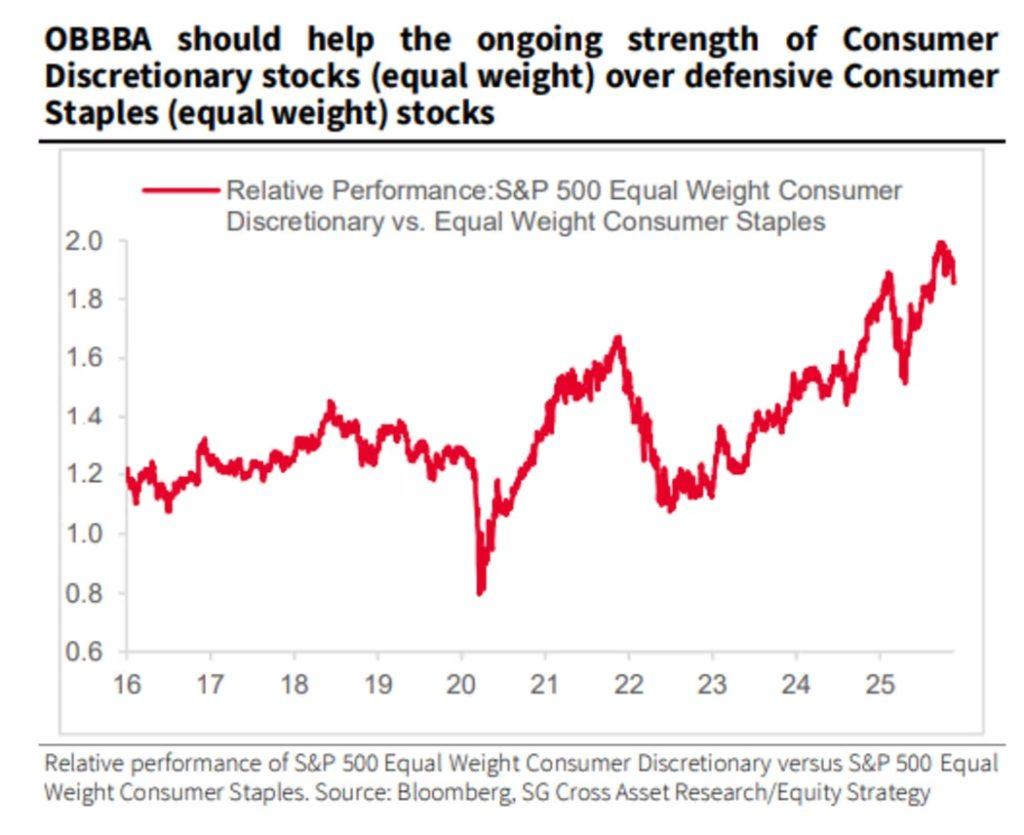
The OBBBA Could Deliver Another Major Boost for Equities in 2026 Most analysts expect stocks to climb again in 2026, thanks to a steady pace of interest-rate cuts, a resilient economy, and growing confidence in a broader AI-driven rally. But Societe Generale’s Manish Kabra, head of U.S. equity strategy, points to an additional—and powerful—tailwind: the One Big Beautiful Bill Act (OBBBA). In a recent report with SocGen’s global head of equity strategy, Charles de Boissezon, Kabra notes that the OBBBA “authorizes one of the largest spending packages in recent history,” channeling $4.1 trillion through 2034 toward defense, infrastructure, and targeted tax measures. If temporary provisions are made permanent, spending could rise to $5.5 trillion. This massive stimulus is expected to push annual fiscal deficits above $600 billion after 2025, before easing below $400 billion after 2030. Historically, that’s positive for equities: profit margins tend to rise roughly one year after deficits increase, SocGen notes. Five OBBBA Themes and the Stocks Poised to Benefit SocGen outlined five core themes within the OBBBA and built a 30-stock basket of potential winners. 1. Capex Revival The OBBBA reinstates and expands investment incentives aimed at strengthening domestic production. Lowered investment costs and improved cash flow should encourage companies to upgrade equipment, expand facilities, and accelerate R&D. Potential beneficiaries:Caterpillar (CAT), Cummins (CMI), Deere (DE), Eaton (ETN), Nucor (NUE) 2. A Defense Spending Lift Roughly $150 billion, much of it front-loaded into 2026, will support the U.S. defense industrial base and critical mineral supply chains. Potential beneficiaries:General Dynamics (GD), L3Harris (LHX), Northrop Grumman (NOC), Huntington Ingalls (HII) 3. Tax Changes Increasing Disposable Income Tax adjustments in the OBBBA should boost disposable income—mainly for middle- and high-income households. That supports consumer discretionary sectors like retail, autos, and leisure. Meanwhile, reduced SNAP and Medicaid funding could pressure staples and discount retailers. Potential beneficiaries:Ralph Lauren (RL), Tapestry (TPR), Costco (COST) 4. Support for Small Businesses Targeted tax relief and expanded financing tools are designed to help early-stage investors, improve after-tax earnings for small businesses, and drive loan demand for community banks. Potential beneficiaries:KeyCorp (KEY), M&T Bank (MTB), Apollo (APO) 5. Energy Sector Upswing The OBBBA is a clear positive for oil, gas, and coal producers—especially those operating in Alaska and the Gulf. It’s less favorable for large wind and solar developers that depend on federal land. The plan reinstates onshore and offshore drilling rights. Potential beneficiaries:Exxon Mobil (XOM), ConocoPhillips (COP) SocGen wrapped up with a full OBBBA equity basket—a curated list of stocks positioned to gain from this sweeping fiscal package. John PaulJohn Paul is the founder of DayTradeToWin, a trading education and software company established in 2008, supporting traders worldwide. His expertise focuses on price action-based futures trading strategies and structured market analysis. DayTradeToWin delivers trading education, indicators, and software tools designed to help traders apply disciplined, rule-based decision-making across global futures markets. He is the creator of multiple trading methodologies, including the Sonic System, Atlas Line, and Trade Scalper, which help traders identify structured opportunities in markets such as the E-mini S&P 500 (ES), Nasdaq (NQ), crude oil (CL), and gold (GC). Official website: https://daytradetowin.com daytradetowin.com

Scroll to Top