

stock news

Dow
Market News

What’s Driving October’s Market Drop?

The Dow and S&P 500 ended October with their first monthly declines since April, while Halloween brought more market scares than treats. A wave of tech-sector selling on Thursday pulled down the S&P 500, and the Nasdaq Composite posted its steepest one-day drop since early September. Analysts pointed to various factors behind the slide, including cautious guidance from Big Tech and potential pre-election anxiety. Thomas Martin, senior portfolio manager at Globalt Investments, noted that investors seem to be zeroing in on earnings reports from the “Magnificent Seven” tech giants, even though he felt most of their results were solid. The Nasdaq Composite dropped 2.8%, its sharpest one-day percentage drop since Sept. 3, while tech sectors led the S&P 500 down 1.9%. Meanwhile, the Dow Jones Industrial Average, more weighted toward cyclical sectors, lost 0.9%. The month marked the first declines since April for the S&P 500 and Dow and the first since July for the Nasdaq. The Invesco QQQ Trust, which tracks the Nasdaq-100, dropped 2.5%. Microsoft and Meta Platforms fell 6.1% and 4.4%, respectively, following strong earnings reports that were overshadowed by conservative revenue outlooks and continuing high costs linked to artificial intelligence. Louis Navellier, founder of Navellier & Associates, explained that tech companies with high price-to-earnings ratios must beat expectations and provide robust guidance, a situation he describes as “priced for perfection.” Navellier also pointed to rising uncertainty around the upcoming election, as reflected in a jump in the Cboe Volatility Index, which rose above its historical average. Despite Thursday’s losses, Microsoft remains up more than 8% this year, Meta has gained over 60%, and Nvidia is up nearly 170%. Still, rising Treasury yields—now around 4.3% on the 10-year note, up from 3.6% in mid-September—have intensified pressure on high-valuation tech stocks, as higher yields reduce the present value of future earnings. Jonathan Krinsky, chief market technician at BTIG, noted that the S&P 500 has broken its uptrend from the August lows. He previously warned of market vulnerability in mid-October, and now suggests that the next key support level could be around 5,500-5,650. John PaulJohn Paul is the founder of DayTradeToWin, a trading education and software company established in 2008, supporting traders worldwide. His expertise focuses on price action-based futures trading strategies and structured market analysis. DayTradeToWin delivers trading education, indicators, and software tools designed to help traders apply disciplined, rule-based decision-making across global futures markets. He is the creator of multiple trading methodologies, including the Sonic System, Atlas Line, and Trade Scalper, which help traders identify structured opportunities in markets such as the E-mini S&P 500 (ES), Nasdaq (NQ), crude oil (CL), and gold (GC). Official website: https://daytradetowin.com daytradetowin.com
stocks
Market News

Election Outcomes That Could Boost Stocks Through January

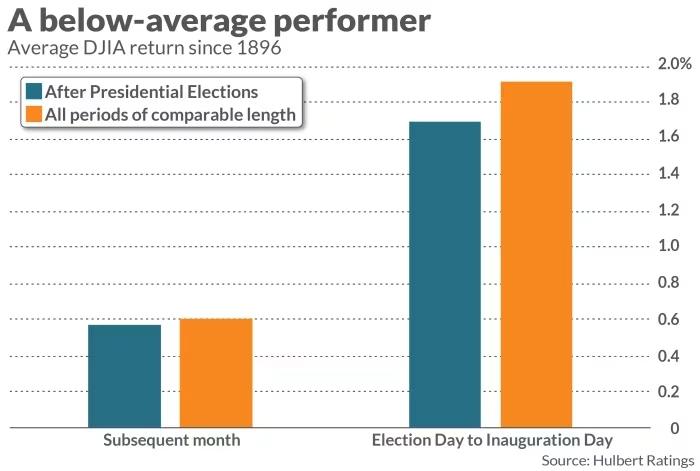
Following Election Day, U.S. stocks often face headwinds—not necessarily because of post-election uncertainty but due to a long-term trend of below-average performance in the immediate weeks afterward. Historically, stock markets tend to perform better when the incumbent party retains the White House, while declines are more frequent when the opposition takes over. On average, the Dow Jones Industrial Average has returned 4.4% between Election Day and Inauguration Day if the incumbent party wins, versus a 2.0% drop when it loses. Since 1900, in 42% of the periods between Elections Day and Inauguration Day, the Dow stocks have ended up lower than it started on Election Day. This serves as a reminder to exercise caution when assuming recent trends will continue uninterrupted. When the incumbent party loses, any initial rally is usually short-lived. After the campaign ends, the realities of governing set in, and many campaign promises remain unfulfilled, especially for key interest groups. In elections where the incumbent party lost, the Dow was lower on Inauguration Day 62% of the time, compared to only 28% of the time when the incumbent retained power. The takeaway? Expect potential volatility after the November 5 election, particularly if the incumbent party loses. John PaulJohn Paul is the founder of DayTradeToWin, a trading education and software company established in 2008, supporting traders worldwide. His expertise focuses on price action-based futures trading strategies and structured market analysis. DayTradeToWin delivers trading education, indicators, and software tools designed to help traders apply disciplined, rule-based decision-making across global futures markets. He is the creator of multiple trading methodologies, including the Sonic System, Atlas Line, and Trade Scalper, which help traders identify structured opportunities in markets such as the E-mini S&P 500 (ES), Nasdaq (NQ), crude oil (CL), and gold (GC). Official website: https://daytradetowin.com daytradetowin.com

market
Market News

2023’s Market Surge: Is More Growth Ahead?

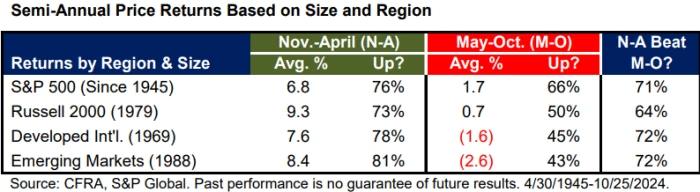
The U.S. stock market is gearing up for its historically strongest six-month period, November through April, following impressive gains over the summer months. Traditionally, investors adhere to the “sell in May and go away” adage, but this year’s performance defied that trend. Yet with rising Treasury yields and the looming presidential election, many wonder if the market rally has enough fuel to keep running. Historically, the November-April period is the best six-month stretch for stocks. Since 1945, the S&P 500 has averaged nearly a 7% return in this window compared to only 2% from May to October, according to Sam Stovall, CFRA Research’s chief investment strategist. This year, however, has been an outlier. Since April 30, the S&P 500 has surged more than 16%, setting up for the biggest May-October gain since 2009, on top of the previous November-April’s 20% gain. This two-part rally has raised questions about whether the market is due for a slowdown, yet history suggests the momentum could continue. Stovall notes that previous strong gains from May to October have often led to even stronger performance in the following November-April period. In fact, in the 12 instances since 1945 when the S&P 500 rose over 10% from May to October, it went on to climb an average of 13% in the subsequent November-April period. Additionally, in cases where double-digit gains occurred in both periods, stocks stayed on an upward trend in four out of five subsequent periods, with an average gain of 11%. Beyond the large-cap S&P 500, the November-April stretch has also been strong for smaller stocks and international markets, including the Russell 2000, MSCI EAFE, and MSCI Emerging Markets indices. However, election-related concerns and economic pressures are adding uncertainty. Recently, rising Treasury yields have triggered market volatility, with the yield on the 10-year note trading above 4.3%, a level that has challenged stocks in recent months. “With stocks up 23% year-to-date, many are questioning the remaining upside,” commented José Torres, senior economist at Interactive Brokers. Although this year has seen impressive growth, he pointed out that it trails some recent years like 2021, 2019, and 2013, each of which saw returns ranging from 24% to 30% in the first 10 months. Torres added that for stocks to keep their upward momentum, factors like favorable election outcomes, calmer interest rates, and strong AI-driven earnings could play a role. Sam Stovall is still optimistic, emphasizing that the market has historically risen through periods of uncertainty, driven by potential interest rate cuts and solid tech earnings. U.S. stocks closed mostly higher on Tuesday, with the Nasdaq up 0.8% for its 28th record close of the year. Meanwhile, the S&P 500 edged up 0.2%, while the Dow Jones slipped 0.4%. John PaulJohn Paul is the founder of DayTradeToWin, a trading education and software company established in 2008, supporting traders worldwide. His expertise focuses on price action-based futures trading strategies and structured market analysis. DayTradeToWin delivers trading education, indicators, and software tools designed to help traders apply disciplined, rule-based decision-making across global futures markets. He is the creator of multiple trading methodologies, including the Sonic System, Atlas Line, and Trade Scalper, which help traders identify structured opportunities in markets such as the E-mini S&P 500 (ES), Nasdaq (NQ), crude oil (CL), and gold (GC). Official website: https://daytradetowin.com daytradetowin.com
election
Market News

Why the Election Outcome Could Shock the Markets

Throughout most of 2024, stock-market investors showed little concern over whether Donald Trump or Kamala Harris might win the presidential race. However, with Election Day just two weeks away, political anxiety has finally begun to impact equities. This week, a notable climb in Treasury yields, which have been on the rise since September, rattled the U.S. stock market. The selloff raised worries that this surge might jeopardize what’s been a record-breaking year for stocks as the election draws near. On Wednesday, U.S. markets saw a dip with the S&P 500 and Dow Jones Industrial Average both falling nearly 1%, marking three consecutive days of declines — the longest losing streak since early September. The tech-focused Nasdaq Composite dropped by 1.6%, its sharpest daily decline since early September, according to Dow Jones Market Data. The selloff aligned with long-dated Treasury yields hitting their highest levels in nearly three months. Many investors worry that the election could exacerbate the fiscal deficit, while rising odds of a Trump victory in a close race, combined with expectations of less aggressive monetary easing from the Federal Reserve in November, weighed on the market. Concerns have heightened over both Trump’s and Harris’s economic policies, each seen as likely to increase inflation, interest rates, and deficits. However, Brad Neuman, senior VP at Fred Alger & Co., told MarketWatch that Trump’s proposals are anticipated to have a more inflationary impact. Treasury yields have been climbing since mid-September, following the Fed’s rate cuts and strong economic data, yet the stock market had remained relatively calm until now. Last Friday, the S&P 500 closed at a record high, marking its 47th such close this year and capping a six-week winning streak — the longest since last December. On course for its best first ten months of an election year since 1936, the S&P is defying the seasonal trend by showing gains in October, often a volatile month in election years, as per Dow Jones Market Data. Even as the Cboe Volatility Index (VIX), Wall Street’s “fear gauge,” has surged nearly 16% this month, it’s still below the “high volatility” threshold of 20. Until recently, stock prices have seemed unaffected by fluctuations in bond yields and the dollar. Jonathan Krinsky, chief market technician at BTIG, remarked that investors have been more focused on the pace of yield increases than their levels, pointing to a sense of market complacency. However, stocks now appear to be absorbing concerns over both the election and rates. Krinsky expects broad downside risk for stocks in the coming weeks and anticipates a pullback in the S&P 500 to between 5,500–5,650. The index closed Wednesday at 5,797.42. Aaron Clark, portfolio manager at GW&K Investment Management, told MarketWatch he doesn’t foresee a major selloff or spike in volatility before Election Day, as both candidates’ policies are likely to moderate post-election. He noted that “markets can’t predict which policies will actually be pursued or implemented,” suggesting that a divided Congress, which could temper drastic changes, would likely benefit markets and the economy. Clark believes that a split Congress would limit significant policy shifts. While there may be modest adjustments in taxes, tariffs, or immigration policies, he expects any changes to be less extreme than current campaign rhetoric. On Thursday morning, U.S. stock futures showed mixed movement: S&P 500 futures rose 0.4%, Nasdaq 100 futures climbed 0.8%, while Dow futures dropped slightly by 0.1%, per FactSet data. John PaulJohn Paul is the founder of DayTradeToWin, a trading education and software company established in 2008, supporting traders worldwide. His expertise focuses on price action-based futures trading strategies and structured market analysis. DayTradeToWin delivers trading education, indicators, and software tools designed to help traders apply disciplined, rule-based decision-making across global futures markets. He is the creator of multiple trading methodologies, including the Sonic System, Atlas Line, and Trade Scalper, which help traders identify structured opportunities in markets such as the E-mini S&P 500 (ES), Nasdaq (NQ), crude oil (CL), and gold (GC). Official website: https://daytradetowin.com daytradetowin.com
trader
Market News

Trader Confidence Back to Pre-Plunge Levels

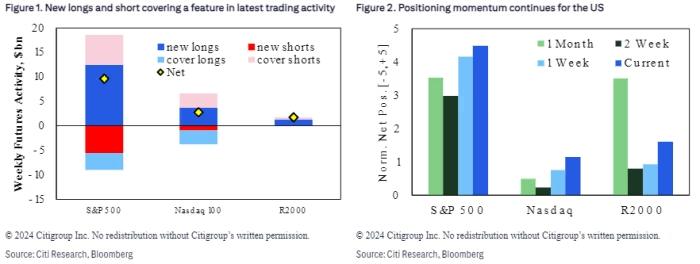
Citigroup strategists are growing concerned about the current bullish sentiment in the stock market but aren’t advising investors to reduce their positions yet. Chris Montagu, Citigroup’s global head of quantitative research, noted that net-long positioning in S&P 500 futures has reached its highest level since July 2023. At that time, such extreme bullish positioning was followed by a sharp three-month decline, with the S&P 500 falling 10%. Montagu warns that a similar pullback could happen if investors aren’t cautious. “The last time positioning was this stretched, the S&P 500 fell more than 10% over the next 2-3 months. While we aren’t suggesting reducing exposure, positioning risks increase when markets get this extended,” Montagu and his team said in a report shared with MarketWatch. Nasdaq-100 futures are less overextended than the S&P 500, avoiding the frothy conditions seen in mid-2023 and again in July 2024. The strategists also pointed out that recent short-covering in S&P 500 futures may have driven the market higher. A key difference from mid-2023 is that investors’ profit-and-loss positions are less stretched now, so they may be less inclined to sell off stocks to protect their gains, Montagu noted. Additionally, all short positions in both S&P 500 and Nasdaq-100 futures are currently underwater, which could force further buying as trader cover their short positions. While markets have been climbing in October, Tuesday saw the first consecutive losses for the S&P 500 since early September, as rising Treasury yields reignited concerns of a repeat of the 2023 selloff, when the S&P 500 dropped 10% between August and October. On Tuesday, the 10-year Treasury yield rose 2.5 basis points to 4.204%, its highest level since July. The S&P 500 fell slightly by 2.78 points (0.1%) to close at 5,851.20. The Dow Jones Industrial Average dropped 6.71 points, and the Nasdaq Composite lost 33.12 points (0.2%). John PaulJohn Paul is the founder of DayTradeToWin, a trading education and software company established in 2008, supporting traders worldwide. His expertise focuses on price action-based futures trading strategies and structured market analysis. DayTradeToWin delivers trading education, indicators, and software tools designed to help traders apply disciplined, rule-based decision-making across global futures markets. He is the creator of multiple trading methodologies, including the Sonic System, Atlas Line, and Trade Scalper, which help traders identify structured opportunities in markets such as the E-mini S&P 500 (ES), Nasdaq (NQ), crude oil (CL), and gold (GC). Official website: https://daytradetowin.com daytradetowin.com

markets
Market News

U.S. Exceptionalism: Markets Gains and Potential Pitfalls

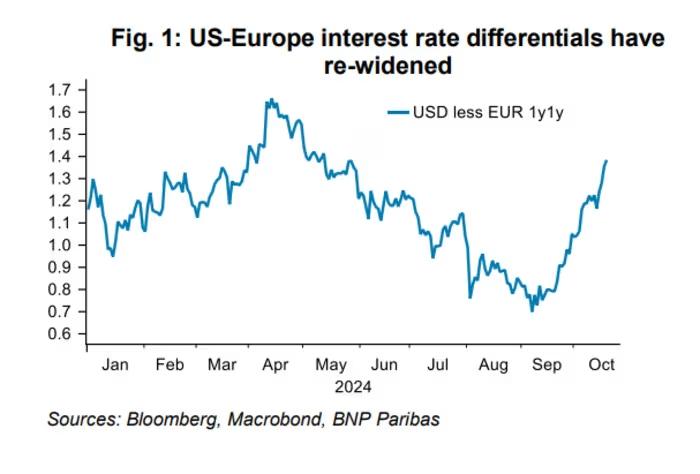
BNP Paribas and UBS Global Wealth Management Highlight U.S. Economy’s Resilience The U.S. economy is once again in the spotlight, with The Economist calling it the envy of the world in a recent cover story. While some, like Brett Donnelly from Spectra Markets, have noted that such magazine covers often signal a contrarian view, it’s not just The Economist that is praising U.S. economic strength. BNP Paribas strategists are focusing on U.S. resilience as policymakers and market participants head to Washington D.C. for the International Monetary Fund and World Bank meetings. They pointed out that the Atlanta Fed’s Q3 GDP growth forecast is an impressive 3.4% annualized, while the eurozone is expected to grow just 0.3% quarter-on-quarter. This means U.S. growth is likely to triple that of the eurozone in the third quarter. This performance difference is reflected in the markets. The spread between one-year forward rates in the U.S. and eurozone has widened by 60 basis points over the past month, with the U.S. dollar index rising 3%, and the S&P 500 outperforming the Euro Stoxx 50. In terms of central bank strategy, the Federal Reserve faces uncertainty heading into its next meeting, relying on current data to potentially support a quarter-point rate cut in November. In contrast, the European Central Bank has been more reactive to recent data, cutting rates unexpectedly just five weeks after hinting that a cut was unlikely. UBS Global Wealth Management has also revised its outlook, raising its target for the S&P 500 from 6,200 to 6,300 for June, and introducing a year-end 2025 target of 6,600. UBS cited a more resilient labor market, stronger-than-expected economic performance, and a medium-term growth rate above the Fed’s long-term projection of 1.8%. This strength, combined with falling inflation, has reinforced UBS’s positive view on U.S. equities for the future. John PaulJohn Paul is the founder of DayTradeToWin, a trading education and software company established in 2008, supporting traders worldwide. His expertise focuses on price action-based futures trading strategies and structured market analysis. DayTradeToWin delivers trading education, indicators, and software tools designed to help traders apply disciplined, rule-based decision-making across global futures markets. He is the creator of multiple trading methodologies, including the Sonic System, Atlas Line, and Trade Scalper, which help traders identify structured opportunities in markets such as the E-mini S&P 500 (ES), Nasdaq (NQ), crude oil (CL), and gold (GC). Official website: https://daytradetowin.com daytradetowin.com

Scroll to Top