

stock news

inflation
Market News

Why U.S. Stocks May Struggle Amid Inflation and Earnings Volatility

This week’s spotlight for the stock market is on Wednesday’s inflation report, set against a backdrop of significant earnings announcements from major retailers and a retail sales update. Wall Street is increasingly uneasy about the U.S. economy’s health, and the strain on American households could be confirmed in this week’s economic and earnings reports, potentially derailing the stock market’s recovery after its worst day in two years. Last week, U.S. stocks concluded a turbulent period marked by the unwinding of a yen-driven carry trade and fears of a weakening U.S. economy, which rattled global financial markets. Despite the volatility, the major indexes ended the week just short of reversing their losses. The S&P 500 dipped by less than 0.1% for the week, the Nasdaq Composite fell 0.2%, and the Dow Jones Industrial Average dropped 0.6%, according to FactSet data. Now, the focus shifts to a new wave of U.S. economic data, including July’s Consumer Price Index (CPI), a retail sales update, and earnings reports from top U.S. retailers. Investors are watching closely to see if American households are facing greater stress from high inflation and rising interest rates. “Markets have temporarily calmed after a brief panic over hard-landing risks,” said Michael Gapen, an economist at BofA Global Research. “Upcoming data will reveal whether the economy is slowing gradually or sharply.” As always, the CPI report is crucial, but this time, investors are especially concerned that signs of an economic slowdown or persistent inflation could trigger another downturn in stocks. Economists surveyed by the Wall Street Journal expect headline inflation to remain steady at 3% year-over-year in July, while core CPI, which excludes volatile food and energy prices, is forecasted to ease slightly to 3.2% from 3.3% in June. Brian Weinstein, head of global markets at Morgan Stanley Investment Management, noted that inflation will likely remain above the Fed’s 2% target for some time. He pointed to persistent price increases in areas like car and home insurance, particularly in regions with rapid population growth. “These ongoing costs are cutting into consumers’ budgets every month,” Weinstein said. Weinstein also mentioned that geopolitical uncertainties and the economic plans of the 2024 U.S. presidential candidates are contributing factors that could keep inflation elevated. Consumers are feeling the pinch, and businesses are starting to notice. The Fed’s strategy to curb inflation while maintaining economic growth worked well in the year’s first half, but recent months have shown early signs of a consumer spending slowdown, as highlighted by several companies focused on consumer goods. For instance, luxury-goods giant LVMH recently reported a decline in second-quarter sales from its Asia (excluding Japan) operations, which accounted for 30% of its first-half 2024 revenue. McDonald’s Corp. also reported that inflationary pressures are making lower-income consumers more cautious with their spending. Similarly, Airbnb Inc. expects a slowdown in leisure travel as consumers hold back on bookings amid economic uncertainty. Years of high inflation and the Fed’s tightening policies have squeezed American households, who are now depleting the savings they built up during the COVID-19 pandemic. As a result, many consumers are becoming more selective in their spending. “Most consumer-facing companies, like Starbucks and McDonald’s, have issued profit warnings, signaling a tough environment for consumers,” said Brad Conger, chief investment officer at Hirtle Callaghan & Co. “This reflects the exhaustion of consumers’ savings and their concerns about job security and future income.” This makes the upcoming earnings reports from major U.S. retailers a critical event for the stock market this week. Walmart Inc. and Home Depot Inc. are among the companies set to release earnings on Tuesday and Thursday, respectively. Investors are eager for more insights into the state of consumer spending from companies that sell essential household goods. Conger warned that the slowdown in consumer spending could spread to other parts of the economy. “People are cutting back on all kinds of expenses, which means businesses might reduce hiring, leading to a feedback loop affecting employment and incomes,” he said. Despite these concerns, recent economic data has shown mixed signals about growth. Last week, the service sector rebounded in July, countering fears that the U.S. might be edging closer to a recession. Additionally, the number of Americans filing for unemployment benefits fell to 233,000, a sign that the labor market may still be strong despite a soft July jobs report. These reports helped stocks recover some of their earlier losses. “There’s a sense of panic and fragility in the stock market right now,” Conger told MarketWatch. “Positive economic data is unlikely to dramatically shift market sentiment, and if more positive reports emerge in the coming weeks, each will have a diminishing impact on the market.” Weinstein expects more volatility ahead, which could limit gains in the stock market. However, he added, “This doesn’t necessarily mean a hard landing or guarantee a recession.” John PaulJohn Paul is the founder of DayTradeToWin, a trading education and software company established in 2008, supporting traders worldwide. His expertise focuses on price action-based futures trading strategies and structured market analysis. DayTradeToWin delivers trading education, indicators, and software tools designed to help traders apply disciplined, rule-based decision-making across global futures markets. He is the creator of multiple trading methodologies, including the Sonic System, Atlas Line, and Trade Scalper, which help traders identify structured opportunities in markets such as the E-mini S&P 500 (ES), Nasdaq (NQ), crude oil (CL), and gold (GC). Official website: https://daytradetowin.com daytradetowin.com
S&P 500
Market News

Amazon Leads: S&P 500’s Largest Stocks Are Now Cheaper

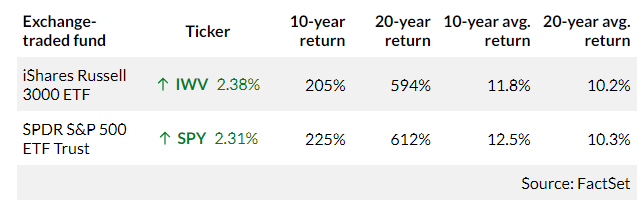
Amazon’s stock has become more attractive relative to its expected earnings and sales. Amazon.com Inc. has long focused on growth, often reporting low profits due to heavy reinvestment in its business. However, the recent broad stock market decline has led to a significant shift: Amazon’s stock, which once traded at high multiples relative to expected earnings, now has a forward price-to-earnings (P/E) ratio that aligns more closely with other large, successful companies. Below is a comparison of how forward P/E and price-to-sales valuations have changed for the largest U.S. companies following the recent market downturn. Encouragement for Long-Term Investors Investors may have felt some relief when the S&P 500 rebounded with a 1% gain on Tuesday, after a three-session 6.2% slide. Despite a 0.8% pullback on Wednesday, the index remains 7.8% below its July 10 high, yet still up 9% for 2024 (excluding dividends). For those focused on the long term, it’s important to recognize that large market fluctuations are common. From October 19, 1995, through May 17, 2024, the Russell 3000 Index experienced 51 declines of 7.5% or more, with an average drop of 14.2% over 55 days. These were balanced by 51 gains of 7.5% or more, averaging a 21.3% increase over 145 days. Historically, investors who remained patient through downturns have generally been rewarded. Shifts in Valuation Metrics Focusing on the largest stocks in the S&P 500, all 10 have seen their forward P/E ratios decrease since July 10. For Amazon, the forward P/E ratio has dropped to 30, down from 38.1 on July 10 and 41.7 at the end of 2023, despite the stock still being up 31% for 2024. Amazon now has the lowest P/E ratio compared to its five-year and 10-year averages among these companies. This shift could make Amazon more attractive to value-oriented investors who previously tolerated its high P/E ratios. However, Amazon’s recent second-quarter results were met with a mixed response. While Amazon Web Services continues to grow rapidly, overall revenue fell short of expectations, likely due to a broader economic slowdown. A Potential Bargain in Price-to-Sales Ratio Amazon also stands out for its forward price-to-sales ratio, which is now lower than the S&P 500’s average. Among the top 10 S&P 500 components, Amazon is one of only two companies trading below both its five-year and 10-year average price-to-sales ratios. The other is Tesla, which, despite high valuations, is still priced lower relative to its sales. In summary, Amazon’s P/E ratio has adjusted to more typical levels after years of being exceptionally high, and its price-to-sales ratio suggests the stock might be undervalued in the current market. As always, it’s crucial to conduct your own research when assessing any stock, considering the company’s long-term potential and competitive position. John PaulJohn Paul is the founder of DayTradeToWin, a trading education and software company established in 2008, supporting traders worldwide. His expertise focuses on price action-based futures trading strategies and structured market analysis. DayTradeToWin delivers trading education, indicators, and software tools designed to help traders apply disciplined, rule-based decision-making across global futures markets. He is the creator of multiple trading methodologies, including the Sonic System, Atlas Line, and Trade Scalper, which help traders identify structured opportunities in markets such as the E-mini S&P 500 (ES), Nasdaq (NQ), crude oil (CL), and gold (GC). Official website: https://daytradetowin.com daytradetowin.com
recovery
Market News

History’s 4-Step Path to Market Recovery

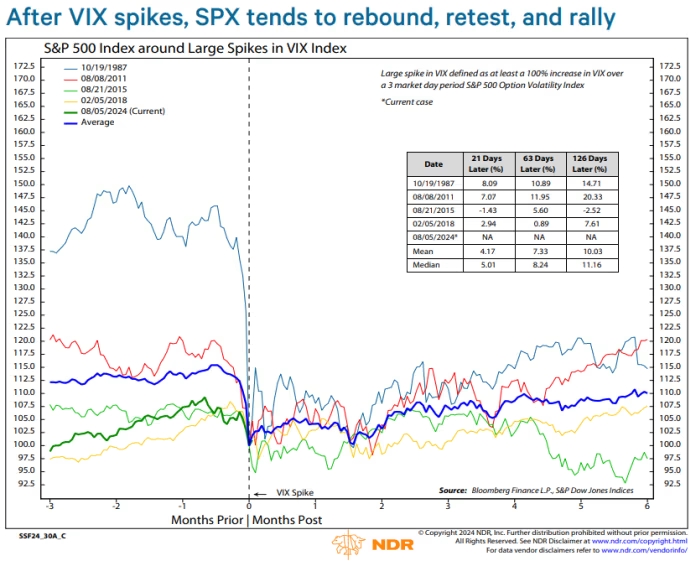
Monday’s Shock Could Haunt Markets for Weeks, NDR Analysts Say After the S&P 500’s sharpest drop in nearly two years on Monday, a rebound on Tuesday followed by a shaky Wednesday has left investors questioning the next steps. According to Ed Clissold, chief U.S. strategist, and Thanh Nguyen, senior quantitative analyst at Ned Davis Research, a retest of Monday’s lows is probable, but the market could regain strength in the coming weeks if a recession is avoided. “The effects of Monday’s shock could linger for several weeks. However, current fundamentals don’t support a major bear market,” they wrote in a note on Wednesday. The analysts pointed to a dramatic rise in the Cboe Volatility Index (VIX), often called Wall Street’s “fear gauge,” which more than doubled in just three days—a rare event that has occurred only four times before. Historically, such spikes in volatility have led to initial market drops, followed by rebounds and subsequent retests of the lows. Monday’s 3% decline left the market oversold, setting the stage for a four-step recovery process: oversold, rally, retest, and breadth thrusts. While the market began to bounce back on Tuesday, gains were shaky by Wednesday afternoon. Clissold and Nguyen stressed that the retest phase could be critical, with the key to recovery being that fewer stocks hit new lows than during the initial selloff. Despite the volatility, they believe that as long as underlying fundamentals remain solid, the stock market is likely to resume its uptrend after navigating this four-step recovery process. John PaulJohn Paul is the founder of DayTradeToWin, a trading education and software company established in 2008, supporting traders worldwide. His expertise focuses on price action-based futures trading strategies and structured market analysis. DayTradeToWin delivers trading education, indicators, and software tools designed to help traders apply disciplined, rule-based decision-making across global futures markets. He is the creator of multiple trading methodologies, including the Sonic System, Atlas Line, and Trade Scalper, which help traders identify structured opportunities in markets such as the E-mini S&P 500 (ES), Nasdaq (NQ), crude oil (CL), and gold (GC). Official website: https://daytradetowin.com daytradetowin.com
Wall Street
Market News

Market Recovery or Bear Trap? Insights from a Wall Street Expert

U.S. stocks rebounded on Tuesday after fears of a weakening economy triggered a global selloff, leading to Wall Street’s worst day since 2022. Despite the rebound, Barry Bannister, chief equity strategist at Stifel, warns it is too early to jump back into the U.S. stock market. He maintains his prediction that the S&P 500 (SPX) will drop to 5,000 by October, a 12% decline from its July peak, due to a significantly slowing economy and persistent inflation. “Our view remains a correction to 5,000 on the S&P 500 by October,” Bannister and his team wrote in a Monday note. “While we foresee a low-double-digit correction, there is also a risk of a bear market if the slowdown turns into a recession, which would be a surprise to investors and the Federal Reserve.” A market correction typically occurs when a stock index falls at least 10% from a recent high. This can worsen into a bear market, marked by a drop of 20% or more. The S&P 500 last entered correction territory on October 27, 2023, and the recent selloff has brought it close to another correction. It is currently down 7.5% from its high of 5,667 set on July 16, according to Dow Jones Market Data. Earlier this year, Bannister predicted a summer selloff and has repeatedly forecasted a market correction by October. His stance makes him one of Wall Street’s few remaining bears, as many other strategists have raised their year-end targets for the S&P 500, expecting multiple interest-rate cuts by the Fed. Bannister and his team advise investors to remain defensive, favoring “defensive-value” sectors such as healthcare, consumer staples, and utilities. These sectors typically perform well if inflation remains high and GDP growth slows sharply, offering a hedge against a potential recession. On Tuesday, the S&P 500 and Nasdaq Composite (COMP) each rebounded over 1%, while the Dow Jones Industrial Average (DJIA) advanced 0.8%, according to FactSet data. John PaulJohn Paul is the founder of DayTradeToWin, a trading education and software company established in 2008, supporting traders worldwide. His expertise focuses on price action-based futures trading strategies and structured market analysis. DayTradeToWin delivers trading education, indicators, and software tools designed to help traders apply disciplined, rule-based decision-making across global futures markets. He is the creator of multiple trading methodologies, including the Sonic System, Atlas Line, and Trade Scalper, which help traders identify structured opportunities in markets such as the E-mini S&P 500 (ES), Nasdaq (NQ), crude oil (CL), and gold (GC). Official website: https://daytradetowin.com daytradetowin.com
JPMorgan
Market News

Unveiling the Classic Signs of a Stock-Market Bottom: JPMorgan’s Expert Tips

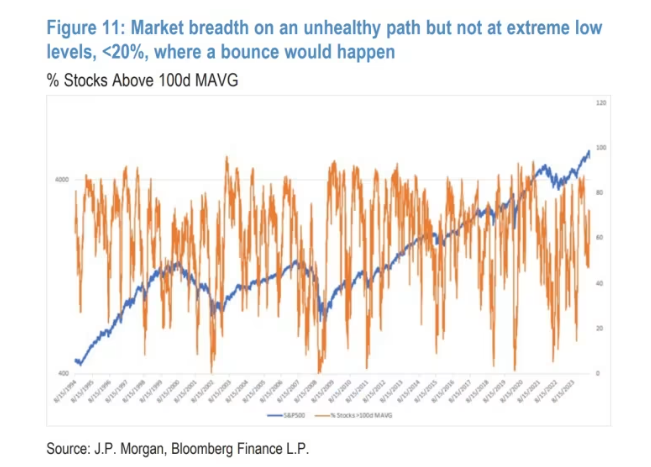
U.S. stock index futures are up early Tuesday following a significant decline on Monday that caused the S&P 500 to drop by 3%, marking its worst single-day performance in nearly two years. Over the past three sessions, the S&P 500 lost 6%, the Nasdaq Composite fell 8%, and the Russell 2000 plummeted 10%. These declines are driven by fears of a U.S. recession and the Bank of Japan’s interest rate hike, which impacted the yen carry trade. The pressing question now is whether the worst is over for the market. Thomas Salopek, head of cross-asset strategy at JPMorgan, believes the answer is no. He explains that the necessary conditions for a market bottom are not yet present. Salopek identifies the pullback as “legitimate,” supported by widening credit spreads, a steepening Treasury yield curve, and the outperformance of utilities over the broader market. Factors like economic slowdowns or disinflation, which negatively affect other sectors, benefit utilities and defensive sectors that thrive on lower interest rates. “The growth outperformance of the second quarter suggested an economic slowdown while the third-quarter defensive leadership suggests growth risk,” says Salopek. Salopek also questions the optimistic view of labor market data, which suggests that the rise in the unemployment rate is due to increased labor supply. “If that were the case, we would expect unemployment to stabilize, not continue to rise as it has,” he notes, adding that Hurricane Beryl affected the latest figures. With the next jobs report a month away, investors need to focus on technical and risk-based signals, which are not indicating a market bottom, according to Salopek. For instance, stocks rarely bottom when the VIX (the market’s fear gauge) is at its highs, although the VIX has dropped sharply in early Tuesday trading. Additionally, the 20-day moving average’s slope does not provide reassurance, and crossing above it is “a minimum starting point.” He also notes that the put/call ratio typically peaks at market lows. The percentage of Nasdaq stocks above their 100-day moving average is 34%, but Salopek would prefer this to drop to 20% before considering it closely. Similarly, the percentage of stocks at four-week lows is far from the 60% seen in previous corrections. He also monitors the American Association of Individual Investors sentiment survey, which sent a strong signal in fall 2022 when sentiment was worse than during the COVID crisis. “Historically, a confluence of these bottoming signals during market corrections helps pinpoint the best time to re-enter,” Salopek says. For now, he recommends staying underweight in stocks and waiting for conditions to worsen enough to signal capitulation. John PaulJohn Paul is the founder of DayTradeToWin, a trading education and software company established in 2008, supporting traders worldwide. His expertise focuses on price action-based futures trading strategies and structured market analysis. DayTradeToWin delivers trading education, indicators, and software tools designed to help traders apply disciplined, rule-based decision-making across global futures markets. He is the creator of multiple trading methodologies, including the Sonic System, Atlas Line, and Trade Scalper, which help traders identify structured opportunities in markets such as the E-mini S&P 500 (ES), Nasdaq (NQ), crude oil (CL), and gold (GC). Official website: https://daytradetowin.com daytradetowin.com

stocks
Market News

Wall Street Woes: Stocks and Crypto Fall Sharply

Dow, S&P 500, and Nasdaq-100 Futures Plunge Sunday Night U.S. stock-market futures fell late Sunday following a turbulent week on Wall Street, during which the Nasdaq entered correction territory. As of 11 p.m. Eastern, Dow Jones Industrial Average futures dropped over 250 points, or 0.7%. S&P 500 futures decreased by 1.4%, and Nasdaq-100 futures fell 2.4%. All showed slight improvements from their session lows late Sunday. Crude oil futures rose slightly amid concerns over escalating hostilities in the Middle East. Cryptocurrencies also fell, with Bitcoin dropping 8% to below $55,000 after reaching over $65,000 on Friday. Ether dropped more than 15%. Japan’s Nikkei 225 plunged 5%, continuing the previous week’s trend, as global markets reacted to recent U.S. economic data and Wall Street’s losses. U.S. stocks fell on Friday after a weaker-than-expected jobs report raised concerns about economic growth. This followed Fed signals on Wednesday indicating potential interest rate cuts in September. However, investors worry these cuts might come too late to prevent a recession. Last week, all three major indexes experienced significant losses. The S&P 500 had its worst week since April, falling 2.1%. The Dow also dropped 2.1%, and the Nasdaq saw a 3.4% decline, ending 10% below its July 10 record close, placing it in correction territory. Stephen Innes, managing partner at SPI Asset Management, noted, “Market participants scrambled for hedges amidst growing panic over interest rates and a looming recession. The spike in volatility underscores how jittery markets have become.” He added, “The real question is whether the typical market reflex to sell volatility or buy the dip can overcome the anxiety from this sudden recession scare.” Investors might brace for further declines in tech stocks on Monday after Warren Buffett’s Berkshire Hathaway revealed it reduced its Apple stake by nearly 50% last quarter. Tech stocks have struggled recently, highlighted by Intel, whose stock plunged 26% on Friday following disappointing earnings. John PaulJohn Paul is the founder of DayTradeToWin, a trading education and software company established in 2008, supporting traders worldwide. His expertise focuses on price action-based futures trading strategies and structured market analysis. DayTradeToWin delivers trading education, indicators, and software tools designed to help traders apply disciplined, rule-based decision-making across global futures markets. He is the creator of multiple trading methodologies, including the Sonic System, Atlas Line, and Trade Scalper, which help traders identify structured opportunities in markets such as the E-mini S&P 500 (ES), Nasdaq (NQ), crude oil (CL), and gold (GC). Official website: https://daytradetowin.com daytradetowin.com

Scroll to Top