

Market News

meta
Market News

Meta AI Investment: A Game Changer

Meta CEO Calls Consumer AI ‘One of the Most Transformative Products We’ve Made’ Meta Platforms Inc. isn’t backing down from its aggressive spending, even after the DeepSeek news. The company reaffirmed its forecast of $60 billion to $65 billion in capital expenditures for the year—an outlook CEO Mark Zuckerberg first shared on Facebook last week. Furthermore, Meta remains committed to massive investments in artificial intelligence for the long haul. During the earnings call, Zuckerberg emphasized that Meta plans to pour “hundreds of billions of dollars” into AI infrastructure over time. Following the earnings announcement, Meta’s stock climbed 2.3% in after-hours trading, despite a mixed financial report. Zuckerberg acknowledged that he often describes each year as critical for Meta, but this time, he believes “the trajectory for most of our long-term initiatives will become much clearer by the end of the year.” A key focus is Meta AI, the company’s consumer AI platform, which he aims to roll out to over a billion users by the end of 2025. “I continue to think that this is going to be one of the most transformative products that we’ve made,” Zuckerberg stated. Meta’s optimistic outlook on AI helped offset concerns about its first-quarter guidance. A strong U.S. dollar poses challenges for multinational corporations, and Meta anticipates significant currency-related headwinds. The company projects Q1 revenue between $39.5 billion and $41.8 billion, with the midpoint slightly below analysts’ expectations of $41.7 billion, according to FactSet. Despite this cautious forecast, it delivered solid fourth-quarter results. Revenue surged 21% year-over-year to $48.4 billion, surpassing the $47.0 billion analysts had expected. The company also reported a 6% increase in ad impressions and a 14% rise in the average price per ad. In a separate development, The Wall Street Journal reported that Meta reached a $22 million settlement with former President Donald Trump over the suspension of his account following the January 2021 U.S. Capitol riot. According to a Meta spokesperson, most of the settlement funds will go toward Trump’s presidential library. John PaulJohn Paul is the founder of DayTradeToWin, a trading education and software company established in 2008, supporting traders worldwide. His expertise focuses on price action-based futures trading strategies and structured market analysis. DayTradeToWin delivers trading education, indicators, and software tools designed to help traders apply disciplined, rule-based decision-making across global futures markets. He is the creator of multiple trading methodologies, including the Sonic System, Atlas Line, and Trade Scalper, which help traders identify structured opportunities in markets such as the E-mini S&P 500 (ES), Nasdaq (NQ), crude oil (CL), and gold (GC). Official website: https://daytradetowin.com daytradetowin.com
barclays
Market News

Barclays: Fed Rate Hikes Unlikely, But Risks Remain

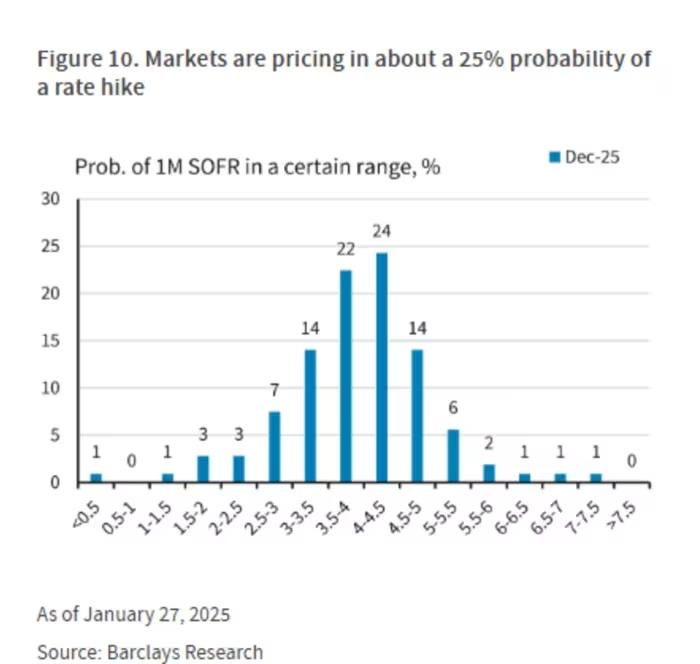
While the Federal Reserve is expected to keep interest rates steady on Wednesday, speculation about potential hikes has resurfaced. Analysts at Barclays still anticipate a gradual decline in rates through 2025 but acknowledge that a rate hike isn’t entirely off the table. Options markets currently price in a 25% chance of an increase. “The threshold for the Fed to reverse its rate-cutting course is high,” Barclays’ macro research team noted in a client report Tuesday. “Such a move could damage the Fed’s credibility.” However, they warned that a shift in economic conditions—such as a renewed surge in inflation, rising inflation expectations, or a sharp drop in unemployment—could prompt policymakers to reconsider. Lessons from Past Fed Reversals Barclays examined three historical cases where the Fed reversed course and raised rates: In all instances, labor market strength and a steepening yield curve were major drivers. Market Implications The 10-year Treasury yield (4.52%) has already climbed above the 3-month yield (4.29%), reflecting confidence in economic resilience but also concerns over potential inflationary pressures under a second Trump administration. Short-term yields initially declined when the Fed began cutting rates in September and December, bringing its policy rate to 4.25%–4.50%—a full percentage point below its peak. If the Fed signals a possible hike, Barclays expects the 2-year and 10-year Treasury yields to exceed 5%, which could weigh on equities. The bank previously warned that a 10-year yield at 5% could be problematic for stocks. Treasury Market & Liquidity Shifts A shift toward rate hikes could trigger a repricing in short-term Treasury rates, further expanding the $7 trillion money-market fund industry while pressuring bank deposits. The Road Ahead Despite the uncertainty, market sentiment still leans toward additional rate cuts in 2025. As of Tuesday, Fed-funds futures traders were pricing in a 50-basis-point cut this year, up from 25 basis points the prior week, per the CME FedWatch Tool. Investors will be closely watching Fed Chair Jerome Powell’s press conference on Wednesday and Friday’s release of the December personal consumption expenditures (PCE) index, the Fed’s preferred inflation gauge. John PaulJohn Paul is the founder of DayTradeToWin, a trading education and software company established in 2008, supporting traders worldwide. His expertise focuses on price action-based futures trading strategies and structured market analysis. DayTradeToWin delivers trading education, indicators, and software tools designed to help traders apply disciplined, rule-based decision-making across global futures markets. He is the creator of multiple trading methodologies, including the Sonic System, Atlas Line, and Trade Scalper, which help traders identify structured opportunities in markets such as the E-mini S&P 500 (ES), Nasdaq (NQ), crude oil (CL), and gold (GC). Official website: https://daytradetowin.com daytradetowin.com
nvidia
Market News

When AI Trading Shook Nvidia Valuation

On Monday, Nvidia Corp. suffered the largest single-day loss in U.S. stock market history, shedding $593 billion in market value, according to Dow Jones Market Data. The catalyst? A breakthrough attributed to Liang Wenfeng, co-founder of High-Flyer Quant and its AI-focused subsidiary, DeepSeek. DeepSeek, an advanced AI model, was developed by High-Flyer Quant, one of China’s largest quantitative trading firms. While it’s common for Wall Street quant veterans to explore the tech sector, DeepSeek’s debut marks a pivotal moment in AI innovation. High-Flyer, a major player in Chinese financial markets, uses algorithms and mathematical models for trading. Over the weekend, DeepSeek’s AI model achieved global recognition after its release on a mobile app available to U.S. users. By late Sunday, the app had climbed to the top of Apple’s download charts. Social media was abuzz with comparisons between DeepSeek’s model and leading Western AI systems from OpenAI and Anthropic. What set DeepSeek apart was its ability to compete with top-tier AI models while operating on a fraction of their budgets. The company claims it trained its models with fewer than 10,000 Nvidia A100 GPUs—a claim met with skepticism by figures like Tesla CEO Elon Musk. This efficiency sent shockwaves through the market as investors questioned the U.S.’s AI dominance and Nvidia’s role as the backbone of AI innovation. Nvidia’s stock plummeted 16.9%, erasing nearly $589 billion in market capitalization. The market reaction also impacted shares of Microsoft, Alphabet, and Amazon, as doubts emerged about whether their massive AI infrastructure investments would deliver returns. Analysts, including those at Goldman Sachs, estimate that U.S. tech companies will spend over $1 trillion on AI development in the coming year. However, Sequoia’s David Cahn predicts a $600 billion gap between AI spending and revenue by late 2024. Who Is Liang Wenfeng? Liang Wenfeng, 40, grew up in Guangdong province and studied electronics and computer vision at Zhejiang University, one of China’s top institutions. In 2015, he co-founded High-Flyer Quant with two university friends. His increasing prominence in China’s AI sector was highlighted by his recent participation in a symposium hosted by Premier Li Qiang. High-Flyer, which manages an estimated $8 billion in assets, began developing its AI capabilities by building a cluster of Nvidia GPUs. Liang joins a storied tradition of finance professionals leveraging their quantitative expertise to drive technological breakthroughs. Visionaries like Jeff Bezos, David Siegel, and David E. Shaw have similarly bridged the gap between finance and tech, creating transformative innovations in both industries. The Intersection of Quant and AI The fields of quantitative finance and AI research share significant overlap. According to Gareth Shepherd, co-head of Voya Machine Learning Intelligence, techniques such as reinforcement learning, deep learning, and Bayesian networks are foundational to both. For years, hedge funds dominated the recruitment of top tech talent, offering some of the most lucrative opportunities in data science and machine learning. However, as the AI revolution gains momentum, tech giants like OpenAI are now luring talent with competitive compensation and the promise of groundbreaking projects. Liang’s transition from quantitative trading to AI reflects the immense opportunities in the field. His success with DeepSeek highlights the rising competition in AI development and the sector’s potential to reshape global markets and challenge established leaders. John PaulJohn Paul is the founder of DayTradeToWin, a trading education and software company established in 2008, supporting traders worldwide. His expertise focuses on price action-based futures trading strategies and structured market analysis. DayTradeToWin delivers trading education, indicators, and software tools designed to help traders apply disciplined, rule-based decision-making across global futures markets. He is the creator of multiple trading methodologies, including the Sonic System, Atlas Line, and Trade Scalper, which help traders identify structured opportunities in markets such as the E-mini S&P 500 (ES), Nasdaq (NQ), crude oil (CL), and gold (GC). Official website: https://daytradetowin.com daytradetowin.com
nvidia
Market News

Nvidia vs. Alphabet: AI’s New Power Struggle

Analyst Highlights Alphabet’s Potential in AI Chips but Criticizes Missed Market Opportunities As Wall Street searches for alternatives to Nvidia Corp., an unexpected player has emerged in the conversation: Alphabet Inc. (GOOGL, GOOG). D.A. Davidson analyst Gil Luria has singled out Alphabet for its tensor processing units (TPUs), describing them as the “most compelling alternative to Nvidia GPUs.” TPUs, Alphabet’s proprietary accelerators for machine-learning tasks, are considered “viable, and possibly even superior” to Nvidia GPUs, Luria noted. As an example, he pointed to Apple Inc. (AAPL), which has reportedly leveraged TPUs to train its models. However, despite his praise for Alphabet’s chip technology, Luria expressed a critical view of the company’s approach to the $4 trillion AI hardware market. He argued that Alphabet isn’t doing enough to capitalize on the opportunity, saying, “The company does not appear to be aggressive enough pursuing the opportunity.” One major issue, according to Luria, is Alphabet’s restrictive approach to TPUs, which has historically made it difficult for external developers to access and utilize the technology. This has created a “bottleneck” that limits the chips’ broader adoption and commercial potential. By contrast, Nvidia (NVDA) has cultivated a robust developer ecosystem, enhancing the accessibility and appeal of its hardware. Luria estimated that the combined value of Alphabet’s TPU business and its Google DeepMind AI division could reach $700 billion on a sum-of-the-parts (SOTP) basis. For comparison, Nvidia commands a $3.5 trillion valuation, while Advanced Micro Devices Inc. (AMD), another Nvidia competitor, has a market capitalization of around $200 billion. To unlock more value, Luria suggested Alphabet should consider restructuring. His SOTP valuation model pegs Alphabet’s total worth at $3.5 trillion, breaking it down as follows: $700 billion for TPUs and DeepMind, $700 billion for Google Cloud, $300 billion for YouTube, and $1.3 trillion for search and networking. However, Luria cautioned that such valuations are meaningful only if investors begin assessing Alphabet through an SOTP lens. “We are waiting for the company to indicate it is willing to release some of the SOTP value to shareholders,” he wrote. Luria’s price target for Alphabet stock remains at $200, approximately where it trades now. The company’s current market valuation is $2.46 trillion. Alphabet did not immediately respond to a request for comment. John PaulJohn Paul is the founder of DayTradeToWin, a trading education and software company established in 2008, supporting traders worldwide. His expertise focuses on price action-based futures trading strategies and structured market analysis. DayTradeToWin delivers trading education, indicators, and software tools designed to help traders apply disciplined, rule-based decision-making across global futures markets. He is the creator of multiple trading methodologies, including the Sonic System, Atlas Line, and Trade Scalper, which help traders identify structured opportunities in markets such as the E-mini S&P 500 (ES), Nasdaq (NQ), crude oil (CL), and gold (GC). Official website: https://daytradetowin.com daytradetowin.com
stocks
Market News

Skip Expensive Stocks: Bet on These Sectors

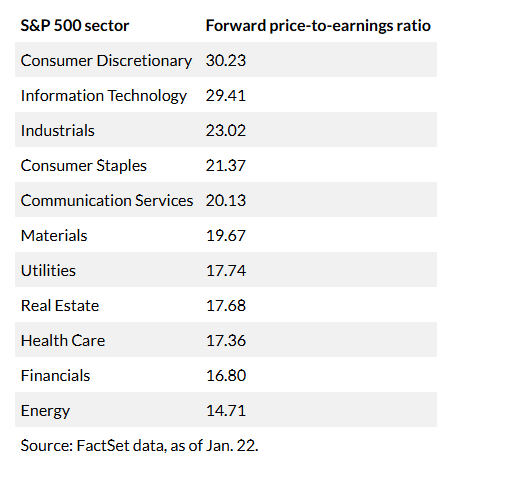
The start of President Donald Trump’s second term has sparked a robust rally, driving the S&P 500 stocks to record highs and stretching market valuations to historic levels. Investors are now exploring alternatives to megacap technology stocks, seeking more affordable opportunities that could still benefit from the administration’s early policy actions. This week, the forward price-to-earnings (P/E) ratio of the S&P 500 rose above 22, nearing its highest point in nearly four years. The last time it exceeded this level was in November, when the ratio reached 22.34, the highest since December 2020, according to Dow Jones Market Data. The P/E ratio—a key metric that compares a stock’s price to its earnings per share—can signal overvaluation. A high ratio suggests that stock prices may have outpaced their underlying earnings, raising concerns about sustainability. Elevated Valuations Raise Questions Jamie Dimon, CEO of JPMorgan Chase, expressed caution about current market conditions. In an interview with CNBC during the World Economic Forum in Davos, Switzerland, he remarked that asset prices are “in the top 10% or 15%” of historical valuations, describing them as “kind of inflated, by any measure.” Given these lofty valuations, analysts suggest turning to less speculative, fundamentally strong sectors that could thrive under a Trump-led economy. With a resilient U.S. economy and optimism surrounding advancements in artificial intelligence, certain areas of the market may offer attractive opportunities. Promising Market Sectors Financials Financial stocks, though no longer as inexpensive as earlier in 2024, still hold appeal. With solid economic prospects, analysts anticipate increased bank loan activity, mergers and acquisitions, and IPOs. These trends, combined with Trump’s deregulation agenda, create a favorable environment for the financial sector, which was one of 2024’s top performers. Industrials Industrial stocks are gaining momentum, with Wall Street forecasting double-digit earnings growth in 2025. Additionally, economic stimulus measures in China are expected to boost demand within this cyclical sector. Utilities The utilities sector also looks compelling, driven by the administration’s $500 billion Stargate initiative aimed at supporting AI infrastructure. This project is expected to drive significant electricity demand, providing a tailwind for utility companies. The Role of Big Tech in 2025 Despite their elevated valuations, megacap technology stocks remain a focal point for investors. The so-called “Magnificent Seven” are projected to continue delivering strong earnings growth, albeit at a slower pace compared to recent years. According to Mark Luschini, chief investment strategist at Janney Montgomery Scott, these tech giants will likely remain the primary drivers of market performance in 2025. However, for the broader S&P 500 to advance, the market must rely on actual earnings growth rather than further expansion of already high valuations. Katie Nixon, CIO at Northern Trust, noted that while robust earnings growth is expected in 2025, high interest rates could act as a headwind, potentially offsetting some of the market’s gains. Market Snapshot On Thursday, U.S. stocks delivered mixed results. The S&P 500 edged up 0.2% to another record high, while the Dow Jones Industrial Average gained 0.8%. Meanwhile, the Nasdaq Composite dipped 0.2%, according to FactSet data. President Trump’s calls for lower interest rates and reduced oil prices continue to influence market sentiment. John PaulJohn Paul is the founder of DayTradeToWin, a trading education and software company established in 2008, supporting traders worldwide. His expertise focuses on price action-based futures trading strategies and structured market analysis. DayTradeToWin delivers trading education, indicators, and software tools designed to help traders apply disciplined, rule-based decision-making across global futures markets. He is the creator of multiple trading methodologies, including the Sonic System, Atlas Line, and Trade Scalper, which help traders identify structured opportunities in markets such as the E-mini S&P 500 (ES), Nasdaq (NQ), crude oil (CL), and gold (GC). Official website: https://daytradetowin.com daytradetowin.com

markets
Market News

A Monster Vibe Shift in Markets: Insights from a Top Strategist

Demand for Bullish Equity Options Signals Renewed Optimism in Markets The S&P 500 (SPX) narrowly missed hitting a new all-time high on Wednesday, though Thursday’s early indicators point to a softer start. In a bullish turn, Nomura strategist Charlie McElligott suggests a potential “melt-up” could be underway. Known for his accurate market calls—including the post-election rally and recent reversals in crowded trades on the U.S. dollar and bonds—McElligott sees a notable shift in investor sentiment. He highlights a transition from bearish put options used for downside hedging to increased interest in bullish call options on stocks. This shift in options trading could signal the early stages of another rally. Another factor adding fuel to the bullish case is the activity of volatility-controlled funds. McElligott estimates these funds could deploy roughly $40 billion into S&P 500 futures, thanks to the recent calming of market swings. These funds, designed to reduce portfolio volatility, tend to increase equity exposure as market conditions stabilize. The S&P 500’s five-day realized volatility has fallen significantly, from 22.2 to 8.7, reflecting this trend. This changing landscape has sparked renewed interest in growth sectors, including Big Tech, AI, semiconductors, small-cap stocks (IWM), and gold (GC00). Despite the optimism, McElligott offers a word of caution. The aggressive buying by volatility-controlled funds and other investors may lead to market instability, potentially disrupting a steady upward trajectory and introducing more erratic price movements. In summary, growing demand for equity call options and a decline in market volatility are driving a more bullish sentiment, but investors should remain vigilant for signs of volatility returning to the markets. John PaulJohn Paul is the founder of DayTradeToWin, a trading education and software company established in 2008, supporting traders worldwide. His expertise focuses on price action-based futures trading strategies and structured market analysis. DayTradeToWin delivers trading education, indicators, and software tools designed to help traders apply disciplined, rule-based decision-making across global futures markets. He is the creator of multiple trading methodologies, including the Sonic System, Atlas Line, and Trade Scalper, which help traders identify structured opportunities in markets such as the E-mini S&P 500 (ES), Nasdaq (NQ), crude oil (CL), and gold (GC). Official website: https://daytradetowin.com daytradetowin.com

Scroll to Top