Market News

Steady as She Goes: U.S. Stock Futures Hold Ground Ahead of Data Onslaught

U.S. stock futures are indicating a mostly flat opening for Wall Street on Monday, as investors prepare for a data-packed week and seek fresh momentum to drive the market higher after Nvidia’s recent boost. Here’s a breakdown of the current stock-index futures trading: On Friday, the Dow Jones Industrial Average rose 62.42 points, or 0.2%, closing at 39,131.53, while the S&P 500 edged up 1.77 points to an all-time closing high of 5,088.80. However, the Nasdaq Composite fell 44.80 points, or 0.3%, ending at 15,996.82. Key Market Dynamics: After last Thursday’s significant surge driven by Nvidia’s stellar results, Friday’s session was more subdued. However, the S&P 500 managed to notch another record closing high. Charalampos Pissouros, senior investment analyst at XM, noted, “This likely suggests that as the earnings season winds down, market participants are slowly shifting focus back to monetary policy. Anything confirming the view that Fed officials are not rushing to implement interest rate cuts could result in a corrective retreat.” The week ahead holds significant data releases, including the first revision to fourth-quarter gross domestic product on Wednesday and the core reading of the personal-consumption expenditures index, the Federal Reserve’s preferred inflation metric, on Thursday. Deutsche Bank’s strategists, led by Jim Reid, commented, “Our economists expect the month-on-month core print to be 0.36% compared to 0.17% last time. This would be the highest since last January. Though the year-on-year rate is expected to edge down to 2.8%, it’s the monthly print that will be most crucial.” Additionally, Monday will see the release of new home sales for January at 10 a.m., along with appearances by several Fed speakers throughout the week.

Market News

Nasdaq 100’s Historic 3% Surge: Drawing Parallels to the Dot-Com Bubble

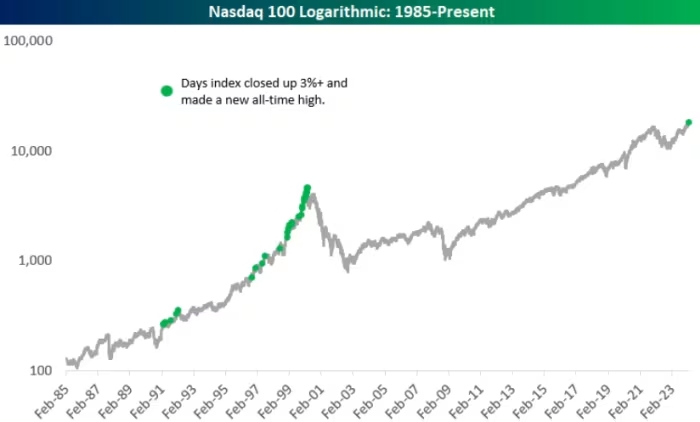
Bespoke analysts anticipate a potential downturn in U.S. stocks in the weeks ahead, citing historical trends and seasonal vulnerabilities. The recent surge in the Nasdaq 100 index, reminiscent of the dot-com era’s exuberance, has raised concerns. While such significant gains haven’t been observed since March 2000, similar occurrences were common during the lead-up to the dot-com bubble’s peak. Similarly, the S&P 500’s recent climb to a new all-time high, not seen since March 2000, is cause for caution. Previous instances of such rapid gains in the index have resulted in mixed performance in the subsequent days and weeks. Despite positive economic indicators and strong quarterly results driving market optimism, questions persist about the rally’s sustainability, especially regarding potential interest rate adjustments by the Federal Reserve. The recent market surge followed Nvidia Corp.’s impressive revenue forecast, pushing major indexes to new record highs. However, parallels drawn between current market trends and the dot-com bubble raise concerns among market participants. While Bespoke analysts refrain from directly equating the current rally to the dot-com bubble, they point to historical patterns and the traditionally weak performance of stocks in the upcoming month as potential signs of an impending pullback. On Friday, U.S. stocks mostly closed higher, with the Nasdaq Composite fluctuating and the S&P 500 and Dow industrials poised for further record highs and their most significant weekly gains of the year.

Market News

Pullback Alert: S&P 500 Futures Ease After Nvidia’s Market Surge

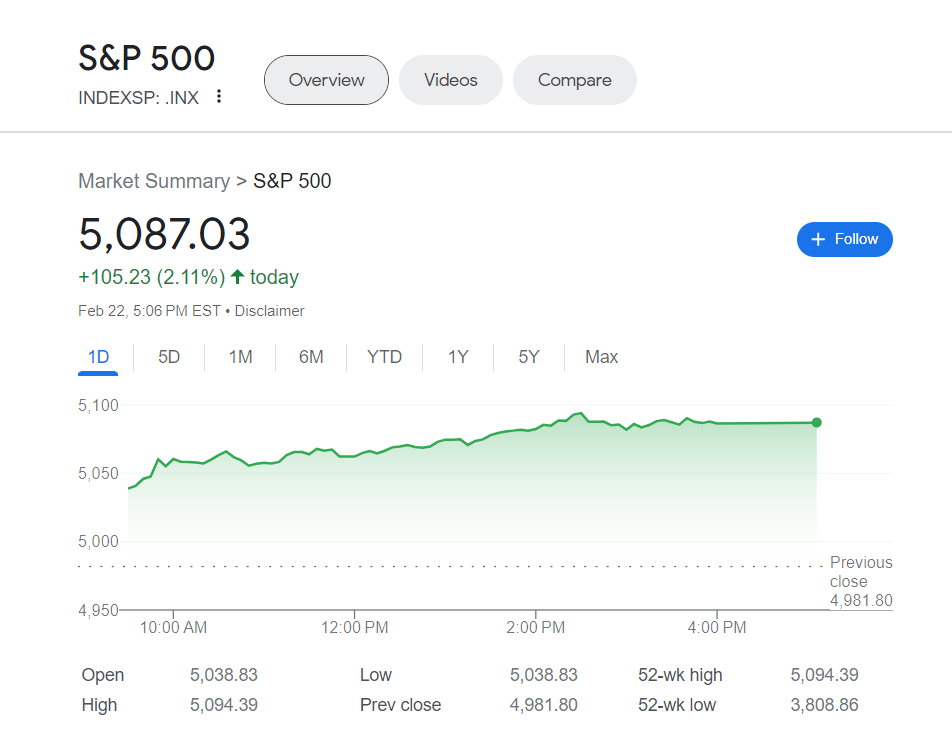
U.S. stock-index futures saw a slight decline on Friday following a strong rally, driven by the positive performance of chipmaker Nvidia. This success raised hopes for a potential breakthrough in artificial intelligence. What’s happening On Thursday, the Dow Jones Industrial Average rose by 457 points, a 1.18% increase reaching 39069. The S&P 500 also went up significantly by 105 points, or 2.11%, reaching 5087. Similarly, the Nasdaq Composite surged by 461 points, or 2.96%, reaching 16042. The S&P 500 ended the day at its 12th highest level of the year, and the Nasdaq Composite was just 0.1% away from a new all-time high. Even though they encountered difficulties, small-cap stocks also saw gains, with the Russell 2000 index increasing by 1%. What’s driving markets Nvidia’s stock price surged by 16% on Thursday after they reported better-than-expected fourth quarter revenue and first quarter sales outlook. As a result, Nvidia is now the third most valuable stock in the S&P 500, surpassing both Alphabet and Amazon.com. The company will likely continue to attract attention on Friday. Investors were interested in Nvidia CEO Jensen Huang’s statement that AI had reached an important turning point. Mark Haefele, who serves as the chief investment officer at UBS Global Wealth Management, predicts that generative AI will be the main trend in the near future. The recent earnings report from Nvidia also indicates a significant increase in investment in AI infrastructure. During a presentation following the closing of the stock market on Thursday, Federal Reserve Governor Lisa Cook discussed the gradual and uncertain nature of the impact of AI on productivity. Cook pointed out that historical trends indicate that advancements in general-purpose technologies, like AI, can take considerable time to translate into noticeable productivity improvements. She also highlighted the importance of making additional investments and implementing changes in corporate strategies, management techniques, and employee training in order to fully harness the potential benefits of generative AI. Cook mentioned that the current monetary policy is restrictive, but emphasized the importance of being confident that inflation will meet the 2% target before contemplating lowering interest rates. In a speech given after the stock market closed on Thursday, Federal Reserve Governor Christopher Waller stressed that he expects it will be appropriate to begin reducing monetary stimulus at some point this year. He did mention, though, that the specific timing and magnitude of this action will depend on upcoming economic indicators. Other companies, such as Warner Bros. Discovery and Icahn Enterprises, are set to release their earnings reports soon. Intuitive Machines experienced a rise in its stock price following the successful landing of its spacecraft on the moon and the subsequent transmission of signals to Earth.

DayTradeToWin Review

Finding Balance: Strategies for Profiting in Sideways Markets

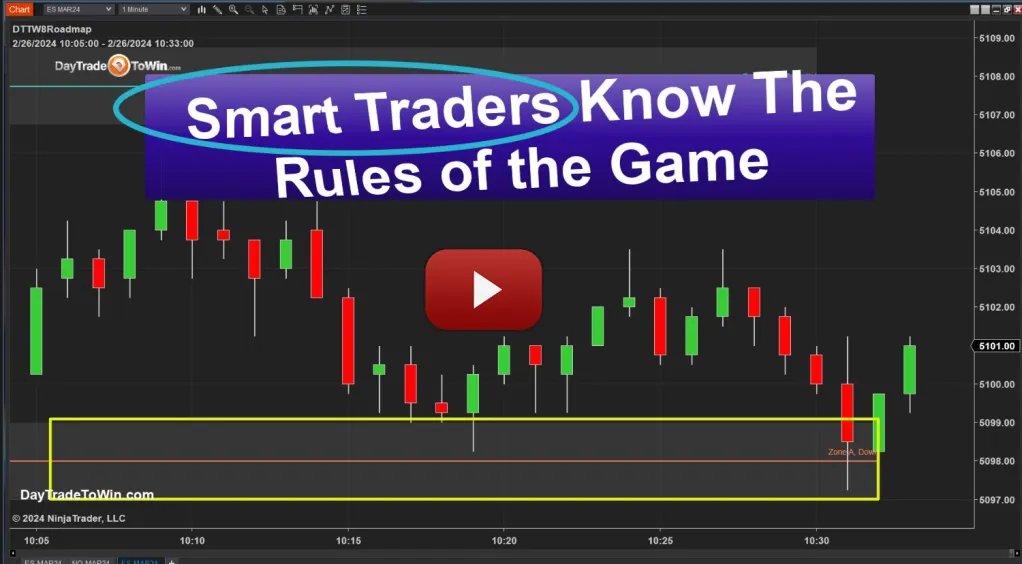
Today, on February 22nd, let’s delve into the intricate world of trading as I introduce you to a game-changing tool: the Roadmap. Developed by our expert team at DayTradetoWin, this proprietary software offers a comprehensive guide to understanding market movements with unmatched precision. Whether you’re a seasoned trader or just starting out, the Roadmap provides invaluable insights into market direction, equipping you to make informed decisions. Understanding the Roadmap The Roadmap operates on a simple yet powerful premise: identifying key zones on the chart where the market is likely to pause, reverse, or continue its current trajectory. When you add the Roadmap to your chart, you’ll immediately notice shaded areas highlighting these critical zones. These zones serve as invaluable markers, indicating potential buy or sell opportunities based on market behavior. Trading with Confidence Empowering traders to navigate the market with confidence, the Roadmap enables you to understand the significance of these zones and employ various strategies accordingly. Whether it’s counter-trend trading or trend-following, the Roadmap equips you with the tools to adapt to market conditions. For example, when the market breaches a zone and continues in the same direction, it signals a potential continuation of the trend. Conversely, if the market stalls or reverses upon reaching a zone, it presents an opportunity for counter-trend trading. Risk Management While trading presents numerous profit opportunities, it’s crucial to acknowledge the inherent risks involved. The Roadmap aids in prudent risk management by providing clear entry and exit points, allowing traders to set tight stops and manage risk effectively. Real-Life Examples To illustrate the practical application of the Roadmap, let’s analyze recent market movements. By examining charts from both today and yesterday, we can observe how the Roadmap accurately predicted market behavior, guiding traders towards profitable opportunities. Join the Community Ready to elevate your trading experience? Visit daytradetowin.com to learn more about the Roadmap and sign up for a free member account. Gain access to valuable resources, educational materials, and our live trading room, where you can interact with fellow traders and hone your skills. Final Thoughts In conclusion, the Roadmap stands as a beacon of guidance in the dynamic world of trading. With its intuitive interface and powerful insights, it empowers traders to navigate the market with clarity and precision. Remember, success in trading requires not only skill but also the right tools and mindset. Embrace the Roadmap, and embark on a journey towards trading excellence.

Market News

Economic Forecast: Strategists Signal Potential for ’70s Stagflation Replay

Equities faced difficulties while bonds excelled during the turbulent inflationary periods of the 1970s. Presently, investors are drawn to the idea of a “Goldilocks” market, but a group of quantitative strategists from Wall Street warns of a potential return to conditions reminiscent of the disco era. In a recent communication, J.P. Morgan analysts, spearheaded by the well-known strategist Marko Kolanovic, cautioned about a possible shift in market sentiment away from the current narrative of Goldilocks toward a scenario similar to the stagflation experienced in the 1970s, which could have significant consequences for asset allocation. The 1970s were marked by persistent high inflation, characterized by three distinct waves linked to geopolitical events such as the Vietnam War and conflicts in the Middle East. These events, combined with escalating government deficits, created an environment where equities saw minimal nominal gains from 1967 to 1980, while bonds and credit instruments significantly outperformed. Drawing parallels between the geopolitical landscape of the 1970s and current tensions in regions like Eastern Europe, the Middle East, and the South China Sea, the analysts pointed to recent energy crises and shipping disruptions in the Red Sea as potential indicators of historical parallels. The analysts cautioned that the escalation of tensions, particularly with China, could exacerbate inflationary pressures and trigger a market downturn. Additionally, they noted that fiscal deficits are unsustainable, raising concerns about the potential shift in the macroeconomic backdrop from the peace dividend era of the late 1980s to 2000s to a period characterized by conflict-driven inflation. In such a scenario, investors would likely favor fixed-income assets over equities, seeking higher yields to offset the effects of stagflation. Historically, during the 1970s, bonds significantly outperformed equities, with yields averaging above 7%, making any yield pickup crucial for long-term portfolio performance. Despite these warnings, current market trends show stocks rallying into 2024, with major indices reaching new milestones. However, investors remain cautious, as evidenced by their reaction to the Federal Reserve’s policy meeting minutes, indicating a readiness to reassess market dynamics in light of evolving economic conditions.

DayTradeToWin Review

Timing is Everything: The Science Behind Winning Day Trades

Hello there! Welcome back to the discussion. Today, I’m thrilled to delve into recent signals using the DayTradeToWin software. It’s endlessly intriguing to witness the market’s movements and discover how we can capitalize on them for successful trades. In this video, I’ll zoom in on a crucial aspect of trading: the significance of aligning your trades with prevailing signals rather than conflicting methods. Whether you’re following your own strategies or utilizing DayTradeToWin methods like the Blueprint, Trade Scalper, or Atlas Line, it’s vital to heed the signals they generate. As we examine today’s signals, it’s worth noting that the majority, if not all, are signaling short positions. Across various methods and instruments such as the Mini Nasdaq and E-mini S&P, consistent signals pointing towards the short side emerge. This alignment serves as a potent indicator of market sentiment, offering clarity for our trading decisions. I emphasize the importance of trading in alignment with multiple methods rather than relying solely on a single indicator. By cross-referencing signals from different sources, we enhance the likelihood of making successful trades. Some traders prefer a top-down approach, analyzing multiple time frames for insights. While effective, I find focusing on a single chart, like the one-minute chart I’m using today, provides ample information for timely decisions without overwhelming complexity. Furthermore, current market conditions support healthy trading opportunities, with favorable targets and potential profits. Each trade presents around three to four points, or approximately 13-14 ticks on the E-mini, making short positions attractive for profit-taking. While I can’t guarantee another short position during this video, the demonstration underscores prevailing market sentiment and the potential for successful trades. As always, it’s crucial to adapt and remain flexible in response to evolving market dynamics. If you’re new to day trading or seeking to refine your skills, I urge you to explore the benefits of trading the markets with DayTradeToWin. Visit our website, daytradetowin.com, to learn more about our mentorship classes and subscribe to our YouTube channel for valuable insights and strategies. Thank you for joining me today. Stay tuned for more updates, and until next time, happy trading!

Scroll to Top